In short: This wall coat rack is made of a solid board whose edges are left in the shape the tree gave them. The board has two natural cutouts, and wooden pegs are set in it for hanging clothes. The length of the coat rack, the number of pegs and the finish are agreed with each customer separately.
A wall coat rack on a log wall
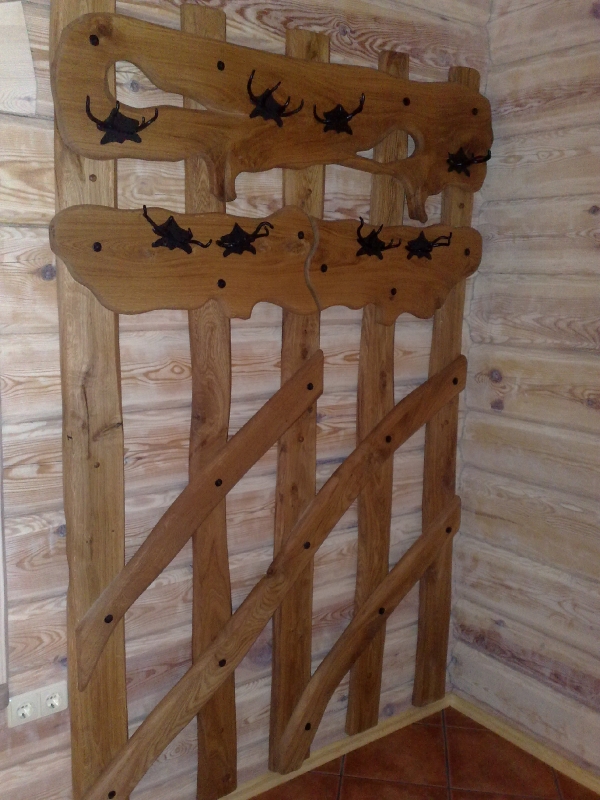
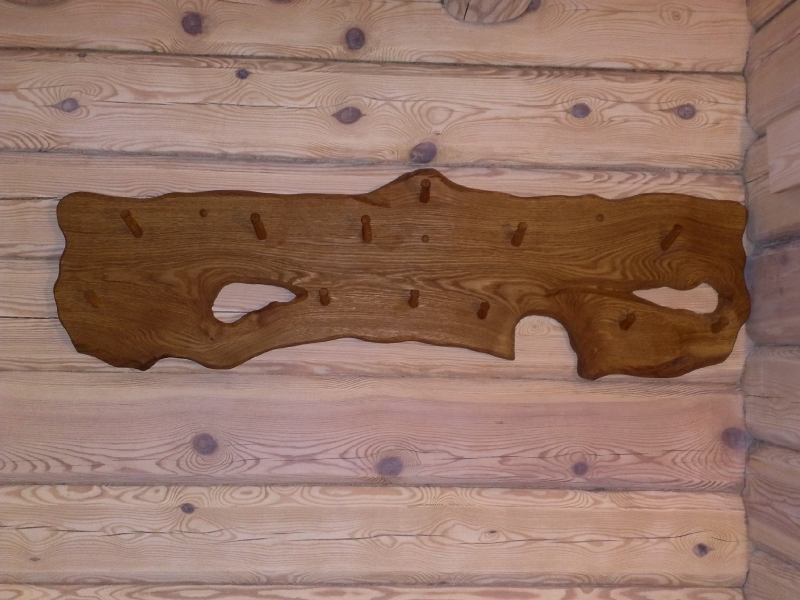
In the photo the coat rack is fixed to a light log wall, near a corner. The logs of the wall are light, with vivid grain and dark knots, while the coat rack stands out with its richer honey and walnut finish. Thanks to this contrast it is clearly visible even from afar and looks like a separate accent of the wall.
The coat rack is long and narrow, fixed horizontally. This shape is convenient: clothes spread along its whole length, so they do not interfere with one another, and the coat rack does not look overloaded.
In the photo the coat rack is empty, so its outline, cutouts and pegs are easy to see. Empty like this, it shows its greatest advantage: even without clothes it looks like a wooden sculpture or a decorative wall panel.
The photo also shows how the coat rack fits the lines of the wall. Its horizontal silhouette repeats the direction of the logs, so the coat rack does not look foreign but seems to grow out of the wall itself. The corner on the right shows that such a coat rack can be hung close to a corner if there is no door beside it.
A log house and a natural-shaped coat rack go together very well. Both speak the same language of wood: no strict right angles, plenty of grain, knots and living lines. But a wall coat rack like this will look good on a plastered or painted wall too, where it becomes a warm, natural contrast.
A natural edge and two cutouts
The most important detail of this coat rack is its outline. The edges of the board are not cut straight: the top undulates, the left end is rounded, and at the bottom you can see a dip and projections. An edge like this appears when the outline of the board is left as it was in the trunk.
There are two cutouts in the board, one on the left and one on the right. The wall can be seen through them, so the coat rack looks lighter and livelier. Openings like these often appear where there were branches or natural cracks in the tree, and they are not patched but left as a decoration.
The edges of the cutouts look smooth and rounded, so clothes do not catch on them. At the same time the cutouts are a reminder that each such coat rack is one of a kind: in another board the cutouts will have a different shape, be in a different place, or not be there at all.
The finish emphasizes the natural outline even more. The edges of the board look somewhat darker than the middle, so its shape stands out against the light wall. In the light the surface shines softly and reveals the grain.
A natural-shaped coat rack is especially valued by those who do not want a serial piece of furniture. UAB “Laukbaldis” stresses that branches and natural curves of the wood make every product unique, and in this coat rack that is seen especially clearly.
Wooden pegs for clothes
Short round wooden pegs are set in the board for hanging clothes. They are arranged in two irregular rows: in the upper row the pegs are longer and tilted slightly upward, and in the lower row shorter. In places you can also see small round wooden heads.
The pegs are not set at quite equal distances: some are slightly tilted and some are closer to one another. That is not a flaw: this arrangement matches the natural shape of the board and keeps the coat rack from looking too severe. If you want a tidier look, the pegs can be placed in even rows.
Wooden pegs have several advantages over metal hooks:
- Gentle on clothes. A round wooden peg leaves no marks on collars and does not stretch the fabric.
- No rust. A wet jacket or a towel can be hung on them too.
- A unified look. The pegs are the same color as the board, so the coat rack looks unified and calm.
- Safe. The rounded ends of the pegs are less dangerous when passing by than sharp hooks.
Two rows of pegs let you distribute the space comfortably. Coats and jackets are handy to hang on the upper pegs, and scarves, hats, handbags or children’s clothes on the lower ones. If the coat rack will hang in a hallway that children will also use, the lower row can be planned lower. That way everyday clothes are always at hand, and the hallway stays tidier.
The features of the coat rack in brief
The table lists what can be seen in the photo of this typical example.
| Feature | In the photo |
|---|---|
| A solid board with a natural edge | Yes |
| Natural cutouts in the board | Yes, two |
| Wooden pegs | Yes, in two rows |
| Metal hooks | No |
| A shelf for hats at the top | No |
| A rich, honey-colored finish | Yes |
Where to hang a wooden coat rack
A wall coat rack is most often hung in a hallway, but there are more places where it can be used:
- In a hallway: for everyday coats, jackets and bags.
- In a sauna changing room: for robes, towels and clothes.
- On a farmstead or in a guest house: for guests’ clothes when many people arrive at once.
- In a bathroom: for towels, if the room is well ventilated.
- In a children’s room: for backpacks and sports bags, hung lower.
In a small hallway a wall coat rack can be the only piece of furniture. Then it does double duty: it holds everyday clothes and at the same time decorates the wall you see first when you come in.
A long, horizontal coat rack suits a longer stretch of wall, for example along a corridor or by a door. If there is less wall space, it can be ordered shorter, with one cutout accent and fewer pegs.
It is handy to put a bench or a shoe shelf under the coat rack. Laukbaldis also makes such combinations: look at the coat rack with a bench and a shoe shelf. For a larger hallway the hallway coat rack with forged hooks suits, and for a sauna or rest room the wall shelves with a coat rack and a lamp. All the products are collected in the section wooden coat racks, shelves and cabinets.
Fixing and care
A coat rack with clothes can be fairly heavy, so it is important to fix it firmly. The fixings are worth choosing to suit the wall material: they differ for logs, masonry or a plasterboard wall. The longer the coat rack, the more fixing points it needs.
A few tips for installing and looking after the coat rack:
- Before drilling, hold the coat rack against the wall and check that it hangs at the right height and will not interfere with an opening door.
- Leave enough room beneath it so that long coats do not touch the floor or a bench.
- Wipe dust with a dry soft cloth, especially the edges of the cutouts and the bases of the pegs.
- It is better to hang wet clothes when the room is ventilated, so that the wood does not stay damp for long.
- When the finish fades after a few years, the surface can be renewed with a product meant for wood.
If the coat rack will hang on the wall of a new log house, keep in mind that the logs settle during the first years. In that case it is worth checking the fixing after a while and, if needed, tightening it.
Natural wood reacts to changes in humidity and temperature, so in a log house or a sauna the coat rack may change slightly over time. That is typical of natural wood and usually does not affect its strength. The main thing is that the coat rack does not hang right next to a stove or a hot radiator.
For a log house, a sauna or a summerhouse it is convenient to choose interior details in the same style as the building itself. You will find examples of wooden buildings in the section saunas and summerhouses.
How to order a wall coat rack
UAB “Laukbaldis” has made wooden products since 1996 and, as the company states, was the first in Lithuania to start making this production. Furniture of solid oak is made by experienced craftsmen, and every product is individual because of the natural shapes of the wood.
Call +370 687 25388 and say that you are interested in the wall coat rack of a board with a natural edge. During the call you will discuss the length and height of the coat rack, the number and arrangement of the pegs and the shade of the finish. Since every board is different, it is also worth discussing what outline or cutouts you would like.
Before calling, measure the stretch of wall where the coat rack will hang, and think about how many clothes will usually hang on it. If there is already wooden furniture in the hallway, a photo of it will help you choose a close shade.
If you plan several coat racks for different rooms, for example for a hallway and a sauna, they can be ordered at the same time. Then they will all have a similar finish and go together, although the outline of each board will be its own.
Only typical examples are shown on the website. This coat rack shows one possible solution, a long board with a natural edge, cutouts and wooden pegs, and the specific dimensions and finish are agreed before production.
Frequently asked questions
What is this wall coat rack made of?
The coat rack is made of a solid board with a natural edge, and wooden pegs are set in it for hanging clothes. The natural curves and two cutouts are left in the board.
Does the coat rack have metal hooks?
No, only wooden pegs can be seen in the photo. They are gentle on clothes and do not rust, so they also suit wet clothes and towels.
Can I choose the number of pegs?
Yes, the number and arrangement of the pegs are agreed individually. A lower row can also be planned for clothes for children.
Does every coat rack look the same?
No, the outline of the board and the cutouts depend on the particular tree, so every coat rack is distinctive. The form you want is worth discussing when you order.
Where is it best to hang such a coat rack?
It suits a hallway, a sauna changing room, a farmstead or a guest house. The main thing is that the coat rack does not hang right next to a stove or a hot radiator.
How do I order a wall coat rack?
Call us and say that you are interested in the wall coat rack with a natural edge. We will discuss the length, the number of pegs and the finish.