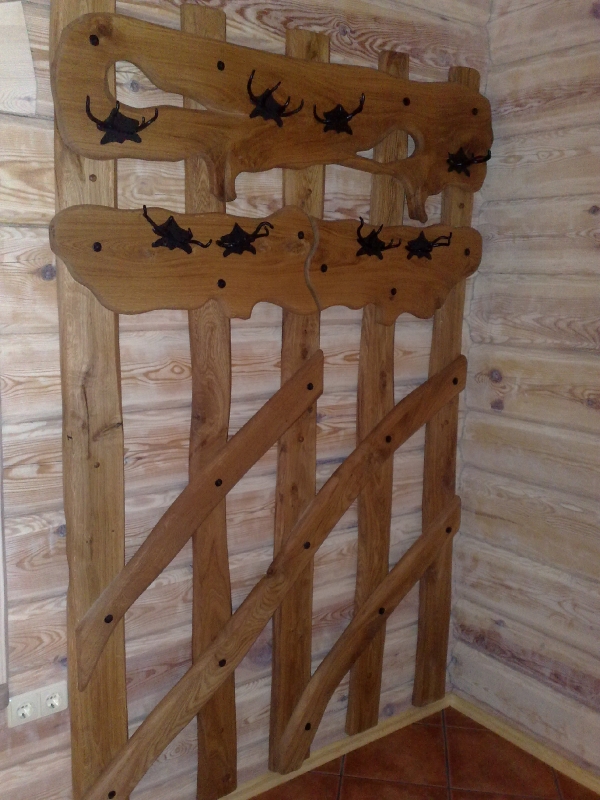
In short: This hallway coat rack is a tall piece of furniture standing on the floor, made of five vertical natural-shaped uprights. Two boards with a natural edge and black forged hooks are fixed at the top, and three diagonal slats join the uprights at the bottom. The height, width, number of hooks and finish are agreed with each customer separately.
A tall hallway coat rack in the corner of a room
In the photo the coat rack stands in the corner of a room, against whitewashed log walls. The floor is made of terracotta-colored tiles, and on the left, right by the floor, you can see an electrical outlet. The warm oak color stands out sharply against the light walls, so the coat rack looks like the main accent of the room.
This is not a small wall rack but a piece of furniture that fills a whole stretch of wall. The uprights rest on the floor and rise upward, so the coat rack not only holds clothes but also creates a kind of wooden partition, a backdrop against which it is handy to put a shoe shelf, a bench or a basket.
It is convenient to put a coat rack like this in a corner. It does not get in the way of passing, the side wall protects the clothes from being caught accidentally, and when seen from the middle of the room the hanging clothes are less conspicuous.
A large coat rack like this is especially useful for a family with many members, or a home that often receives guests. All the coats, jackets, hats and handbags have their own place, and no clothes are left thrown over chairs in the hallway.
In the photo the coat rack is empty, so the whole construction is easy to see: the uprights, the boards, the hooks and the bottom slats. A view like this helps you judge how the piece looks even when nothing hangs on it, which matters because in summer a coat rack is often almost empty.
Five uprights and diagonal slats
The base of the coat rack consists of five vertical uprights. They are not perfectly straight or of equal width: their edges undulate slightly, and the grain of the oak and natural transitions of shade are visible on the surface. Because of this the whole piece looks alive and natural, as if created from natural tree trunks.
In the lower part the uprights are crossed by three parallel diagonal slats. They are fixed with dark round heads and do two jobs. First, they strengthen the construction so that the uprights do not wobble. Second, they create a diagonal rhythm that contrasts nicely with the vertical lines of the uprights and the horizontal boards at the top.
Below there are no shelves or boxes, so free space is left by the floor. It is handy to put shoes, long umbrellas or sports bags there. The diagonal slats also protect the wall behind the coat rack from being rubbed by shoes and bags.
Five uprights form a wide, stable base. If the hallway is narrower, there can be fewer uprights, and if the wall is long, more. The only thing is to keep the proportion between the uprights, the boards and the slats so that the coat rack looks harmonious.
Gaps are left between the uprights through which the wall is visible. Because of this the coat rack, although large, does not look massive or heavy: it resembles a wooden frame more than a closed cabinet.
Forged hooks on boards with a natural edge
In the upper part of the coat rack two boards with a natural, wavy edge are fixed across the uprights. The upper board has a cutout on the left side and an expressive, free-form outline; the lower one is somewhat calmer, with projections at the bottom. The edges of both boards keep the natural form of the tree.
Black forged hooks are fixed to the boards. Each of them resembles a little star or an opened sprig with several curled branches. Such hooks are not only a functional detail but also a decoration: even when nothing hangs on them, they look like a collection of blacksmith’s work.
Several branches on one hook are practical. A jacket and a scarf, a hat and a handbag or a few children’s backpacks can be hung on one hook. The curled ends keep clothes from slipping off.
In the photo the hooks are set with gaps between them, so clothes do not hang one on top of another even when the coat rack is fully loaded. The positions of the hooks can be planned according to how many people will use it.
Black metal on warm oak is a classic combination that suits both a farmstead and a contemporary home. If there are already forged door handles, lamps or stair railings in the interior, the coat rack naturally ties in with them.
The construction of the coat rack in a table
The table lists what can be seen in the photo of this typical example.
| Feature | In the photo |
|---|---|
| Vertical natural-shaped uprights | Yes, five |
| Boards with a natural edge for hooks | Yes, two |
| Black forged hooks | Yes |
| Diagonal slats at the bottom | Yes, three |
| A shelf for hats at the top | No |
| A bench or a shoe shelf | No |
How to make everyday use of the coat rack
A large hallway coat rack serves best when clear order is kept in using it. A few tips for planning it:
- The upper board is for coats and long jackets, which when hung should not reach the floor.
- The lower board is for shorter clothes, hats, scarves and handbags.
- One hook for each family member: that makes it easier to keep order, and everyone knows their own place.
- The bottom is for shoes, umbrellas, sports bags or a basket of gloves.
If there are small children at home, the lower row of hooks can be planned lower so that they can hang up their own clothes. It is a simple way to get children used to order.
A large coat rack suits any season. In winter thick coats and down jackets hang on it, in summer light raincoats and bags. Less loaded, it looks like a decorative wooden screen.
A coat rack like this suits more than the hallway of a home. It will look good in a sauna changing room, or in the corridor of a guest house or rural tourism farmstead where room for many clothes is needed at once.
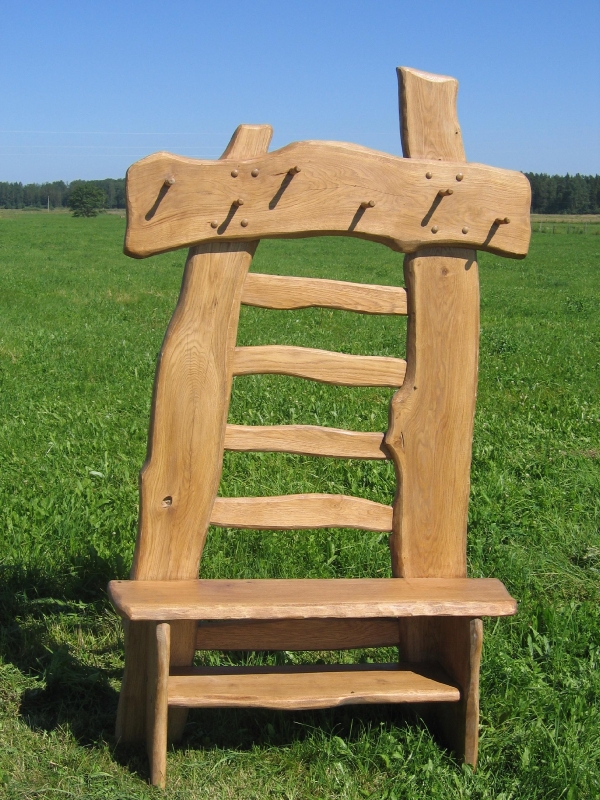
It is handy to add a bench or a chest next to the coat rack. Look at the coat rack with a bench and a shoe shelf or the oak chest with forged hardware. The wall coat rack of a natural-edge board with cutouts will suit a smaller hallway. All the products are collected in the section wooden coat racks, shelves and cabinets.
Placing, fixing and care
A tall coat rack with heavy winter clothes must stand firmly. In the photo it rests on the floor and leans against the wall; for a coat rack like this it is recommended to fix the upper part to the wall as well so that it does not tip over.
A few practical tips:
- Before ordering, measure the width of the wall and the height up to the ceiling or another obstacle.
- Check that the uprights will not block electrical outlets or switches, and if needed discuss their arrangement.
- Judge how much room is left to pass when thick winter coats hang on the hooks.
- Wipe dust with a dry soft cloth; clean the forged hooks now and then and check that they are firmly in place.
- Hang wet clothes when the room is ventilated so that the wood does not stay damp for long.
If the coat rack will stand on tiles, as in the photo, it is worth putting thin protective pads under the ends of the uprights. They keep the uprights from sliding and protect the floor from scratches.
Natural wood reacts to changes in humidity and temperature, especially in a hallway where the front door is often opened. Small changes are typical of wood and usually do not affect the strength of the piece. When the finish fades after a few years, it can be renewed with a product meant for wood.
If you are creating the interior of a log house, a sauna or a summerhouse, it is convenient to choose furniture together with the building itself. You will find examples of wooden buildings in the section saunas and summerhouses.
How to order a hallway coat rack
UAB “Laukbaldis” has made wooden products since 1996 and, as the company states, was the first in Lithuania to start making this production. Furniture of solid oak is made by experienced craftsmen, and branches and natural curves of the wood make every piece unique.
Call +370 687 25388 and say that you are interested in the tall hallway coat rack with forged hooks. During the call you will discuss the height and width of the coat rack, the number of uprights, how many hooks are needed and at what height to place them, and the shade of the finish.
Before calling, photograph the place where the coat rack will stand and write down the dimensions. Think about how many people will use it every day and whether you would like a bench or a shoe shelf next to it.
If you want the coat rack to match the other furniture in your hallway, mention it during the call. The hooks, the outline of the boards and the finish can be chosen to fit what you already have.
Only typical examples are shown on the website. This coat rack shows one possible solution, a tall frame of natural-shaped uprights with two boards and forged hooks, and the specific dimensions and finish are agreed before production.
Frequently asked questions
Does this hallway coat rack stand on the floor?
Yes, in the photo the uprights rest on the floor and lean against the wall. A tall coat rack is recommended to be fixed to the wall as well, so that it stands firmly.
What hooks are used in this coat rack?
The coat rack uses black forged hooks that resemble a little star with several curled branches. Several things can be hung on one hook.
What are the diagonal slats at the bottom for?
They strengthen the uprights and create a decorative diagonal pattern. They also protect the wall behind the coat rack from being rubbed by shoes and bags.
Can the coat rack be made narrower?
Yes, only typical examples are shown on the website. The number of uprights, the height, the width and the number of hooks are agreed individually.
Where else can such a coat rack be used?
Besides a home hallway, it suits a sauna changing room, a guest house or a rural tourism farmstead. A tall coat rack is especially handy where many clothes need room at once.
How do I order a hallway coat rack?
Call us and say that you are interested in the tall hallway coat rack with forged hooks. We will discuss the dimensions, the number of hooks and the finish.