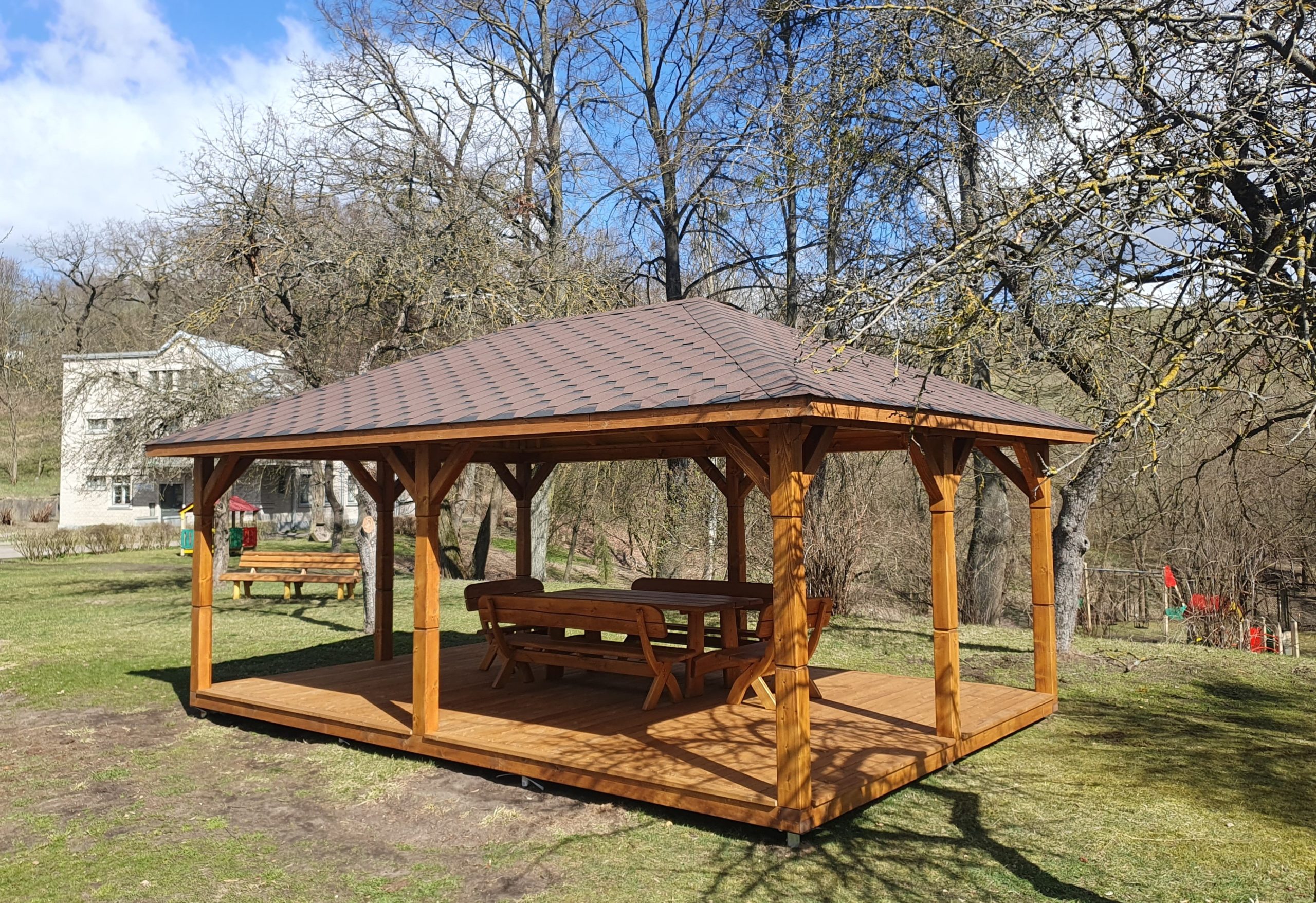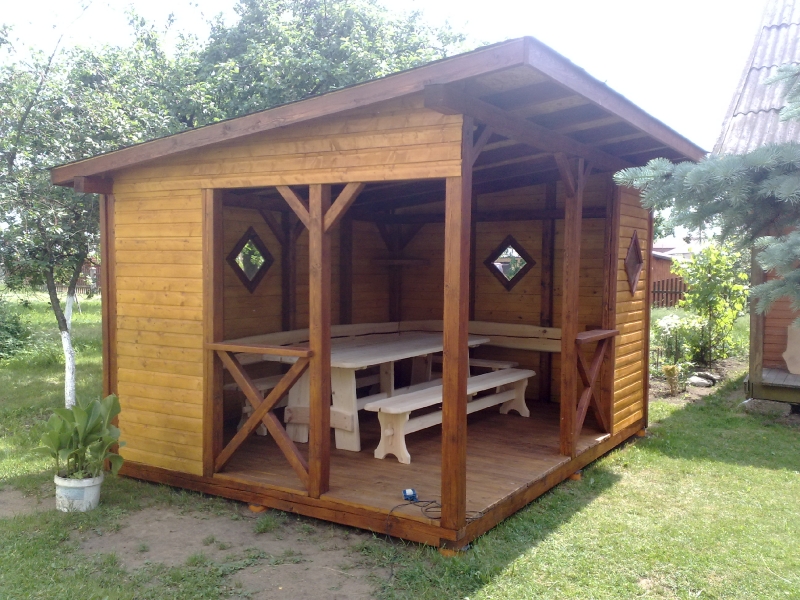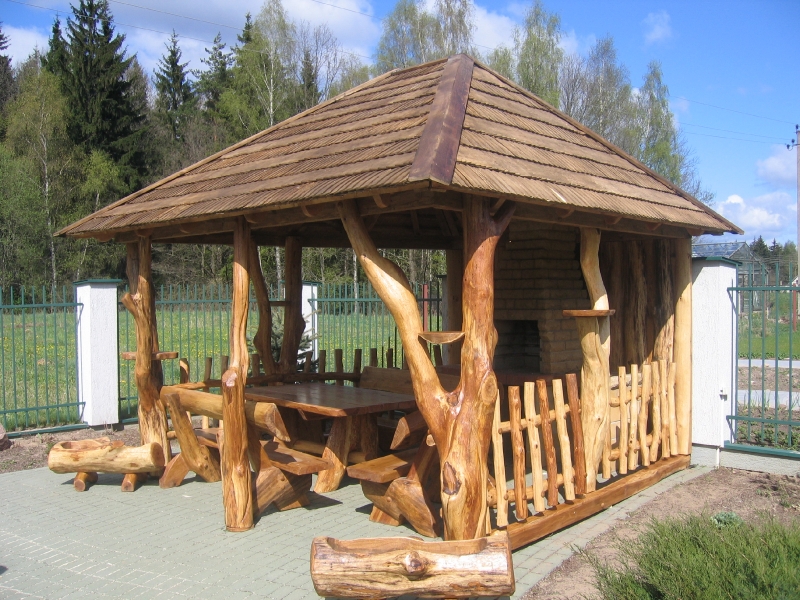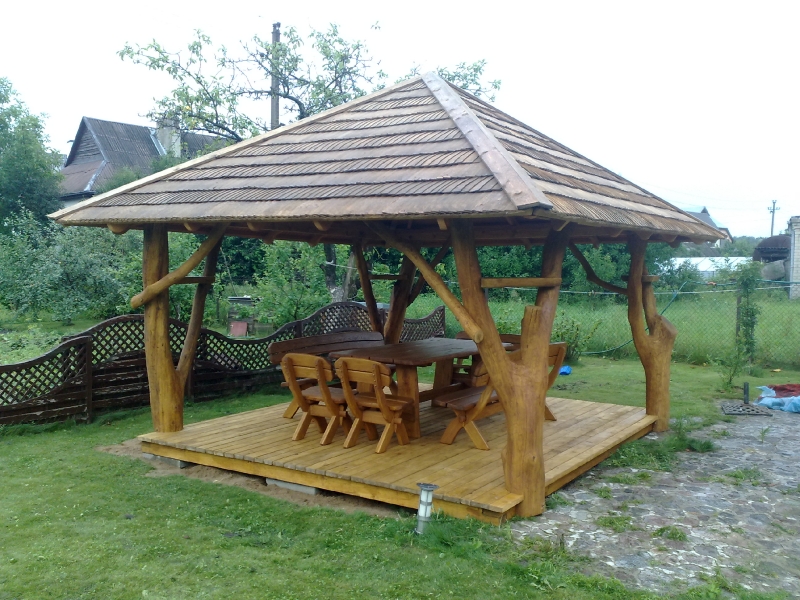
In short: Gazebo with sliding windows No. 25-12.3 is a wooden gazebo with a hip roof whose front and side walls consist of large sliding glass panels set back behind profiled columns with braces. The rear part is closed, and inside there are a table and benches with backrests. The size, glazing and finishing of the gazebo are agreed with each customer individually.
A gazebo with sliding windows: what it is and why it is convenient
Sliding windows, or sliding glass, are large sections of glass that slide along tracks one behind another. They can be slid aside to open the gazebo and then closed again. Unlike hinged doors, sliding sections take up no room when opening, so the wind cannot slam them and they do not get in the way of people sitting at the table.
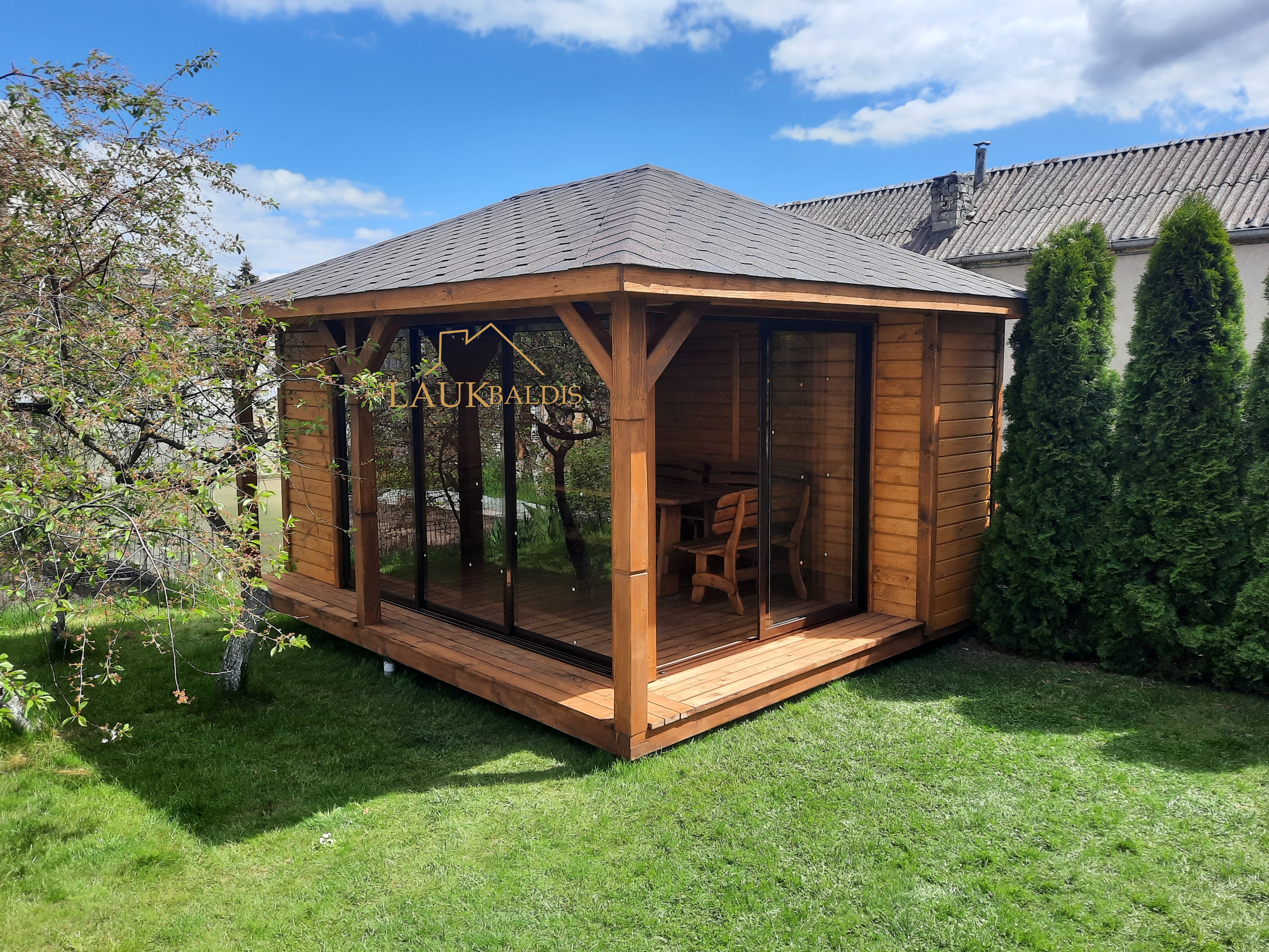
In this gazebo the sliding windows take up almost the whole front wall and part of the right side. This forms a glass corner through which most of the garden can be seen. When the windows are closed, the gazebo becomes a bright room sheltered from the wind, and with a few sections slid aside it is almost an open gazebo.
Such flexibility is especially valuable in Lithuania, where spring and autumn days are often sunny but windy. With the windows closed, you can sit in the sun and not feel the wind, and in the heat of summer you can open the gazebo and enjoy the draft.
The glass is set in dark frames that contrast beautifully with the warm shade of the wood. Between the sections only thin frames can be seen, so the view through the windows stays wide and unbroken.
In the photo, through the glass you can see not only the interior but also the reflected garden: tree branches, a fence and the sky. Such a reflection makes the gazebo lighter: it seems to dissolve into its surroundings and does not look massive, even though a table with benches and several people fit inside.
A wall of thuja and a blossoming tree: a natural backdrop
In the photo the gazebo stands in a sunny spring garden. On the right grows a tall row of thuja, which forms a dense green wall, and on the left a tree with young leaves and blossom. Behind the gazebo you can see an older house with a slate roof and a chimney. The blue sky and white clouds complete the picture, and the green lawn around the gazebo is only just recovering after winter.
The row of thuja plays an important role here. It screens the gazebo from the neighbors, holds back the wind and forms a dark green background against which the warm-toned wood looks even brighter. The gazebo is built next to the thuja so that there is room between them to walk and to look after both the gazebo and the thuja.
The blossoming tree on the left gives the picture lightness. Its branches hang over the lawn, and in spring you can watch the blossom open from the gazebo. A spot like this, between thuja and fruit trees, is one of the coziest in a garden.
In the yard of an older house, a new gazebo often becomes the first step in renewing the whole surroundings. It gives the yard a new center around which paths, flower beds and relaxation zones are later formed. The photo shows that even next to an old house a wooden gazebo of a warm shade looks harmonious, because wood suits buildings of any age.
The gazebo is built beside the tree and not directly under its crown. This way the branches do not touch the roof, and fewer leaves and petals fall on it. When planning a place in your garden, think about how the trees will grow in a few years: then the gazebo will stay light and clean for a long time.
The gallery, the columns and the closed end
The roof is held up by straight profiled columns: their lower part is wider, and higher up the column narrows through a stepped notch. At the top the columns are joined to the roof by diagonal braces that form a Y shape. Such columns give the gazebo the features of a classic wooden veranda, and their rhythm at the front frames the glass like large pictures.
The sliding windows are set a step deeper than the columns. This forms a covered gallery at the front and on the side: a strip of floor under the roof. You can walk around the gazebo along it without getting wet, put down a planter or wipe your shoes before going in.
The right end of the gazebo is closed, clad with horizontal boards. This wall faces the thuja, so on that side the gazebo is fully screened. The closed end lets you place a cabinet, a shelf or a bench against it inside, and hang a lamp or hooks for blankets and towels on the wall.
The roof is a hip roof covered with dark gray tiles, and beneath it runs a light wooden cornice. All the wood of the gazebo is covered with a warm, amber shade that glows in the sun.
The gazebo is raised above the ground on a base, so a gap is left between the lawn and the floor. It helps the floor dry faster after rain, and the lawn grass does not touch the wood. It is easy to step up into the gallery, because the platform is low.
What can be seen in the frame
A short summary of what the photo of this gazebo shows. It is a typical example, not the only possible option.
| Feature | In the photo |
|---|---|
| Hip roof with dark gray tiles | Yes |
| Sliding windows at the front and on the side | Yes |
| Profiled columns with braces | Yes |
| Covered gallery in front of the glass | Yes |
| Closed end of horizontal boards | Yes |
| A table and benches with backrests | Yes |
| Columns of natural trunks | No |
How to use sliding windows in different weather
Sliding windows let you adapt the gazebo to the weather several times a day. A few examples of how this looks in practice:
- A cool spring morning. The windows are closed, the sun warms the interior through the glass, and you can have breakfast even though it is still chilly outside.
- A hot summer day. Slide a few sections aside from different sides, and air will start to move through the gazebo.
- A sudden shower. It is enough to slide the windows shut, and dinner carries on dry.
- A windy autumn evening. The windows are closed, and through them you can see the garden and the sunset.
Through the glass you can see that inside there is a wooden table and two benches with curved backrests. Such furniture suits family dinners and entertaining guests. Laukbaldis makes similar furniture from solid oak, and you will find it in the section oak garden and outdoor furniture.
It is worth cleaning the tracks of the sliding windows regularly: then the sections slide easily and the windows close tightly.
Interestingly, sliding windows change the mood of the gazebo itself. Closed, it resembles a cozy garden room where you can talk in peace, and open, a summery terrace where guests walk freely between the interior and the garden. One gazebo performs two different functions.
What to discuss when ordering a gazebo with sliding windows
Laukbaldis shows only typical examples, so the size, glazing and finishing of the gazebo are agreed individually. Before you call, it is worth thinking about:
- How many walls to glaze. The photo shows a glass corner, but you can choose more or less glass.
- Where the gallery will be. It can run along one, two or more sides.
- Where the gazebo will stand. Next to a hedge or a fence, the closed end shelters you from the neighbors.
- What shade of wood. A warm amber tone, as in the photo, goes well with greenery.
There are more gazebos in this series: the outdoor gazebo with braces No. 25-12.1 and the gray gazebo with a natural wood interior No. 25-12.2. You will find all the models in the section wooden gazebos.
It is important to think about the size of the gazebo too. If you will mostly sit in the family circle, one table with two benches is enough, as in the photo. If you often have guests or want to fit a relaxation corner with armchairs inside, it is worth choosing a larger area. Also think about whether you will need electricity at the gazebo for lighting: it is easier to plan in advance.
Care and ordering
Every spring inspect the gazebo: the floor of the gallery, the bottoms of the columns and the joints of the braces. When the coating turns pale or water no longer beads up, clean the surface and renew it with a product for exterior wood. Wash the glass with ordinary window-cleaning products, and clean the tracks of sand, petals and leaves.
When thuja grows next to the gazebo, it is worth leaving a gap between them and the wall so that the wood can dry. Trim the thuja regularly so that it does not grow right up to the wall. In autumn sweep the leaves off the roof and the gallery, and in winter do not let a thick layer of snow build up.
UAB “Laukbaldis” has made wooden products since 1996 and, as the company states, was the first in Lithuania to start making this production. To order, call +370 687 25388 and quote No. 25-12.3. During the conversation you will agree on the size of the gazebo, the glazing, the gallery and the finishing. If the gazebo will stand next to a hedge or an old house, as in the photo, prepare photos of that place: then it is easier to choose the size and the position of the closed wall.
Frequently asked questions
How are sliding windows more convenient than hinged doors?
Sliding sections move along tracks and take up no room when opening. You do not need to protect them from the wind, and they do not get in the way of people sitting at the table.
Can only some of the windows be opened?
Yes, the sliding sections can be slid aside one at a time. That way you can adjust how much air gets into the gazebo.
Can a gazebo be built next to thuja?
It can, as the photo shows. Just leave a gap between the thuja and the wall, so that the wood can dry and be looked after.
How do I look after sliding windows?
Clean the tracks of sand and leaves regularly, and wash the glass with ordinary window-cleaning products. Then the sections slide easily.
Are the table and benches included in the set?
The photo shows a table and benches with backrests, but furniture is discussed separately. Laukbaldis also makes oak garden furniture.
How do I order gazebo No. 25-12.3?
Call us and quote No. 25-12.3. We will discuss the size, the glazing and the finishing.