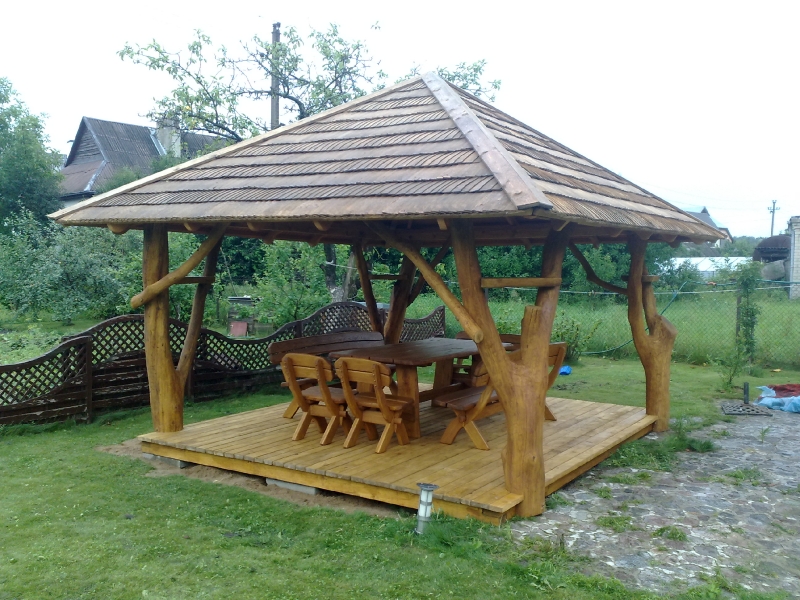
In short: Gazebo with a terrace No. 25-20 is a wooden gazebo with a brown hip roof, sliding glass and a large open terrace bounded on two sides by wooden low fences. A stainless steel chimney pipe rises above the roof, and the gazebo itself stands in the shade of large trees. The size, terrace, finishing and equipment are agreed with each customer individually.
A gazebo with a terrace, part of which is under the open sky
Usually the terrace is under the same roof as the gazebo. In this example the solution is different: most of the terrace extends beyond the roof and stays under the open sky. On the left, next to the closed wooden wall, spreads a wide area of boards, protected at the end and on the side by wooden low fences. On the right, along the glass, runs a narrower covered terrace with columns.
This gives one structure three different places:
- a glazed room, where you can sit in the rain and the wind;
- a covered terrace under the roof overhang, where it is handy to stand or put things down;
- an open terrace, where you can sunbathe, put out sun loungers or a large table for a summer dinner.
An open terrace is especially valuable to those who like the sun. A gazebo protects from sun and rain, but sometimes you want precisely the sun: in spring, when it warms for the first time, or on a cool autumn afternoon. Then you do not need to carry chairs onto the lawn: it is enough to walk a few steps out of the gazebo.
The boards of the open terrace are laid lengthwise, tightly against one another, and covered with a coating of a warm honey shade, the same as the walls. As a result the terrace and the gazebo look like one structure, not two separately built things.
Railings of vertical slats
The open terrace is bounded by wooden low fences. They consist of thicker posts, two horizontal rails and closely set vertical slats between them. The low fence is of a height that makes it comfortable to lean on while standing, and when you sit behind it the garden is still visible.
The railings do several jobs here. They mark the edge of the terrace, so that in the evening nobody steps off the edge by accident. They hold back the wind that blows low over the lawn and add cozinesss: sitting on the terrace you feel protected even though the space around is open. If there are small children in the yard, the low fence is also a safety feature.
The slats of the low fences in the photo are the same color as the terrace and the walls. That matters: if the railings were a different shade, they would stand out and look as if added later. Now the whole structure looks like an integral, pre-planned building.
The front side of the terrace, facing the lawn, is left without railings. This way you can step onto the terrace from anywhere, and the view of the garden stays completely open. Which sides will have low fences and which will be open is decided when you order, according to how the terrace will be used and where the paths are.
A chimney pipe above the roof
A shiny stainless steel chimney pipe rises from the roof on the left side. The photo does not show what is inside, but such a pipe indicates that a heating appliance, a stove or a fireplace, is planned in the gazebo. This is what makes the gazebo a place where you can sit on a cool autumn evening or even in winter.
If you want a gazebo with heating, you must say so when you order. The position of the stove, the passage of the chimney through the roof and the distances to the wooden walls have to be planned in advance and not adapted later. It is also worth thinking about where firewood will be kept: a small woodshed nearby or a shelf under the roof overhang may suit.
Trees matter for the position of the chimney too. In this photo the pipe rises right next to the broad crown of a deciduous tree, so the distance to the branches must be safe. If you are building your own gazebo under trees, discuss this separately.
A gazebo with heating fundamentally changes how it is used. In summer it stays open and light, and in November, when the garden is dark and damp, with the glass closed and a fire lit you can sit in it with friends, drink tea or simply watch the flames. Together with an open terrace, such a structure serves all year round, not only for a few summer months.
What can be seen in the photo
The table lists the clearly visible details. It is a typical example, so each of them can be changed.
| Feature | In the photo |
|---|---|
| Hip roof with brown tiles | Yes |
| Open terrace beyond the roof | Yes, on the left |
| Wooden low fences around the terrace | Yes, on two sides |
| Sliding glass | Yes, at the front and on the right |
| Profiled columns with braces | Yes |
| Chimney pipe | Yes |
| Furniture | No, the interior is empty |
A gazebo under big trees: advantages and chores
The gazebo stands under two big trees: on the left a broad deciduous crown spreads, and on the right the branches of a birch hang down. Such a place has many advantages. On a hot summer day the shade of the trees cools the roof and the terrace, and the wind in the leaves rustles so that in the gazebo you feel the real mood of a garden. A big tree also visually grounds the structure: it looks as if the gazebo has stood here for a long time.
But trees bring work too. In autumn leaves fall on the roof and the terrace, in spring pollen and seeds, and after rain water drips from the branches for a long time. So:
- it is worth sweeping the terrace more often so that leaves do not lie long on the boards;
- the roof should be inspected every autumn and any accumulated twigs removed;
- the tracks of the sliding glass get dirty faster, so clean them several times a season;
- if you build very close to a trunk, seek advice about the roots and the foundation.
If there are no large trees in the yard, a gazebo with a terrace will also suit an open place. Then the open terrace will be sunny all day, and the glazed part will become a shelter from wind and heat.
Behind the gazebo in the photo you can also see garden beds covered with dark film, and a road. This is a reminder that a gazebo is often built not in an ideal but in a real place: between the vegetable garden, trees and neighbors. A well-thought-out arrangement of glass and closed walls helps you see what is beautiful from the gazebo and not what is next to it.
What to decide when planning the terrace
On its website Laukbaldis shows only typical examples, and the size, shape and railings of the terrace are always agreed individually. Before you call, think about:
- Whether the terrace will be covered or open. An open terrace is for the sun, a covered one for the rain. You can have both, as in this example.
- What size of terrace you need. Whether only a couple of chairs will stand on it or a large table and sun loungers.
- Where railings are needed. They are most often built where the terrace is raised higher above the ground or where you want shelter.
- Whether there will be heating. If so, the position of the stove and the chimney must be planned in advance.
Think also about how the terrace will face. In the photo the open part is on the left, next to the closed wall, and the glass faces the garden. If the terrace is on the south or west side, there will be the most sun on it, and if on the east, it will be most pleasant in the mornings, over a cup of coffee. A closed wall between the terrace and the neighboring plot gives more privacy.
You will find similar solutions in other works too: the gazebo with a terrace, steps and skylights No. 25-5 and the semi-enclosed gazebo with a terrace No. 25-11.5. You will find all the examples in the section wooden gazebos, and ideas for low fences and bridges in the section wooden bridges and fences.
Care and ordering
An open terrace is most exposed to the weather, so it needs looking after more often than walls under a roof. Every spring inspect the boards and railings: if the surface has turned pale or rough, it is time to renew the oil or stain made for exterior wood. Check especially carefully the places where the boards rest on the joists, and the top of the railings, where water lingers longest.
The glazed part is easier to look after: it is enough to wash the glass, clean the tracks and air the interior after rainy days.
In winter it is worth sweeping the snow off the open terrace so that it does not melt on the boards for weeks, and clearing ice off the railings. If the gazebo is heated, check the chimney and its passage through the roof once a season.
UAB “Laukbaldis” has made wooden products since 1996 and, as the company states, was the first in Lithuania to start making this production. To order, call +370 687 25388 and quote No. 25-20. Together we will discuss the size of the terrace, the railings, the glazing and the heating option.
Frequently asked questions
Can the whole terrace be under the roof?
Yes, the size of the terrace and how much of it is under the roof are agreed when you order. In this example part of the terrace is open so that you can enjoy the sun on it.
What are the railings around the terrace for?
The railings mark the edge of the terrace, hold back low wind and add cozinesss. If children play in the yard, they are also a safety feature.
Can a stove be installed in the gazebo?
In the photo a chimney pipe can be seen above the roof, so heating is planned in this example. The position of the stove and the chimney must be discussed when you order, so that everything is planned in advance.
Can a gazebo be built under trees?
It can: trees give shade and cozinesss. But the roof, the terrace and the tracks of the sliding glass will then need cleaning more often, and close to a trunk it is worth seeking advice about the roots and the foundation.
Does an open terrace wear out faster?
An open terrace is more exposed to sun and rain, so its protective coating has to be renewed more often than that of walls under a roof. Wood that is looked after regularly stays beautiful and strong for a long time.
How do I order gazebo No. 25-20?
Call us and quote No. 25-20. We will discuss the size of the terrace, the railings, the glazing and your other wishes.