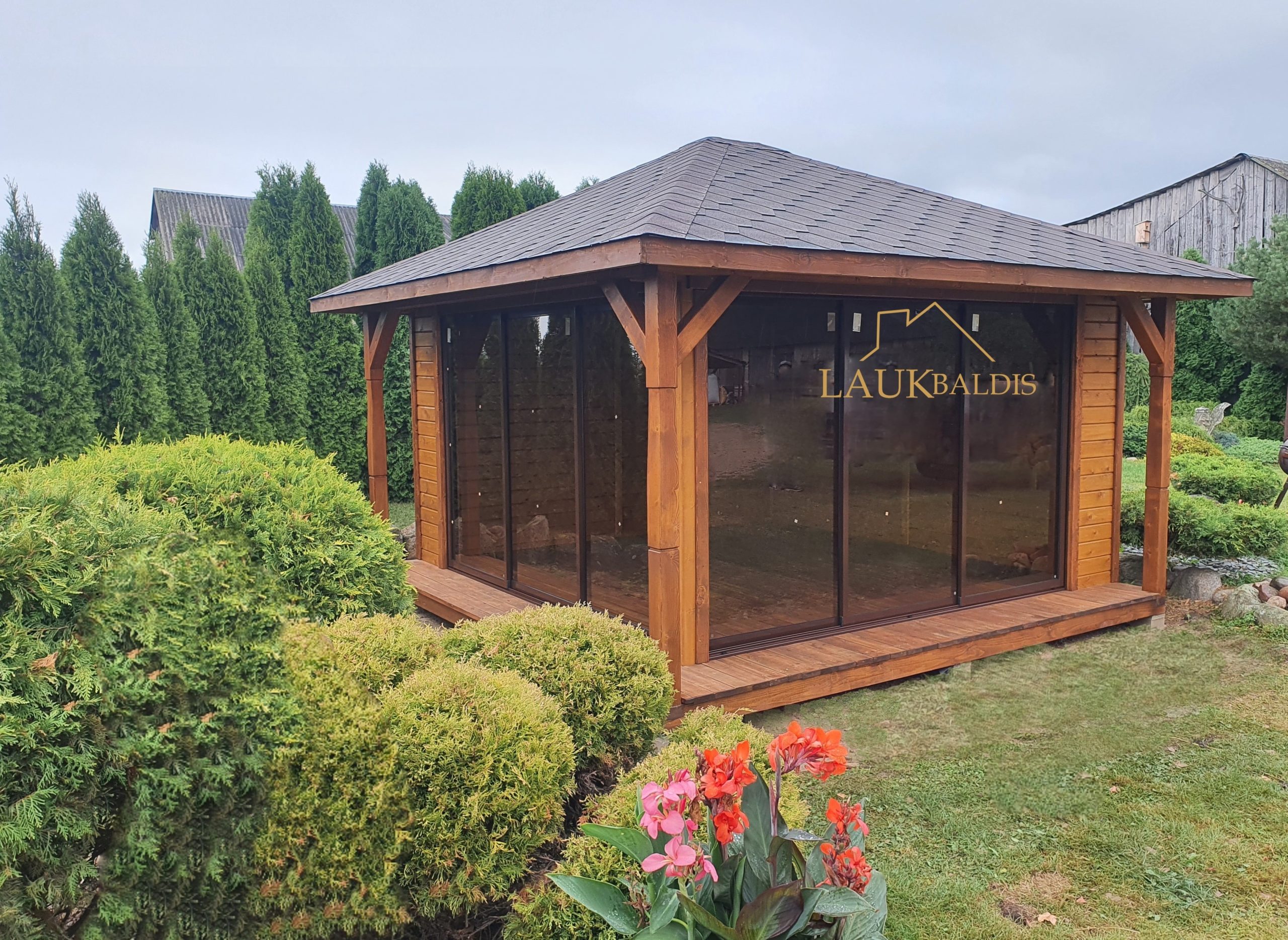
In short: Glazed gazebo No. 25-53 is a wooden gazebo with a hip roof, two adjacent sides of which are fitted with sliding glass, while the roof at the corners is held up by square timbers with diagonal braces. It stands in a well-kept garden among thujas, stones and blooming cannas. The size, finishing and equipment are agreed with each customer individually.
A glazed gazebo surrounded by plantings
In this photo the surroundings speak as much as the gazebo itself. In front grow round golden thujas, on the left behind the gazebo rises a dense stand of columnar thujas, and on the right, by the stones, a few more conifers stay green. Right in the foreground red and pink cannas are in bloom. All of this shows that the gazebo was built into an already established garden and not onto an empty plot.
A gazebo like this suits people who have tended their yard for many years and now want a place from which to enjoy it. The glazed gazebo works here like a display case in reverse: you do not look into it through the glass, you look out from inside at the garden. Sitting at the table, you see the wall of thujas, the stones and the flower beds, while the wind and rain stay behind the glass.
The sky in the photo is overcast, yet the warm honey-colored wood and the bright blooms look light even on a gray day. It is a good example of how wood enlivens a planting composition and gives it warmth.
How can you use a gazebo like this? It suits morning coffee while the dew has not yet dried, and long evenings with the family. You can set up a summer dining room in it, because a table with chairs fits under the roof and the glass protects from the wind. For gardeners it can also be a place to rest between chores without taking off your boots or going into the house. If there are small children in the family, it is easy to watch them play in the garden through the glass.
Two glass walls meeting at a corner
The front and the left side of the gazebo are filled with sliding glass, with three large glass sections in dark frames on each side. The two glass walls meet at one corner, so a wide, almost panoramic view of the garden opens up from inside. At the ends the glass is finished with narrow strips of boards, which frame the glazed part and give it strength.
The sliding sections let you choose how much to open the gazebo. On a warm day you can slide one or several sections aside and let in the scent of flowers, and on a cool evening close all the glass. Since the glass is fitted on two sides, you can open the side the wind is not blowing from at the moment.
Through the glass you can see that the interior is empty for now, with a wooden floor and board walls. The glass reflects the garden, the stones and the buildings on the other side of the yard, so the gazebo itself looks lighter and seems to blend into its surroundings.
An empty interior gives you freedom. Some people would put in a long table with benches, others a soft sofa and a low coffee table, and others would set up a place for the children to play or for board games with friends. Since two walls are glass and two are wood, it is convenient to put furniture against the wooden walls, so that the garden is visible from your seat at the table.
Corner posts and a narrow edge of floor
The corners of the roof are held up by square timbers set slightly in front of the glass. Diagonal braces are fixed to the top of each one, connecting the post to the roof beam. About halfway up the timber its edges are chamfered, so the post looks more graceful than a plain smooth timber.
Because the posts are set away from the glass, a narrow, roofed edge of floor remains between them. It wraps around the gazebo at the front and on the side. It is a handy place to step before going in, and you can put a planter or a lantern on it. In addition, the projecting roof and the edge of the floor protect the bottom of the glass from rain and mud.
The roof is a hip roof covered with dark tiles, and its edge is framed by a wide wooden eaves board. The dark roof contrasts well with the warm wood and the green plants, and seen from a distance it seems to tie the gazebo to the ground and keep it from looking too light.
The floor frame is raised above the ground, so the floor does not touch the wet lawn. A gap remains between the ground and the wood through which air moves. That helps the wood dry faster after rain and reduces moisture build-up under the floor.
Plantings around the gazebo: what to learn from this garden
The photo illustrates well how plants help a gazebo look as if it has always stood there. A few observations that may be useful when planning your own yard:
- Low plants at the front. Round thujas and flowers do not block the glass, so the view from inside stays open.
- Tall plants at the back. Columnar thujas behind the gazebo create a green backdrop and screen it from the neighbors.
- Stones. A group of field boulders next to the gazebo adds solidity and a natural look.
- A gap by the walls. A lawn strip is left between the plants and the gazebo, so the wood can dry and the walls are easy to look after.
Wooden planters also go well next to plantings. Laukbaldis makes planters, so you can choose them in the same shade as the gazebo. You will find examples in the section wooden planters and doors.
A gazebo beside old farm buildings
In the background, behind the thujas, you can see an old gray wooden barn-like building, and on the left another building with a dark roof. The new gazebo with its tidy, light wood does not look out of place next to them, because all the structures are wooden. It shows that a wooden gazebo suits a homestead where older buildings already stand.
To make a new gazebo go with an old setting, it is worth thinking about a few things. First, the roofing can be of a color similar to the roofs of the other buildings. Second, the shade of the wood does not have to be exactly the same, but it should come from the same group of warm or cool tones. Third, the size of the gazebo should suit the yard: a small gazebo next to a big building gets lost, and one that is too large overwhelms the garden. So before ordering it is useful to mark the outline of the future gazebo in the yard and look at it from the windows of the house.
What to discuss before it is made
The website shows only typical examples, so this version can be adapted to your yard. Before you call, think about:
- The glass walls. In the photo two adjacent sides are glazed. Perhaps in your garden it is worth glazing three or even all four.
- The size. How many people will usually sit at the table and how much room will remain for walking. Think also about whether you will want to keep extra furniture inside, for example sun loungers or a sofa.
- The edge of the floor. Whether a narrow strip is enough or you would like a wider terrace in front of the glass.
- The color of the roofing and the wood. So that the gazebo goes with the house and the other buildings.
If the gazebo is going into an already landscaped garden, as in the photo, it is worth thinking in advance about how it will be delivered and set up. Shrubs or flower beds may block the way to the spot, so it is useful to plan where the parts will be carried through. The place under the gazebo has to be leveled and the base prepared. What kind of base is needed depends on the size and the soil, so it is best to discuss it by phone.
For comparison, take a look at the gazebo with sliding windows by a row of thujas No. 25-12.3, the gazebo for a homestead next to an old farmhouse No. 25-11.8 and the enclosed gazebo with glass across the corner No. 25-17. You will find all the examples in the section wooden gazebos.
Care among plants and ordering
When a gazebo stands among plants, the main thing is that the wood can dry out. Do not let shrubs grow up to the walls and the edge of the floor, and when watering flowers, try to keep water off the wood. In spring inspect the bottoms of the posts and the edge of the floor: if the wood has turned pale or started to absorb water, renew the protective coating made for exterior wood.
Leaves, petals and sand collect in the tracks of the sliding glass, so it is worth cleaning them regularly. Wash the glass with ordinary window cleaners.
In winter it is worth brushing a thick layer of snow off the roof so that it does not fall on the thujas growing nearby and break their branches. In spring, before the season starts, air out the gazebo, sweep the floor and check that no needles or leaves have collected on the edge of the floor.
UAB “Laukbaldis” has worked since 1996 and, as the company states, was the first in Lithuania to start making this production. To order, call +370 687 25388 and quote No. 25-53. During the call you will discuss the size, the glazing, the roofing and the shade of the wood.
Frequently asked questions
How many walls of this gazebo are glazed?
In the photo the sliding glass is fitted on two adjacent sides, at the front and on the left side. The number of glass walls can be discussed when you order.
Why do the posts stand in front of the glass?
The posts hold up the projecting edge of the roof, and a narrow roofed strip of floor remains between them and the glass. It protects the bottom of the glass from rain and makes it comfortable to step in.
Can a gazebo be built close to plants?
Yes, but it is worth leaving a gap between the plants and the walls so that the wood can dry. Shrubs that grow up to the gazebo should be trimmed regularly.
Is the gazebo sold with furniture?
The interior in the photo is empty, so you can choose furniture yourself. Laukbaldis also makes solid oak garden furniture.
Can the narrow edge of floor be replaced with a terrace?
Yes, the edge of the floor can be widened into a terrace. This is discussed when you order, because the size and equipment are agreed individually.
How do I order gazebo No. 25-53?
Call us and quote No. 25-53. We will discuss the size, the glass walls, the roofing and the place in your garden.