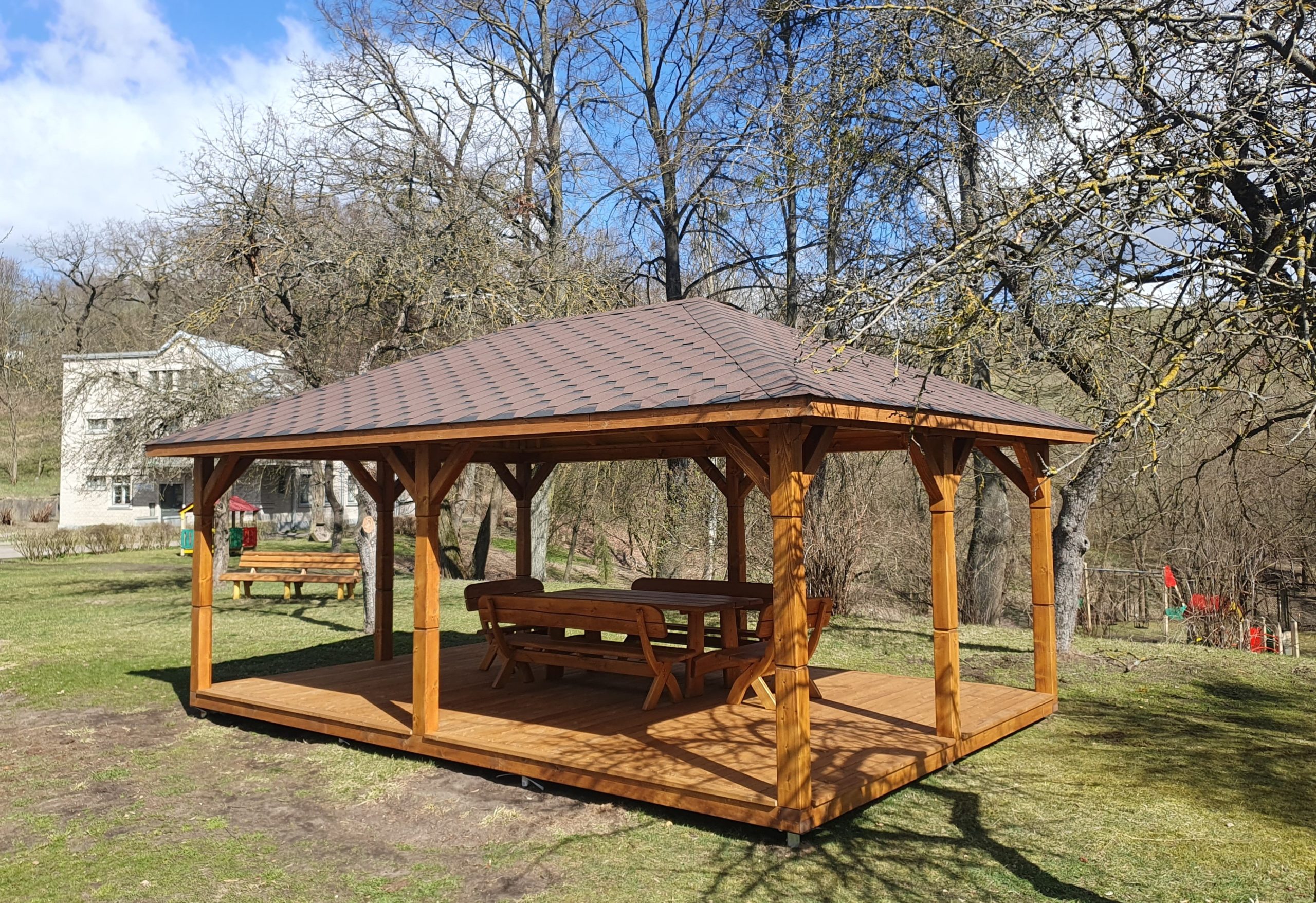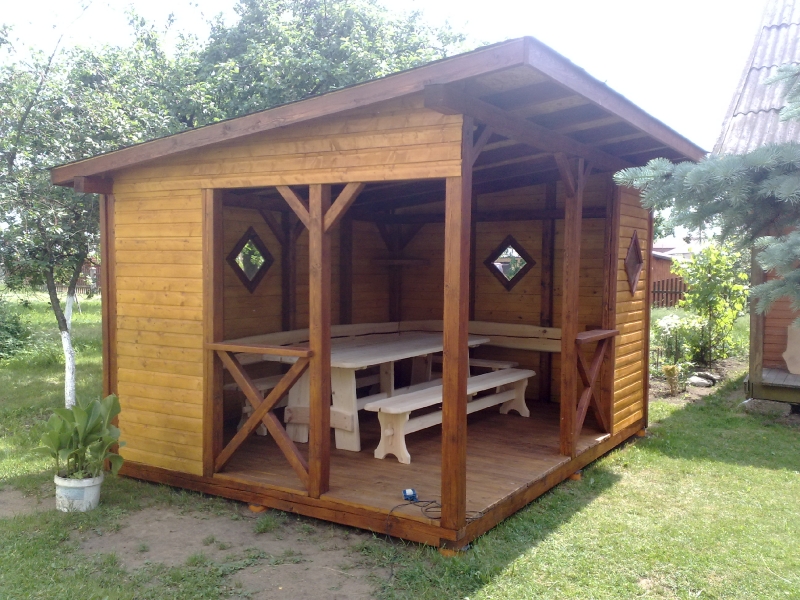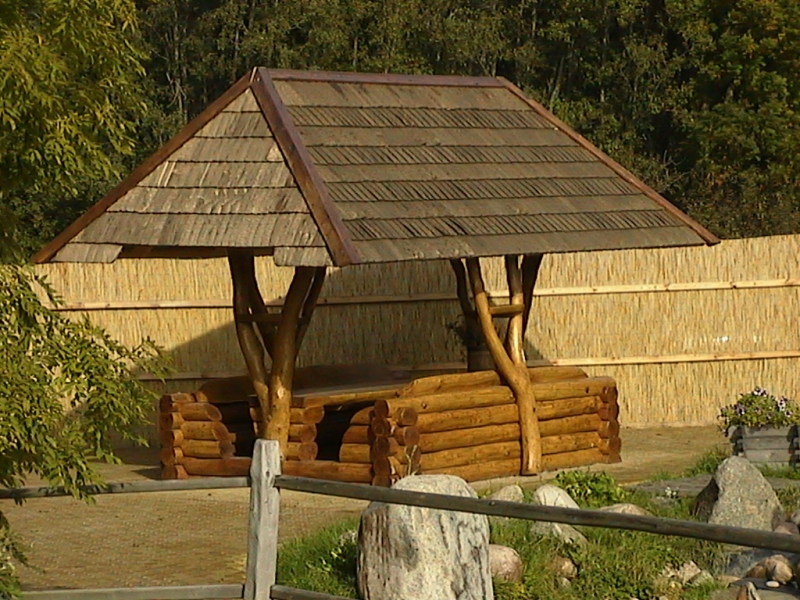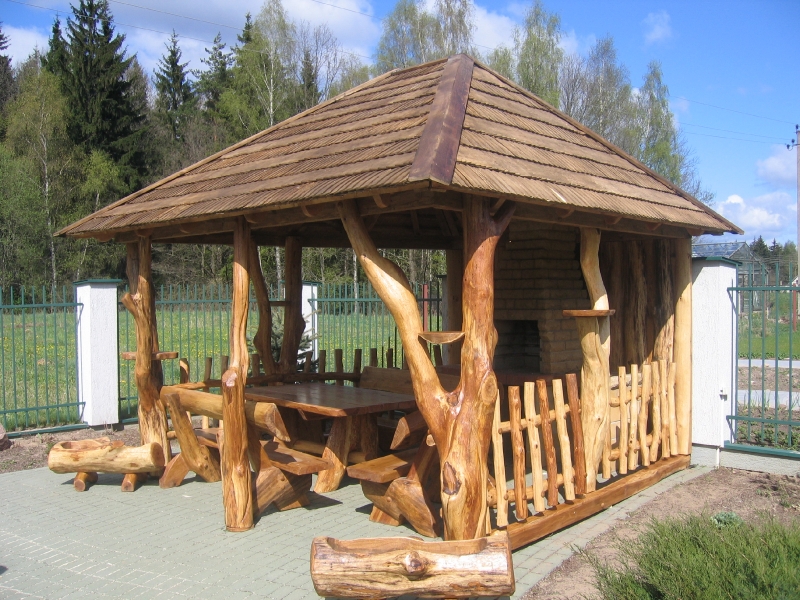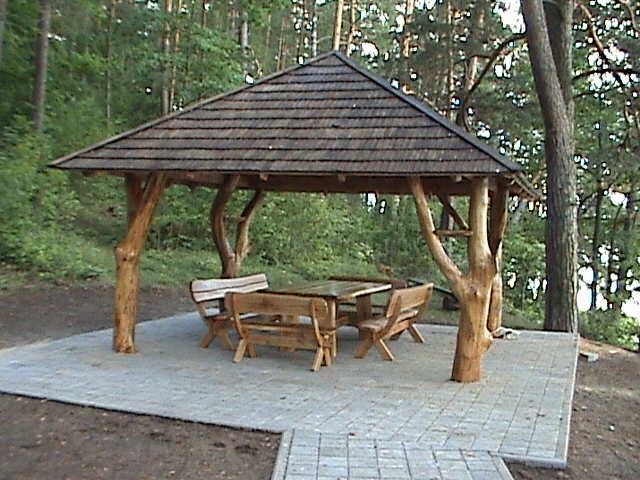
In short: Rest-area gazebo No. 16-9 is an open wooden gazebo built on a paving-block pad in a pine forest. The hip roof of dark shingles is held up by natural, partly branching trunks, and under the roof stand a table, benches with backrests and a chair. A paving-block path leads to the pad. The size, finishing and equipment are agreed individually.
A rest-area gazebo: shelter in nature
In the photo the gazebo stands not in a private yard but in a pine forest. Tall pines and deciduous trees grow all around, on the right the surface of water seems to gleam between the trees, and the ground is covered with pine needles. A paving-block path connects the gazebo with the rest of the area. This is a typical rest-area spot: you arrive, sit down at the table and relax in nature. The gazebo in the photo is still empty, so you can clearly see how the furniture is arranged and how much free space is left around it. Picture a family coming back from the water here, or a group of friends gathering for dinner under the open sky.
For rest areas and campsites a gazebo is almost a necessity. It gives shelter from rain and the scorching sun, and the table with benches makes it comfortable to eat, rest or play board games. Without a gazebo even a beautiful spot by a lake becomes uncomfortable when the rain comes.
Here the gazebo is completely open: no walls, no railings. That is practical for a public place. People can enter from any side, a larger group fits in easily, and the view of the water is not blocked anywhere. An open structure is also well ventilated, so it stays cool under the roof even on the hottest day.
Gazebos like this are needed not only at public rest areas. They suit rural tourism homesteads, campsites, fishermen’s and hunters’ lodges, community grounds by lakes and private farmsteads in the forest. Wherever people gather in nature and want a comfortable place at a table, an open gazebo becomes the center of attention.
On a private plot in a pine forest, such a gazebo can replace a whole outdoor kitchen: people eat here, relax and wait for food to cook on a campfire or a grill nearby. The main thing is to keep the fire at a safe distance from the gazebo and the trees.
Natural trunks in a pine forest setting
The roof rests on natural, debarked trunks. The front left trunk is fairly straight, while the right one divides into two thick branches that support the roof beam. At the back you can see one more trunk, which splits into several parts. All the trunks are light, with a honey tint, so they stand out against the dark background of the pine forest and the gazebo is easy to see from afar.
A gazebo like this blends beautifully with the forest. Its columns look like a continuation of the surrounding trees, and the dark shingle roof recalls pine crowns. Visitors feel not that they are in a building but that they are under the trees, only dry and comfortable.
Light trunks are also practical. In the evening, when it gets dark quickly in the forest, light wood stays visible longer in the twilight, so the gazebo is easier to find on the way back from the water. If lighting is planned at the rest area, light trunks reflect the light well and the gazebo looks cozy.
Natural trunks are different every time, so every gazebo gets its own character. The craftsmen choose the trunks by shape and thickness. The branching points not only decorate but also work as supports, so separate diagonal beams are hardly needed here.
In a public place it also matters that the trunks are massive. They are hard to damage by accident, and thick columns withstand intensive use when many people visit the gazebo every day. In addition, wood in its natural shape creates no harsh angles or flat planes that would look foreign in a forest setting.
A dark shingle roof
The hip roof is covered with wooden shingles that have darkened over time and taken on a rich dark brown shade. The shingles are laid in dense rows, and the roof edges project widely beyond the trunks. That matters for an open gazebo: the wider the overhang, the less rain reaches the table when it blows in at an angle.
In a pine forest needles and cones constantly fall on the roof. A shingle roof copes with this well, but once or twice a year it is worth sweeping it off so that needles do not pile up and hold moisture. This is especially important in autumn, before winter. Darkened shingles are not a sign of damage. It is the natural aging of wood, which gives the roof a calm shade close to that of the forest.
Under the roof you can see the open structure of beams and rafters. There is no ceiling, so the gazebo feels tall and spacious, and the wood under the roof is well ventilated. Laukbaldis makes shingles for roofs, so the roofing is chosen together with the whole structure.
A paving-block pad and path
The gazebo does not stand on a wooden floor but on a large paving-block pad that is considerably wider than the roof itself. A paving-block path leads to the pad. This solution suits a public place especially well: paving blocks do not mind heavy foot traffic, they do not need painting, and dirt and needles are easy to sweep off.
The pad around the gazebo is useful too. You can put extra benches, bicycles or children’s strollers on it, and visitors do not have to wade through wet grass or sand. Rainwater running off the roof falls on a hard surface and does not wash out the soil by the trunks.
A paving-block pad also clearly marks the rest spot in the forest. Visitors immediately understand where they can sit down, and the rest of the pine forest stays untouched. This way the surrounding vegetation is trampled less, and the approaches to the gazebo stay tidy for a long time even in a heavily visited place.
It is important that the pad is level and compacted. It is worth discussing how the gazebo will be fixed to the base in advance, before the paving blocks are laid, so that fixing points can be provided if needed.
If the rest area is in a forest or by a lake where access is harder, it is also worth mentioning this in advance. Access determines how the parts of the gazebo will be delivered and what size of structure suits the particular site.
What the photo shows
The table lists what can be seen in the photo of this product. It is a typical example that can be changed.
| Feature | In the photo |
|---|---|
| Hip roof of dark shingles | Yes |
| Columns of natural trunks | Yes, some of them branching |
| Paving-block pad and path | Yes |
| Table, benches with backrests and a chair | Yes |
| Railings or low walls | No |
| Wooden floor | No |
What to discuss when ordering a rest-area gazebo
Laukbaldis shows only typical examples, so a gazebo can be adapted to a particular place. Before you call, think about:
- How many people will visit. The size of the gazebo and the number of tables depend on it.
- The base. Paving blocks, a wooden floor or another solution, depending on the site.
- Furniture. Whether you need one long table or several smaller ones.
- Closed sides. The wind is stronger by the water, so one side can be closed.
In the photo a table, benches with backrests and a chair stand inside. UAB “Laukbaldis” makes oak outdoor furniture, so it can be ordered together with the gazebo. Solid wooden furniture suits public places, because it is heavy, stable and hard to push around. Benches with backrests are more comfortable for longer rests, and a separate chair lets someone sit at the end of the table.
Moisture and sun do the most harm to wood outdoors. In a pine forest there is usually more moisture, so once a year inspect the bottom of the trunks and the branching points. If the surface has become paler or rough, renew the protective coating made for exterior wood. Remove needles and cones from the roof and the pad. In a public place it helps to have a simple maintenance plan: in spring, an inspection and renewal of the coating; in autumn, cleaning of the roof and the pad. That way the gazebo will look tidy for a long time and visitors will enjoy it for many seasons.
You will find more examples in the section wooden gazebos. Similar works are the log gazebo by the pond No. 26, the classic wooden gazebo on paving blocks No. 16-2 and the gazebo on a wooden platform No. 16-8. Look for tables and benches in the section oak garden and outdoor furniture.
How to order gazebo No. 16-9
UAB “Laukbaldis” has made wooden products since 1996 and, as the company states, was the first in Lithuania to start making this production. The company is based in Dapkiškių village, Tauragės district.
Call +370 687 25388 and quote No. 16-9. During the conversation you will agree on the size, the base, the roofing and the furniture. If the gazebo is meant for a rest area or a campsite, tell us how many visitors you expect and what the site is like, which makes it easier to choose the right solution.
The website shows only typical examples, so feel free to ask about changes: a larger gazebo, several tables, one closed side or a wooden floor. The gazebo is made according to the agreed solutions, so it will fit your site and not just the photo. Natural trunks are different every time, so your gazebo will be one of a kind.
Frequently asked questions
Is the gazebo suitable for a public rest area?
Yes, an open gazebo with massive trunks and sturdy furniture suits places that many people visit. The size is chosen according to the number of visitors.
Can the gazebo be built on paving blocks?
Yes, in the photo it stands on a paving-block pad. It is worth discussing how it will be fixed to the base before the paving blocks are laid.
How do I look after a shingle roof in a pine forest?
Needles fall on the roof in a pine forest, so it is worth sweeping it off at least once or twice a year. That way the shingles dry faster after rain.
Can one side of the gazebo be closed?
Yes, especially if the gazebo stands by the water, where the wind is stronger. The number of closed sides is agreed when you order.
Is the furniture included in the order?
In the photo the furniture shows one possible arrangement. The table and benches can be ordered together with the gazebo.
How do I order gazebo No. 16-9?
Call us and quote the product number. We will agree on the size, the base, the roofing and the furniture.