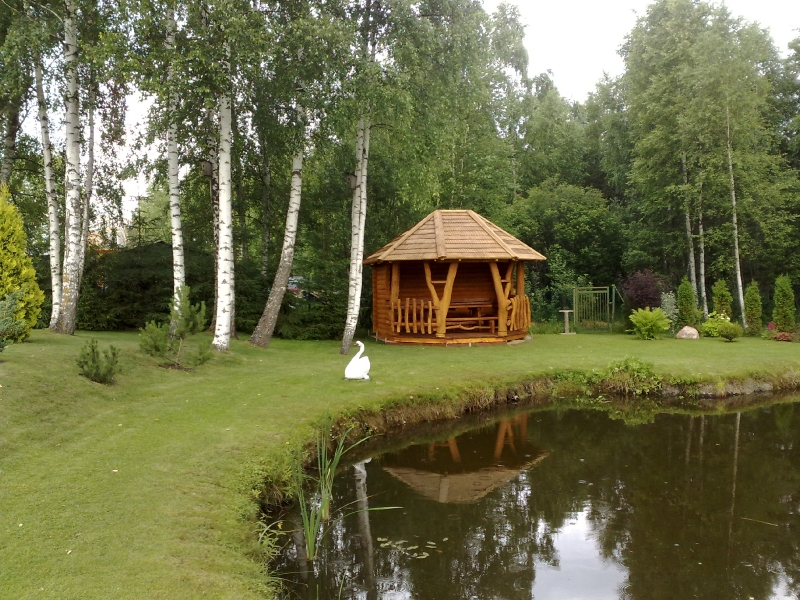
In short: Log gazebo by a pond No. 26 is a polygonal wooden gazebo with a shingle roof, whose back is built of round logs, while at the front the roof is held up by natural trunks that fork into two branches. In the photo it stands on a lawn among tall birches, and its image is reflected in the pond water. The size, finishing and equipment are agreed individually.
A log gazebo by a pond, reflected in the water
This photo was taken from the opposite bank of the pond, so the gazebo is seen together with its whole surroundings. In front is calm water with a tuft of reeds and floating leaves, beyond it a mown lawn, and further on the gazebo itself. On the left white-trunked birches rise, and on the right there are metal gates, thujas and ornamental shrubs. A small white swan figure sits on the lawn, which only emphasizes the calm, almost park-like mood.
The most beautiful detail in the photo is the reflection. The light shingle roof and the honey-colored trunks are repeated in the dark water, so from afar the gazebo seems to be doubled. This view is the main reason to build a gazebo by water: sitting inside, you see the pond, and looking from the other bank, the gazebo itself becomes part of the landscape.
The birches play an important role in this view. Their crowns cast a light, translucent shadow that protects from the heat on a hot day but does not darken the whole surroundings. In addition, the white trunks contrast with the warm shades of the wood and emphasize the silhouette of the gazebo.
The gazebo is built not quite at the water edge but a few steps away from it, on a level lawn. This is a sensible solution: the shore stays free, there is room to walk between the water and the gazebo, and the structure itself stands on a drier spot.
A shingle roof and a wall of round logs
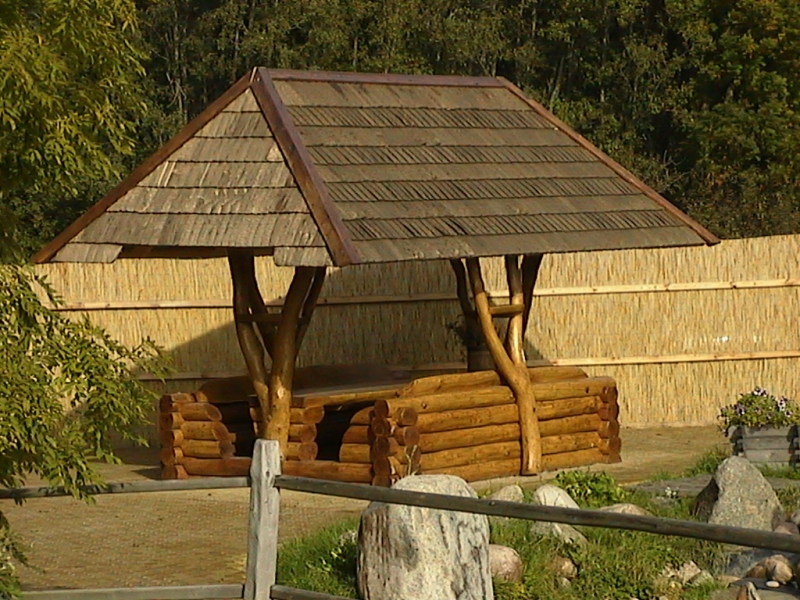
The roof is made up of several triangular planes that meet at the peak. It is covered with wooden shingles laid in dense overlapping rows, and the roof edges are covered with boards. The light, warm-toned covering goes well with the logs, so the whole structure looks as if it had been carved from a single tree.
The back of the gazebo is closed with a wall of round logs. The logs are notched together at the corners, and their ends project outward, a characteristic feature of log buildings. The wall protects from the wind from the depth of the garden and creates a cozy backdrop for the table. The front part is left open toward the pond, so while sitting inside nothing blocks the view of the water.
A shingle roof changes color over time. When new it is light and yellowish, and after a few years it naturally turns gray and takes on a silvery shade. Both variants are beautiful: whoever likes the tone of fresh wood can coat the roof with a protective layer, and whoever wants a natural patina lets it age by itself.
Branching trunks and a low wooden fence
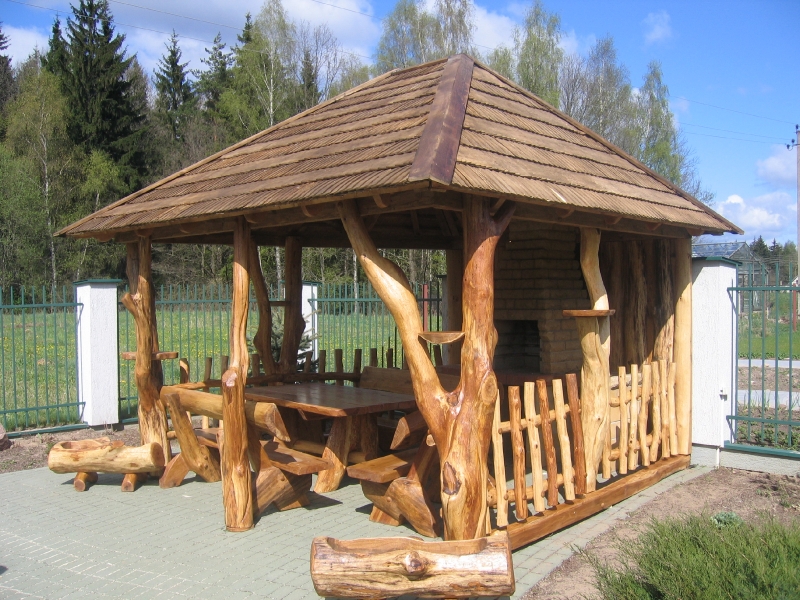
At the front you can see two natural trunks that fork into two parts at the top and support the roof beam with both branches. Columns like these resemble the letter Y and are a characteristic mark of this series of gazebos. The trunks are peeled, sanded and coated with the same honey-colored layer as the logs.
Between the columns there is a low fence of vertical stakes. It does not block the view but clearly separates the inside from the lawn, and reminds children that beyond it there is water. An entrance is left between the sections of the fence, through which it is easy to carry in dishes or snacks. Inside you can see a table at which the whole family will sit.
The stake fence and the branching trunks form one stylistic whole: not one detail is straight as if drawn with a ruler, everything keeps the bends of the wood. That is exactly why the gazebo blends so naturally among the birches: their white trunks and the honey-colored columns look like parts of the same grove.
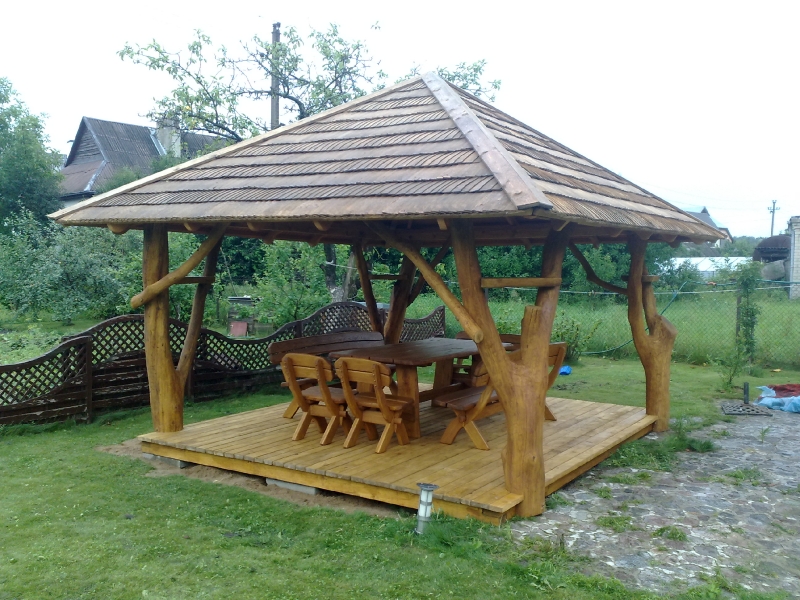
Since the gazebo was photographed from some distance, some details can be seen only in general terms. The table marks what can be clearly made out.
| Feature | In the photo |
|---|---|
| Polygonal plan | Yes |
| Wooden shingle roof | Yes |
| Wall of round logs | Yes, at the back |
| Y-shaped trunk columns | Yes |
| Stake low fence | Yes |
| Table inside | Yes |
| Glass | No |
How to use a gazebo by the water
A gazebo on a pond shore has more purposes than an ordinary gazebo in the middle of a yard. Here are a few ways it is most often used:
- quiet mornings with coffee, while mist still rises over the water and birds can be heard;
- family dinners with a view of the sunset reflected in the pond;
- a resting place after swimming or fishing, where you can put down your things and hide from the sun;
- get-togethers with guests on holidays, when a feast table stands under the roof and the children play on the lawn;
- a quiet corner for a book, when you want to be away from the noise of the house.
Since the back is closed, the gazebo also suits windier days, when it is cool by open water. The roof protects from rain, so even if a summer downpour arrives you do not have to run to the house: it is enough to move closer to the log wall and watch the drops ripple the surface of the water.
What to think about when building a gazebo by water
A gazebo by the water is one of the favorite spots on a homestead, but before building it is worth considering a few things. The most important is the base. By a pond the ground is often damper, and in spring the water level can rise. So the gazebo should stand on a higher, drier spot, with the floor raised above the ground so that air moves beneath it.
Other questions worth discussing:
- Direction. The open side is worth turning toward the water, and the log wall toward the side the wind usually blows from.
- Distance to the shore. Leave enough room for a path and for looking after the shore, so you do not have to walk across wet grass.
- Lighting. It gets dark quickly by water in the evenings, so it is worth thinking in advance about a lamp in the gazebo and low lanterns along the path.
- Sun. The evening sun reflected in the water can dazzle, so the roof overhang and the closed wall are especially useful here.
- Evening coolness. By water it is cooler and damper in the evenings, so the log wall that holds back the wind is especially useful here.
- Paths and bridges. If the pond is larger, a wooden bridge or a pier can be built by the gazebo.
Many homesteads have both a small body of water and an old row of trees. A gazebo between them joins both accents into one view, as in this photo, where birch trunks frame the wooden gazebo from both sides.
If the pond is only being dug, the spot for the gazebo is worth planning right away. Then the soil from the hole can be used to form a higher site, and the path and the shore plants will be planned together with the gazebo and not fitted in later.
Care in a damper place
By a pond the wood gets damp more often than on an open lawn, so a bit more attention is needed for care. The good news is that the tasks are few and simple; the main thing is to do them on time, before moisture does harm. In spring inspect the lower rows of logs, the bases of the trunks and the floor. If the surface has turned pale or water no longer beads up, it is time to renew the protective coating.
In autumn sweep birch leaves and twigs off the shingle roof: water lingers longer in damp piles, and moss may start to grow. Keep nearby shrubs and tall grass away from the walls so that the logs dry faster after rain. In winter it is worth making sure a thick layer of snow does not build up on the roof.
Natural trunks may crack slightly as they dry; this is normal behavior of wood. Check more carefully only the places where branches fork and the upper ends, where water can linger.
How to order gazebo No. 26
This is a gazebo from the series that Laukbaldis labels “Egle-5”. The website shows only typical examples, so the size, shape, roofing and finishing can be adapted to your plot. If you want to compare, take a look at other works too: the wooden windbreak shelter with massive trunks No. 15-8, the gazebo by the water with a pier No. 25-22 and the gazebo for a homestead by a pond No. 25-4. You will find all the examples in the section wooden gazebos, and the shore of the pond will be complemented by wooden bridges and fences.
Laukbaldis is a company from Dapkiškių village in Tauragės district, working since 1996. Call +370 687 25388 and quote No. 26. During the call you will discuss the size of the gazebo, which side to close with logs, which roofing to choose and where it will stand. If you have photos of your plot and the pond, have them ready: it will be easier to choose the right solution.
It is worth mentioning in the call whether you want furniture in the gazebo. The table and benches can be ordered together, and then their size will be fitted to the interior of the gazebo and their style to the trunks and logs.
Frequently asked questions
How far from the water should a gazebo be built?
It is best to choose a higher, drier spot a few steps from the shore. The exact distance is worth discussing according to your plot and the fluctuations of the water level.
Is a shingle roof suitable for a damper place?
Yes, if the roof is regularly cleaned of leaves and twigs. It is important that the covering can dry after rain.
Can more sides be closed with logs?
Yes, the photo shows a typical example. Which sides will be closed is decided when you order, according to the direction of the wind and the view.
What does the name Egle-5 mean?
This is how Laukbaldis named the examples of this series of log gazebos with natural trunks. Each one is made individually, so the details differ.
How do I order this gazebo?
Call us and quote the product number. We will discuss the size, the finishing and the place by your pond.