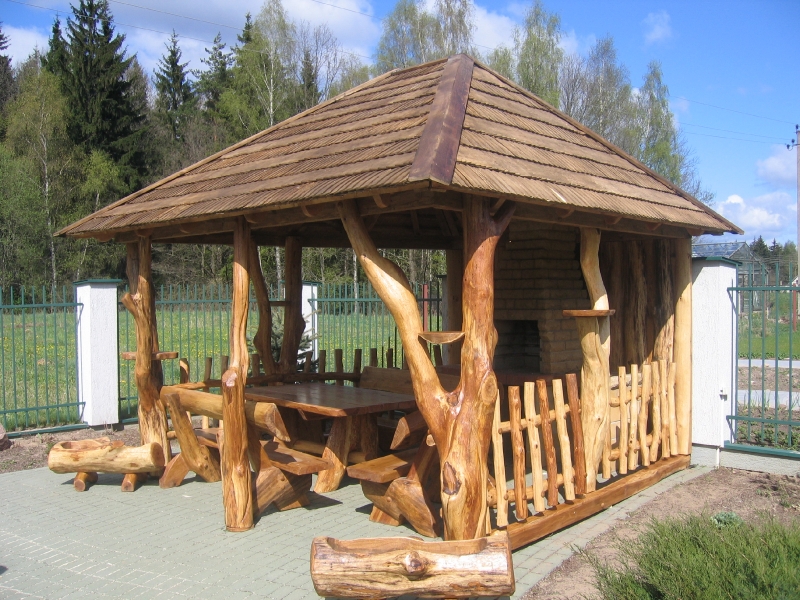
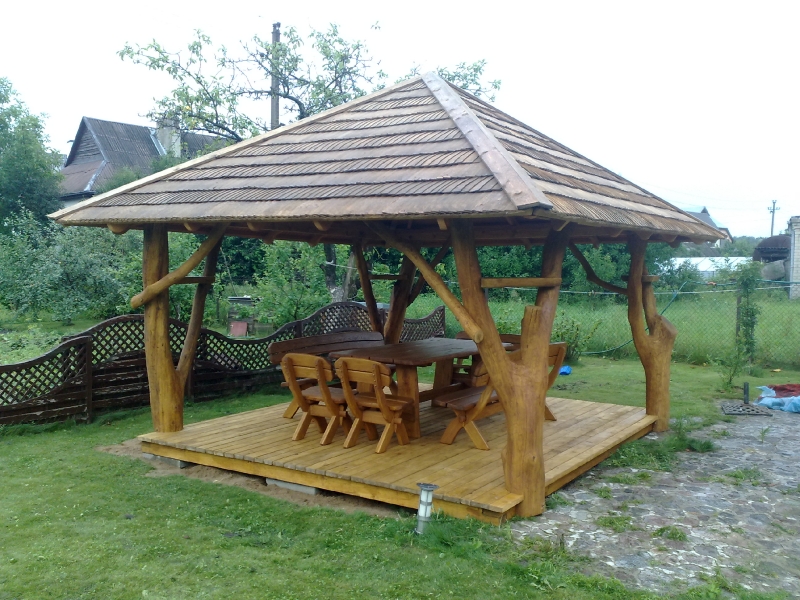
In short: Wooden windbreak shelter No. 15-8 is a polygonal gazebo whose back is closed with a wall of boards with a natural edge, while the front is left open to the garden. The roof is held up by very massive peeled and sanded tree trunks, a low slat fence is built on the sides, and a table with a bench stands inside. The size, finishing and equipment are agreed individually.
A wooden windbreak shelter that protects on one side and opens on the other
The word “windbreak” suits this structure very precisely. The back and side parts of the gazebo are closed with a tall wall, so wind blowing from that side does not get inside. The front stays open: through it you can see the whole yard, and the sun lights the floor almost to the back wall. A solution like this suits plots where the wind mostly blows from one direction: the gazebo can be placed with its back to the wind and its open part facing the garden.
The photo was taken in spring, when the trees are just unfolding their leaves and the first dandelions are blooming on the lawn. The shelter stands on an open lawn next to a country road, with a dwelling house and a garden further off. This is not an exhibition ground: the structure has already settled into a real homestead, so it is easy to imagine how it would look in your yard too.
It also matters that the shelter is not an enclosed room. It has no doors, windows or glass, so there is always fresh air inside, and in summer it never gets stuffy. At the same time the back wall gives coziness and privacy: sitting at the table, you lean your back against a wall of wood and not against open space.
Massive trunks: the main accent
What stands out most in this gazebo are the columns. These are not hewn beams but thick tree trunks with all their natural bumps and bends. The bark has been removed, the surface sanded smooth and coated with a layer in a warm honey shade, so in the sun the wood simply glows.
The front left trunk is wide at the bottom and higher up splits into two parts, as if two trees had grown together. The right trunk has a branch rising at an angle, which supports the roof beams and forms a silhouette resembling the letter V. Small round shelves are fixed to both columns. They are handy for putting down a cup, a candle or a phone, so you do not have to carry things from the table.
Natural trunks are different every time, so two absolutely identical gazebos like this do not exist. The craftsmen choose trunks by shape and thickness, and the final look depends on the wood available. That is exactly why this structure looks not like a factory product but like a handmade work.
A wall of boards with a natural edge and a slat low fence
The back wall is made of vertical boards whose edges are not cut straight. Each board keeps the natural outline of the tree trunk, so the seams between them undulate. The darker shade contrasts nicely with the light trunks and the floor: from a distance you see a deep, shadowed interior and bright columns at the front.
On the sides there is a low fence of flat vertical slats with small gaps. It is not tall, but it clearly separates the inside from the lawn and keeps the wind from carrying leaves straight onto the floor. A wide entrance is left between the columns, so you can freely carry dishes or extra chairs inside.
Under the edge of the roof you can see the round ends of the rafters, with their cuts picked out in a lighter color. It is a small but characteristic detail: the roof looks lighter, and the whole structure takes on the traits of traditional wooden architecture.
The roof is multi-pitched, adapted to the polygonal plan, and covered with brown asphalt shingles. Their pattern resembles scales, and the color goes with the honey-colored wood. This covering is light, adapts well to many roof surfaces and does not need complicated care: it is enough to sweep off the leaves from time to time and check the edges after a strong wind. The roof projects widely beyond the columns, so rain does not reach the edge of the floor and the inside stays dry longer.
What can be seen in the photo
A short summary will help you quickly compare this shelter with other gazebo examples.
| Feature | In the photo |
|---|---|
| Polygonal plan | Yes |
| Roof of asphalt shingles | Yes, brown |
| Massive natural-trunk posts | Yes, sanded |
| Small shelves on the columns | Yes, two |
| Closed back wall | Yes, of boards with a natural edge |
| Slat low fence on the sides | Yes |
| Table and bench with a back | Yes |
| Glass or doors | No |
Who a windbreak shelter suits
A windbreak shelter is a good choice for those who want to spend time outdoors but do not want an enclosed room. It protects from sun and rain, and the back wall also from the wind. It is convenient for:
- having lunch or dinner with the whole family, especially when the table stands against the closed wall;
- resting after work in the garden when you need shade on a hot day;
- receiving guests at a homestead, when the house is too cramped or you want to be in nature;
- taking shelter from a sudden summer rain and carrying on the conversation at the table;
- setting up a permanent resting place at a rural tourism homestead or campsite.
In the photo there is a table and a bench with a back and X-shaped legs inside. UAB “Laukbaldis” also makes solid oak outdoor furniture, so the table, benches or chairs can be ordered together with the gazebo, and then the furniture will match the trunks and the wooden walls.
The shelter especially suits a country homestead, where there is a lot of space around, and natural-shaped wood goes with old trees, meadows and wooden farm buildings. But it can also become an expressive accent in a suburban yard, as long as there are not too many modern, strict forms nearby.
The shelter is useful not only in summer. In spring, when the sun already warms but the wind is still cool, the back wall holds back the gusts, and the open side lets you enjoy the warmth. In autumn, dressed more warmly, you can still have tea in it or admire the garden in its fall colors. In winter the structure becomes a shelter for garden furniture, which is worth keeping under a roof, away from the snow.
The base, the site and care of the wood
In the photo the floor is raised above the ground, and the corners rest on concrete blocks. It is a simple and practical solution: air circulates between the ground and the floor, so the lower beams dry faster after rain. When choosing a spot, make sure the base is level and that water does not stand there after rain.
Before ordering, think about which side of your plot the wind usually blows from and where you would like to see the view. It is worth turning the closed side toward the wind, the plot of the neighbors or the road, and the open side toward the garden, a pond or the evening sun.
Moisture and the rays of the sun do the most harm to outdoor wood. The surface of the trunks, the ends of the boards and the floor need regular care:
- once a year, preferably in spring, inspect the wood and, if it has turned pale or rough, renew the protective coating;
- remove leaves and twigs from the floor and the roof so that they do not hold moisture;
- pay attention to the bottoms of the trunks and to the places where branches fork, because water stays longest there;
- small cracks as the wood dries are natural and usually do not harm the structure.
What to discuss when ordering, and how to order shelter No. 15-8
The Laukbaldis website shows only typical examples, so this shelter can be adapted to your needs. Before you call, think about a few things: how many people will usually sit at the table, which sides should be closed, whether you want a low fence, and what color of roofing will go with the house. Also discuss what furniture you would like to see inside.
It is easiest to work out the size starting from the furniture. Think about how long a table you will need, how much room must remain for the benches and for walking around, and whether you will want to keep a few extra chairs or a small table for dishes inside. If the shelter will stand far from the house, it is worth planning a path to it at once: then you will use it more often, even after rain.
If you like natural forms, take a look at other similar works too: the rustic gazebo with massive trunks No. 25-11, the gazebo with a Y-shaped trunk No. 25-9 and the glazed gazebo with trunk columns No. 24-3. You will find the whole selection in the section wooden gazebos, and furniture for the interior in the section oak garden and outdoor furniture.
The company has operated since 1996 and, in its own words, was the first in Lithuania to take up this kind of production. Call +370 687 25388 and quote No. 15-8, and it will be clear at once which structure you mean. During the call you will discuss the size, the shape, the roofing, the finishing and the place on your plot. If you have photos of your plot or a plan, have them ready in advance: it will be easier to agree on the details.
Frequently asked questions
How does a windbreak shelter differ from an ordinary gazebo?
Some of its sides are closed with a wall, so it protects better from the wind. The front stays open, so it is bright inside and the air is fresh.
Can I close more or fewer sides?
Yes, the photo shows a typical example. Which sides will be closed and which open is discussed when you order, according to your plot and the direction of the wind.
Will all the trunks be the same as in the photo?
No, natural trunks are different in shape every time. The craftsmen select wood of similar thickness and character, so every gazebo is unique.
What does this gazebo stand on?
In the photo the floor is raised above the ground and rests on concrete blocks. The most suitable base is worth discussing according to the soil on your plot.
Can I order furniture together?
Yes, Laukbaldis also makes solid oak outdoor furniture. The table and benches can be chosen to match the size and style of the gazebo.