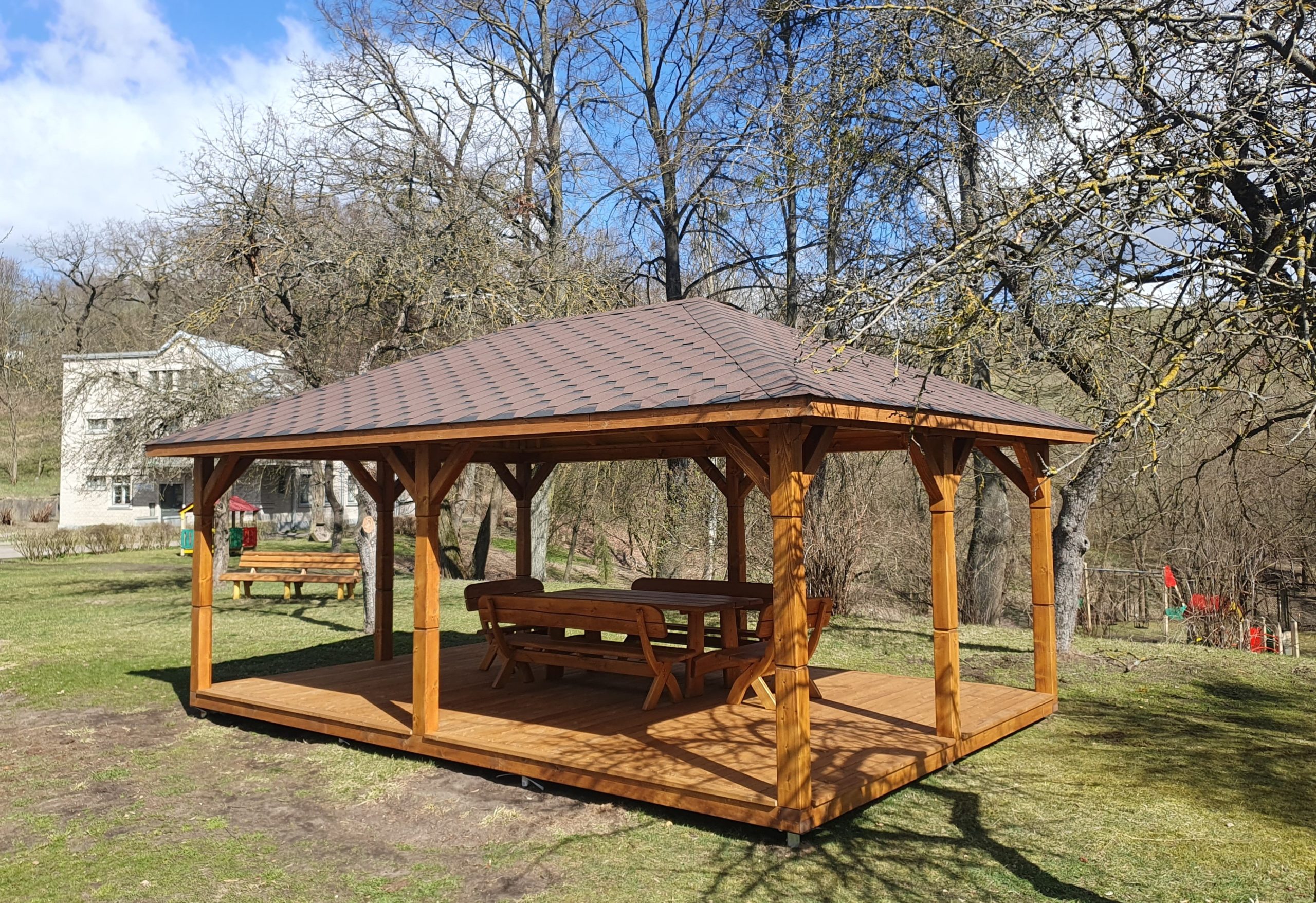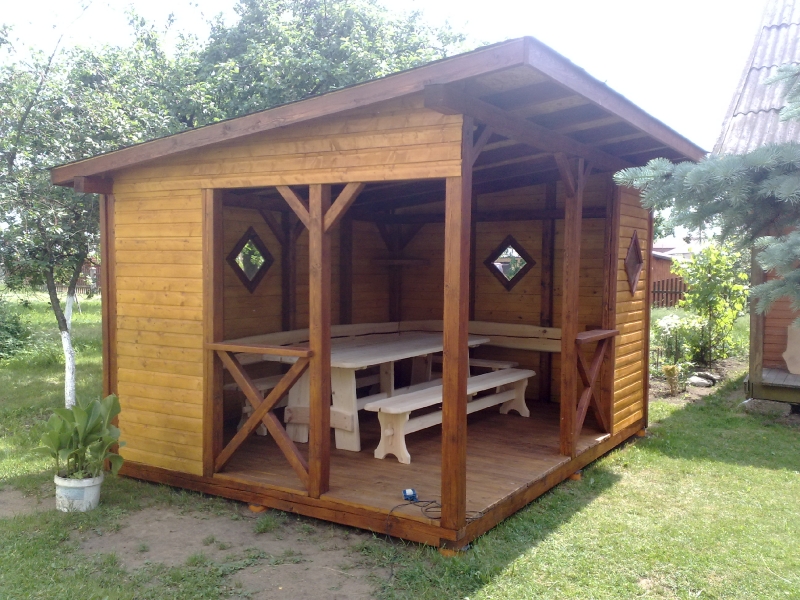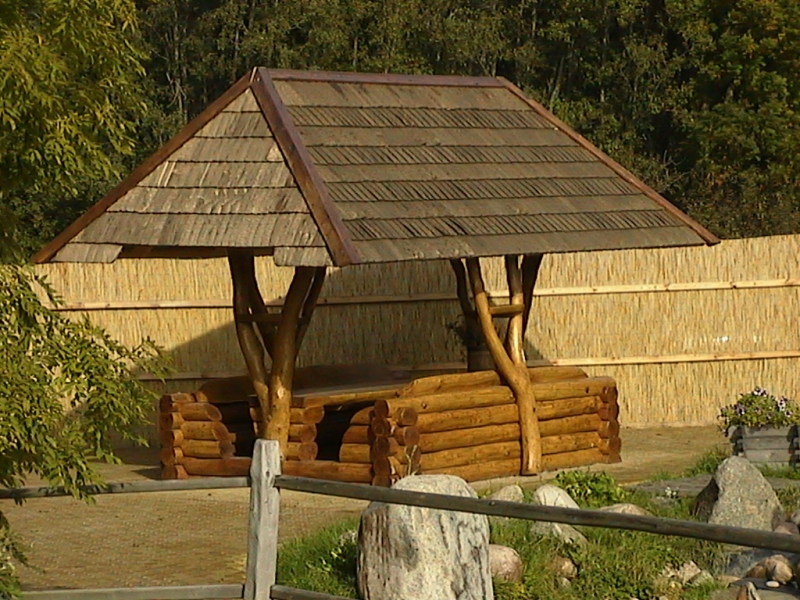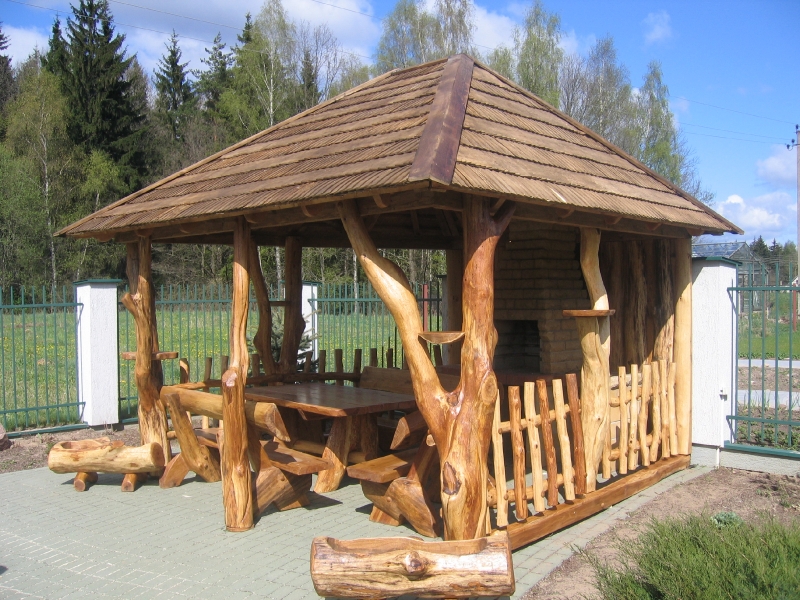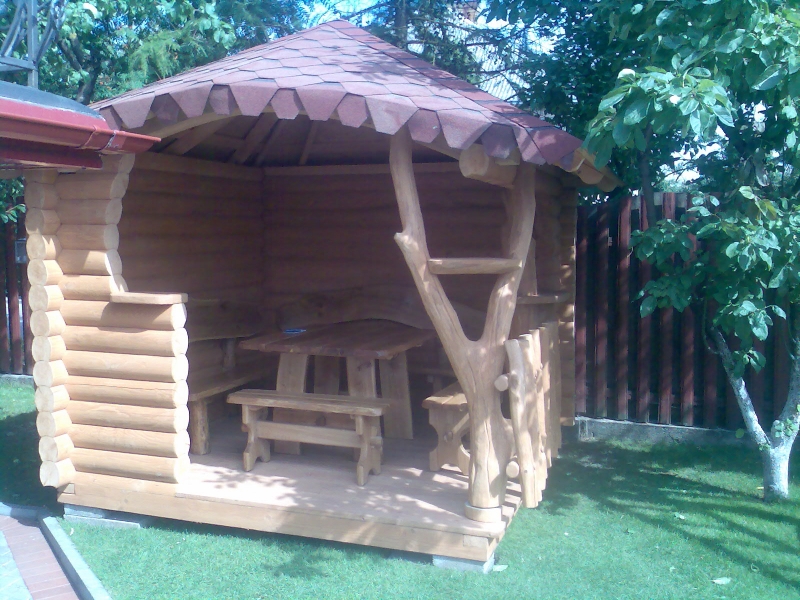
In short: Gazebo with an asphalt shingle roof No. 21-2 is a small log gazebo whose roof is covered with red-brown asphalt shingles laid in a large scale pattern. The back and left walls are built of round logs, a Y-shaped trunk stands at the front, and on the right there is a low fence of vertical half-logs. The size, finishing and equipment are agreed individually.
A gazebo with an asphalt roof that looks like scales
What stands out most in this gazebo is the roof. It is covered with asphalt shingles, each tab of which has a large, rounded edge. Laid in rows, they form a pattern of scales or dragon skin, and along the bottom the edge becomes wavy, as if embroidered. A roof like this looks very playful and even a little fairy-tale-like: to children the gazebo looks like a cottage from a storybook.
The red-brown color was not chosen by accident. The photo shows the gazebo standing right next to a house whose roof edge and gutters are red too. This way the gazebo and the house become one composition: although their shapes differ, the colors repeat, and the yard looks well thought out.
Asphalt shingles are also called soft roofing. It is light, adapts well to complicated roof shapes and makes little noise in the rain. Looking after it is simple: it is enough to sweep off leaves and twigs in spring and autumn and to inspect the roof edges after a strong wind. That is convenient when the gazebo stands under trees, as it does here.
The roof projects widely beyond the walls and the trunk, so it protects the logs from rain. Under the roof you can see sturdy beams and rafters, which from inside look like a warm wooden ceiling. Sitting at the table, you see not a flat surface above your head but the whole roof structure, so the interior looks taller and cozier.
Log walls with a stepped front section
The left and back walls of the gazebo are built of round logs whose ends project at the corners. The front part of the left wall is interesting: the logs get shorter in steps, so the wall is lower at the front and higher nearer the corner. A shape like this gives the wall dynamism and lets those sitting at the table see the yard through the upper opening.
The top log of the lower section forms a wide ledge on which it is handy to put a cup or a plate. From outside, the log wall closes the view into the interior, so you feel privacy in the gazebo even though it stands right next to the house.
The logs are sanded and coated with a light, warm shade. In the sun they look almost golden, and in the shade honey-colored. The light wood contrasts nicely with the red-brown roof and the dark fence behind the gazebo. It is this three-color combination, light logs, a red roof and a dark background, that gives the picture its warmth.
A Y-shaped trunk with a crossbar shelf
On the right side of the front, the roof is held up by a natural-shaped trunk. It is thick at the bottom and higher up divides into two parts that form a silhouette resembling the letter Y. A crossbar shelf, like a ladder rung, is fitted between the branches. It both decorates and comes in handy: you can put a candle, a small flower pot or a phone on it.
The trunk is peeled and sanded but keeps all its natural forms: knots, branch stubs, a slight bend. It stands on the floor frame, and its bottom is clearly separated from the lawn. Each gazebo gets a trunk of its own, because the craftsmen choose it from the wood available, looking for an expressive shape.
On the right, between the trunk and the back wall, there is a low fence of vertical half-logs. They are set close to one another, so the low fence looks like a low wooden wall. It holds back the wind from the side and separates the gazebo from the tree next door, but does not close it off completely. The half-logs go with the round logs and continue the same wooden mood, only they look lighter.
How to choose the color and shape of the roofing
Asphalt shingles come in various shapes, rectangular, hexagonal, rounded or scale-like, and in many colors. So when choosing a covering for a gazebo, it is worth looking not only at the catalog but also at your own yard. A gazebo never stands alone: there is a house nearby, a fence, farm buildings, a terrace or paths, and they all have their own colors.
A few simple principles help you choose:
- if the gazebo will stand close to the house, the same or a similar color to the house roof usually looks best;
- if the gazebo stands far off in the garden, you can choose a brighter, contrasting shade that will become an accent among the greenery;
- playful scale shapes suit smaller gazebos and children yards, and calmer shapes suit larger structures;
- darker colors show fallen leaves and dust less, lighter ones visually make the roof feel lighter.
In this photo the red-brown scale pattern goes very well with the red gutters of the neighboring house and with the light logs. At the same time the roof stays visible and bright even through the shadows of the branches of the deciduous tree. You will discuss the type and color of the roofing when you order: Laukbaldis shows only typical examples, so the final decision is always made together with the customer.
What the photo shows
A short summary helps you judge which solutions were used in this typical example.
| Feature | In the photo |
|---|---|
| Asphalt shingle roof | Yes, red-brown, scale pattern |
| Round log walls | Yes, back and left |
| Stepped front section of the wall | Yes |
| Y-shaped trunk with a shelf | Yes |
| Half-log low fence | Yes, on the right |
| Wooden floor on a base | Yes |
| Table and benches | Yes |
A small gazebo right next to the house
In the photo the gazebo stands almost at the corner of the house, between a path, a lawn and a tall dark fence. A large deciduous tree grows nearby, and its branches cast shade on the roof. It shows that a small gazebo can fit even where there seems to be little space: it does not take up the whole yard, but it creates a separate space for relaxing.
A gazebo by the house has clear advantages. It is a few steps from the kitchen, so carrying dishes and food is easy. In the evening you do not have to walk across the whole garden, and children playing in the yard can be watched straight from the gazebo. A place like this often becomes an everyday outdoor dining room, not only for celebrations but also for simple lunches. Even in the rain you can run to the gazebo in a few seconds, and in the evening the light from the yard of the house is enough.
Inside stand a table and benches, and one more bench is placed at the front. UAB “Laukbaldis” makes solid oak outdoor furniture, so the table and benches can be ordered together with the gazebo. In a small gazebo it is important for the furniture to be in proportion and to leave a comfortable passage.
When building a gazebo close to the house, keep a few things in mind:
- leave enough distance from the wall of the house so that the water running off both roofs does not collect in one place;
- think about how the roof color and shape of the gazebo will go with the roof of the house;
- if a big tree grows nearby, allow for leaves and twigs falling on the roof;
- make sure the floor is raised and air circulates beneath it.
How to order and look after gazebo No. 21-2
Laukbaldis shows only typical examples, so the size, layout of the walls, roofing and its color, type of low fence and finishing are agreed individually. Before calling, think about where the gazebo will stand, how many people will usually sit at the table and what color of roof will go with your house.
Looking after the wood is simple: once a year inspect the logs, the trunk and the low fence, and if the surface has turned pale or rough, renew the protective coating. Check the bottom logs and the bottom of the trunk especially carefully, because moisture lingers longest there. In autumn, when leaves fall from the tree next to it, it is worth sweeping the roof and the floor more often. Small cracks as the wood dries are natural and usually do not harm the structure.
You will find similar examples here: the small gazebo with a forked trunk No. 21, the square gazebo with a branch railing No. 21-1 and the log gazebo with a red tile roof No. 18-2. You will find all the works in the section wooden gazebos, and furniture in the section oak garden and outdoor furniture.
UAB “Laukbaldis” has worked since 1996 and, as the company states, was the first in Lithuania to start making this production. Call +370 687 25388 and quote No. 21-2: during the call you will discuss the size, the roofing, the low fence and the finishing.
Frequently asked questions
What is an asphalt shingle roof?
It is a roof covered with asphalt shingles, also called soft roofing. It is light, adapts well to complicated shapes and does not need complicated care.
Can I choose a different shape and color of shingles?
Yes, the shape and color of the shingles are agreed individually. They are often chosen to match the roof of the house, as in this photo, but you can also choose a contrasting shade.
Can a gazebo be built right next to the house?
Yes, but enough distance must be left so that the water running off both roofs does not collect in one place. The spot is worth discussing when you order.
What is the half-log low fence for?
It holds back the wind from the side and separates the gazebo from its surroundings, but does not close it off completely. The height and length of the low fence can be chosen.
How does an asphalt roof differ from a wooden shingle roof?
Wooden shingles are natural wood that turns gray over time and needs more attention. Asphalt shingles keep their color longer and are easier to look after, so they are often chosen for gazebos under trees.
How do I order gazebo No. 21-2 with an asphalt roof?
Call us and quote No. 21-2. Together you will discuss the size, the roofing and its color, the low fence and the finishing.