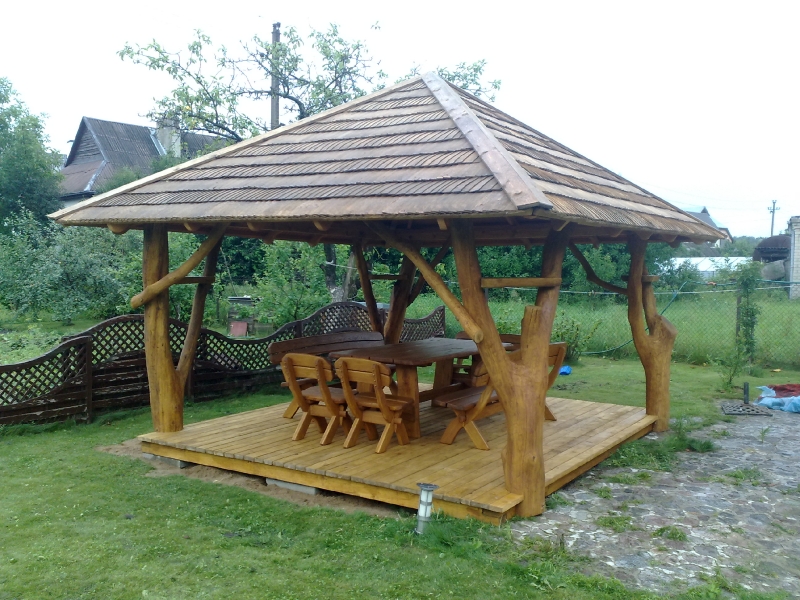
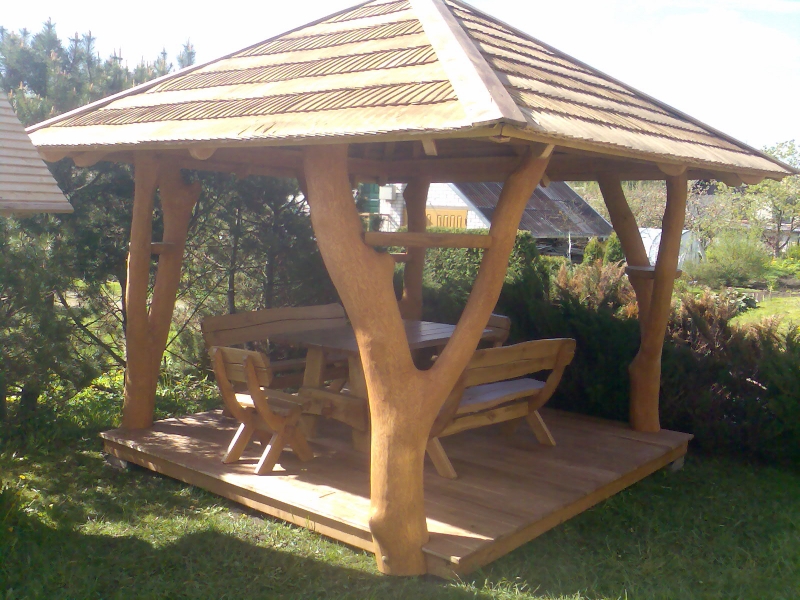
In short: Gazebo for children No. 20 is a small wooden structure with a gable roof, made up of two parts: an enclosed room with an entrance and an open veranda with decoratively cut-out railings. The bright yellow walls and reddish-brown corners attract children’s attention, and the roof protects from sun and rain. The size, colors and equipment are agreed individually.
A gazebo for children on a fenced playground
In the photo the gazebo stands on a fenced children’s playground among blocks of flats. It is built on a platform of concrete tiles, with lawn and paths around it; the edge of a sandbox can be seen at the side and a long bench at the front. Such a setting is typical of kindergarten and school yards, but the same gazebo can stand in a private yard or on a farmstead too.
On a children’s playground the gazebo plays several roles. First, it is a shelter: when it starts to rain or the midday sun beats down, the children have somewhere to hide and do not have to go back indoors. Second, it is a place to play: a little house, a shop, a railway station or a castle, depending on the children’s imagination. Third, under the roof it is convenient to sit in a circle, listen to a story or have a snack.
The photo was taken on a gloomy autumn day, when fog covers a tall building in the distance. Yet even in such weather the bright yellow gazebo looks cheerful and invites you in. The color here is not only a matter of looks: children easily notice a bright structure and like it.
The gazebo is small and in proportion to children, so they feel at home in it and not in a building meant for adults. There is nothing superfluous in it: a simple shape, clear parts, sturdy corners. This simplicity lets children come up with what the gazebo will become today.
Two parts: an enclosed little house and an open veranda
An enclosed room is built in the left part of the gazebo. An entrance opening leads into it, with a frame decorated by reddish-brown boards with a cut-out top. There is no door in the opening, so children can enter and leave freely, and adults can easily see what is going on inside. This part resembles a real little house and often becomes the favorite place for play.
On the right is an open veranda. At the front it is bordered by low railings in two sections, and the back and side walls are closed, so there is no draft on the veranda. The veranda is covered by the same gable roof, so it stays dry even in the rain. It is a good place for a small bench or table to play board games, draw or just sit and watch what is happening on the playground.
The two-part design is practical: some children can play in the enclosed room and others on the veranda without getting in each other’s way. In addition, the enclosed part shelters from the wind, while the open one lets you see the whole playground.
At the front of the veranda stands a post with diagonal braces that hold up the ridge of the roof. Above the veranda the end of the roof is not boarded up: you can see a triangular structure with braces, so the veranda is bright and spacious and the gazebo itself looks lighter.
The whole gazebo stands on a flat, level base, so there are no tall steps between the surface of the playground and the floor. This matters for small children: they can go inside without scrambling or stumbling. A level threshold is convenient for adults too, who bring in boxes of toys or snacks.
Bright colors and decorative cut-outs
The walls of the gazebo are clad with horizontal boards and painted a bright yellow, warm shade. The corner posts, the entrance frame, the cornice and the tops of the railings are painted reddish-brown. This contrast clearly emphasizs the shape of the structure and gives it the look of a fairy-tale cottage.
The veranda railings catch the eye most. They are made of vertical boards with round holes and keyhole-like silhouettes cut out. This pattern is typical of traditional wooden architecture and gives the gazebo cozinesss. For children it is interesting in a practical way too: you can look out through the cut-outs and play hide and seek.
Under the edge of the roof you can see the projecting round rafter ends, and the roof is covered with brown tiles. All these details together make a unified, slightly fairy-tale picture that suits a children’s setting well.
The colors can be matched to other playground equipment as well. If the playground already has blue, green or red elements, the corners of the gazebo and the tops of the railings can be painted in the same tones. Then the whole playground will look thought out and unified, and it will be easier for children to find their way around. On the other hand, the shade of natural wood suits places where a calmer, more natural environment is wanted.
What is in the photo
The table lists what can be seen in this photo of a gazebo for children. It is a typical example, not the only possible option.
| Feature | In the photo |
|---|---|
| Gable roof with brown tiles | Yes |
| Enclosed room with an entrance opening | Yes |
| Open veranda | Yes |
| Railings with decorative cut-outs | Yes |
| Yellow walls and reddish-brown corners | Yes |
| Post with diagonal braces | Yes |
| Glass or doors | No |
How children use a gazebo
A good children’s gazebo is not only a shelter from the rain. For children it becomes a stage on which a different story is played out every day. The enclosed part can be a kitchen, a shop or a hideout, and the veranda a railway platform or a ship’s deck. The simpler and more versatile the gazebo, the more room is left for imagination.
The gazebo is also useful for quiet activities. On the veranda you can put a small table for drawing or modeling, and teachers or parents can hold a short activity here in the fresh air. On a hot day children rest from the sun under the roof, and when it rains they can stay outdoors and watch the rain.
In a private yard the same gazebo can become a combination of a children’s playhouse and a gazebo. It is convenient for adults to sit on the veranda and watch the children play, while the children have their own corner where they can play without close supervision by adults.
Another advantage is that the gazebo helps children stay outdoors longer in any weather. In kindergartens and schools children go out every day, but a sudden rain often cuts the games short. When there is a shelter on the playground, it is enough to move under the roof and carry on, and you have to go indoors only when it really turns cold.
- for hide and seek, “house” and shop games;
- for drawing, modeling and board games on the veranda;
- for reading stories and quiet rest;
- as a shelter in a sudden rain or at hot midday.
What to think about for a kindergarten, a school or a home yard
Laukbaldis shows only typical examples, so the size, colors and ratio of the parts of the gazebo are agreed with each customer individually. Before calling, it is worth considering:
- The number and age of the children. A larger group will need a wider veranda, and small children lower railings and a comfortable entrance.
- The place on the playground. It is convenient to put the gazebo where it can be seen well from other parts of the playground.
- The colors. Yellow with reddish-brown looks cheerful, but the colors can be chosen to suit the surroundings.
- The base. A tiled platform, as in the photo, stays dry and is easy to clean.
If the gazebo is to be built at an educational institution, check in advance what requirements your institution must meet and discuss them when you order. You will find similar solutions on the pages of the gazebo for children No. 20-1 and the gazebo for children No. 20-2, and all the models in the section wooden gazebos. The playground can also be supplemented with a wooden playhouse for children or other products from the section wooden swing sets and sandboxes.
Care and ordering
A gazebo on a children’s playground is used intensively, so it is worth inspecting more often than garden structures. Once a season check the sturdiness of the railings, the edges of the cut-outs and the floor. If you notice a loose splinter or a rough edge, sand it down so that children do not get splinters. Renew the colored coating when it fades or starts to peel; this both protects the wood and keeps the cheerful look.
Examine especially carefully the places that children touch most: the entrance frame, the tops of the railings and the veranda floor. These places wear fastest, so their coating may need renewing more often than that of the walls. In autumn clear leaves off the roof, and in winter do not let a thick layer of snow build up. The tiles around the gazebo should stay clean so that rainwater runs off and does not collect by the wood.
UAB “Laukbaldis” has been making wooden products since 1996 and, according to the company, was the first in Lithuania to start making this production. To order, call +370 687 25388 and quote No. 20. During the conversation you will discuss the size of the gazebo, the layout of the parts, the colors and the place on the playground. If you have a plan of the playground or photos, have them ready, as it makes it easier to choose a suitable size.
Frequently asked questions
What age of children is this gazebo suitable for?
The gazebo suits preschool and primary-school children who like playing in little houses. The height of the railings and the entrance can be discussed according to the age of the children.
Can the gazebo be painted in other colors?
Yes, in the photo the walls are yellow and the corners reddish-brown, but the colors are agreed individually. You can also choose the shade of natural wood.
Does the enclosed room have a door?
In the photo the room has only an entrance opening without a door, so children enter and leave freely. Whether a door is needed is discussed when you order.
Can such a gazebo be built in a private yard?
Yes, it also suits a home yard or a farmstead. There it can serve both as a playhouse for children and as a place for adults to sit.
How do I look after a gazebo for children?
Once a season check the railings, the floor and the edges of the cut-outs. Sand down rough places and renew the coating when it fades.
How do I order gazebo for children No. 20?
Call us and quote No. 20. We will discuss the size, the colors and the layout of the parts.