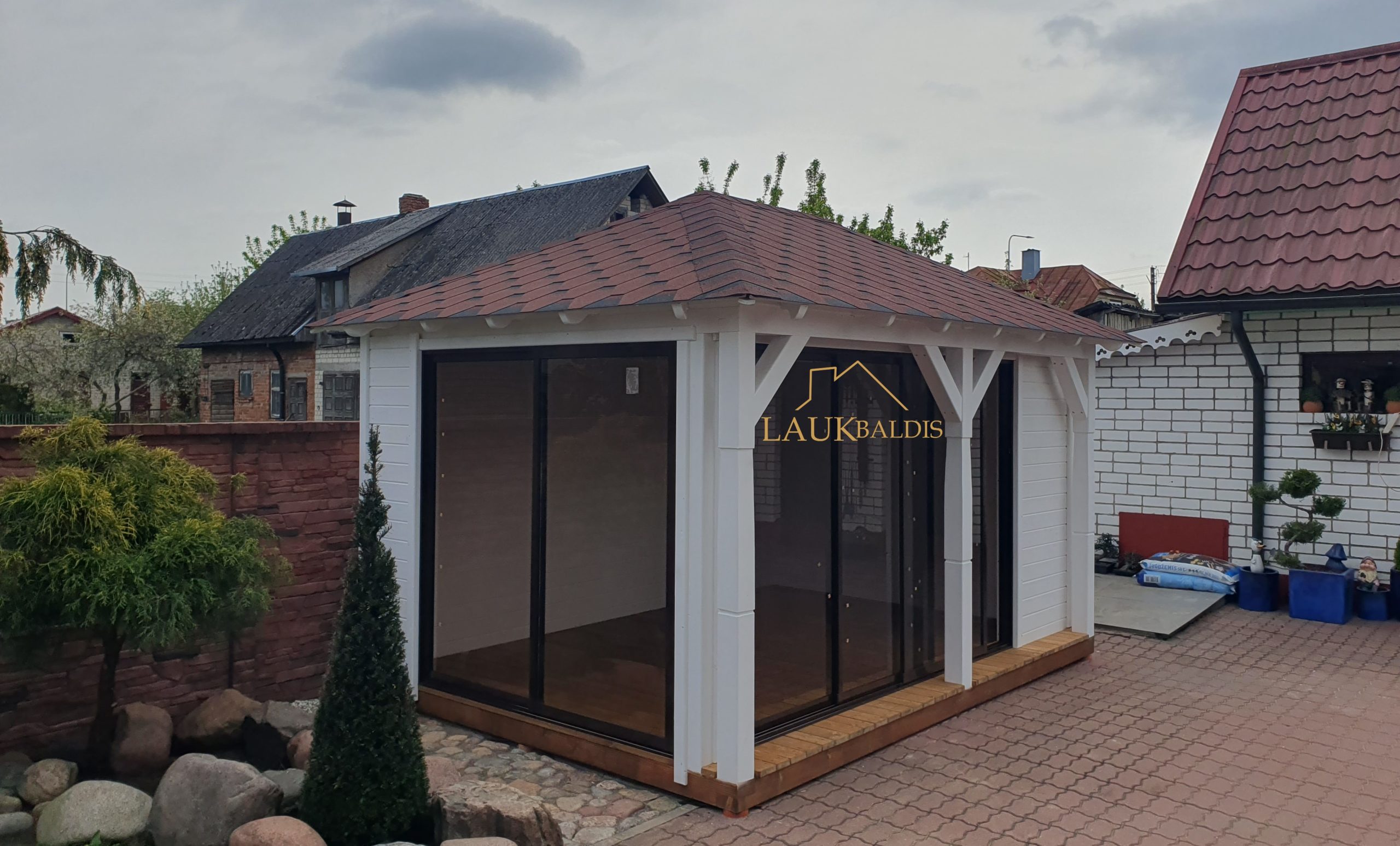
In short: White gazebo No. 25-54 is a small glazed garden structure with a red-brown hip roof, white-painted walls and white posts with diagonal braces. Two of its sides are glazed, so it is bright inside, while the roof protects from sun and rain. The size, finishing and equipment are agreed with each customer individually.
A white gazebo that continues the colors of the house
In the photo the gazebo stands in a paved courtyard, just a few steps from a white brick house with a red roof. A setting like this explains well why white was chosen: the structure does not look like something brought in at random, but seems to continue the facade of the house. The red-brown roofing repeats the shade of the roof of the dwelling, so the two buildings merge into a whole.
Most wooden gazebos are the color of natural wood or honey. A white-painted gazebo is a rarer but very rewarding solution when light walls, white window frames or light paving already dominate the yard. White visually reduces the bulk of a structure, so even an enclosed, glazed gazebo does not overwhelm a small yard.
It also matters that white looks tidy and festive. Greenery, stones and flowers in planters go well with it, and all of that can be seen in the photo, where large boulders are set beside the gazebo, a narrow cone-shaped conifer is planted and a few shaped shrubs stand around.
It is worth choosing white when the gazebo will be seen from the windows of the house. In the evening a light structure in the yard reflects the last of the daylight, and when the lights are on inside, the white construction around the dark glass looks like a bright frame. Darker wood tends to disappear into the dusk at such hours.
The roof, the eaves and the white braces up close
The hip roof is covered with red-brown tiles. The slopes are not steep, so the gazebo looks low and cozy, and the roof edges project beyond the walls and protect them from rain. Under the edge of the roof you can see white-painted rafter ends, small details that give the eaves a rhythm and recall classic wooden architecture.
At the front there are two white posts. Both are joined at the top to the roof structure by diagonal braces, which not only stiffen the frame but also give an impression of an arch. The corner posts are wider, so the gazebo looks sturdy. Painted white, all these lines stand out even more than in a natural wood structure.
At the bottom you can see the edge of the floor in natural, unpainted wood. The warm honey shade gently separates the white walls from the paving and reminds you that this is a wooden structure. This two-color combination, white walls with warm natural wood below, gives the gazebo a lightness so that it does not look cold or sterile.
Glass walls and closed corners
The gazebo is glazed on two sides: at the front and on the right side. The glass is set in dark frames, which contrast nicely with the white walls and posts. The left end and some of the corners are covered with white-painted horizontal boards. So the gazebo has both a bright, open side and a cozy back sheltered from the neighbors or the street.
Through the glass you can see a light interior with a wooden floor. The inside in the photo is empty, so you can choose the furniture and lighting to suit your needs. The sliding glass lets you open the gazebo to the yard on a warm day and close it again on a windy or rainy evening.
- In summer, with the glass slid aside, the gazebo works as an open place to relax.
- In spring and autumn, closed glass holds back the wind, so you can sit inside longer.
- Closed walls help create a more private corner where you can put a sofa or a cabinet.
A small glazed gazebo by the house often becomes an additional room that is used much more often than a structure at the far end of the garden. In the morning you can have coffee there while it is still cool outside, during the day read or work on a laptop, and in the evening sit down with guests. Since the house is only a few steps away, you do not have to carry many things: a cup and a book are enough.
For children such a gazebo can be a play space in the rain, and for older family members a quiet place to talk in the fresh air. The glass lets you see the whole yard, so it is easy to keep an eye on what is going on around.
The features of the white gazebo in a table
Below is what is clearly visible in the photo of this product. It is a typical example, not the only possible version.
| Feature | In the photo |
|---|---|
| White-painted walls and posts | Yes |
| Hip roof with red-brown tiles | Yes |
| Glass walls | Yes, on two sides |
| Posts with diagonal braces | Yes |
| Rafter ends visible under the eaves | Yes |
| Open terrace in front of the glass | No |
A gazebo in a paved courtyard by the house
This gazebo shows that a glazed garden structure does not need a large plot or a wide lawn. It stands on paving stones, next to the wall of the house, where the yard is already landscaped and paved. This solution has several advantages:
- it is easy to walk to the gazebo in any weather, and your feet do not get wet in the grass;
- it is easy to sweep around the structure, and mud and fallen leaves do not collect;
- the house is right there, so carrying food and dishes is no trouble;
- the paved base is level, so the gazebo stands stable.
On the left of the photo you can see red brick masonry, in front of the gazebo a composition of stones and boulders, and by the house wall planters with shaped plants are lined up. The white gazebo looks like a calm backdrop among them, against which the greenery and the texture of the stones stand out even better.
Before putting a gazebo on paving, check that the surface is level and that rain water runs off it and does not collect under the floor. The foundation solution is best discussed when you order, because it depends on the size of the gazebo and the existing surface.
When building a gazebo close to the house, think about the rain water from the roofs as well. If rain falls from the roof of the house right next to the gazebo, the splashes will hit the white walls and stain them. A small distance between the buildings, or turning the downpipe to the other side, will help the walls stay clean longer. Also consider the direction of the sun: it is best to turn the glass walls toward the side with the nicest view of the yard.
How to look after painted white wood
Wood outdoors is most affected by moisture and the ultraviolet rays of the sun. A white-painted surface has an advantage in this respect: a light color heats up less in the sun. On the other hand, dust, pollen and dirt marks show up faster on white, so it is worth washing the gazebo once or twice a season with water and a mild cleaning product.
Every spring inspect the lower rows of boards and the bottoms of the posts, since these places get wet most from rain splashes. If the paint has started to peel or cracks have appeared, sand the surface and coat it with paint made for exterior wood. It is better to repair small damage at once, before moisture gets deeper into the wood.
Sand and small debris collect in the tracks of the sliding glass, so they should be cleaned regularly. Protect the natural wood edge of the floor with oil made for exterior wood or another suitable product. In winter it is worth clearing a thick layer of snow off the roof.
If a white gazebo stands near trees or shrubs, in autumn leaves should be swept off the roof and the eaves, because wet leaves hold moisture for a long time and can leave stains on light surfaces. The interior walls and floor, protected by the roof and the glass, need less care: it is enough to air them after rainy days and wipe off the dust from time to time. Looked after like this, a white wooden gazebo keeps a tidy, fresh look for a long time.
Ordering: what to say when you call
UAB “Laukbaldis” has worked since 1996 and, as the company states, was the first in Lithuania to start making this production. The company is based in Dapkiškių village, Tauragės district. The website shows only typical examples, so the size, color, glazing and roofing of this gazebo can be adapted to your yard.
Call +370 687 25388 and quote No. 25-54, so it is immediately clear which gazebo you mean. A photo of your yard and an approximate spot where you would like to put the gazebo will be useful for the conversation. If you are considering several options, compare it with the white gazebo with a monopitch roof No. 25-27, the gray gazebo with a natural wood interior and the enclosed gazebo with a gray roof No. 25-17. You will find all the works in the section wooden gazebos, and furniture for the interior in the section oak garden and outdoor furniture.
Frequently asked questions
Can a white gazebo be ordered in another color?
Yes, the photo shows a typical example. The color of the walls, posts and roof can be discussed when you order, so that the gazebo goes with your house.
Does white get dirty quickly outdoors?
Dust and dirt marks show up faster on white than on dark wood. So it is worth washing the gazebo once or twice a season with water and a mild cleaning product.
How many sides of the gazebo are glazed?
In the photo the glass is fitted on two sides, while the other walls are covered with white-painted boards. Which walls will be glazed is agreed when you order.
Can a gazebo be placed on paving stones?
Yes, in the photo the gazebo stands in a courtyard paved with stones. It is important that the surface is level and that rain water runs off it.
Does the gazebo come with furniture?
The interior in the photo is empty, so you can choose furniture separately. Laukbaldis also makes solid oak garden furniture, so it can be discussed together with the gazebo.
How do I order white gazebo No. 25-54?
Call us and quote No. 25-54. We will discuss the size, color, glazing and the place in your yard.