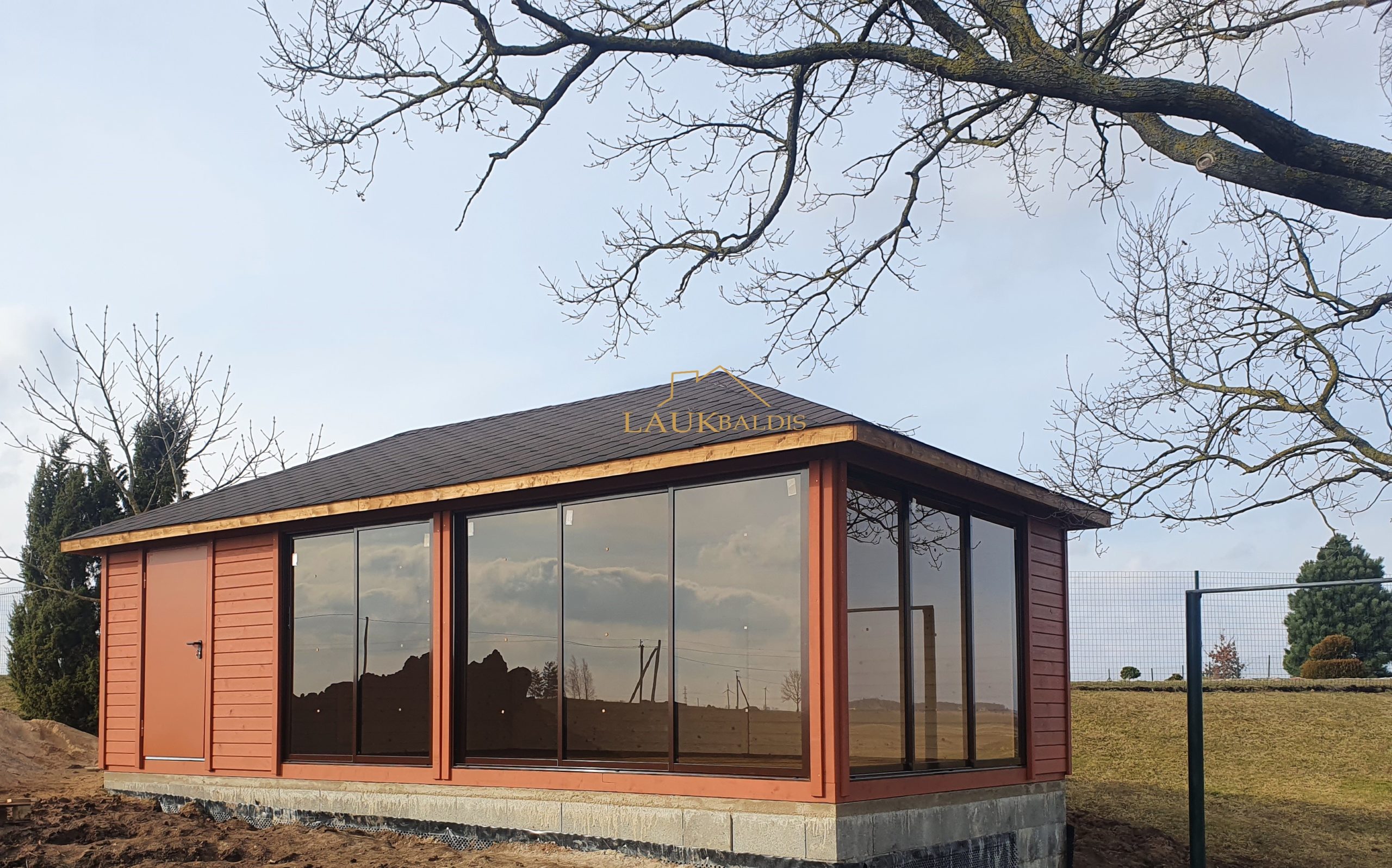
In short: Enclosed glazed gazebo No. 25-39 is a wooden garden structure with a hip roof, terracotta-painted walls and large glass walls on two sides. It has no open terrace: the whole area under the roof is an enclosed room, entered through a door at the side. The size, color and equipment are agreed with each customer individually.
A gazebo without a terrace: everything under one roof
Many gazebos in this series have at least a small open terrace with posts. This example is different: the roof covers only the room itself, and the walls stand directly under the eaves. Seen from the side, the gazebo looks like a compact rectangular volume with a dark roof, resembling a small garden house, only with much larger windows.
Such a solution has a clear advantage: the whole floor area is used for the interior. There is no part that rain would flood from the side, and furniture, cushions and tablecloths can be left inside without fear of them getting wet. An enclosed glazed gazebo suits those who want to sit outdoors yet feel as if they were in a room: warmer, calmer and without wind.
On the other hand, without a terrace there is no place to stand under the roof before going in or to set up a grill. If you need that, a terrace or a canopy can be discussed when you order – the website shows only typical examples.
A gazebo without a terrace takes up less space on the plot, so it is easier to fit next to a fence, a vegetable garden or other buildings. The simple rectangular shape also makes it easy to adapt the interior: a table can be placed along the glass, and room left by the enclosed wall for a cabinet or a bench.
Terracotta-colored walls and a light cornice trim
The color catches the eye first. The horizontal wall boards, the corner trim, the door and the boards around the glass frames are painted a warm terracotta shade reminiscent of fired clay. With the exterior kept in a single color it looks unified and neat, and against a meadow and a gray sky the gazebo can be seen from afar.
The cornice board running under the edge of the roof is left light, in the color of natural wood. This thin light line separates the dark roof from the terracotta walls and gives the building lightness. The roof is covered with dark brown tiles, which match the warm shade of the walls and do not overpower it.
Painted wood suits those who want the gazebo to match a specific house or the other buildings in the yard. Terracotta looks especially good next to red brick, a brown roof or natural stone. If your house is a different color, the shade can be chosen to match it.
A painted coating has a practical side too: it covers all the boards evenly, so the surface looks smooth and differences in the shades of individual boards do not show. And after a few years, when you tire of the color, the gazebo can be repainted in another shade, refreshing the look of the whole yard.
Large glass walls and an enclosed corner with a door
Two glass panels are set into the front wall: a narrower, two-part one on the left and a wider, three-part one in the middle. On the right side, around the corner, the glass wall continues with three more panes. The glass is in dark frames and takes up almost the full height from the plinth to the cornice, so a wide view of the fields and the sky opens up from inside. In the photo the glass reflects clouds, distant trees and power poles.
The glass slides, so on a warm day part of it can be pulled aside to let in fresh air. When it is cool outside or the wind blows, sliding it shut makes the gazebo an enclosed room again.
Large glass walls also mean a lot of light. On a sunny day the room warms up quickly, so in spring it is cozy here even when it is still chilly outside. In summer, especially if the glass faces south, it is worth keeping the option of opening at least two sections of glass so that a cross-draft forms. That way the interior does not overheat and the air is constantly renewed.
The left end of the gazebo is left enclosed. It has a door of the same color with a handle, so it almost merges with the wall. This enclosed part makes the gazebo cozier: inside there is a wall against which you can put a cabinet, a shelf or a bench, and you cannot see everything from all sides through the glass.
A door at the side is a practical solution. You do not have to slide the glass when coming in, and with the door closed you can leave the gazebo tidy, with things stored inside. The position of the door is chosen according to which side you come from, from the house or the path.
A plinth of blocks in an open spot
The gazebo stands on a high plinth of concrete blocks. You can see that work is still going on around it: the ground has not been sown, there is a pile of soil nearby, and a dark membrane sticks out at the bottom of the plinth. Even so, it is already clear what benefit such a foundation brings – the wooden walls and floor are raised above the ground, so rain splashes and snow harm them less.
An open meadow and fields stretch all around, behind a mesh fence grow round-shaped shrubs, and on the left columnar conifers. From the right the bare branches of a large tree hang over the roof: in summer they cast shade on the roof and the glass, so the room heats up less. In autumn, in such a spot, you will have to clear leaves off the roof more often.
An open spot with a view of the fields is a good choice for an enclosed gazebo. Through the large glass walls you can watch a sunset, a storm or winter snow without fear of a cold wind. In the evening, when the light is switched on, such a gazebo looks from afar like a glowing lantern at the edge of the meadow.
List of details
| Feature | In the photo |
|---|---|
| Hip roof with dark brown tiles | Yes |
| Painted horizontal wall boards | Yes, terracotta color |
| Light cornice trim | Yes |
| Sliding glass | Yes, at the front and on the right side |
| Door in the enclosed part | Yes, on the left |
| Open terrace | No |
| Plinth of concrete blocks | Yes |
Who an enclosed glazed gazebo suits
An enclosed gazebo comes in handy where an open one would be used only during the few warmest months. In Lithuania spring and autumn are often windy, so a room with glass walls lets you spend more time outdoors. The roof protects from sun and rain, while the enclosed walls and glass protect from the wind.
- Family dinners and celebrations when the weather is unsettled.
- A quiet corner for reading, handicrafts or working on a computer.
- A place where garden furniture, cushions and blankets can be kept in summer.
- Watching the view of the fields or the garden in any weather.
An enclosed gazebo is not a residential house or a summerhouse, but it fills well the gap between an open gazebo and a heated building. It is comfortable to spend time in during the day and in the evening, and your things stay protected from changes in the weather.
Before ordering, it is worth thinking about where the door will be, on which sides you want glass and how much enclosed wall you will need for furniture. Also discuss whether you want to add a terrace or a canopy over the entrance. You will find similar solutions in the enclosed gazebo with a gray roof No. 25-17, the enclosed wooden gazebo No. 25-42 and the enclosed gazebo with a roller blind No. 25-3. More examples are in the section wooden gazebos, and if you are thinking about a structure to stay overnight in, see the section saunas and summerhouses.
Caring for a painted exterior, and ordering No. 25-39
Painted wood outdoors is gradually affected by sun and moisture: the color may fade a little, especially on the south side. Once a season inspect the walls, the corner trim and the bottom row of boards above the plinth. If the paint starts to peel or the wood becomes rough, the surface should be cleaned and coated again with a product suited to exterior wood.
Clean the tracks of the sliding glass from time to time of dust, sand and leaves so that the glass slides easily. Because the gazebo is enclosed, it is worth airing it after rainy days – opening the glass and the door dries the dampness faster. In winter do not let a thick layer of snow build up on the roof, and in autumn clear the leaves from the roof edges. It is also worth inspecting the plinth blocks now and then: if water stands around them, make sure rainwater drains away from the gazebo.
UAB “Laukbaldis” has been working since 1996 and, as the company states, was the first in Lithuania to start making this production. To order, call +370 687 25388 and quote No. 25-39. In the conversation you will discuss the size of the gazebo, the color of the walls, the arrangement of the glass, the position of the door and the foundation. If you have photos of your house or plot, have them ready – it is then easier to choose the shade and the location.
Frequently asked questions
How does an enclosed glazed gazebo differ from an open one?
An enclosed gazebo is protected on all sides by walls and glass, so inside there is no wind or slanting rain. An open gazebo has only a roof and posts. An enclosed one suits spring and autumn better, when it is cooler outside.
Can I choose a different wall color?
Yes, the color and the finish are agreed individually. The terracotta shade in this example is only one of the possible options, so the color can be chosen to match your house or the other buildings in the yard.
Can a terrace be added to this gazebo?
In the photo the gazebo has no terrace, but it is a typical example. A terrace, a canopy over the door or another layout can be discussed when you order.
What is the plinth of blocks for?
The plinth raises the wooden walls and floor above the ground, so moisture, rain splashes and snow affect them less. The foundation solution depends on the soil of your plot and the size of the gazebo.
How do I order gazebo No. 25-39?
Call us and quote No. 25-39. You will discuss the size, the color, the position of the glass and the door, and the foundation for your plot.