In short: Farmstead gazebo No. 25-45 is a honey-colored wooden gazebo with a hip roof, sliding glass and a covered terrace running along two facades. One corner is enclosed, made of horizontal boards, so a cozy zone protected from the wind remains inside. The size, finishing and equipment are agreed with each customer individually.
A farmstead yard in spring
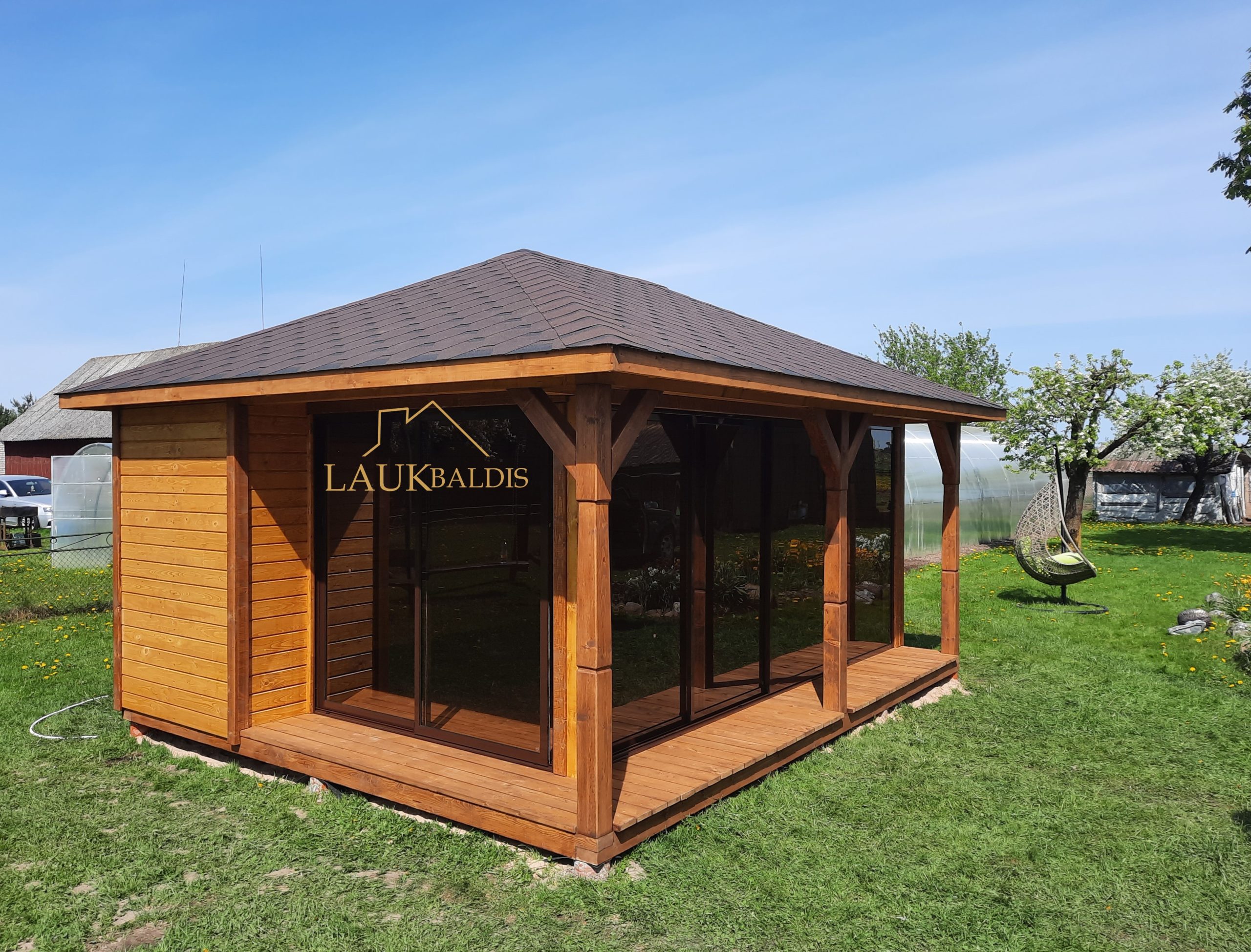
The photo was taken on a sunny spring day when the apple trees are in bloom. The gazebo stands on a broad lawn dotted with dandelions, behind it the white apple blossom gleams, and greenhouses, outbuildings and country farm buildings can be seen. A bit farther off on the lawn hangs a cocoon-style hanging chair, and on the right lie a few field stones. It is a typical view of a Lithuanian farmstead, in which the gazebo looks not like a new, foreign structure but like a natural part of the yard.
The shade of the wood is warm, in honey and amber tones. Brown roof tiles and light eaves boards go nicely with it. Such colors almost always suit a farmstead: they combine with old log buildings, with newer outbuildings and with the greenery around.
On a farmstead a gazebo has to meet somewhat different requirements than in a small city yard. Here it is often seen from afar – from the road, from the doorstep of the house or from the vegetable garden – so it matters that the structure has a clear, tidy silhouette. A hip roof gives such a silhouette: it is low, wide and looks equally finished from every side.
The gazebo here does not try to compete with the dwelling house or the outbuildings. It is set a little apart, between the lawn and the orchard, and becomes a separate place to relax, where you can get away from daily chores yet still stay in your own yard.
The enclosed corner and the wall of glass
At the left end of the gazebo there is an enclosed corner made of horizontally laid boards. It covers part of the front wall and the whole side wall. Such an enclosed part does several jobs: it holds back the wind from one side, gives privacy and lets you put furniture against the wall rather than against the glass.
The rest of the facade is taken up by large sliding glass in dark frames. It runs along the front and turns onto the right side, so a large part of the garden can be seen through it. The glass can be slid aside to open the gazebo, and closed on a cool day or in the rain. Inside you can see a light wooden floor, so even with the glass closed the gazebo does not look dark.
It is also important that the size of the enclosed part can be changed. For some people one wooden wall on the side of the prevailing wind is enough, others want a larger enclosed corner in which to place a cabinet or shelves for dishes. This is discussed when you order, because every farmstead has its own directions, views and habits.
From outside you can see the garden and the greenhouses reflected in the glass. On a farmstead, where there is a lot of space and light all around, such a reflection creates the impression that the gazebo almost dissolves into its surroundings.
A terrace under the roof along two facades
The roof of this gazebo is wider than the glazed room. It projects forward and to the right, and under it a wooden terrace wraps around the glass on two sides. The terrace floor is raised above the ground, the boards are laid evenly and neatly, and the edge is clearly visible from the lawn.
Such a terrace is extremely practical on a farmstead. When you come back from the vegetable garden or the orchard, you do not have to go straight inside: on the terrace you can take off your shoes, set down a basket of apples or vegetables, and sit on the edge for a rest in the shade. In the rain the terrace stays dry, because it is covered by the same hip roof.
The edges of the roof are held up by square hewn posts. Each is joined to the roof beam by two diagonal braces that form a calm Y-shaped silhouette. These braces strengthen the structure and also become a decorative accent – their rhythm is clearly seen from afar, even from the other end of the yard.
Between the posts and the glass there is enough room to walk, so the terrace also works as a path around the glazed room. You can walk around the gazebo from the front to the side without stepping on wet grass. In the early morning, when the lawn is still dewy, this is especially handy: you reach the table with dry feet, and your shoes stay clean.
What a farmstead gazebo is good for
On a farmstead a gazebo often becomes a combination of summer kitchen, living room and place of rest. Here are some ways to use it:
- the whole family gathers for celebrations, even if the weather is changeable;
- breakfast in spring, when the apple trees bloom but mornings are still cool;
- rest after work in the garden or vegetable garden, out of the scorching sun;
- hosting guests who come to stay a few days and want a cozy place for the evenings;
- keeping outdoor furniture under a roof so that it does not have to be carried inside every time.
Sliding glass lets you use a gazebo much longer than an open one. In spring and autumn, when the sun still warms but the wind is sharp, you can close the glass and sit in comfort. In summer, on a hot day, you can slide it aside and the wind blows freely through the gazebo.
The enclosed corner and the covered terrace let you create several zones. For example, a table can stand in the glazed part, and on the terrace a bench or a few armchairs for sunbathing. Laukbaldis makes oak garden furniture, swings and lamps, so the gazebo can be furnished from one source.
In the photo you can also see a hanging chair on the lawn. It is a good hint that a place to relax on a farmstead does not have to be only one: the gazebo can become the center, and swings, benches or a fire pit will appear around it.
A spot between greenhouses and fruit trees
A big advantage of a large farmstead is that there is plenty of room, but for that very reason it is worth choosing the position of the gazebo thoughtfully. In the photo the gazebo stands on an open lawn, farther from the trees. This decision has clear advantages: leaves and petals do not fall on the roof, there is no damp shaded zone around it, and the wood dries quickly after rain.
When choosing a spot on your farmstead, take the following into account:
- in which direction the best view opens – toward the orchard, the fields or the pond;
- how far the gazebo will be from the house and whether it is convenient to carry food to it;
- whether the spot is dry and whether water does not stand there after rain;
- where the grill or fire pit will be, so that smoke does not drift into the gazebo.
The foundation must be level and firm. Before the gazebo is delivered, it is worth preparing the site: remove the turf, level the ground and discuss what the foundation frame will rest on. These decisions depend on the size of the gazebo and the particular soil, so they are best discussed by phone.
Care in country conditions
On a farmstead a gazebo often stands in the open, so sun, wind and rain affect it more than in town. A protective coating made for exterior wood – an oil, a glaze or another suitable product – helps the wood keep its color and its resistance to moisture. In spring inspect the terrace floor and the bottoms of the posts: if the surface has faded or water no longer beads into drops, it is time to renew the coating.
Dust, grass clippings and petals collect in the tracks of the sliding glass, so they are worth cleaning several times a season. When mowing the lawn near the gazebo, it is worth aiming the mower discharge in the opposite direction so that clippings do not get onto the terrace and into the tracks. In autumn sweep off the leaves, and in winter do not let a thick layer of snow build up on the roof.
If the gazebo stands close to greenhouses or a vegetable garden that is often watered, make sure that the water from sprinklers does not reach the wooden walls and the edge of the terrace. Wood that is constantly wetted darkens and ages faster, and this is easy to avoid simply by turning the direction of watering.
Similar examples and ordering
If you are still choosing, also look at other similar works: the semi-enclosed gazebo with a terrace No. 25-11.5, the garden gazebo by a blossoming fruit tree No. 25-25 and the rustic gazebo in a farmstead yard No. 25-11. You will find all the examples in the section wooden gazebos, and amusements that go well next to a gazebo in the section outdoor swings and sandboxes.
UAB “Laukbaldis” has been working since 1996 and, according to the company, was the first in Lithuania to start making this production. The company is based in Dapkiškių village, Tauragės district. To order, call +370 687 25388 and quote No. 25-45. In the conversation you will discuss the size, the width of the terrace, the position of the enclosed part, the glazing and the finish. Only typical examples are shown on the website, so the final solution is adapted to your farmstead.
Frequently asked questions
How many sides of this gazebo are glazed?
In the photo the sliding glass is set in at the front and on the right side, and the left corner is enclosed, made of boards. Which walls will be glazed is agreed when you order.
Is the terrace covered by a roof?
Yes, the hip roof projects forward and to the side, so the terrace under it stays dry even in the rain. The width of the terrace can be discussed individually.
Why does a farmstead gazebo have an enclosed corner?
An enclosed corner holds back the wind from one side and gives privacy. It is convenient to put furniture or shelves against it, and to leave the rest of the gazebo bright and open.
Can a gazebo be built far from the house?
It can, but it is worth thinking about how convenient it will be to carry food and dishes. When a dry path leads to the gazebo, it gets used more often.
How do I look after the terrace floor?
Inspect the boards every spring and, if necessary, renew the coating made for exterior wood. Regularly sweep grass, leaves and sand off the terrace.
How do I order farmstead gazebo No. 25-45?
Call us and quote No. 25-45. We will discuss the size, the terrace, the glazing, the finish and the location on your farmstead.