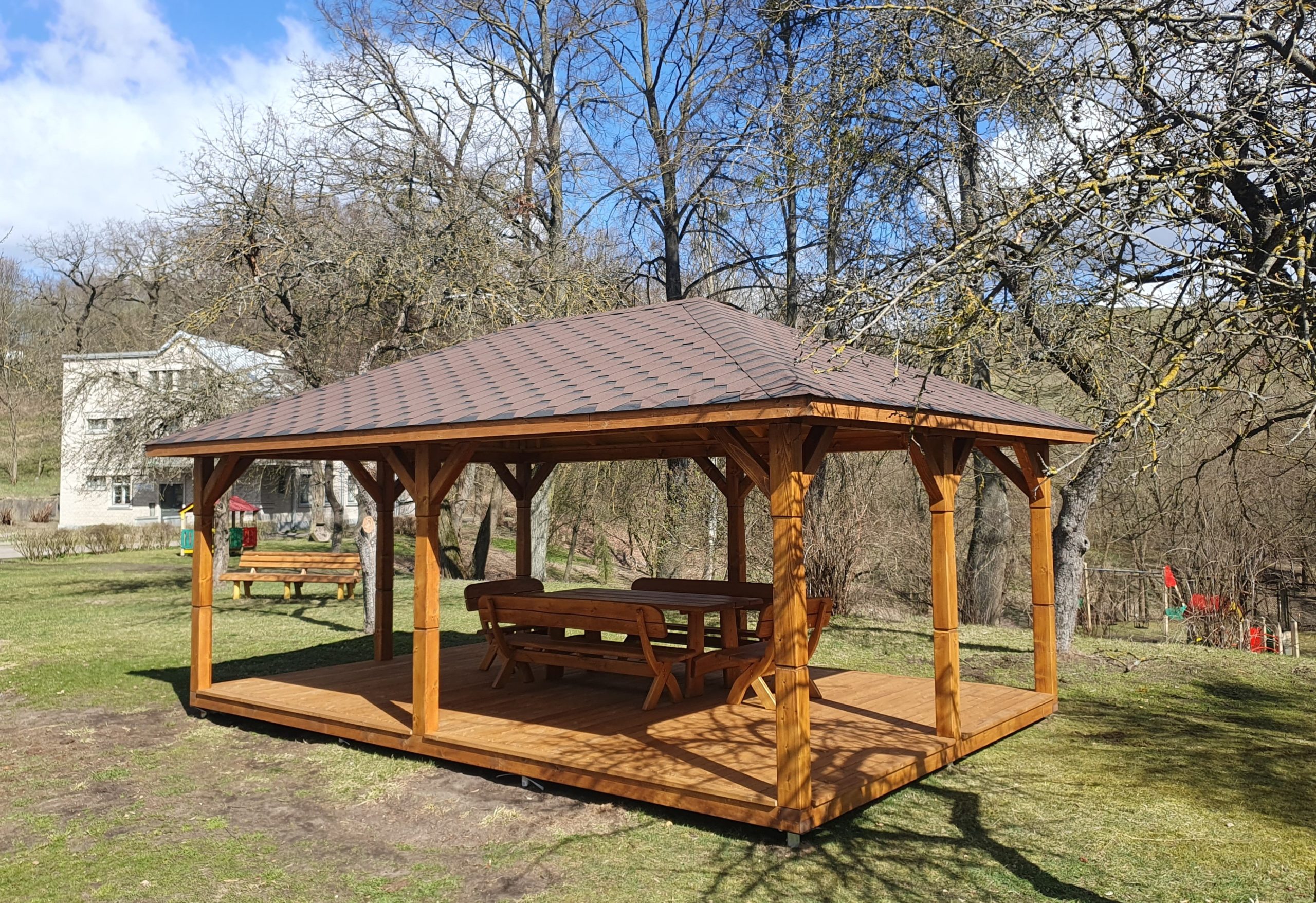
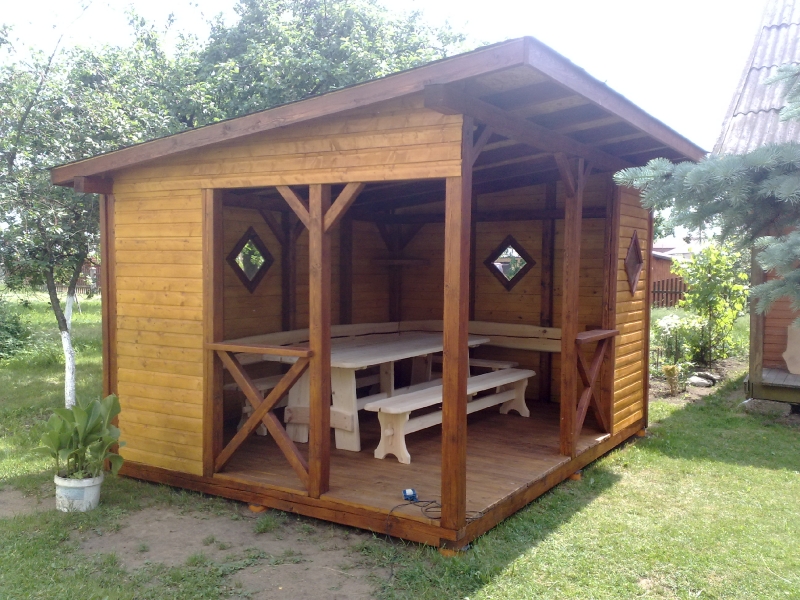
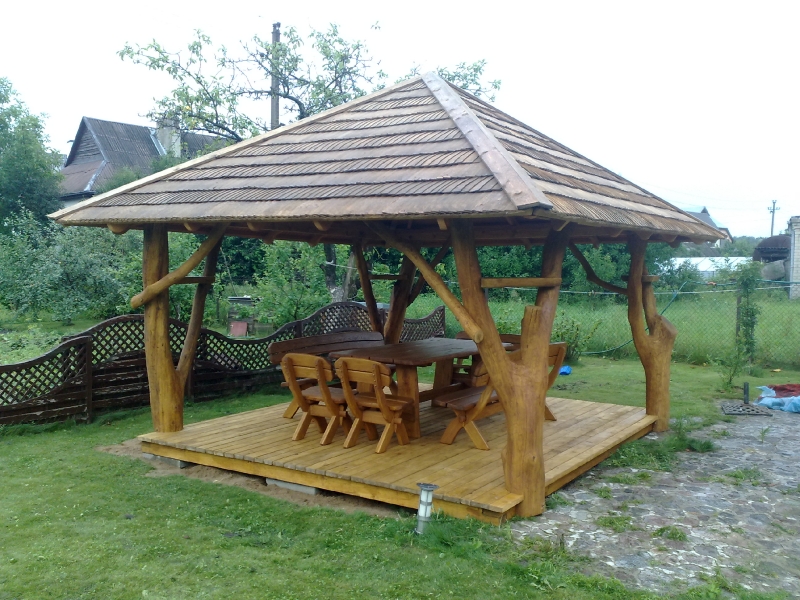
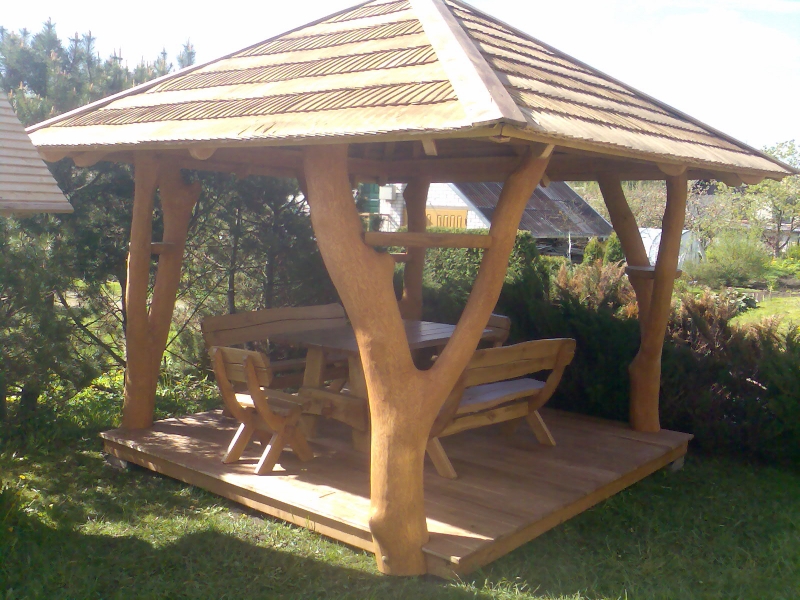
In short: Garden gazebo No. 25-25 is a wooden gazebo with a brown hip roof. Its left corner is enclosed, while the front and the right side open up through sliding glass. A covered terrace with profiled columns runs in front of the glass, and a table, a bench and chairs already stand inside. The size, finishing and equipment are agreed with each customer individually.
A garden gazebo in spring bloom
This photo was taken when the garden is at its most beautiful, in early spring. On the left a fruit tree with a whitewashed trunk is in white blossom, in front yellow spring flowers are blooming, and a large blue-green agave rises from the flower bed. On the right grows a small tree with drooping branches and a tall, dark juniper or thuja. Amid all this stands a warm, honey-colored gazebo, which becomes the quiet center of the garden.
This is exactly how a garden gazebo differs from a gazebo in the yard by the house. It is built not to be close to the kitchen but to be close to the plants. From it you can see the trees come into bloom, the flower beds change and the garden slowly move from spring into summer. The glass lets you watch this view even when it is still cool or rainy outside.
The gazebo stands on a level, well-kept lawn, and behind it are a wooden fence and a gate into the yard. The spot was chosen so that the structure does not get in the way of moving around the garden but can be seen from many of its corners.
Although the entrance to the yard can be seen nearby, the glass faces not the road but the garden. It is a good example of how you can create a quiet corner even near the yard gate: the enclosed side and the plants screen off what you would rather not see, while the glass opens up a view of greenery.
A garden gazebo often becomes the place where days off are spent. You can have your morning coffee here, rest after work in the vegetable garden or the beds, and sit down with the family in the evening. Because the gazebo protects from sun and rain, it is useful both in the midday heat and in a sudden summer downpour.
The enclosed corner and the open side
The layout of this gazebo is clearly divided. On the left is an enclosed corner: the side wall and part of the front are clad with horizontal boards. From the side it looks like a small wooden house with an open, bright part attached to it.
The enclosed corner has a practical benefit. It blocks the view from one side, holds back the wind and adds coziness: sitting at the table, you have a wall behind you rather than the open garden. Next to such a wall it is convenient to put a cabinet for dishes, a shelf or a bench. In addition, wiring and lights are easier to install in the enclosed part.
The right side is completely different. Here the glass is set slightly back from the edge of the roof, and profiled columns with diagonal braces stand in front of it. Between the glass and the columns a covered terrace forms, which turns the corner and runs along the front. On the terrace floor you can put a planter or a few chairs and sit outdoors, but under a roof.
Narrower sections are carved on the surface of the columns, so they look lighter and more ornate than plain square timbers. A light cornice trim under the edge of the roof emphasizes the outline of the structure and goes nicely with the brown tiles.
The floor and the terrace are raised slightly above the lawn, so rainwater runs off into the grass rather than onto the boards. The edge of the terrace is finished with a board that hides the base and gives the structure a finished look.
What we see through the glass
Through the sliding glass you can clearly see that the gazebo is already furnished and in use. Inside stands a massive wooden table, with a bench with a backrest and a striped cushion beside it, and wooden chairs next to that. A jug or a vase stands on the table. The furniture is a warm shade, so it matches the walls and the floor.
This detail is important because it helps you judge how much space there is. You can see that the table with the bench and chairs fits comfortably, and there is still room to walk around. If you plan a similar setup, it is worth thinking in advance how many people will usually sit at the table.
A bench with a backrest at the table is a convenient solution for a garden gazebo. More people fit on it than on separate chairs, and the cushions add softness. Since the gazebo is enclosed and protects from rain, you do not have to carry the cushions into the house every evening: they stay dry and ready for the next day.
Laukbaldis makes solid oak garden furniture. It is built by experienced craftsmen, and the branches, rings and natural grain of the wood make every piece distinctive. Furniture can be ordered together with the gazebo – you will find examples in the section oak garden and outdoor furniture.
Details in the photo
The table lists what can be clearly seen in this typical example.
| Feature | In the photo |
|---|---|
| Hip roof with brown tiles | Yes |
| Enclosed wooden corner | Yes, on the left |
| Sliding glass | Yes, at the front and on the right |
| Profiled columns with braces | Yes |
| Covered terrace | Yes, on the right and at the front |
| Table, bench and chairs inside | Yes |
How to blend a gazebo into the garden
A garden gazebo looks best when plants grow around it. The photo shows this well: the blossoming fruit tree on the left, the flower bed with yellow flowers in front and the tall conifers on the right create a frame in which the gazebo looks natural. A few tips for achieving a similar look:
- plant low flower beds at the corners of the gazebo – they soften the transition from the lawn to the wooden floor;
- plant tall plants or trees on the side that is enclosed, so that they do not block the view through the glass;
- leave a distance of at least a few steps from the trunk of a tree, so that roots and branches do not get in the way;
- do not plant shrubs under the glass that would grow up to cover the view and dampen the wood.
It also matters that the roof color matches the surroundings. The brown tiles in the photo go well with the wooden fence and the trunks of the fruit trees. If your garden has a different style, the colors can be chosen differently.
The agave growing in front of the gazebo is a reminder that a garden gazebo can also be a backdrop for more exotic plants. Warm wood tones bring out blue or silvery foliage, bright flowers and dark conifers, so almost any plants suit a wooden gazebo.
Think about a path, too. In the photo the gazebo stands on the lawn, but if you use it often, a path will gradually wear across the grass. A few slabs or a strip of paving blocks from the house to the gazebo will solve this problem and keep mud off the floor.
What to discuss when ordering a garden gazebo
On its website Laukbaldis shows only typical examples, so every gazebo is adapted to a specific garden. Before you call, think about:
- Where the enclosed corner will be. It is worth turning it toward the neighbors, the street or the windward side.
- How much glass there will be. In the photo the front and the right side are glazed.
- The width of the terrace. Whether you will need room for chairs or a narrow walkway under the roof will do.
- Furniture. Whether you will order it together or already have your own.
- Electricity. Where the lights and sockets will go.
Before deciding, also look at other similar works: the gazebo with glass among fruit trees No. 25-1, the gazebo with a storage shed No. 25-11.7 and the gazebo with glass and a terrace among roses No. 25-16. You will find all our work in the section wooden gazebos.
Seasonal care and ordering No. 25-25
In spring, when the garden comes back to life, inspect the gazebo too. Check the terrace boards, the bottoms of the columns and the south wall – they are most affected by sun and rain. If the surface has faded or become rough, renew the coating made for exterior wood. Clean the tracks of the sliding glass of petals, leaves and sand.
In autumn sweep the leaves off the roof and the terrace, and in winter make sure a thick layer of snow does not build up on the roof. The furniture inside is worth inspecting once a season and oiling if needed.
If a fruit tree grows nearby, as in this photo, petals will fall on the roof and the terrace in spring, and leaves and sometimes fruit in autumn. It is worth sweeping them away in time, so that no stains are left on the boards and the roof edges do not clog.
UAB “Laukbaldis” has been making wooden products since 1996 and, according to the company, was the first in Lithuania to start making this production. Call +370 687 25388, quote No. 25-25 and tell us about your garden – together we will discuss the size, the glass, the terrace and the furniture.
Frequently asked questions
How does a garden gazebo differ from a gazebo in the yard?
A garden gazebo is built closer to the plants and is usually meant for relaxing in nature. The glass lets you see the garden even when it is cool or rainy outside.
What is the enclosed corner for?
An enclosed corner blocks the view from one side, holds back the wind and creates coziness. It is convenient to put a cabinet or a shelf next to it, and which side it is on is decided when you order.
Can I order the gazebo together with furniture?
Yes, Laukbaldis makes solid oak garden furniture. It can be discussed together with the gazebo and matched to the size of the interior.
Can a gazebo be built under a fruit tree?
It can, but it is worth leaving some distance from the trunk so that roots and branches do not get in the way. Under trees the roof and the glass tracks have to be cleaned more often.
Is glass essential in a garden gazebo?
No, which sides will be glazed is decided when you order. Glass lets you use the gazebo for more of the year, because it holds back wind and rain, and slid open it makes the gazebo open.
How do I order gazebo No. 25-25?
Call us and quote No. 25-25. We will discuss the size, the glass, the terrace and the furniture to suit your garden.