In short: Gazebo with glass No. 25-1 is a wooden garden gazebo whose walls are made of sliding glass in brown frames, while the roof rests on branching tree trunks with round shelves. In the photo it stands in a garden among fruit trees, on a base raised on supports. The size, finishing and equipment are agreed individually with each customer.
A gazebo with glass in the shade of fruit trees
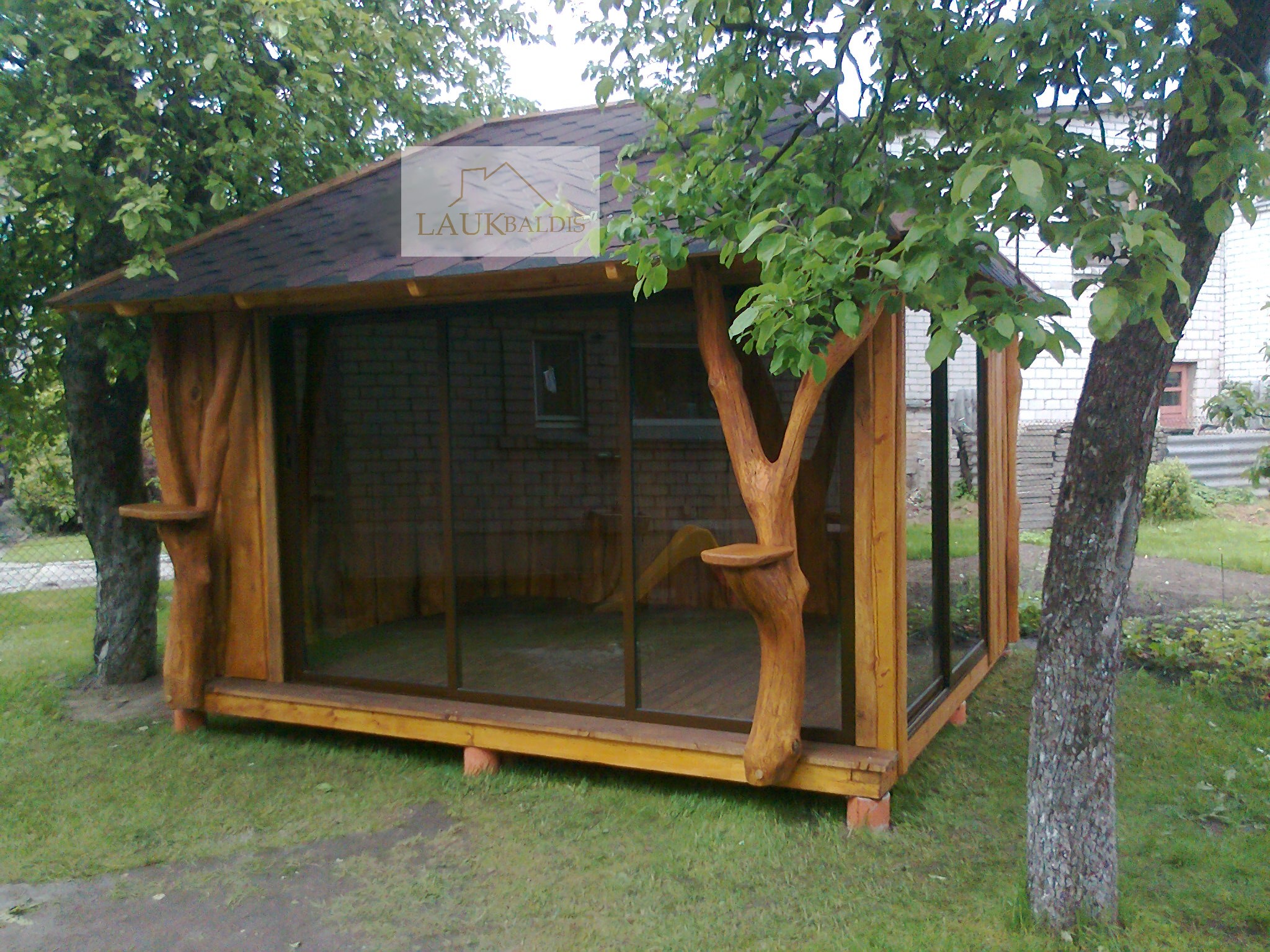
This photo shows how a gazebo looks not in an open meadow but nestled among old garden trees. In front grows a thick fruit tree whose branches droop almost to the roof, and on the left stands another. The gazebo seems to fit in between them and does not compete with the garden: the brown roof, the brown frames and the warm wood go well with the tree trunks and the greenery.
The main accent is the branching trunk at the front. It forks into two parts, and a round wooden shelf is fixed below the limbs. In the other corner stands a thick, wrinkled trunk with the same kind of shelf. The trunks are finished in a light honey shade, so they stand out clearly against the darker glass and look as if they had grown up together with the garden.
The roof is a hip roof covered with a brown material whose pattern resembles small tiles. The rafter ends can be seen under the edge of the roof. The roof is not tall, so the whole gazebo looks low and cozy and fits well under the tree crowns.
On the left side of the gazebo the wall is covered not with smooth boards but with panels of naturally shaped wood, which continue the theme of the trunks. This makes the corner look massive and rich, and the glass part light. This combination of two elements creates the look of the gazebo: on one side a cozy wooden shelter, on the other a bright space opened up by glass.
What the photo reveals
The photo is older, but it clearly shows the main features of this gazebo:
- the front wall consists of three large glass sections in brown frames;
- the side wall is glazed too, so the gazebo is bright from several sides;
- you can see right through the gazebo: behind it there is a brick building and its window;
- the right corner is framed by a straight wooden beam, and the left one by a thick natural trunk;
- the floor is made of wooden boards, and the base frame is raised above the lawn and rests on separate supports;
- round shelves are fixed to both trunk columns.
All this makes a light, almost transparent structure. When the glass is closed, it is calm and dry inside, and when it is pushed aside, the gazebo opens to the garden. In either case the roof protects from sun and rain.
A raised base: why it is useful
The photo clearly shows that the gazebo does not stand directly on the ground. The base frame is raised and rests on separate supports, so a gap is left under the floor. This solution especially suits a garden, where the soil is often soft and moisture lingers long after rain.
The gap under the floor lets air circulate freely, so the lower beams dry faster after rain. In addition, the gazebo depends less on an uneven surface: the supports help level out differences in height, while the structure itself stays straight. This matters for sliding glass, which runs smoothly only when the frame stands level.
When planning a spot among trees, pay attention to the roots. Old fruit trees have many and they spread wide, so it is worth choosing the places for the supports so that the roots do not have to be damaged. How best to prepare the base in your own garden can be discussed when you order.
A raised base has an everyday side too: you step into the gazebo over a small threshold, and the floor stays cleaner because less soil and grass gets inside. If older people or small children will often visit the gazebo, a step can be provided by the entrance, which is also worth mentioning in the conversation.
Brown frames and warm wood
The color of the glass frames changes the overall look of the gazebo considerably. In this example the frames are brown, almost the same tone as the roof, so they do not contrast but blend with the wood. From a distance the gazebo looks like a single wooden structure with large windows, not a glass pavilion.
Such a range of colors suits a farmstead or a garden with lots of trees, wooden fences and other natural materials. If your house is more modern, the color of the frames can be discussed separately; what matters is that the gazebo suits its surroundings and does not just look good in a photo.
The trunk columns are warm and honey-colored too. They have not been turned or smoothed, so every gazebo is distinctive. Even if you order a similar one, the bends, the places where the limbs branch and the thickness of the trunks will be different.
It is also worth knowing that glass looks different at different times of day. In the daytime it reflects the trees and the sky, so the interior is less visible from the garden. In the evening, when the light is switched on inside, it is the other way round and the gazebo becomes transparent. If you want more privacy, curtains or other solutions can be planned in advance.
How to furnish a wooden gazebo with glass
In the photo a lot of free space can be seen through the glass, so the interior can be furnished in various ways. A few popular options:
- A summer dining room. A large table with benches or chairs, suitable for family lunches and guests.
- A relaxation corner. A few comfortable armchairs and a low table, a place to read, rest or look at the garden.
- A children’s play space. In an enclosed gazebo children can play even in the rain, while the adults see them through the glass.
The shelves on the columns come in handy every day: you can put a cup of tea, a lantern or a small pot with a flower on them. If you want the furniture to be in the same style as the gazebo, Laukbaldis also makes solid oak garden furniture.
Lighting will be useful in the evenings. The glass reflects light, so even a few small lamps inside create a cozy mood, and from the garden the gazebo looks like a glowing lantern. Lamps are also made by Laukbaldis, so they can be chosen to match the wooden surroundings.
More similar works: the gazebo with a storage shed and trunk columns No. 25-7, the glazed gazebo on paving blocks No. 24-3 and the gazebo with a wooden terrace No. 25-9. You can browse all the gazebos in the section wooden gazebos and the furniture in the section garden and outdoor furniture made of oak.
Care when branches spread above the roof
A gazebo under fruit trees means pleasant shade but also a little extra work. In autumn leaves and fruit will fall on the roof, and in spring petals. If they lie for long in a damp place, the roof edges and wooden parts dry more slowly.
- Several times a season, clear the leaves off the roof and the overhangs.
- Prune branches that touch the roof, because on a windy day they can rub the covering.
- Clean the tracks of the sliding glass of leaves, petals and sand.
- Wash the glass with ordinary window-cleaning products, especially after flowering, when pollen settles on it.
Outdoors, wood is protected by a coating made for exterior wood. When the surface becomes paler, or water no longer beads up but soaks straight in, it is time to renew the coating. Inspect the trunk columns and the places where limbs branch more carefully, because water can stay there. Small cracks that appear as the wood dries are a natural phenomenon.
From the phone call to the gazebo: how ordering works
UAB “Laukbaldis” has been making wooden products since 1996. The company states that it was the first in Lithuania to start making this production, and it works in Dapkiškių village, Tauragės district.
An order starts with a call. Say that you are interested in gazebo No. 25-1 and discuss how large it should be, how many walls to glaze, and what color of frames and roof covering to choose. Tell us about the site too: whether it is among trees or in the open, level or sloping.
The website shows only typical examples, so the photo is a starting point. The final version depends on your needs and your plot. If you have photos of your yard, have them ready, as it will help you agree on the details faster.
It is useful to think in advance about the way to the gazebo as well. If it will stand deep in the garden, a path or at least a few laid stones will come in handy, so that you do not have to wade through wet grass after rain. Then the glazed gazebo will become a place where you want to spend time not only on a sunny summer day but also in spring or autumn.
Frequently asked questions
Is gazebo No. 25-1 glazed on all sides?
In the photo the front and side walls are glazed, and through the glass you can also see what is behind the gazebo. Which walls will be glass in your gazebo is agreed when you order.
Why is the gazebo raised above the ground?
The base rests on separate supports, so a gap for air is left under the floor. This way the beams dry faster after rain, and it is easier to keep the structure level.
Can a gazebo be built under fruit trees?
Yes, in the photo it stands exactly among fruit trees. You will just need to clear leaves from the roof and tracks more often, and it is worth pruning branches that touch the roof.
Will the columns be the same as in the photo?
Not exactly, because every natural trunk has a different bend and thickness. That is why each gazebo looks slightly distinctive.
Can the gazebo be used in cooler weather?
Yes, closed sliding glass stops the wind and slanting rain, so in spring and autumn it is cozier than in an open gazebo. On a warm day the glass can be pushed aside and the gazebo opened to the garden.
How do I order gazebo No. 25-1?
Call us and quote No. 25-1. We will discuss the size, the glazing, the color of the frames and roof, and the place in your garden.