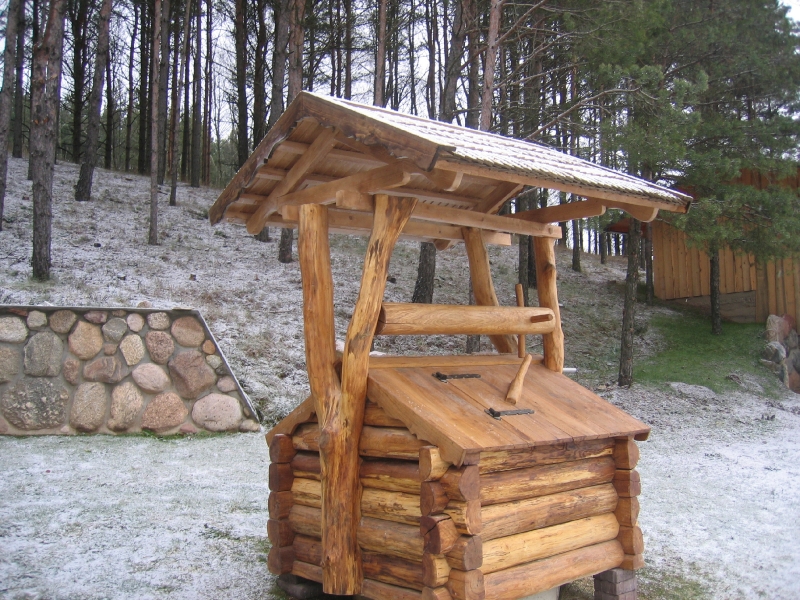
In short: Log well No. 2 has a square well frame of round logs with projecting corners, a sloping hinged lid and a gable shingle roof. The roof is held up by two natural posts, the front one of which is forked, and a round crossbar is fixed between them. The size, height and finish are agreed with each customer separately.
A well in a winter pine forest
The photo was taken in winter: the ground and the roof are dusted with snow or frost, and tall pines rise all around. On the left you can see a wall laid of round field stones, and on the right, among the trees, a brown wooden building. The well stands at the foot of a slope and looks like a natural part of the farmstead, as if it had stood here for decades.
A winter photo is useful because it shows how the well looks not only in summer, surrounded by greenery. The light logs and the warm shade of the wood stand out against the white snow and the dark pine trunks, so the well remains a bright accent of the yard all year round.
The stone wall and the logs go nicely together. Both materials are natural and typical of Lithuanian farmsteads, so a log well next to a stone wall, pines or a wooden building looks at home and not brought from another setting.
The slope behind the well shows one more thing: the frame looks good on uneven terrain too, if a level base is prepared beneath it.
A place like this, a wooded plot, a slope, a natural setting, especially suits log structures. But the well would look good on an open farmstead too, by a dwelling house or next to a sauna, if there are other wooden details around.
A log frame and a hinged lid
The body of the well, the frame, is laid of horizontal round logs. At the corners the logs are notched so that their ends project to the sides, as at the corners of a traditional log house. Thanks to these projecting ends, the well looks massive and genuine and not simply clad with boards.
The log ends are visible from both sides and form a rhythmic pattern. The thickness of each log differs slightly, so the corners look alive and natural. At the bottom, right by the ground, the frame rests on a base that lifts it and protects the bottom log from constant dampness.
A log well with a frame like this looks reliable and solid. The massive logs completely hide the concrete ring, so from the side only wood is visible.
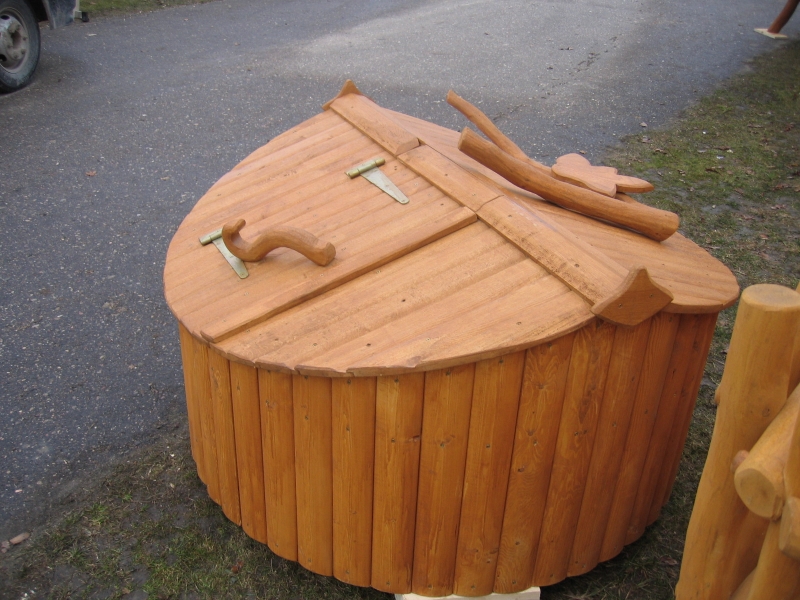
At the top the frame is covered with a sloping lid of boards. Its boards are laid neatly, and on the lid you can see two dark metal hinges: one part of the lid can be lifted to reach the inside of the well. The slope is practical: rain and snow run off the lid and do not collect on it.
The edges of the lid project beyond the frame, so water drips off beside the logs and not down their surface. It is a simple but important solution that helps the frame stay dry for longer.
Forked posts and a shingle roof
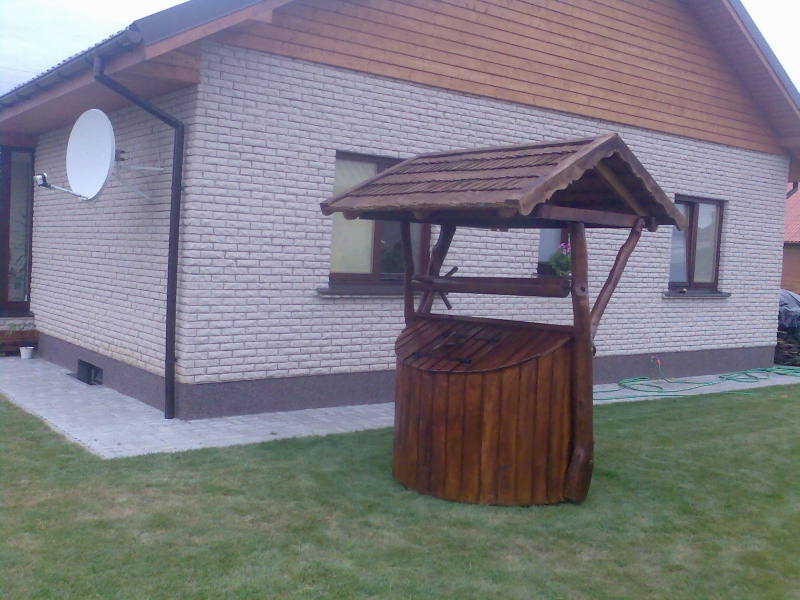
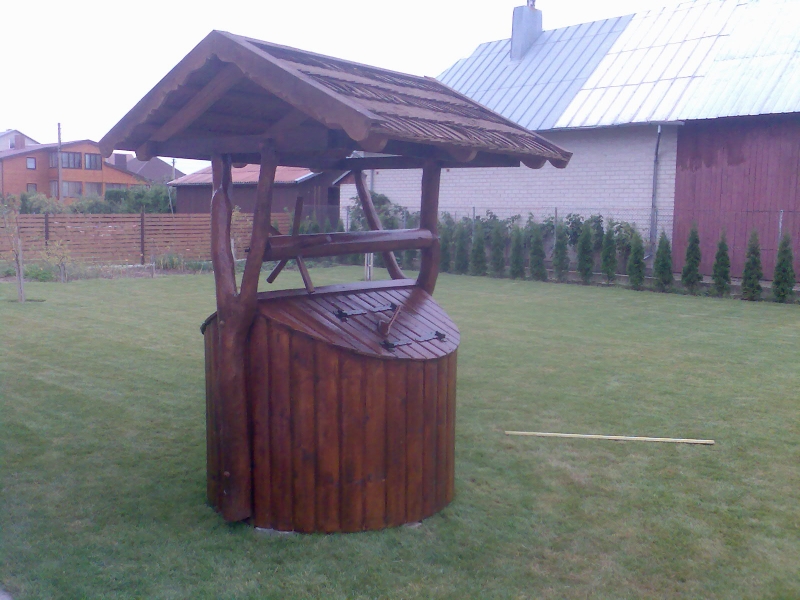
The roof is held up by two natural posts. The front post is especially expressive: it is a forked trunk, one limb of which rises straight up, while the other curves and joins the roof structure. The rear post is straighter and calmer in shape. Posts like these are chosen from trees that grew naturally in such a shape.
The bark of the posts is peeled, and the surface keeps the natural lines of the trunk and the places where branches were. Their light, warm color goes with the logs of the frame, so the whole well looks like a single ensemble.
A round crossbar is fixed between the posts. In traditional wells a chain with a bucket used to be wound on a windlass like this; in this photo there is no chain or bucket, but the crossbar keeps the classic silhouette of a well.
The roof is a gable roof with wide overhangs on all sides. It is covered with wooden shingles, dusted with snow in the photo. From below you can see the roof structure: rafters, cross boards and the beams that hold up the edge of the roof. The roof is much wider than the frame, so it protects the lid from rain, snow and falling pine needles.
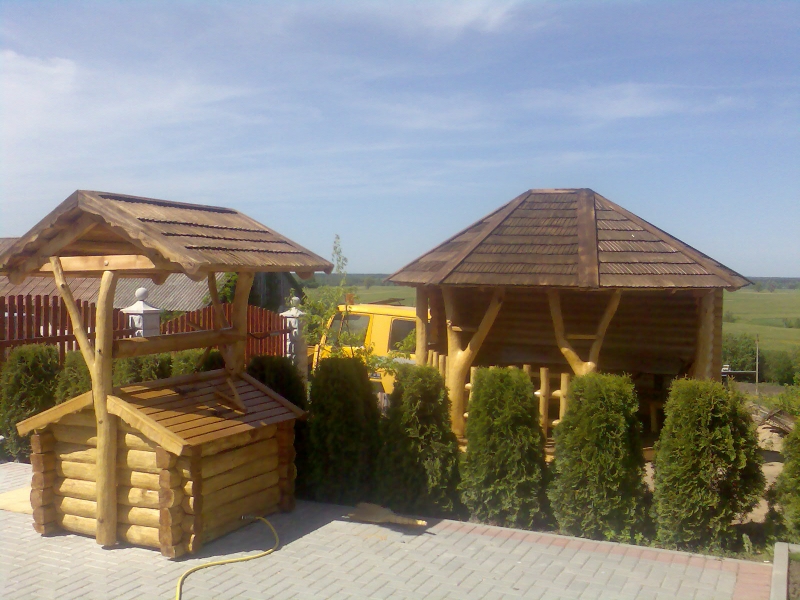
A shingle roof is typical of traditional Lithuanian architecture. Laukbaldis also makes shingles for roofs, so the roof of the well can be matched with the roof of a gazebo, a sauna or another structure in the yard.
Details in the photo
The table lists what can be seen in the photo of this typical example.
| Feature | In the photo |
|---|---|
| A frame of round logs with corners | Yes |
| A sloping lid with metal hinges | Yes |
| A forked front post | Yes |
| A crossbar between the posts | Yes |
| A gable shingle roof | Yes |
| A chain and a bucket | No |
Why a log well is a good choice
On many farmsteads the well is built of concrete rings. They are reliable, but gray concrete looks cold and unwelcoming in a yard. A log frame covers the ring and turns the well into a traditional accent of the yard. A few advantages:
- A traditional look. Logs with corners recall old village wells and go well with wooden buildings.
- Protection. The lid and the roof protect the well from leaves, needles, snow and rain.
- Safety. A closed lid helps keep children or animals from falling into the well.
- Access. When you need to check the water or the pump, it is enough to lift the hinged part of the lid.
A log frame suits more than a working well. It can also be used to cover another ring well or shaft if it is in a visible place in the yard. Then a traditional wooden accent appears in the yard instead of concrete.
If a pump is installed in the well, discuss in advance where the pipes and the electric cable will run. It is better to provide openings for them during production than to cut them later. It is also worth thinking about which side it is most convenient to approach the lid from.
Before ordering, measure the outer diameter of the well ring and its height above the ground. The size of the frame and the number of rows of logs it needs depend on these dimensions. A photo of the yard will also help: it will let you judge what height of roof and posts will suit the surroundings.
You will find other solutions among the other examples: the wooden well with a hinged lid No. 1 has no roof, while the well with a roof No. 3 is shown in a paved yard by a gazebo. You will find all the options in the section wooden wells.
Care through all the seasons
The well stands outdoors all year round, so it is exposed to rain, snow, frost and sun. Simple care helps the logs and the roof stay beautiful for longer:
- In spring inspect the frame, especially the bottom logs by the ground, and renew the protective coating if needed with a product meant for exterior wood.
- Clear needles, leaves and twigs off the roof and the lid so that they do not hold moisture.
- Once a year check the hinges of the lid and oil them if needed.
- In winter clear a thick layer of snow off the lid so that it is easy to open.
- Make sure water does not collect around the frame; if needed, lay a strip of gravel.
Snow on the roof, as in the photo, does no harm, but after heavy snowfall it is worth brushing off a thick layer. The wide eaves let the snow fall beside the frame and not onto the lid.
Longitudinal cracks appear in the logs over time. This is typical of natural wood and usually does not affect strength. A shingle roof changes too: with time it turns gray and takes on an antique shade that many people value.
On a wooded plot, as in the photo, more needles and cones fall on the roof, and the wood dries more slowly in the shade. So in such a place the inspection is worth doing a little more often.
If you are creating a unified style for the yard, a wooden bridge or a stake low fence would also look good next to the well. You will find such products in the section wooden bridges and fences.
How to order well No. 2
UAB “Laukbaldis” has made wooden products since 1996 and, as the company states, was the first in Lithuania to start making this production. The company is based in Dapkiškių village, Tauragės district.
Call +370 687 25388 and quote No. 2. Give the diameter and the height of your well ring, tell us where it stands, and discuss the size of the roof, the shape of the posts and the finish.
The shape of natural forked posts is different every time, so the posts of your well may differ from those in the photo but have the same character.
If you also plan other wooden structures next to the well, such as a gazebo, a sauna or a woodshed, mention it right away. Then it is easier to match the roof covering, the shape of the posts and the shade of the finish so that the whole yard looks unified.
Only typical examples are shown on the website. Well No. 2 shows one possible solution, a log frame with corners, forked posts and a shingle roof, and the specific dimensions and finish are agreed before production.
Frequently asked questions
Does a log well fit on a concrete ring?
Yes, a frame like this is most often used to cover a concrete well ring. Before ordering, measure the outer diameter of the ring and its height above the ground.
Does the well have a lid that opens?
Yes, two metal hinges can be seen on the sloping lid, so one part of it can be lifted. That makes it convenient to get inside the well and to check the water or the pump.
Is there a chain with a bucket on the crossbar?
No chain or bucket is seen in the photo. The crossbar keeps the traditional silhouette of a well, and additional details can be discussed when you order.
What is the roof of the well covered with?
The roof is a gable one, covered with wooden shingles. Laukbaldis also makes shingles for roofs, so the roof can be matched to the other structures in the yard.
Are the posts always forked?
Natural posts are chosen from trees, so their shape differs every time. The character of the posts can be discussed when you order.
How do I order well No. 2?
Call us and quote product number 2. Tell us the dimensions of your well ring and we will discuss the roof and the finish.