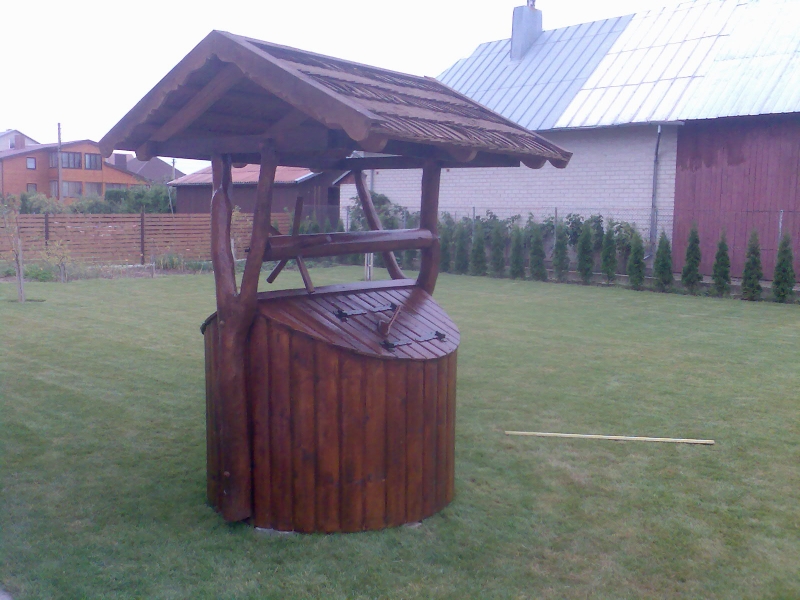
In short: Well roof No. 6 is a steep gable shingle roof on two natural, curved posts, rising above a round dark well body. The body is made of vertical boards, and its sloping lid has metal hinges, so the well can be opened. The size, height and finish are agreed with each customer separately.
A well on an open lawn
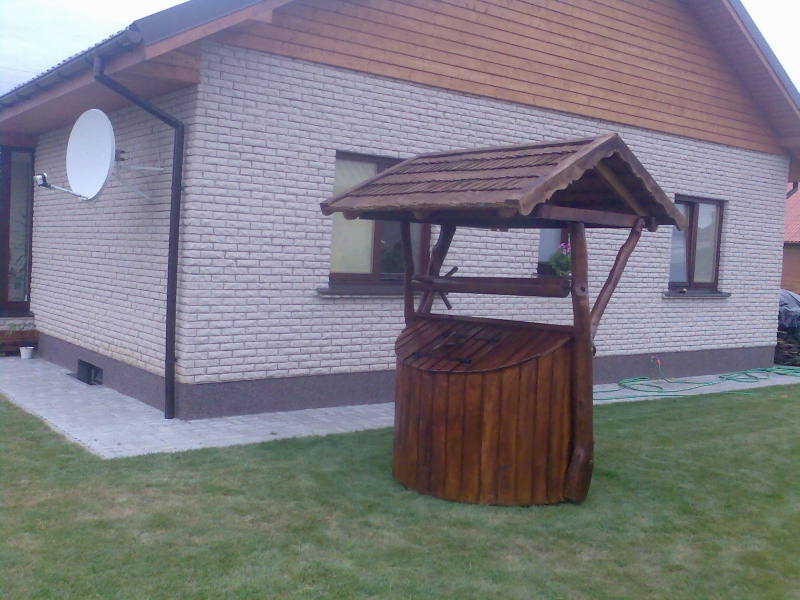
In the photo the well stands in the middle of a wide, neatly mown lawn. On the left you can see a wooden board fence, on the right a long row of arborvitae, and behind them a light brick building with a sheet-metal roof and an outbuilding with brown wooden walls. Farther on, beyond the fence, there are dwelling houses. The sky is overcast, so the dark color of the well looks calm and rich.
Here the well is not pressed against a house or a fence: it stands freely with a lot of space around it. In a place like this the silhouette is especially important: the well can be seen from all sides, so the shape of the roof, the bends of the posts and the proportions of the body become the main accent.
In a wide yard the well acts as a landmark. It divides the large lawn, gives it a center and turns a plain green area into a farmstead yard. Later a flower bed, a path or a bench can be built around it.
A well like this does not need a large foundation or a paved pad; it looks good simply on the lawn. Still, it is worth leaving a narrow strip of gravel around the body, so that the bottom ends of the boards do not stand in grass and dry faster.
The row of arborvitae and the wooden fence in the background show that the well goes well with both plantings and the wooden elements of the yard. Its dark color does not overshadow the greenery, and the natural posts soften the straight lines of the fence and the buildings.
A tall well roof with shingles
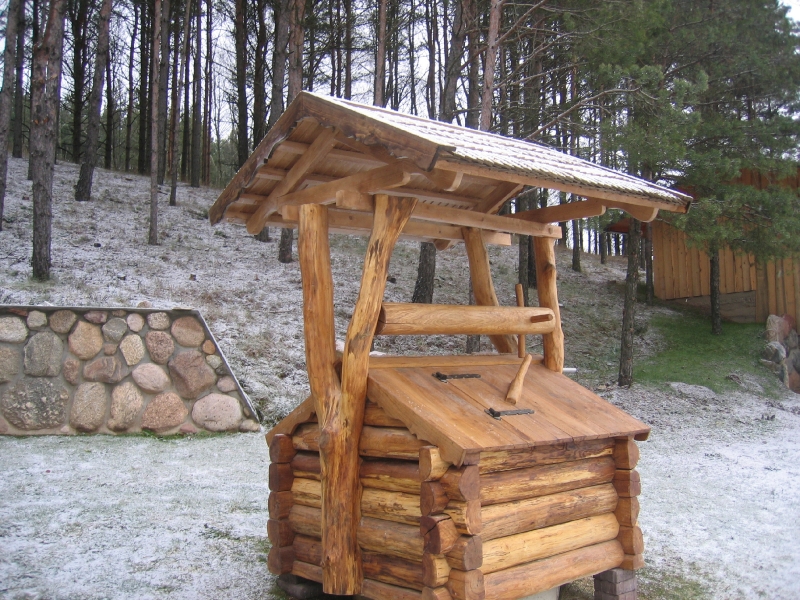
The most striking part of this well is the roof. It is tall and steep, with wide overhangs in all directions. The slopes are covered with wooden shingles, and the edges of the roof are finished with bargeboards. From below you can see the structure of the roof: rafters and several longitudinal beams on which the covering rests.
Steep slopes are practical: rainwater and snow slide off them quickly, and the shingles dry faster after rain. The wide roof edges protect not only the lid but also most of the body, so the boards get wet less often.
From the side the roof resembles the letter A. This shape is easy to see from afar and gives the well a clear, recognizable silhouette even when there are many other structures or plantings around.
The roof of the well is larger than the body, so from a distance the well looks like a little house. This proportion is typical of traditional Lithuanian wells and gives the product coziness. Under a wide roof it is convenient to stand even in the rain when you need to get to the well.
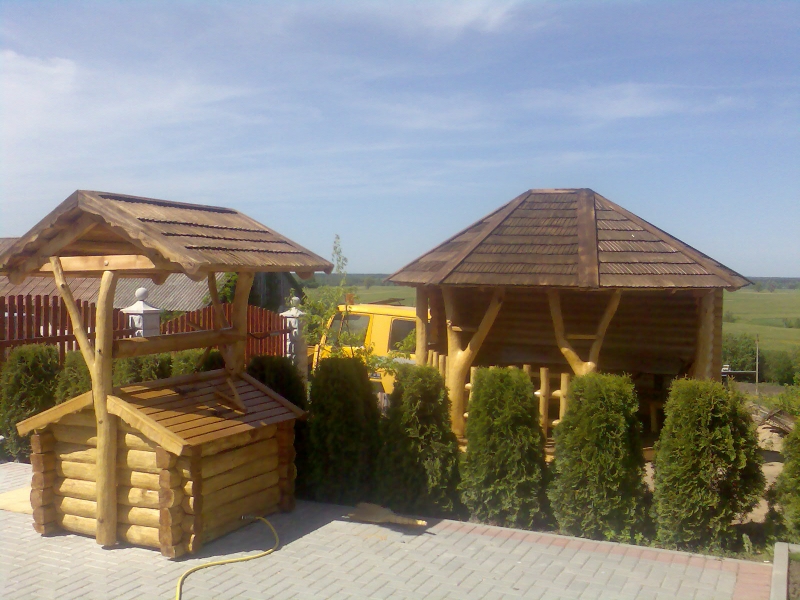
A shingle roof is an old, natural way of roofing. Laukbaldis also makes shingles for roofs, so the roof of the well can be matched with the roof of a gazebo, a sauna or another structure in the yard.
The body, the hinged lid and the posts
The body of the well is round, laid of vertical boards set tightly side by side. The shades of the boards differ slightly, so the surface looks natural, like a large wooden barrel. The whole body is covered with a dark, reddish-brown finish.
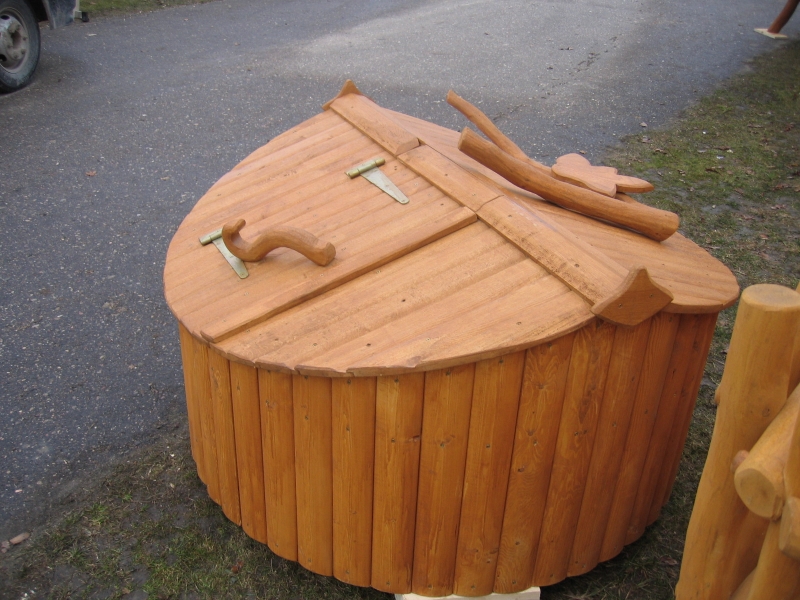
At the top the body is covered with a sloping lid of boards. Metal hinges can be seen on it, so part of the lid can be lifted to reach the inside of the well. A wooden rod runs across the middle of the lid, resembling a handle or a support. This is convenient when you need to check the water level, the pump or other equipment in the well.
The roof is held up by two natural, curved posts. One of them is thick, stands beside the body and rests directly on the ground; branch marks and natural bends can be seen on its trunk. The other post rises from the rear of the body. A round crossbar is fixed between the posts and keeps the traditional silhouette of a well. There is no chain or bucket in the photo.
The thick post gives the roof strength and at the same time becomes a bright decoration. Its shape depends on the particular tree, so the posts of every well differ slightly.
The vertical boards of the body have a practical benefit too: rainwater runs down them and does not linger on horizontal edges. This helps the walls dry faster after rain.
The details of this example
The table lists what can be seen in the photo of this typical example.
| Feature | In the photo |
|---|---|
| A steep gable shingle roof | Yes |
| A round body of vertical boards | Yes |
| A lid with metal hinges | Yes |
| Natural curved posts | Yes, two |
| A crossbar between the posts | Yes |
| A dark, reddish-brown finish | Yes |
| A chain and a bucket | No |
How to choose the size and shape of a well roof
The roof determines how the well looks from afar, so its size and shape are worth thinking through in advance. A few questions that are useful to answer before ordering:
- How large is the yard? On an open, large lawn, as in the photo, a tall roof looks proportionate. In a small yard a lower and narrower one may suit better.
- What other roofs are around? The pitch and covering of the roof can be matched to the roof of the house, the gazebo or the sauna.
- How often will you open the lid? If you approach the well often, a wide roof overhang protects from rain and snow.
- Do trees grow nearby? More leaves and needles fall on a roof under trees, so steeper slopes are more practical.
The color of the roof is important too. In the photo the shingles look dark, close to the shade of the body, so the well looks unified. If you want contrast, the roof can be left lighter; this is discussed when you order.
The height of the roof should be such that it is comfortable to approach the lid without bending or bumping your head. It is worth discussing this on the phone, especially if tall people will use the well. If you doubt the proportions, get a photo of your yard ready and ask during the call what size of roof would suit your yard best.
There are examples of other wells too: the decorative well with a round dark finish No. 5 stands by a dwelling house, and the log well with a forked post No. 2 has a square frame of logs. You will find all the options in the section wooden wells.
A wooden fence or a gate would also go well with the well. You will find such products in the section wooden fences and bridges.
What to do so the well looks good for a long time
The well stands outdoors all year round, so it is exposed to rain, snow, sun and changes of temperature. A few simple care tasks:
- In spring inspect the body, especially the bottom ends of the boards by the ground, and renew the protective coating if needed with a product meant for exterior wood.
- Once a year check the hinges of the lid and oil them if needed.
- Sweep leaves and twigs off the roof, as they can hold moisture between the shingles.
- In winter, after heavy snowfall, clear the snow off the lid so that it is easy to open.
- When mowing, take care that the mower or trimmer does not hit the bottom boards and the post.
A dark finish brings out the texture of the wood, but in the sun it heats up more than a light one. So on the south side the condition of the coating is worth watching more closely, and it should be renewed evenly over the whole body so that no patches appear.
In autumn, before the frosts begin, it is worth inspecting the well once more: sweep off the leaves, check that the lid closes properly and that water does not collect by the body. Then there will be fewer worries in winter.
A shingle roof gradually turns gray and takes on an antique shade, and small cracks in the boards and posts are typical of natural wood. They usually do not affect strength.
How to order well No. 6
UAB “Laukbaldis” has made wooden products since 1996 and, as the company states, was the first in Lithuania to start making this production. The company is based in Dapkiškių village, Tauragės district.
Call +370 687 25388 and quote No. 6. Give the outer diameter of the well ring and its height above the ground, and discuss the size and pitch of the roof, how the lid opens and the shade of the finish.
If a pump is installed in the well, discuss in advance where the pipes and the electric cable will run. It is better to provide openings for them during production than to cut them later. A photo of the yard will help too: it will let you judge what size of roof will suit the surroundings.
If you plan to build a path or a flower bed around the well, mention it as well. Then it is easier to judge from which side it is most convenient to open the lid and how to turn the roof.
Only typical examples are shown on the website. Well No. 6 shows one possible solution, a steep shingle roof over a round dark body with a hinged lid, and the specific dimensions and finish are agreed before production.
Frequently asked questions
What is the roof of the well covered with?
The roof is steep, gable, covered with wooden shingles. Laukbaldis also makes shingles for roofs, so the roof can be matched to the other structures in the yard.
Does the lid of the well open?
Yes, metal hinges can be seen on the sloping lid, so part of the lid can be lifted. That makes it convenient to check the water or the pump.
Does a round well fit a concrete ring?
Yes, a round body goes well with round concrete rings. Before ordering, measure the outer diameter of the ring and its height above the ground.
Can I order a lower roof?
Yes, the height, pitch and width of the roof are agreed individually. In a small yard a lower roof often suits better.
How do I look after a dark-coated well?
In spring inspect the body and renew the protective coating evenly over the whole surface if needed. Oil the hinges once a year and sweep leaves off the roof.
How do I order well No. 6?
Call us and quote product number 6. Give the dimensions of the ring and we will discuss the roof, the lid and the finish.