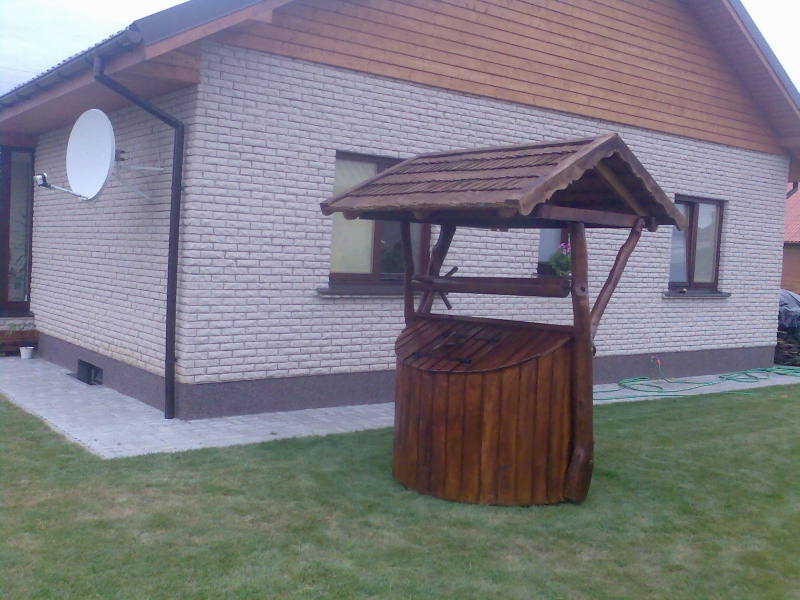
In short: Decorative well No. 5 is a round well surround of vertical boards with a domed lid and a gable shingle roof on natural, curved posts. The whole well is covered with a dark walnut-colored finish and was photographed on a lawn by a dwelling house. The size, height and finish are agreed with each customer separately.
A decorative well by a dwelling house
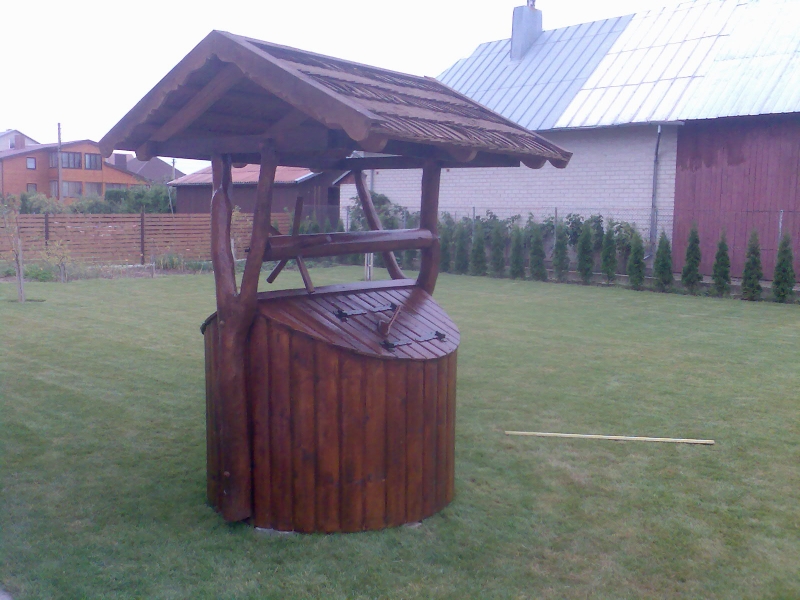
In the photo the well stands on a green lawn quite close to a one-story dwelling house. The facade of the house is light and imitates brickwork, the gable is clad with wood, and the window frames are brown. A paved path runs around the house, and a garden hose can be seen by the wall. The dark well stands out sharply against the light facade and catches the eye at once.
This photo shows how the well looks in the yard of a contemporary house. It is not part of an old farmstead or a forest; it simply stands on a lawn by a modern house and still looks natural. The dark wood goes with the brown window frames and the wooden finish of the gable, so the well and the house form a whole.
A green lawn, a light facade and dark wood make a calm, uncomplicated color combination. In a yard like this the well needs no extra decoration: its shape and the texture of the wood are enough.
The decorative well plays a double role here. On the one hand, it covers the well ring or other equipment that would otherwise be visible next to the house. On the other, it becomes an accent of the yard, toward which the eye turns through a window or on stepping outside.
A well like this especially suits a yard that is only being created. It becomes the first wooden accent, to which benches, flower pots or a gazebo can be matched later.
Since the well stands so close to the house, it is also well visible from inside. That is worth considering when choosing the place: the well can become part of the view from a living-room or kitchen window.
A round body of vertical boards
The body of the well is round, laid of vertical boards set tightly side by side. The boards differ slightly in shade, so the surface looks alive, like an old wooden barrel. The round shape is softer than a square frame and goes well with round well rings.
The upper ends of the boards are hidden under the edge of the lid, so the body looks neat and finished. From the side only a solid wooden cylinder with a vertical rhythm of boards is visible.
Vertical boards have a practical benefit: rainwater runs straight down them and does not linger on horizontal edges. So the walls dry faster after rain, and dampness does not collect between the boards.
The body stands directly on the lawn, so it looks as if it had grown out of the ground. This solution is simple, but at the bottom edge it is worth providing drainage or a strip of gravel so that the board ends do not stand constantly in damp grass.
A round wooden well takes up little space and has no sharp corners to bump into. That is handy when the well stands by a path or a children’s play area, and it is easier to drive a mower around it.
A domed lid and curved posts
At the top the body is covered by a domed lid of boards whose middle is higher than the edges. A shape like this lets rainwater and snow run off in all directions, and the lid itself looks like a little roof. The edge of the lid projects slightly beyond the body.
The roof is held up by two natural, curved posts. The front post is thicker, fixed to the side of the body and reaching the ground; its trunk is bent, and the places where branches grew can be seen on its surface. The rear post is thinner and also curved. At the top they are joined by a round crossbar, and in the corners you can see curved braces that support the roof.
Curved posts give the well a fairy-tale, slightly antique character. Not one of them is straight as if drawn with a ruler: the bends depend on how the tree grew, so every decorative well has its own silhouette.
In traditional wells a chain with a bucket used to be wound on a crossbar like this. There is no chain or bucket in the photo; the well is meant for decorating and covering the well, which is why it is called decorative.
The roof is a gable one, covered with wooden shingles that appear to be coated with the same dark finish as the whole well. From below you can see the structure of the roof: rafters and cross boards. The wide overhang protects the lid from rain and snow.
What can be seen in this shot
The table lists what can be seen in the photo of this typical example.
| Feature | In the photo |
|---|---|
| A round body of vertical boards | Yes |
| A domed boarded lid | Yes |
| Natural curved posts | Yes, two |
| A crossbar between the posts | Yes |
| A gable shingle roof | Yes |
| A dark walnut-colored finish | Yes |
| A chain and a bucket | No |
In this example everything is subordinate to one idea, the round shape and the dark, even finish, complemented by the bends of the natural posts.
A dark finish: when it suits
Many wooden wells are light, honey-colored. This one stands out with a dark, rich walnut color. When is it worth choosing a finish like this?
- A light house facade. As in the photo, a dark well looks contrasting and elegant against a light house.
- Dark window frames or roof. Dark wood repeats these colors and ties the well to the house.
- An antique impression. A dark shade recalls wood darkened by time and gives the well solidity.
- Plenty of greenery. On a bright lawn a dark well does not look too colorful and does not overshadow the plants.
A dark finish brings out the texture of the wood nicely, the grain of the boards and natural differences of shade. On the other hand, in the sun a dark surface heats up more than a light one, so its protective coating is worth watching more closely.
Light accents around suit a dark finish: light gravel by the body, blooming flowers or white pebbles. They set off the dark wood even more and make the well a brighter center of the yard.
If there are already wooden structures in your yard, the shade of the well can be chosen to match them. A similar finish can be chosen for a gazebo too; you will find examples in the section wooden gazebos.
There are wells of a similar shape too: the round dark well with a hinged lid No. 6 stands on an open lawn, and the light round well without a roof No. 1 shows a simpler solution. You will find all the options in the section wooden wells.
A well next to a house: place and care
When the well stands close to the house, it is worth considering several things:
- Leave enough room between the well and the wall so that you can approach from all sides and comfortably lift the lid.
- Do not place the well under the drip line of the house roof: water from the roof of the house should not fall straight onto the well.
- If a pump is installed in the well, discuss in advance where the pipes and the electric cable to the house will run.
- Judge whether the well will block the view from a window and get in the way of walking around the house.
Electricity, water supply and other underground utilities often run right next to a house. Before placing the well, check where they run, and do not cover places you may need to reach.
Care is simple. In spring inspect the body, especially the bottom ends of the boards by the ground, and renew the protective coating if needed with a product meant for exterior wood. For a dark finish it is worth choosing the same shade of coating, so that the well does not look patchy.
A dark decorative well looks best when its surface is even. So when renewing the coating, it is worth recoating the whole body and not just the most worn places.
Regularly sweep leaves off the lid and the roof, and in winter a thick layer of snow. Once a year check how the posts are fixed to the body. Small cracks in natural wood are normal and usually do not affect strength.
How to order well No. 5
UAB “Laukbaldis” has made wooden products since 1996 and, as the company states, was the first in Lithuania to start making this production. The company is based in Dapkiškių village, Tauragės district.
Call +370 687 25388 and quote No. 5. Give the outer diameter of the well ring and its height above the ground, tell us where the well stands and discuss the size of the roof and the shade of the finish.
If you want the well to match the house, get photos of the facade and the roof ready. Then it is easier to decide how dark the finish should be.
If you doubt whether a dark finish will suit your yard, discuss it during the call. A lighter shade can be chosen, or one the same as the window frames or the door of the house.
Only typical examples are shown on the website. Well No. 5 shows one possible solution, a round dark surround with a domed lid and a shingle roof, and the specific dimensions and finish are agreed before production.
Frequently asked questions
Why is this well called decorative?
There is no chain or bucket in the photo, so the well is meant to cover and decorate the well ring. It becomes an accent of the yard and hides the concrete.
Does a round well surround fit a concrete ring?
Yes, a round body goes well with round well rings. Before ordering, measure the outer diameter of the ring and its height above the ground.
Can I choose a lighter finish?
Yes, the dark walnut color in the photo is only one option. The finish is agreed with each customer separately.
How much room is needed between the well and the house?
The exact distance depends on the size of the well, but it is important to be able to approach from all sides. The roof also should not stand under the drip line of the house roof.
How do I look after a dark-coated well?
In spring inspect the body and renew the protective coating in the same shade if needed. Regularly sweep leaves and snow off the lid and the roof.
How do I order well No. 5?
Call us and quote product number 5. Give the dimensions of the ring and we will discuss the roof and the shade of the finish.