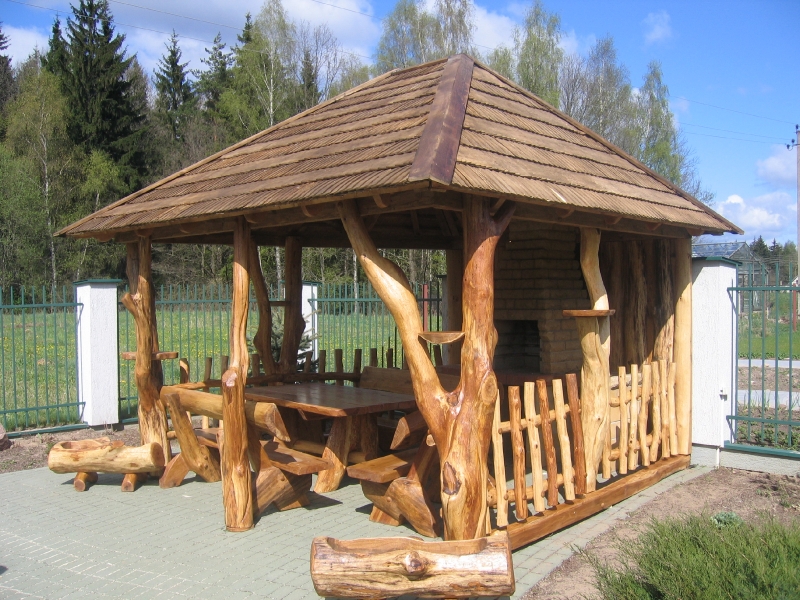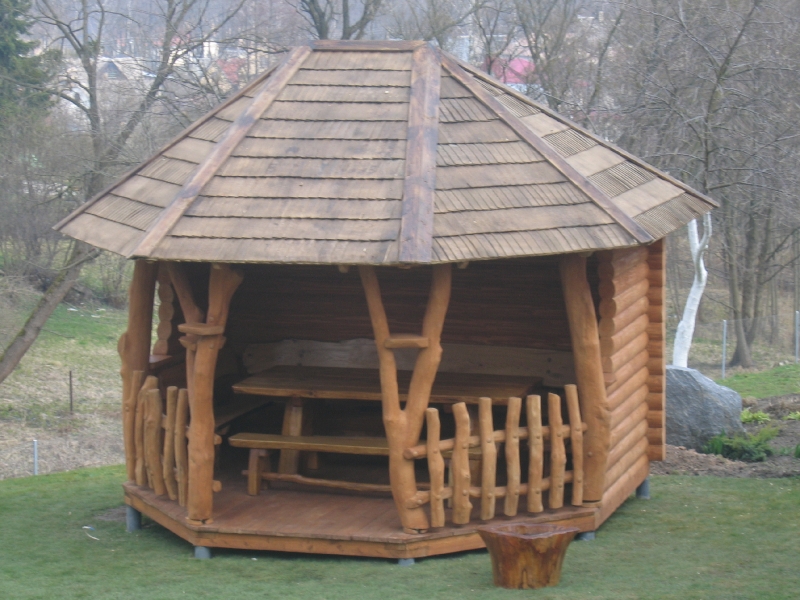
In short: Log gazebo No. 26-4 is a polygonal gazebo whose right and back sides are built of round logs, while the open part is held up by branching natural trunks with crossbars. The roof is covered with wooden shingles with the patina of time, a table with two benches stands inside, and a large tree stump sits in front. The size, finishing and equipment are agreed individually.
A log gazebo in early spring
The photo was taken in early spring, when the trees are still bare and the lawn is only beginning to turn green. In the background you can see the branches of leafless trees, the slope of a hill and, in the distance, the houses of a settlement. At this time of year the garden has no greenery yet, so the gazebo is seen in all its beauty: its warm shades of wood seem to warm up a gray spring day.
The gazebo stands on a level lawn, and its floor is slightly raised above the ground on small supports, so air can move beneath it. To the right behind it lies a large field boulder, and beside it a small thicket of shrubs and a tree with a white trunk. In front, almost at the entrance, stands a hollow tree stump. All these natural accents create a unified mood of a country homestead.
A setting like this shows that a gazebo does not have to stand among flower beds or on paving. Sometimes a lawn, a few stones and old trees are enough, and a structure of logs and trunks looks as if it had always stood there. The gazebo looks good in any season: in spring it warms the eye, in summer it gives shade, in autumn it goes with the yellow leaves, and in winter, covered with snow, it resembles a fairy-tale cottage.
A shingle roof with the patina of time
The roof of the gazebo is made up of several triangular planes meeting at the peak, and each edge is covered with a wide board. The covering is wooden shingles laid in overlapping rows. In the photo they are already grayish brown with a silvery shade, which is how wood naturally looks when weathered by sun and rain over time.
Many people like this patina even more than new shingles. The roof becomes calmer and goes with the gray boulder and the branches of bare trees, and the gazebo itself looks as if it had stood on the homestead for decades. The contrast between the light trunks and the darker roof emphasizes the shape of the structure even more.
Whoever wants to keep the tone of fresh wood can coat the roof with a protective layer. Whoever likes natural aging lets the shingles turn gray by themselves. The choice depends only on your taste and surroundings. In both cases the most important thing is for the roof to be clean: leaves, needles and twigs hold moisture, so they should be swept off at least once a year.
The wide eaves of the roof project well beyond the columns and logs. This way rain water runs off further from the walls, and the edge of the floor and the tops of the trunks stay dry longer.
Trunks with crossbars and a low fence
The open part of the gazebo is held up by natural trunks. The central trunk divides into two higher up, the branches are joined by a short crossbar, and both branches support the roof beam. On the left you can see another similar trunk with a crossbar, and in the corner a straighter column. The crossbars between the branches not only strengthen the structure but can also serve as small shelves for a lantern or a cup.
Between the columns there is a low fence of crooked stakes joined by horizontal crossbars. On the left side the stakes are set densely, and on the right with larger gaps. The low fence does not block the view but clearly separates the inside from the lawn.
Inside stand a long table and two benches, and by the log wall you can see one more bench with a back. This is a classic arrangement in which everyone sits around one table and can see one another.
A gazebo like this is handy for:
- gathering the family for weekend lunch, when the house feels cramped or you want to be in the fresh air;
- taking shelter from the midday sun or a sudden rain while working in the garden;
- celebrating holidays, when a feast table stands under the roof and children play around;
- sitting in the evening with tea and watching it get dark over the hills;
- keeping garden furniture under the roof, so you do not have to carry it indoors every time.
The trunks, stakes and crossbars are all of natural shape, so the gazebo has almost no straight lines apart from the rows of logs. This contrast between the neat logs and the free shapes of the trunks is the main charm of gazebos like this.
A stump, a boulder and other natural accents
The stump in front is a great example of how the surroundings of a gazebo can be complemented with natural elements. A hollow stump can become a planter for flowers, a garden stool or simply a decoration. In summer you can plant summer flowers in it, and in autumn arrange pumpkins or cones. In the photo it stands by the entrance and seems to welcome guests.
The boulder on the right is one more natural accent. Large field stones have long been valued as decoration on Lithuanian homesteads, and next to a wooden structure they look especially good. Stone and wood are two traditional materials of country architecture that complement each other.
It is important that such accents are not too close to the walls of the gazebo. Room must remain between the stone or stump and the logs for air to move and for care, otherwise moisture will linger by the walls longer and the grass will be hard to mow.
If you want similar surroundings, think about a few elements:
- a few large stones by the corners of the gazebo or the path;
- a stump or a piece of log as a planter or a seat;
- low, naturally growing shrubs instead of strictly shaped hedges;
- a path of field stones or wood slices;
- a few lamps that light the stump or the stone in the evening.
Laukbaldis also makes planters, so wooden accents for the surroundings of the gazebo can be chosen together with the gazebo itself.
What the photo shows
The table summarizes what is clearly visible in the photo. It is a typical example, and every detail can be changed.
| Feature | In the photo |
|---|---|
| Wooden shingle roof | Yes, with a natural patina |
| Round log walls | Yes, on the right and at the back |
| Trunks with crossbars | Yes |
| Low fence of crooked stakes | Yes, on both sides of the entrance |
| Table with benches | Yes |
| Stump in front | Yes |
| Floor raised above the ground | Yes |
How a gazebo changes over the years
A wooden gazebo is not a structure that looks the same all the time. In the first years the logs and trunks are light and bright, and the roof shingles are yellowish. Later the wood naturally darkens, the shingles turn gray, and the whole gazebo takes on a calmer, more mature character, like the one we see in this photo.
For the wood to age beautifully and not just wear out, regular care matters:
- in spring, when the snow has melted, inspect the logs, trunks and floor, and coat faded or rough places with a new protective layer;
- clean the roof of leaves and twigs so that the shingles dry quickly after rain;
- watch more closely the bases of the trunks and the places where branches fork, where water can linger;
- do not let shrubs grow right up to the log walls: air must be able to move between the plants and the wood so that the walls dry quickly after rain;
- after heavy snowfall, check that a heavy snow cushion has not formed on the roof.
Small cracks that appear as natural trunks dry are normal and usually do not harm the structure. They are just one more sign that the gazebo is made of real wood.
A well-kept gazebo gets cozier with the years. Plants grow up around it, a path stretches toward it, and the place itself becomes part of the family traditions: holidays are celebrated here, evening tea is drunk, and guests are awaited.
How to order gazebo No. 26-4
Laukbaldis places this gazebo in the “Egle-5” series. The photo shows a typical example, and the size, roofing, amount of log walls, low fence and finishing can be discussed individually. Before deciding, take a look at these works too: the octagonal gazebo with a skylight No. 26-3, the gazebo with a shingle roof and a stone strip No. 26-1 and the rustic gazebo with massive trunks No. 25-11. You will find all the examples in the section wooden gazebos, and wooden planters and doors will suit the surroundings.
UAB “Laukbaldis” has worked since 1996 in Dapkiškių village, Tauragės district. Call +370 687 25388 and quote No. 26-4. You will discuss the size of the gazebo, the roof, the finishing, the furniture and the place on your plot. If you have photos of the homestead, have them ready: it will be easier to choose which side the log walls should be on.
It is easiest to work out the size starting from the furniture. Think about how many people will usually sit at the table, whether you will want extra chairs for guests, and how much room must remain for walking. Laukbaldis makes solid oak outdoor furniture, so the table and benches can be ordered together with the gazebo: they will be fitted to the interior and will go with the trunks.
Frequently asked questions
Why is the shingle roof grayish in the photo?
This is how wooden shingles naturally look after weathering by sun and rain. If you want to keep a lighter shade, the roof can be coated with a protective layer.
Is the stump in front included in the order?
In the photo the stump is an accent of the surroundings. Laukbaldis makes wooden planters, so you can discuss similar solutions by phone.
What are the crossbars between the branches of the trunks for?
They strengthen the forked trunks. In addition, you can put a lantern or a cup on them.
Can a gazebo be placed simply on a lawn?
Yes, in the photo it stands on a lawn, and the floor is raised above the ground. The spot must be level and dry, and the base is worth discussing according to your plot.
Will the trunks of my gazebo look the same?
No, natural trunks are different every time. That is why every gazebo is unique.
How do I order this gazebo?
Call us and quote the product number. We will discuss the size, the roof, the finishing and the place.