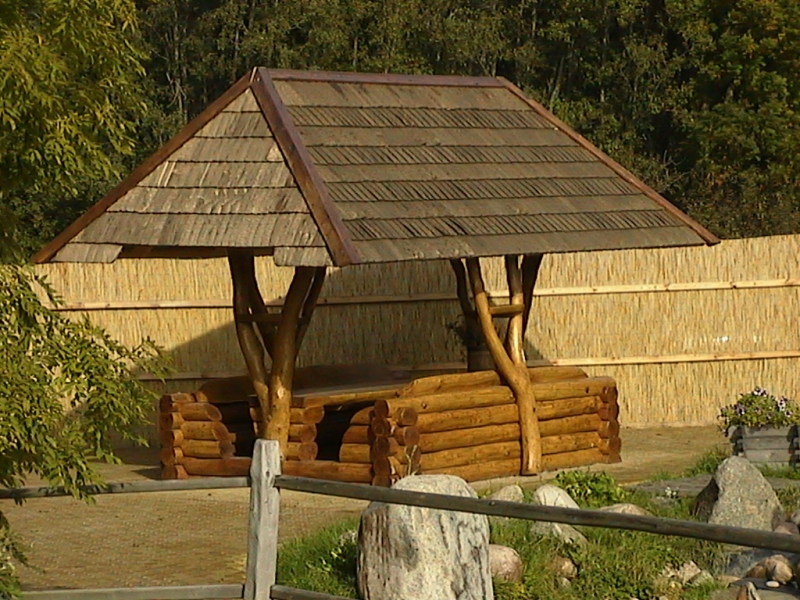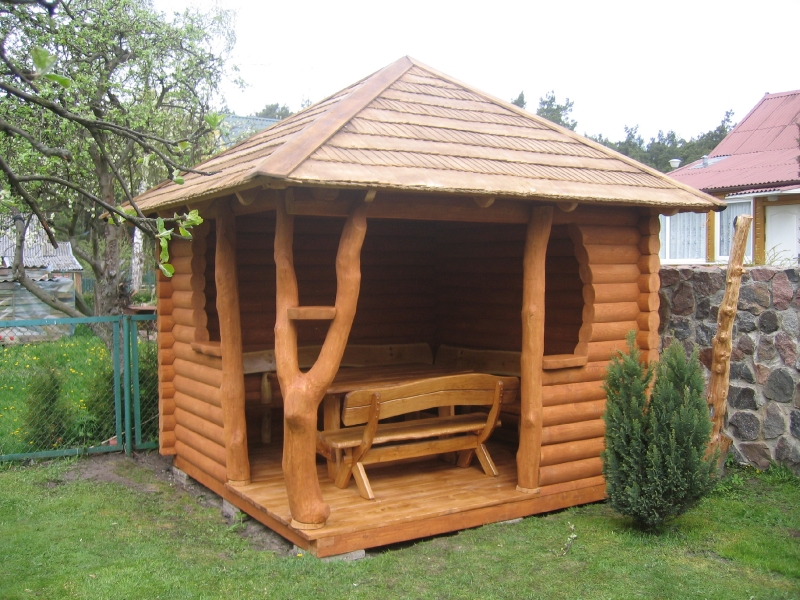
In short: Rustic gazebo No. 21-5 is a square log gazebo with a hip shingle roof, built in the yard of an old homestead next to a fieldstone wall. Curved openings are cut into the log walls, a forked trunk and straight trunks hold up the roof at the front, and inside stand a table and a bench with a curved backrest. The size, finishing and equipment are agreed individually.
A rustic gazebo in the yard of an old homestead
This photo was taken in spring, in an old yard. On the left you can see a green metal fence with a small gate, branches of a fruit tree unfolding young leaves hang over the gazebo, on the right stands a fieldstone wall, and behind it an old house with a red roof. In this yard everything has a history, and the new gazebo blends into it so naturally that it seems to have stood here always.
That is exactly what makes a rustic gazebo valuable. It does not fight the old surroundings but continues them. Logs, shingles and natural-shape trunks are the same materials and forms that people in the Lithuanian countryside have used for generations. So the gazebo goes with old stone barns, with log dwelling houses and with plain garden paths.
A rustic style does not mean the gazebo is simple or uncomfortable. Inside there is enough room for a table and benches, the floor is raised and dry, and the roof projects widely to protect from rain. It is simply all made of natural materials and keeps the traditional form. Traditional forms never go out of fashion, so a gazebo like this will look right in the yard after many seasons.
On an old homestead a gazebo like this often becomes the place where several generations gather. The older people feel at home there because the forms are familiar to them, and the younger ones value the naturalness and the chance to be outdoors, away from screens. Family celebrations, plain Sunday lunches and long summer evenings when nobody is in a hurry all take place at one table here.
Fieldstones, logs and shingles
The photo shows three traditional country building materials meeting beautifully. On the right stands a fieldstone wall, with gray, pinkish and brown stones laid with mortar joints. The walls of the gazebo are built of light round logs, and the roof is covered with shingles. All three materials are natural, in warm shades, and go perfectly together.
The stone wall and the log gazebo complement each other also by contrast. Stone is heavy, cold and gray, while wood is lighter, warm and bright. It is this contrast that brings the picture to life: neither material overpowers the other, and together they create the mood of a real homestead.
By the wall, behind the gazebo, grows a dense thuja bush, and beside it stands a tall natural-shape trunk, a decorative accent echoing the theme of the gazebo columns. Details like these connect the gazebo with other parts of the yard.
If your yard has an old stone wall, a cellar or a fieldstone foundation, it is worth putting the gazebo near it. Stone gives the surroundings solidity and a feeling of history, and a wooden gazebo placed beside it looks like a natural part of the old homestead. The stones also warm up in the sun and give off heat for a while in the evening, a pleasant little thing when you sit nearby.
Log walls with curved openings
The left, back and right walls of the gazebo are built of round logs whose ends project at the corners. In the side walls, near the front, wide openings are cut, where the log ends form a curved, arch-like line. The lower part of the walls stays closed and holds back the wind, while the yard can be seen through the openings.
The curved openings soften the straight rows of logs and give the gazebo lightness. At the same time they let more light inside, so even on an overcast day it is bright in the gazebo. Wide boards are set beneath the openings, on which you can put a cup or a small pot of flowers. In spring blooming plants in pots look lovely there, and in summer herbs that are handy to pick right at the table.
The logs are sanded and coated with a light, honey-colored layer. Light wood looks especially beautiful in spring, when young green leaves burst out all around, and in autumn it goes with the yellowing trees. With time the wood will darken a little and take on an even warmer, deeper shade, especially if the protective coating is renewed regularly.
Trunks and a bench with a curved backrest
At the front the roof is held up by several natural-shape trunks. To the left of the entrance stands a trunk that forks at the top and forms a silhouette resembling the letter Y, with a shelf fixed between the branches. In the corners stand straighter but equally natural-shape trunks, which hold up the roof and connect with the log walls.
Inside stand a table and a bench with a curved backrest and X-shaped legs. The backrest is slightly bowed, so it is comfortable to lean on, and the legs are crossed and sturdy. Behind the table you can see one more bench along the back wall. UAB “Laukbaldis” makes solid oak outdoor furniture, so the table and benches can be ordered together with the gazebo and their style matched.
Every trunk is unique, because the craftsmen choose it from the wood available. There are no two identical gazebos with natural trunks, and this is exactly what gives the rustic style its authenticity. If you want the trunks to be especially expressive, with knots or branch stubs, say so when you order.
What the photo shows
The table helps you quickly assess the solutions used in this typical example.
| Feature | In the photo |
|---|---|
| Hip shingle roof | Yes |
| Round log walls | Yes, on three sides |
| Curved openings | Yes, in the side walls |
| Y-shaped trunk with a shelf | Yes |
| Table and bench with a backrest | Yes |
| Wooden floor on blocks | Yes |
| Surroundings | An old homestead, a fieldstone wall, a fruit tree |
How to fit a gazebo into an old homestead
When putting a new gazebo in an old yard, the main thing is not to spoil what is already beautiful. Old trees, stone walls, fences and paths create the character of the yard, so the gazebo has to adapt to them and not the other way around.
A few tips on how to do it:
- choose a spot near old elements, such as a wall, a large tree or a fence, so the gazebo looks like part of them;
- leave enough distance from the tree trunk so as not to damage the roots;
- choose natural materials and warm shades that go with the old buildings;
- do not make the gazebo too big, because in an old yard a compact structure often suits better;
- build the base so that the floor is raised and air circulates beneath it.
In the photo the gazebo stands on concrete blocks, so the floor is raised above the lawn. It is a simple and practical solution that needs no big earthworks, as long as the spot is level. In old yards, where there may be old foundations or stones under the ground, it is especially convenient: there is no need to dig deep holes.
Looking after the wood is simple: once a year inspect the logs and trunks, and if the surface has turned pale or rough, renew the protective coating. In spring and autumn sweep the leaves off the shingle roof, and from under the fruit tree the fallen fruit too. Small cracks as the wood dries are natural and usually do not harm the structure.
How to order rustic gazebo No. 21-5
Laukbaldis shows only typical examples, so the size, layout of the walls and openings, roofing and finishing are agreed individually. Before calling, think about where the gazebo will stand in your yard, how many people will usually sit at the table and which old elements in the yard should stay visible. If the yard already has old wooden buildings, photograph them: from the photos it is easier to choose the shade of the gazebo and the roofing so that new and old go together.
You will find similar examples here: the gazebo with a corner bench No. 21-4, the small gazebo with a forked trunk No. 21 and the rustic gazebo with massive trunks No. 25-11. You will find all the works in the section wooden gazebos, and fences and bridges suited to an old homestead in the section wooden bridges and fences.
UAB “Laukbaldis” has worked since 1996 and, as the company states, was the first in Lithuania to start making this production. Call +370 687 25388 and quote No. 21-5: during the call you will discuss the size, the shape, the roof and the finishing.
Frequently asked questions
How does a rustic gazebo differ from a modern one?
A rustic gazebo is made of natural materials, such as logs, shingles and natural-shape trunks, and keeps traditional forms. A modern gazebo more often has straight lines, glass and smooth surfaces, so it suits the yards of newly built houses better.
Will the gazebo suit an old homestead?
Yes, logs, shingles and natural trunks go with old stone and wooden buildings. It is important to choose a spot where the gazebo will complement the existing yard.
Can a gazebo be built under a fruit tree?
Yes, but a distance from the trunk must be left so as not to damage the roots. You will also have to clean the roof of leaves and fallen fruit more often, especially in autumn.
What does this gazebo stand on?
In the photo the gazebo stands on concrete blocks, so the floor is raised above the lawn. The most suitable base is worth discussing according to your plot.
Can furniture be ordered together?
Yes, Laukbaldis makes solid oak outdoor furniture. The table and benches can be chosen to fit the size and style of the gazebo, for example with curved backrests and X-shaped legs as in the photo.
How do I order rustic gazebo No. 21-5?
Call us and quote No. 21-5. Together you will discuss the size, the layout of the walls, the roofing and the finishing. Photos of the plot will help you choose the spot and size faster.