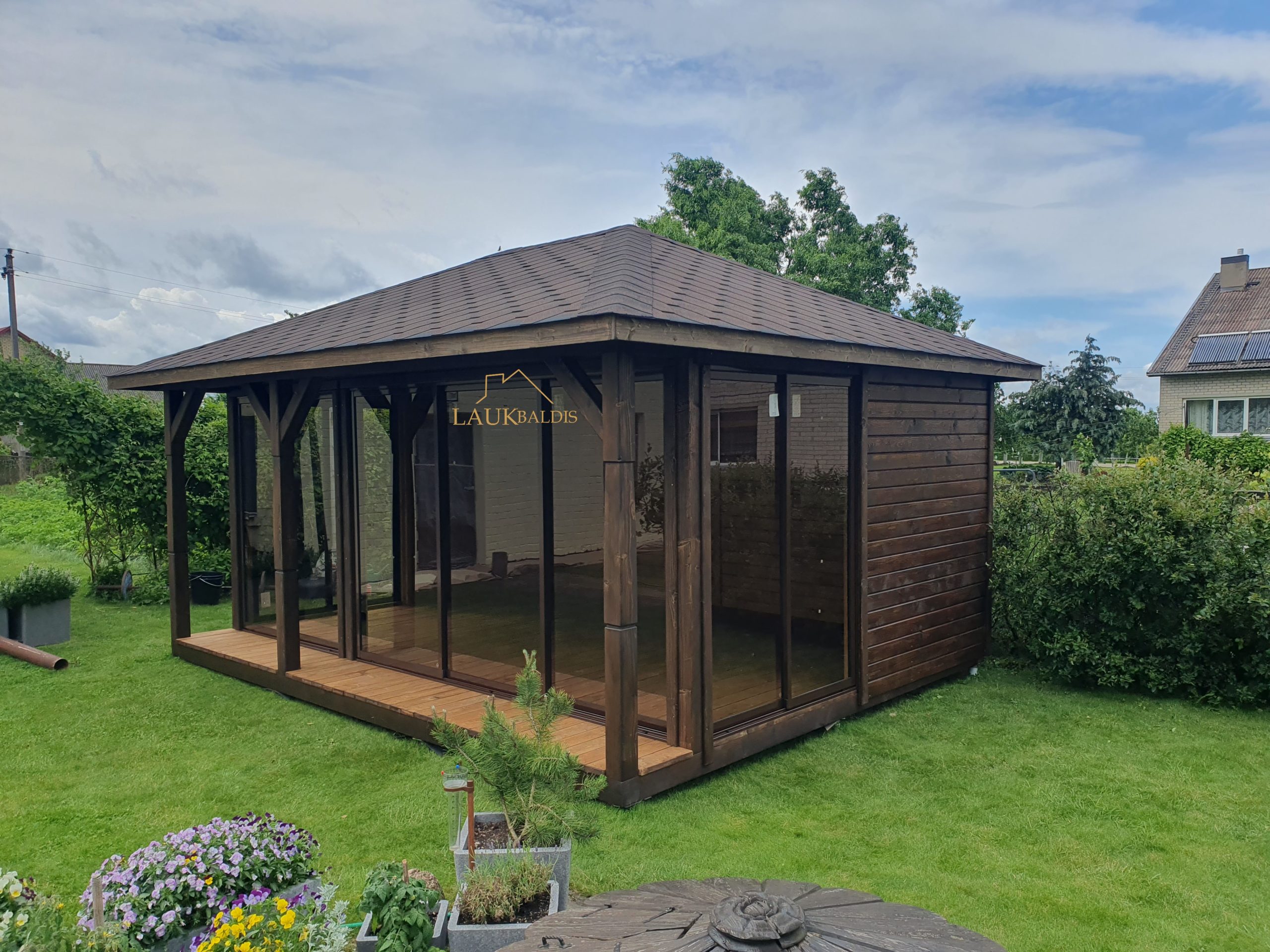
In short: Wooden gazebo No. 25-57 is a dark brown gazebo with a hip roof, glass walls and a narrow covered terrace that runs along the long side. One end is closed with boards, so it is cozy inside, while the roof protects from sun and rain. The size, finishing and equipment are agreed with each customer individually.
A wooden gazebo surrounded by flowers and planters
The photo was taken in summer, in a living, well-kept garden. In the foreground you can see planters with blooming pansies, concrete flower boxes with a young pine and other greenery, and at the very bottom of the frame a dark round wooden tabletop with a carved pattern. Further on stretches a tidy lawn, and on the right a dense hedge surrounds the gazebo. In the background you can see a neighboring house and tall deciduous trees.
In a setting like this a dark wooden gazebo does not stand out as a foreign body but becomes part of the garden. Dark brown goes well with greenery and flowers, and the large glass walls reflect the sky and the trees. When the sun lights up the garden, you can see clouds and foliage in the glass, so the gazebo looks lighter than it really is.
This photo shows well that a gazebo does not need an empty, open site. It blends nicely among existing flower beds, shrubs and planters, and they in turn help the structure look cozy from the very first day.
A gazebo in the garden plays several roles. In the morning you can have coffee there in peace while the dew has not yet dried on the grass, during the day you can hide from the heat or rain, and in the evening you can sit down with family or friends. The glass lets you spend time here even when it is cool or windy outside, so the garden season is extended by several months.
Two-tone colors: dark walls and a light floor
What strikes the eye first is the contrast between the dark brown walls, posts and roof frame and the light, honey-colored floor boards. The narrow terrace in front of the glass looks like a light strip that emphasizes the base of the gazebo and invites you to step up. A combination like this works: a light floor visually widens the space, while dark walls give the structure solidity.
The hip roof is covered with brown tiles that are close in tone to the walls. As a result the upper part of the gazebo looks unified, and the edge of the roof, projecting beyond the walls, forms a clear horizontal line. The overhang protects the glass and the terrace floor from direct rain and casts shade on the gallery on a hot day.
A dark finish in a garden has a practical advantage: dust, pollen and small bits of dirt show less on it. At the same time it nicely brings out the natural grain of the wood, which can still be seen through the coating from up close.
A covered gallery along the glass wall
On the long side, in front of the glass wall, there is a narrow covered terrace. It is bounded on the outside by a row of posts, joined at the top to the roof beam by diagonal braces. This forms a kind of gallery, a walkway under the roof from which you can enter the gazebo or simply stand and look at the garden.
A gallery like this is useful in several ways:
- the roof overhang together with the terrace protects the glass from rain and splashes of mud;
- before going in, you can wipe your boots or leave an umbrella;
- a planter with flowers or a small bench fits on the narrow terrace;
- in summer, with the glass slid aside, the gallery and the interior merge into one space.
The glass walls are set in dark frames that blend with the walls and are barely visible from a distance. There is glass both on the long side and on part of the short end, so the interior is bright and almost the whole garden can be seen from inside. The sliding glass lets you close the gazebo on a cooler day and open it on a hot one.
A closed rear wall and a lamp inside
The right end of the gazebo is covered with dark horizontal boards. This wall faces the hedge, so those sitting inside feel more at ease, as not all sides are open to view. The closed wall also holds back the wind from that side and provides space for furniture that is convenient to put against a wall.
Through the glass you can make out a lamp mounted on the inner wall. This small detail is a reminder that the gazebo can be used after dark too: in the evening a lit lamp turns it into a cozy garden room. What lighting to install is decided when you order, and Laukbaldis also makes wooden lamps.
The interior in the photo is not yet furnished, and only the light floor is visible. That leaves you free: inside you can put a table with chairs, a soft relaxation corner or even a workplace in the fresh air.
Since one wall is closed, it is convenient to put a long bench or sofa against it, and the table closer to the glass, so that the garden can be seen from your seat. This way a wooden gazebo becomes something like an additional room in which you can spend time from early spring to late autumn.
How to fit a gazebo into a living garden
If flower beds, shrubs and trees already grow in the garden, the spot for the gazebo is worth choosing so that it does not disturb the plants and also takes advantage of their beauty. A few tips:
- Turn the closed wall toward the neighbors. As in the photo, the closed end can face a hedge or the boundary of the plot.
- Point the glass at the nicest view. Let the long glass side look onto the flower beds or lawn you want to enjoy while sitting inside.
- Leave room around it. A gap must remain between the gazebo and the shrubs so that the walls can dry after rain and be looked after.
- Planters by the gallery. Flowers in planters next to the terrace connect the gazebo with the garden, and they are easy to move.
The section wooden planters and doors is devoted to wooden planters and other garden accents. You will find similar solutions in other works too: the gazebo with a gallery by the house No. 25-8.2, the gazebo with sliding windows by a row of thujas and the gray gazebo with a natural wood interior. You will find all the examples in the section wooden gazebos.
What to discuss before it is made
The website shows only typical examples, so the photo is a starting point and not a final drawing. Before it is made, it is worth deciding a few things:
- what size of gazebo will fit in your garden and how many people will usually sit in it;
- whether the gallery should be on one side only or on the others as well;
- which walls will be glazed and which closed;
- what color of wood and roofing will go with the house;
- whether lighting and electricity will be needed in the gazebo.
It is especially worth thinking about the width of the gallery. In the photo it is narrow, meant for walking through, standing or putting down a planter. If you want chairs or a small table to fit under the roof in front of the glass, the terrace can be planned wider. Also consider which side the entrance will be on: it is most convenient when it faces the house or the path.
If you plan to spend evenings in the gazebo, discuss the lighting and the electrical supply in advance. Then the lamps can be placed where they will really be needed: above the table, by the entrance or in the gallery.
Care through the year and ordering by phone
Outdoor wood suffers most from moisture and the ultraviolet rays of the sun. Every spring inspect the walls and the gallery floor: if the surface has faded, become rough or water no longer beads up, it is time to renew the coating made for exterior wood. The light floor and the dark walls may need different care products, so it is worth looking after them separately.
Sand, leaves and pollen collect in the glass tracks, so they should be cleaned periodically. In autumn sweep the leaves off the gallery, and in winter do not let a thick layer of snow build up on the roof. After rainy days air the gazebo by sliding the glass open.
Pay more attention to the bottoms of the posts and the edge of the gallery floor, because rain splashes reach them most often. As natural wood dries, small cracks may appear. This is a normal phenomenon that usually does not harm strength. Wash the glass with ordinary window cleaners.
UAB “Laukbaldis” has worked since 1996 and, as the company states, was the first in Lithuania to start making this production. The company is based in Dapkiškių village, Tauragės district. To order, call +370 687 25388 and quote No. 25-57. You will discuss the size, the gallery, the glazing, the color and the place in your garden, and if you have photos of the garden, have them ready in advance.
Do not hesitate to ask about changes. A wooden gazebo is made according to the agreed solutions, so you can change its size, the layout of the glass, the width of the gallery or the color, so that the final result suits your garden.
Frequently asked questions
How does this wooden gazebo differ from a fully enclosed one?
On the long side in front of the glass there is a narrow covered terrace bounded by posts with braces. It protects the glass from rain and lets you stand under the roof before going in.
Can I order a lighter gazebo?
Yes, the dark brown color in the photo is only one of the options. The shade of the wood and the roofing can be discussed when you order.
Can lighting be installed in the gazebo?
In the photo you can see a lamp on the inner wall through the glass. Lighting solutions are discussed when you order, and Laukbaldis also makes wooden lamps.
Why is one end of the gazebo closed?
A closed wall gives privacy and holds back the wind from that side. It is also convenient to put furniture against it.
Can a gazebo be placed among existing flower beds?
Yes, in the photo it stands in a well-kept garden among lawn, hedge and flower planters. It is important to leave a gap between the walls and the shrubs so that the wood can dry after rain.
How do I order gazebo No. 25-57?
Call us and quote No. 25-57. We will discuss the size, the glazing, the color and the place in your garden.