In short: Gazebo with sliding glass No. 25-52 is a wooden gazebo with a hip roof, glazed at the front and on the right side, with the left end closed by boards. A narrow covered terrace runs along the glass under the roof, supported by square timbers with braces. The size, finishing and equipment are agreed with each customer individually.
A gazebo with sliding glass on a country lawn
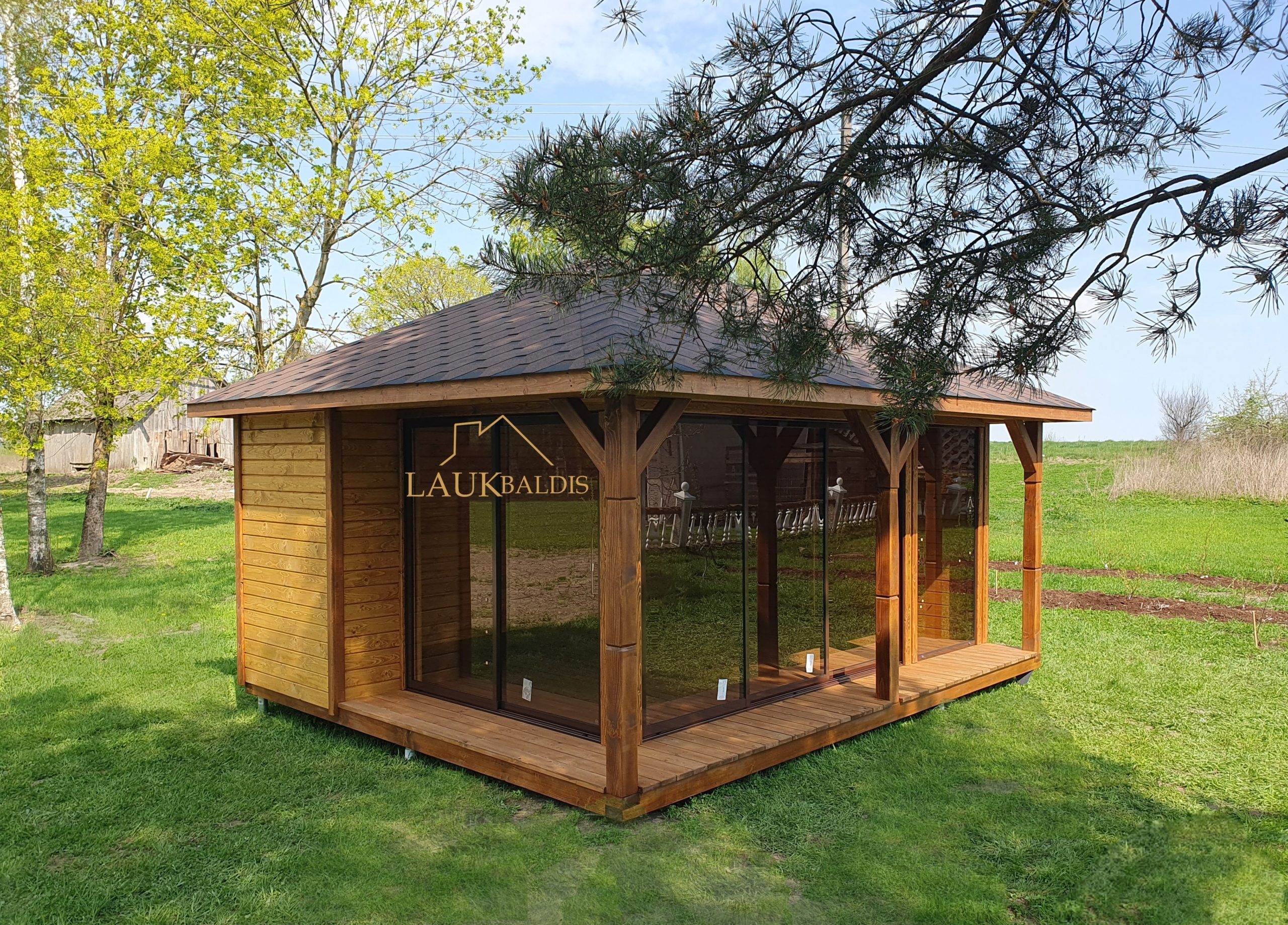
The photo was taken in spring, when the birches had just unfolded their first light green leaves. The gazebo stands on a wide lawn, fields open up behind it, and on the left in the background you can see an old wooden farm building. This is a typical country homestead setting, where there is no shortage of space and the horizon is far away. In a place like this, glass makes particular sense: through it you see not the wall of a neighboring house but a field, trees and sky.
From the right, a large pine branch hangs over the roof. It frames the shot and brings calm to the place. It also shows that the gazebo stands beside old trees and not on an empty plot, which always adds coziness and shade on hot days. For part of the day the pine casts its shadow on the roof and the glass, so on a sunny day it does not heat up as quickly inside.
The gazebo itself has a classic form: a rectangular plan, a hip roof and wood finished in a warm honey shade. Its layout is well thought out, though: one section is closed, another is bright and open to the garden, and along the glass a narrow walkway is left under the roof.
A gazebo like this suits those who spend a lot of time at a homestead and want a bright place to gather but do not want to build another house. It looks good beside old farm buildings and beside a new homestead, because wood and a simple form always fit a country setting. In the gazebo it is pleasant to eat after work in the garden, celebrate family occasions, host grandchildren who arrive in summer or simply watch the sun set over the fields in the evening.
The closed left end
On the left side of the gazebo there is no glass: that wall is made of horizontal boards divided by vertical trim. From this side the gazebo looks like a small wooden cabin, so it goes well with the old farm building in the background.
The closed end has several advantages. It blocks the wind if it blows from that side. It is convenient to put a table or a sofa against it, because there is a solid wall to lean your back on. If needed, shelves for dishes, cushions or candles can be fitted on the inner side. In addition, a closed wall gives privacy: from the road or the neighboring yard nobody can see what is going on in the gazebo.
Which side to leave closed is decided according to the particular plot. The closed wall is usually left where the prevailing winds blow from, or where there is nothing worth looking at.
The closed section can also be put to more practical use. Along its inner wall you can keep folding furniture, garden cushions or dishes, so you do not have to carry them from the house every time. Whether it will be just a wall or a separate small room with a door is discussed when you order, because the website shows only typical examples.
Glass that reflects the garden
Sliding glass in dark frames is fitted at the front and on the right side. On a sunny day it works like a mirror: it reflects the lawn, the birches and even the white fence from the other side of the yard. Because of this, the gazebo looks light from a distance, as if dissolved in its surroundings.
Sliding glass lets you change the character of the gazebo in a few seconds. When the weather is warm and calm, you can slide it aside and open the interior to the garden. When a spring wind blows or rain approaches, the glass is closed again. This is especially valuable in open country, where the wind over the fields is felt more strongly than in town between houses.
Through the glass you can see the wooden floor and the light interior walls. The inside is empty, so you can furnish it as you like: put in a long table for family dinners, soft armchairs for relaxing or a desk.
The glass is most useful in the transitional seasons. In May, when the days are already warm but the evenings are still cool, a closed gazebo lets you sit outdoors longer. In September, when the harvest is being brought in from the fields and the evenings get shorter, you can still have dinner in it and watch the countryside through the glass. That way the season at the homestead starts earlier and ends later.
A covered strip along the glass and posts with braces
In front of the glass the floor extends forward and forms a narrow terrace, which continues along the right side too. It is covered by the same roof, and at the corners and at the front the roof is held up by square timbers. Diagonal braces are fixed to the top of each timber, strengthening the joint with the beam and giving the gazebo the traits of traditional wooden architecture.
The narrow terrace is not meant for large furniture, but it is very practical. You can put a planter with flowers there, leave your boots before going in, or step out to look at the fields without getting wet after rain. It also protects the glass and its bottom edge from direct rain and from the mud that would otherwise splash up from the ground.
The floor frame is raised above the ground, so a gap for air remains underneath. That helps the wood dry faster after rain and dew.
The posts and braces are stained the same honey shade as the walls, so they do not stand out from the overall picture but only accentuate the outline of the gazebo. Viewed from an angle, as in the photo, you can see how the row of posts repeats the rhythm of the glass and how the roof edge runs evenly around the whole building. A simple, clear frame like this is one of the reasons a gazebo of classic form does not get boring even after many years.
A short overview of the details
| Detail | Visible in the photo |
|---|---|
| Hip roof with tiles | Yes |
| Sliding glass | Yes, at the front and on the right side |
| Closed wall of boards | Yes, on the left side |
| Narrow covered terrace | Yes, along the glass |
| Posts with braces | Yes |
| Furniture inside | No |
How to place a gazebo in open country
On a country plot there is a lot of room, so it is tempting to put the gazebo anywhere. A few simple things will help you use it more often:
- The view. Think about what you want to see through the glass: fields, the garden, a pond or a play area for the children. The glass walls should face exactly there.
- The wind. In open country it is worth turning the closed wall toward the side the wind blows from most often.
- Trees. Old trees growing nearby give shade, but needles and cones will fall on the roof, and roots can interfere with the foundation.
- The distance to the house. The easier it is to walk to, the more often the gazebo is used. A path from the house is very handy in autumn and spring.
Before the gazebo is delivered, the spot has to be prepared: strip the turf, level the ground and agree on what the floor frame will stand on. On country plots the soil varies a great deal, from sand to clay, so the foundation solution is best discussed by phone. The drier and more level the base, the longer the gazebo will stand straight and the more smoothly the sliding glass will run.
Wooden garden furniture goes well with the gazebo too. Laukbaldis makes it from solid oak, and the knots, grain and natural curve of the wood make each piece unique. If your homestead needs more wooden buildings, see the section sheds, garages and shelters.
You will find similar works among the other examples: the glazed gazebo at the edge of a pine forest No. 24-3, the gazebo with glass among fruit trees No. 25-1 and the gazebo with an open terrace No. 25-9. You will find all the gazebos in the section wooden gazebos.
Care under pines and ordering
A pine branch over the roof means needles will collect on it, and sometimes resin too. At least once a season it is worth inspecting the roof covering and clearing the accumulated debris so that rain water runs off freely. It is better to trim branches that touch the roof.
A protective coating made for exterior wood shields it from moisture and sun. When the surface turns pale or water no longer beads up, the coating should be renewed. Needles and sand collect in the tracks of the sliding glass, so it is worth cleaning them regularly.
In winter make sure a thick layer of snow does not build up on the roof, especially if snow also falls onto it from the pine branches. In spring, before the first evening of the season, it is worth airing the gazebo, sweeping the floor and washing the glass, and then it will look like new again.
UAB “Laukbaldis” has worked since 1996 and, as the company states, was the first in Lithuania to start making this production. To order, call +370 687 25388 and quote No. 25-52. During the call you will discuss the size, the glazing, the closed wall and the finishing.
Frequently asked questions
Which walls of this gazebo are glazed?
In the photo the sliding glass is fitted at the front and on the right side, while the left end is covered with horizontal boards. The layout of the glass can be changed to suit your plot.
What is the narrow terrace along the glass for?
It lets you leave the gazebo without getting wet and protects the bottom of the glass from rain and mud. It is also handy for putting down a planter or leaving boots.
Can a gazebo be built under big trees?
Yes, but needles and leaves will collect on the roof, so you will need to clean it more often. It is worth trimming branches that touch the roof.
Is the gazebo sold with furniture?
The interior in the photo is empty. You can choose furniture yourself, and Laukbaldis also makes solid oak garden furniture.
Can the closed end be turned into a storage space?
Yes, the purpose of the closed section is discussed when you order. It can stay a plain wall or become a small room for keeping things.
How do I order gazebo No. 25-52?
Call us and quote No. 25-52. We will discuss the size, the position of the glass, the closed wall, the roofing and the shade of the wood.