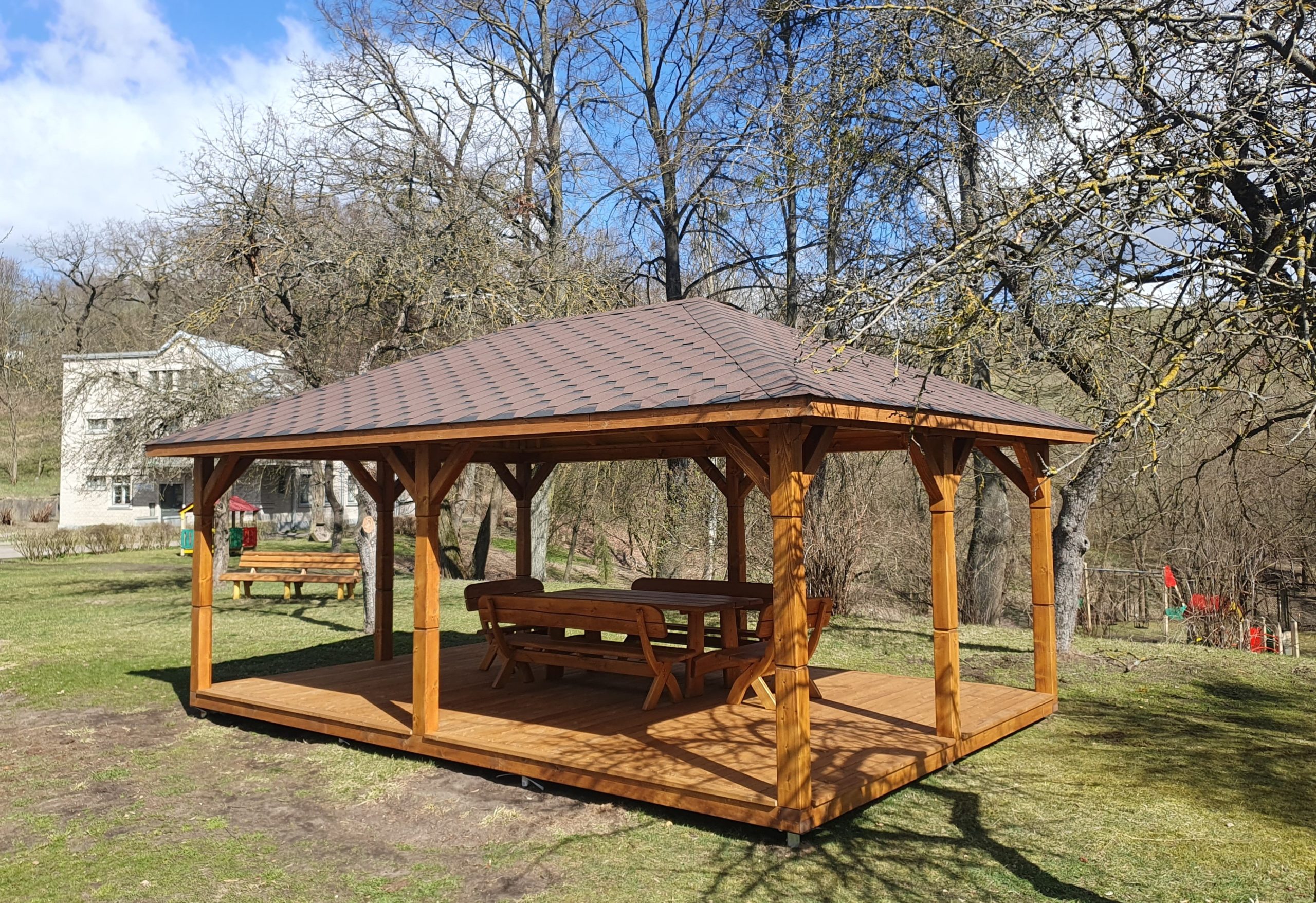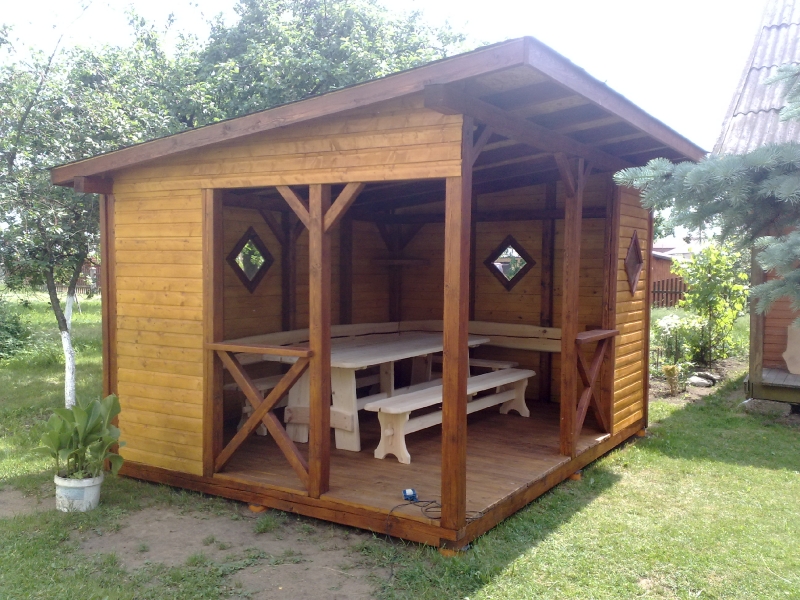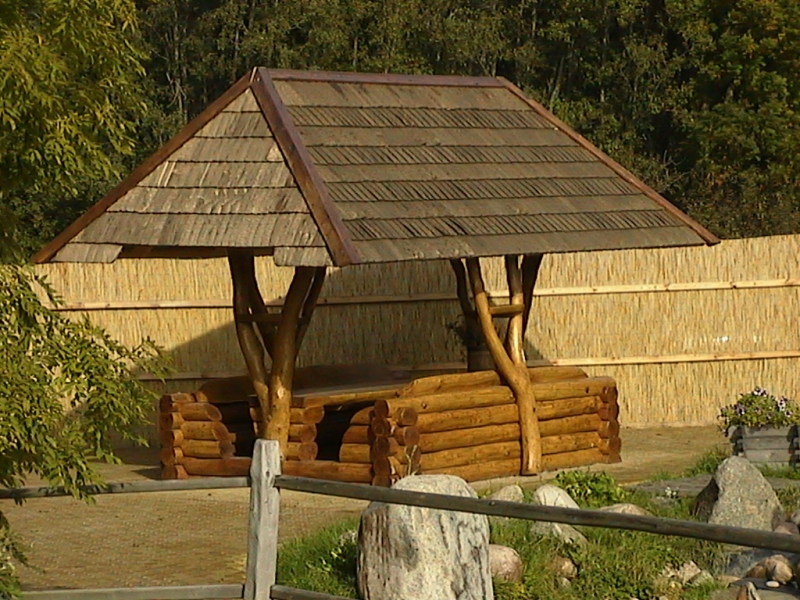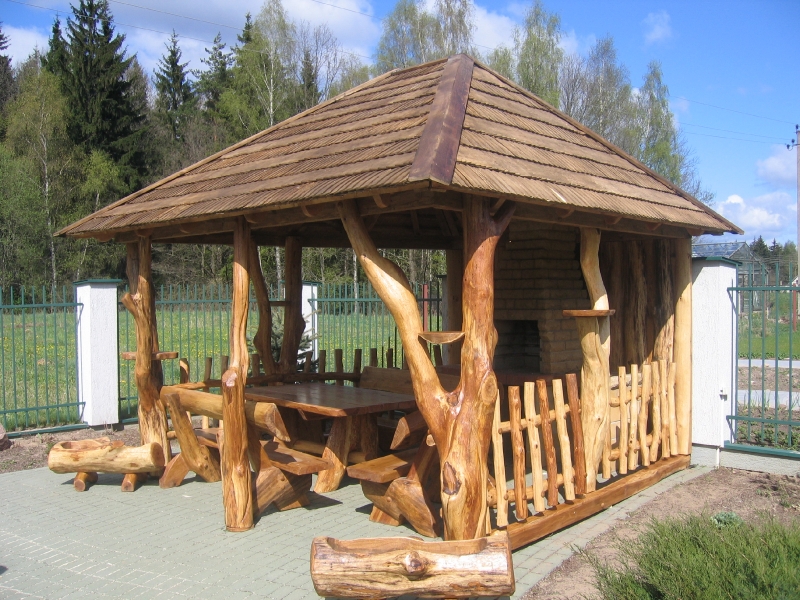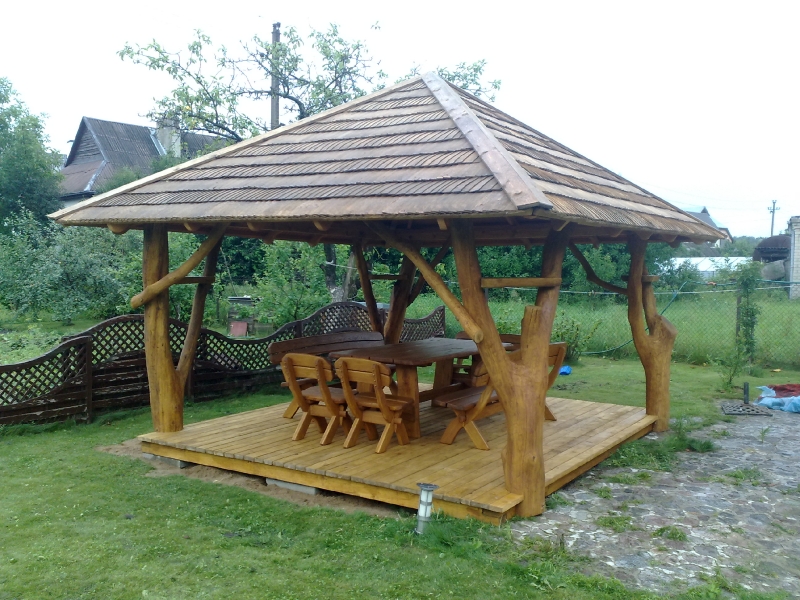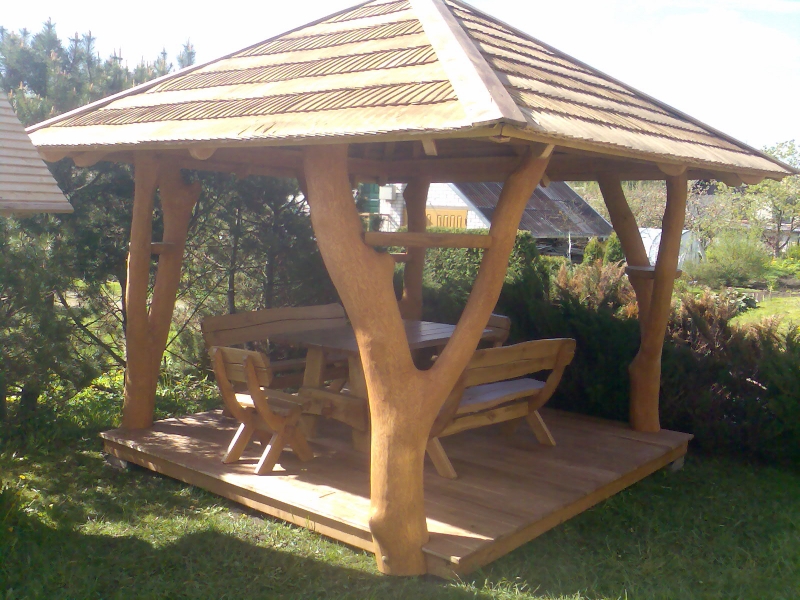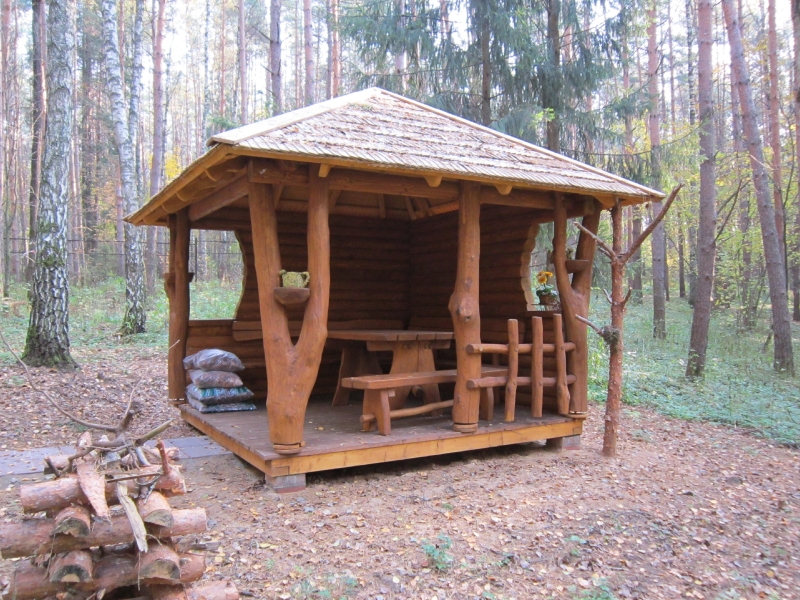
In short: Forest gazebo No. 21-3 is an open log gazebo with a light shingle roof, built among pines and birches. The roof is held up by several natural-shape trunks, log walls are built at the back and on the left, there is a railing of branches on the right, and a table with a bench stands inside. The size, finishing and equipment are agreed individually.
A gazebo in the forest: a resting place among the trees
This photo was taken in autumn, in a forest. Tall pines and white birches stand all around, and fallen leaves and needles cover the ground. The gazebo looks like a natural part of the forest here: its trunks echo the tree trunks, the shingle roof echoes the colors of autumn leaves, and the light wood stands out against the darker forest background.
A gazebo in the forest is a special place to rest. There are no neighbors looking in, no street noise and no strict yard boundaries. All around are only trees, birdsong and the scent of pines. A gazebo like this suits a forest plot by a homestead, holiday houses, rural tourism farmsteads or campsites, where people come precisely for nature.
In a forest the gazebo often becomes a landmark too. It marks the spot where people gather after a walk, mushroom picking or a swim, where guests are awaited and where impressions of the day are shared in the evening. Sometimes it also serves as a shelter from a sudden rain: when clouds arrive unexpectedly, you always know where to take cover.
The open construction was chosen here for a reason. In a forest nature itself provides a windbreak, so there is no need to close many sides. It is much more important to keep the connection with the surroundings: sitting at the table, you see trees on all sides, and the air circulates freely. An open gazebo also dries faster after rain, which matters in the shade, where there is less sunlight than in an open yard.
The photo also shows small signs of life: cushions are stacked on the floor, a flower pot stands on the shelf, and firewood is stacked in front. This is not an exhibition sample but a real, used resting place where it is easy to imagine an autumn evening with tea and conversation. The cushions on the benches can be taken away each time and, after rain, stacked again in a dry place.
An open structure: trunks and log walls
The roof is held up by several natural-shape trunks placed around the perimeter. In the front left corner stands a trunk that branches at the top and forms a silhouette resembling the letter Y. A shelf is fixed between its branches, and in the photo a flower pot stands on it. The other trunks are straighter, but each has its own bend and branch stubs.
At the back and on the left side there are walls of round logs. The back wall is tall, while the front part of the left one is lower, with the log ends cut in a curved line along the top. The walls hold back the wind, separate the table from the forest and give support for your back, yet leave a wide view of the trees through the open sides.
All the wood is peeled, sanded and coated with a warm honey-colored shade. The light trunks and logs contrast with the dark pine trunks and white birches, so the gazebo can be seen from afar among the trees but does not look foreign. In a forest setting such light finishing is practical too: the gazebo is easy to spot from a distance, even at dusk.
The floor is raised above the ground on a base frame. In a forest this is especially important: the ground is often damper, and fallen leaves and needles hold moisture for a long time. A raised floor lets air circulate beneath it, so the wood dries faster. In addition, a gazebo on a base frame does not rest directly on the soft forest floor, so it stands firmer and more level.
A shingle roof under the pines
The hip roof is covered with light shingles laid in dense rows. The ridges are covered with narrow boards, and round rafter ends stick out under the roof edge. The roof projects widely beyond the trunks, so rain does not reach the table even when it falls slantwise.
A shingle roof looks very natural in a forest. With time it will take on a silvery gray patina and blend with the pine bark and the shadows. UAB “Laukbaldis” also makes shingles for roofs, so this kind of covering can be ordered together with the gazebo.
Under pines, needles and small twigs constantly fall on the roof. They need to be swept off regularly so that moisture does not build up and moss does not grow. If large dry branches hang over the roof, it is worth trimming them in advance.
On the other hand, the tree crowns give the gazebo natural shade, so in summer it is pleasant under the shingle roof even in the greatest heat. Sunlight filtering through the branches draws a playful pattern of light and shadow on the floor and the table, which is one of the greatest charms of a gazebo in a forest.
A branch railing and cozy details
On the right side of the front, between two trunks, there is a railing of natural branches. Vertical branches are joined by horizontal crossbars, and a wider rail is laid on top. It marks the border of the gazebo and adds coziness but does not block the view of the forest.
Inside stand a table with sturdy legs and a long bench. UAB “Laukbaldis” makes solid oak outdoor furniture, so the table, benches or chairs can be ordered together with the gazebo. Sturdy, natural-shape furniture suits a forest especially well, as it goes with the trunks and the branch railing.
On the right, next to the gazebo, there stands a decorative forked post. Small details like this help blend the gazebo into its surroundings and create a unified picture of a forest resting place.
Other natural wood products also go well with a gazebo in a forest: a bench by the path, a small wooden bridge over a ditch or a woodshed. When they are all made in a similar style, the forest plot looks like a unified, thought-out resting area and not randomly placed structures.
What the photo shows
The table helps you quickly assess the solutions used in this typical example.
| Feature | In the photo |
|---|---|
| Shingle roof | Yes, hip |
| Natural-shape trunks | Yes, several |
| Round log walls | Yes, at the back and on the left |
| Branch railing | Yes, on the right |
| Wooden floor on a base | Yes |
| Table and bench | Yes |
| Surroundings | Forest of pines and birches |
What is important to know when building a gazebo in a forest
A forest is a beautiful but distinctive environment. Moisture lingers longer there, there is less sun, and needles, leaves and twigs constantly fall on the roof and the floor. When planning a gazebo in a forest, pay attention to a few things:
- The spot. Choose a somewhat higher, drier place where water does not stand after rain and where at least a little sunlight reaches through the tree crowns.
- The base. The floor must be raised so that air circulates beneath it.
- Trees around. Inspect the nearest trees and remove dry branches that could fall on the roof.
- Fire. If you plan a fire pit, set it up at a safe distance from the gazebo and the trees, and keep firewood not right under the roof.
- Care. Inspect the wood every year; if the surface has turned pale or rough, renew the protective coating.
In a forest gazebo the wood may dry more slowly than in an open place, so check the bottom logs, the bottoms of the trunks and the floor especially carefully. Small cracks as the wood dries are natural and usually do not harm the structure. The main thing is that the wood is not constantly damp, so it is worth leaving a clean strip around the gazebo without piles of leaves and dense shrubs.
How to order forest gazebo No. 21-3
Laukbaldis shows only typical examples, so the size, layout of the walls, railing, roofing and finishing are agreed individually. Before calling, think about how many people will usually gather in the gazebo, what the spot in the forest is like and how easy it will be to walk to it. If the forest plot is remote, it is worth discussing in advance the access to the planned spot.
More similar examples: the small gazebo under tree canopies No. 21, the square gazebo with a branch railing No. 21-1 and the log gazebo by a pond among birches No. 26. You will find all the works in the section wooden gazebos, and if you also plan a sauna or a summerhouse in the forest, look in the section saunas and summerhouses.
UAB “Laukbaldis” has worked since 1996 and, as the company states, was the first in Lithuania to start making this production. Call +370 687 25388 and quote No. 21-3: during the call you will discuss the size, shape, roof and finishing.
Frequently asked questions
Can a gazebo be built in a forest?
Yes, the photo shows exactly such a gazebo in a forest of pines and birches. It is important to choose a drier spot and to raise the floor so that air circulates beneath it.
Why is an open gazebo worth choosing in a forest?
In a forest the trees themselves hold back the wind, so there is no need to close many sides. An open gazebo lets you see the forest on all sides and dries faster after rain. The log walls at the back and on the side still give shelter to those sitting at the table.
How do I look after a shingle roof under pines?
Regularly sweep off needles and twigs so that they do not hold moisture. If you notice moss, remove it in time, and trim dry branches above the roof.
Can a fire pit be set up next to the gazebo?
Yes, but it must be set up at a safe distance from the gazebo and the trees. It is better to keep firewood in a separate woodshed and not under the gazebo roof.
Can I choose which sides are closed?
Yes, the layout of walls and railings is discussed when you order. It is worth considering where the nicest view of the forest opens up and which side the path comes from.
How do I order forest gazebo No. 21-3?
Call us and quote No. 21-3. Together you will discuss the size, the layout of the walls, the roofing and the finishing. Photos of the planned spot in the forest will help you choose the right solution faster.