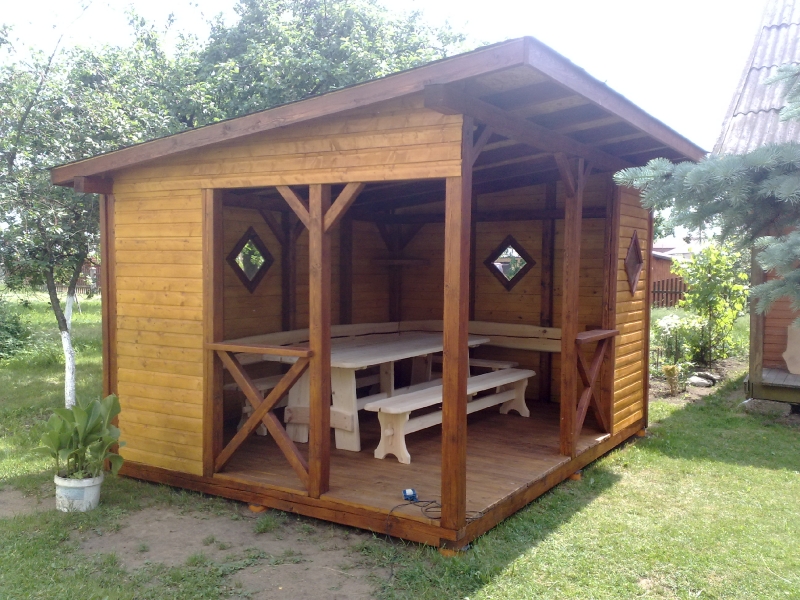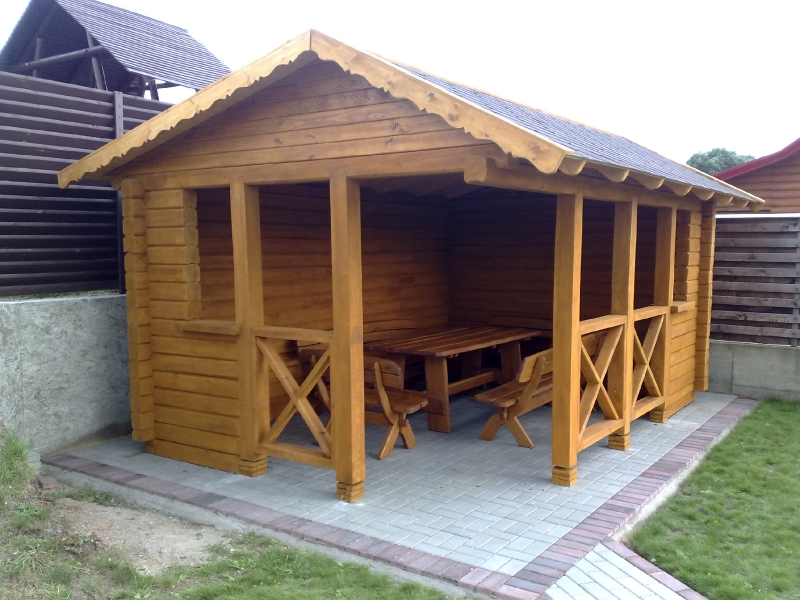
In short: Gazebo with a gable roof No. 23-5 is a rectangular wooden gazebo with a roof covered in gray tiles, carved bargeboards and a board gable. At the front and on the side the roof is held up by hewn posts, with cross-braced railings between them, while the back and left walls are made of milled logs. The size, finishing and equipment are agreed individually.
A gazebo with a gable roof: a form of tidy lines
This gazebo differs considerably from many Laukbaldis gazebos with natural trunks. Here straight, tidy lines predominate: the roof has two slopes, the posts are hewn with a square cross-section, and the railings consist of straight boards crossed in an X. Such a shape recalls traditional Lithuanian farmyard buildings – granaries, porches, woodsheds – and suits those who find the expression of natural trunks too wild.
A gable roof is the simplest and clearest roof form. It has two gables at the ends, so seen from the side the gazebo looks like a small house. The long, elongated shape suits a narrower plot or a spot along a fence: the gazebo can stand with its long side toward the yard and its end toward the neighbors.
Under a gable roof there is more height in the center, under the ridge, so the interior feels more spacious. This is handy when many people move around in the gazebo, and when you want to hang a lantern or small plant pots from the beams. In addition, the structure of such a roof is clear and easy to look after. Rainwater and snow run and slide off both planes to either side, and on the gable sides the bargeboards protect the edge of the roof from the wind.
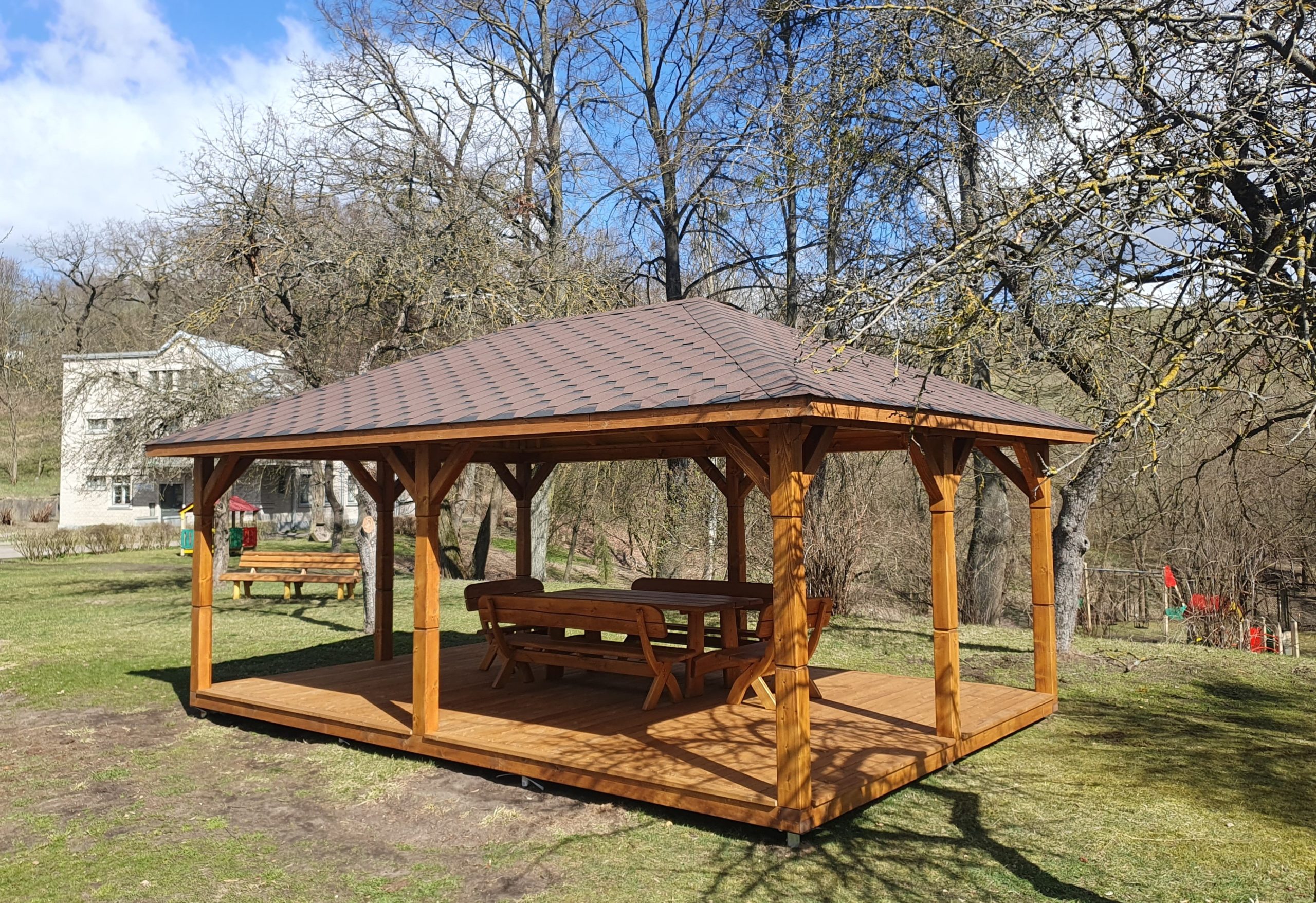
The roof is covered with gray bitumen tiles. The dark gray color contrasts well with the light, honey-colored wood and goes with the gray concrete walls and paving blocks around. Such a covering is light, adapts well to the roof planes and needs no complicated care.
Carved bargeboards and the gable
The look of this gazebo is decorated most by the bargeboards, wide boards covering the roof edge on the gable side. Their lower edge is cut in a wavy, ornate pattern, and at the ends the boards finish in decorative shapes. Such carving is characteristic of old Lithuanian wooden architecture, where each craftsman tried to decorate the gable of a house in his own way.
The gable itself is filled with horizontal boards coated in the same honey shade as the rest of the gazebo. Under the edge of the roof on the long side the rafter ends can be seen, which are also cut decoratively. It is precisely such small details that turn a plain rectangular form into a distinctive, handmade structure.
The pattern of the carved bargeboards can be discussed when you order: some choose a calmer one, others a more ornate ornament. What matters is that the pattern goes with the finish of the house or the other buildings in the yard.
Ornate bargeboards suit especially well when the gazebo stands near a house whose gable or window trim is also decorated. Then a unified style appears in the yard, and the gazebo looks like a natural extension of the house rather than a structure placed there by chance. If the house is modern, the pattern can be simplified, leaving only a light wavy line.
Hewn posts and cross-braced railings
The open sides of the gazebo are held up by sturdy hewn posts. They have a square cross-section and smooth surfaces, and at the bottom they rest on small separate bases, so the wood does not touch the paving blocks. This solution helps protect the ends of the posts from the moisture that can stand on the floor after rain.
Between the posts, at the front left and on the right side, railings with a cross pattern are installed. Each section has an upper rail, a lower crosspiece and two diagonal boards crossed in an X. Such a pattern not only decorates but also stiffens the structure. The railings leave the view of the yard open and at the same time clearly mark the boundaries of the gazebo.
A wide entrance at the front, between the middle posts, makes it easy to bring in furniture and to move freely. In some sections, instead of railings, wider boards can be installed on which it is convenient to put dishes.
Hewn posts have a practical advantage: their smooth surfaces are easy to maintain and to coat with a protective finish. In addition, hooks for lanterns, planters or curtains are easy to attach to straight posts if you want to cover one side from the evening sun. The rectangular, clear form makes it easy to add to the gazebo in the future, for example by installing one more section of railings.
Walls of milled logs
The back and left walls of the gazebo are made of neatly milled logs. They are of equal thickness, with smooth surfaces, stacked in horizontal rows, and at the corners the ends project and form the traditional log joint. Unlike natural round logs, such logs look more precise and go better with the strict lines of the gazebo.
The walls hold back the wind and block the view from the neighbors’ side. In the photo the left wall faces a taller retaining wall and a fence, and the open sides face the lawn and the yard. This makes the gazebo a cozy, enclosed space from which you can still see well what is going on around. The warm honey color looks especially nice next to the gray concrete – it warms the cool surroundings and draws attention away from the retaining wall.
Inside stand a long table, benches and a chair with X-shaped legs. UAB “Laukbaldis” makes oak outdoor furniture, so the table and benches can be ordered together with the gazebo and their shade matched to the walls.
The rectangular plan is very convenient for furniture. A long table is placed along the gazebo, benches on both sides of it, and at the end there is room for a chair or a small table. This arrangement allows a larger family to be seated at one table, and the passage from the entrance to the table stays free.
What can be seen in the photo
The table helps you quickly assess which solutions are used in this typical example.
| Feature | In the photo |
|---|---|
| Gable roof | Yes, gray tiles |
| Carved bargeboards | Yes |
| Hewn square posts | Yes |
| Cross-braced railings | Yes, at the front and on the side |
| Walls of milled logs | Yes, back and left |
| Paving-block floor | Yes, with a border |
| Natural trunks | No |
A gazebo on paving blocks by a retaining wall
In the photo the gazebo stands on a paving-block area bordered by a band of darker paving blocks. Behind the gazebo you can see a concrete retaining wall and a tall board fence, with a lawn beside it. It is a typical plot with a difference in elevation, where the gazebo is placed in the lower, level spot. The retaining wall and the back wall of the gazebo together create a calm corner sheltered from the wind.
A paving-block floor has its advantages: it is easy to sweep and wash, and muddy boots and heavy furniture do no harm to it. In the photo the floor of the gazebo is laid with light paving blocks, with a band of darker paving blocks running around it that clearly outlines the boundaries of the gazebo. It is important that the area slopes slightly away from the gazebo and that rainwater does not collect by the posts and the bottom logs.
Looking after the wood is simple. Once a year inspect the posts, railings and walls: if the surface has faded or become rough, renew the protective coating. Check the tops of the railings and the bargeboards especially carefully, since they are most affected by rain and sun. Sweep leaves and twigs off the roof in spring and autumn. Small cracks that appear as the wood dries are natural and usually do not harm the structure, and it is worth cleaning the joints of the paving blocks once a season so that grass does not grow in them.
How to order gazebo No. 23-5
Laukbaldis shows only typical examples, so the size, the layout of the walls, the pattern of the railings, the ornament of the bargeboards and the roofing are agreed individually. Before calling, think about how many people will usually sit at the table, where the gazebo will stand and whether you want a floor of paving blocks or wood. If your plot has a difference in elevation, as in the photo, it is worth discussing the preparation of the site too. Also think about which sides should be closed with milled logs and which left open with railings.
If you like natural shapes, compare it with these examples: the garden gazebo with a low log wall No. 23-4, the yard gazebo with a brown tiled roof No. 23-1 and the open gazebo with windows No. 25-37. You will find all our work in the section wooden gazebos, and furniture in the section oak garden and outdoor furniture.
UAB “Laukbaldis” has been making wooden products since 1996 and, according to the company, was the first in Lithuania to start making this production. Call +370 687 25388 and quote No. 23-5 – in the conversation you will discuss the size, the roofing, the railings and the finish.
Frequently asked questions
How does a gable roof differ from a hip roof?
A gable roof has two slopes and two gables at the ends, so the gazebo resembles a small house. A hip roof is angled on all sides and looks lower. The choice usually depends on the shape of the roofs of the house and the other buildings in the yard.
What are bargeboards?
They are boards that cover the edge of the roof on the gable side and protect it from wind and rain. In this gazebo they are cut in an ornate wavy pattern and are the main decoration of the facade.
Can natural trunks be chosen instead of hewn posts?
Yes, Laukbaldis also makes gazebos with natural-shaped trunks. It is worth discussing the type of supports when you order, taking into account the style you want and the other buildings in the yard.
Are cross-braced railings required?
No, the railings are optional. They mark the boundaries of the gazebo and stiffen the structure, but some of the sides can be left completely open.
Can the floor be wooden?
Yes, the type of floor is agreed individually. Paving blocks are easier to maintain, while a wooden floor adds more warmth and coziness.
How do I order gazebo with a gable roof No. 23-5?
Call us and quote No. 23-5. Together you will discuss the size, the roofing, the pattern of the railings, the ornament of the bargeboards and the finish.