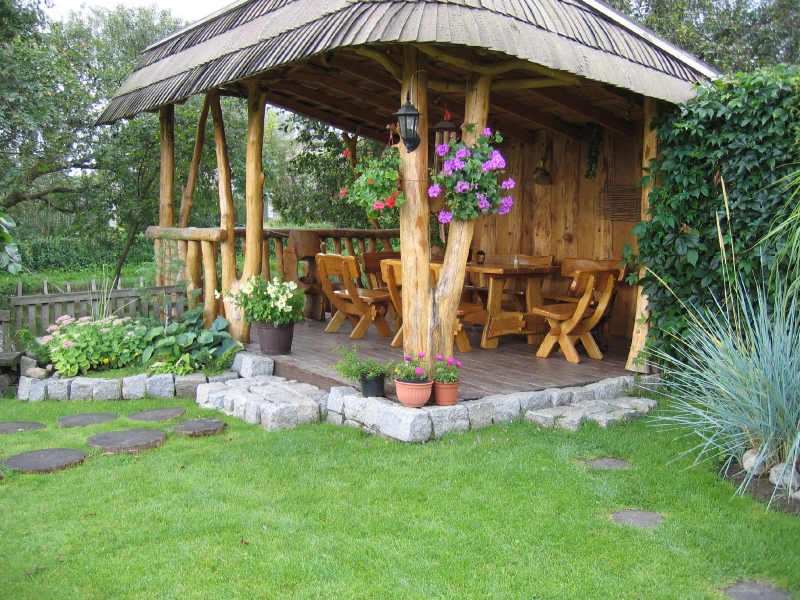
In short: Garden windbreak shelter No. 15-6 is a wooden gazebo whose back wall is built of live-edge boards, while the front and side are left open to the flower beds. The roof is held up by natural-shape trunks, the floor is surrounded by a hewn stone border, and inside stand a table with chairs and benches. The size, finishing and equipment are agreed individually.
A garden windbreak shelter that has become part of the flower bed
In this photo the gazebo no longer looks like a new structure in the yard: it has grown into the garden. A climbing plant winds up the right side, hydrangeas and pelargoniums bloom by the entrance, and pots with violet and red flowers hang from the roof beams. A path of round slabs leads across the lawn toward the gazebo, so even after rain it is easier to come without wet feet.
It is a good illustration of how a wooden windbreak shelter behaves over time. The wood has taken on a rich honey shade, the shingle roof has darkened and turned grayish brown, and the plants around have made a real green frame. The structure does not look foreign: it seems always to have stood here.
If you are creating a garden from the beginning, this photo shows where you can get in a few years. The shelter becomes not only a place at a table but also a support for climbers, a holder for flower baskets and the center of the garden composition.
Pay attention to the path. The round slabs are laid on the lawn with gaps between them, so grass grows around them and the path is barely noticeable. A solution like this suits a garden where you do not want continuous paving. The gazebo then looks like a quiet corner deep in the garden, to which a barely visible way leads.
A curved shingle roof and trunk columns
The roof here is unusual: its slopes are curved, flaring slightly outward at the bottom, so the silhouette resembles a bell or an old thatched roof. The covering is wooden shingles laid in dense rows. The widely projecting edge casts a deep shadow on the floor, and the beams holding up the roof can be seen beneath it.
Outdoors, shingles darken and turn gray over time, which is already clearly visible in the photo. Many people like such aging, because the roof takes on the look of weathered wood and blends even more with the garden. If you want the covering to stay lighter longer, it is worth talking about a protective finish when you order.
The columns are peeled, sanded trunks with all their natural bends. One front column divides into two, and between the branches there is a place to hang a flower basket. The other columns are straighter, but not one is perfectly smooth. That is exactly what gives the gazebo its handmade character: every such shelter is different.
On the left, between the columns, there is a railing of a round pole. It does not close off the view, but it marks the edge of the gazebo and is handy to lean on while standing or to put a glass on.
Trunk columns also suit climbing plants. The plant can climb the thick, rough column, and the forks become natural supports for it. Even so, a climber should not be allowed to wrap all the columns: then the gazebo would lose its shape, and the wood would hold moisture longer.
A back wall with a lantern and small details
The back wall is built of vertical boards whose edges are left natural, so the seams between them undulate. This wall holds back the wind blowing from that side and becomes a cozy backdrop for those sitting at the table. It is easy to hang decorations on it: in the photo a small wooden decoration can be seen.
A black lantern hangs from the roof beam. A lamp like this creates a warm light by the entrance in the evening and goes beautifully with wood and flowers. UAB “Laukbaldis” also makes wooden lamps, so the lighting can be discussed together with the gazebo.
The closed wall has one more advantage: privacy. While sitting at the table your back is to the wall and your gaze is turned to the flower bed. A gazebo like this suits both quiet reading and long conversations in the evening, when you want to feel protected yet remain in the garden.
What the photo shows
A short summary will help you compare this shelter with other examples.
| Feature | In the photo |
|---|---|
| Curved shingle roof | Yes |
| Natural-shape trunk columns | Yes |
| Back wall of live-edge boards | Yes |
| Floor with a hewn stone border | Yes |
| Round-pole railing on one side | Yes |
| Table, chairs with armrests and benches | Yes |
| Hanging lantern | Yes |
| Glass or doors | No |
A floor in a stone border and garden furniture
The most interesting detail of this work is the base. The wooden floor is raised and edged at the front with blocks of hewn gray stone. The stones form a low border on which you can put flower pots, and when you step into the gazebo it becomes a natural step. A beautiful contrast appears between the cold gray stone and the warm brown boards.
A border like this is useful in practice too. It separates the floor from the lawn, so grass does not grow under the boards, and when mowing you do not have to fuss right at the wooden edge. In addition, the border protects the edge of the floor from lawn mower knocks and soil moisture.
Inside stand a wooden table, chairs with armrests and curved backs, and benches. The furniture is the same warm shade as the columns, so the whole picture looks unified. Chairs with armrests are more comfortable for long lunches, and the benches along the wall let you seat more guests when they arrive unexpectedly. Such a combination works in families where sometimes two people sit at the table and sometimes ten. Laukbaldis makes solid oak outdoor furniture, so the table and chairs can be chosen to fit the size and style of the gazebo.
In the photo several clay pots with flowers are set on the stone border. That way the step at the entrance becomes a small flower bed, and the base of the gazebo looks decorative and not just technical. The pots are easy to rearrange or change according to the season.
How to adapt the shelter to your garden
Laukbaldis names only typical examples, so this shelter can be adapted to your yard. Before calling, think about a few things:
- Where the wind blows. It is worth turning the closed back wall toward the side the wind blows from most often.
- What you want to see. Aim the open side at a flower bed, the garden or the evening sun.
- The base. Discuss the stone border or another kind of base according to the soil of your plot.
- Plants. If you plan climbers, leave room by one column or the wall.
- Furniture and lighting. Think about how many people will sit at the table and where you will need light in the evening.
Climbers and flowers give a gazebo a lot of charm, but they need looking after. Do not let climbers creep under the shingles and thickly cover the wood: under the leaves it takes longer to dry. Water hanging baskets so that the water does not run down the columns. Once a year inspect the wood, and if the surface has turned pale or rough, renew the protective coating.
A windbreak shelter in the garden is useful in all the warm seasons. In spring it is a handy place to rest after work in the vegetable garden, in summer to have lunch in the shade, and in autumn, when the garden is painted in colors, to drink tea at the table. Since the gazebo has no glass, it is always aired, and the wood dries quickly after rain.
When choosing a spot in the garden, think about trees too. Under big tree crowns it is pleasantly cool in summer, but leaves will fall on the roof and the floor will stay damp longer. In a more open place the gazebo dries faster after rain, and the flowers around it get more sun and bloom more abundantly.
You will find more examples in the section wooden gazebos. Works in a similar spirit are the windbreak shelter with a terrace No. 15-5, the shelter with massive trunks No. 15-8 and the rustic gazebo No. 25-11. Look for tables and chairs in the section oak garden and outdoor furniture.
How to order shelter No. 15-6
UAB “Laukbaldis” has made wooden products since 1996 and, as the company states, was the first in Lithuania to start making this production. Furniture of solid oak is created by experienced craftsmen, and the branches, twigs and natural curve of the wood make every piece unique.
Call +370 687 25388 and quote No. 15-6. During the call you will discuss the size, the number of closed sides, the roofing, the base and the furniture. If you have photos of your garden, have them ready in advance: it will make it easier to agree on the place and the details.
The website shows only a typical example, so feel free to ask about changes: a different curve of the roof slopes, an extra wall at the side, a longer railing or different furniture. The gazebo is made according to the agreed solutions, so it will suit your garden and not just the photo.
Frequently asked questions
Is the stone border included in the gazebo order?
In the photo the floor is surrounded by blocks of hewn stone, but the base solution depends on the plot. What to include in the order is discussed by phone.
Can climbers be grown by the gazebo?
Yes, in the photo a climber covers one side. Just do not let it creep under the roofing, and trim it regularly so that the wood can dry.
Why does the roof have a curved shape?
The curved slopes are a decorative solution of this work. They give the gazebo a softer, old-fashioned silhouette and look good in the garden among plants.
Can a lantern or flower baskets be hung?
Yes, lanterns and flower pots are convenient to hang from the beams and columns. Laukbaldis also makes wooden lamps, so the lighting can be discussed together.
Will all the columns have the same shape?
No, natural trunks are different every time. The craftsmen select wood of similar thickness, but every gazebo remains unique.
How do I order shelter No. 15-6?
Call us and quote the product number. We will discuss the size, the roofing, the base and the furniture according to your garden.