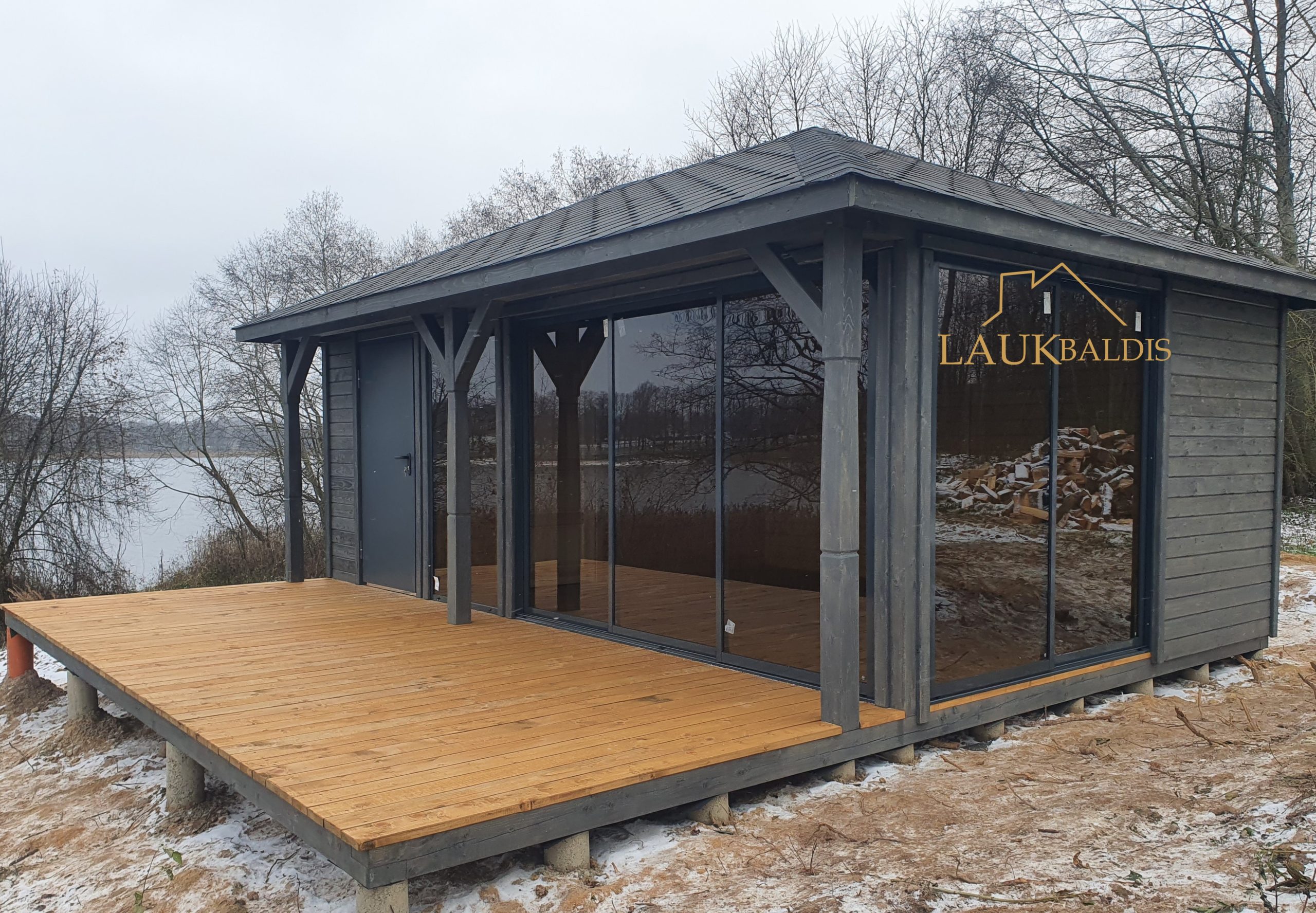
In short: Gazebo by the lake No. 25-38 is a wooden gazebo with graphite-colored walls, a hip roof and large sliding glass, built right on the shore. A wide wooden terrace stretches in front of the glass, most of it left under the open sky. The size, finishing and equipment are agreed with each customer individually.
A shoreline spot this gazebo was made for
The photo was taken in late autumn or early winter: thin patches of snow on the ground, trees without leaves, an overcast sky. On the left, through bare bushes, you can see the surface of the lake and the far shore. The glazed side of the gazebo and the terrace face an open shoreline meadow, and the water lies right next to it.
In a place like this a structure has to withstand more wind and dampness than deeper in a garden. On an open shore the wind blows freely across the water, and in the mornings mist rises from the lake. That is why two features of this gazebo are especially useful here: glass that can be closed and a foundation raised above the ground.
The shot shows one more thing: the gazebo looks good even when nature is gray and colorless. The light terrace boards and the dark walls form a clear contrast, so the structure does not disappear into the landscape even in November.
A graphite-gray exterior and light terrace boards
The walls, posts, cornice and terrace frame of the gazebo are painted a dark gray color reminiscent of graphite. Horizontal boards can be seen at the enclosed ends, and the roof is covered with dark tiles, so the whole exterior looks one color and calm. This shade goes well with the tones of water, stones and bare trees.
The terrace floor boards are left light, in a warm honey shade. This brings out the place where people walk and sit, while the dark structure remains like a frame around it. Such a two-shade combination suits those who want a more modern look but do not want to give up the warmth of natural wood.
The gray door at the left end of the gazebo is set into the enclosed part clad with boards. The door is the same color as the walls, so from a distance it almost merges with the facade. Whether a door is needed here, and which kind, is discussed when you order.
When choosing a color, it is worth thinking about how the gazebo will look in different seasons. In summer a dark exterior stands out boldly against the greenery, and in autumn and winter it matches the gray tones of the water and the sky. If your plot already has a dark-painted house, sauna or fence, such a shade will help tie all the buildings into one whole.
A wall of glass and posts with braces
Most of the front wall is taken up by large panes of glass in dark frames, and on the right side the glass wall continues around the corner. The glass slides, so the panes can be pushed one behind another and the gazebo opened to the terrace. In the photo the glass is closed, and it reflects the trees, the lake and a pile of firewood stacked nearby.
In front of the glass stand posts that hold up the roof. At the top they are joined to the beam by diagonal braces, which strengthen the structure and at the same time give the gazebo traits of traditional wooden architecture.
The hip roof projects beyond the walls and covers a narrow strip of terrace by the glass. You can stand there dry even in the rain, and the roof overhang protects the glass from direct rain.
Through the glass you can see that the interior is still empty, and the floor is laid with the same light boards as the terrace. So, with the glass opened, the interior and the terrace visually join into one space. It is convenient when guests move back and forth: some sit inside, others in the sun on the terrace, and the conversation never stops.
A gazebo by the lake on supports: why it matters
When building a gazebo by a lake, the biggest concern is dampness from below. In this example the whole structure is raised on concrete supports, and in one corner you can also see a support in the form of an orange pipe. A gap remains between the ground and the terrace frame through which air moves freely, so the lower beams dry faster after rain or a thaw.
Supports also help on an uneven plot. Shoreline ground is often sloping, softer or has hollows, and separate supports let you level the terrace without digging a large foundation. Which supports will suit your plot depends on the soil and the size of the gazebo, so this is worth discussing in advance.
- Check how much the water rises in spring and whether the place where you want to build is not flooded at high water.
- Find out whether there are building restrictions in the shoreline strip in your municipality and on your particular plot.
- Take the prevailing wind direction into account – the glazed side is best where you want to see the water but a constant strong wind does not blow.
What the photo shows
This short summary will help you quickly compare this example with other gazebos. It is a typical version whose details can be changed.
| Feature | In the photo |
|---|---|
| Hip roof with dark tiles | Yes |
| Sliding glass | Yes, at the front and on the right side |
| Graphite-colored walls and posts | Yes |
| Open terrace in front of the glass | Yes, wide |
| Posts with diagonal braces | Yes |
| Door in the enclosed part | Yes, at the left end |
| Foundation on supports | Yes |
| Furniture inside | No, the interior is empty |
Using a gazebo by the water in different seasons
In summer the wide open terrace becomes a place to sunbathe, have dinner outdoors or sit down with friends. With the glass slid back, the terrace and the interior merge into one space, so guests can move freely between sun and shade. The roof protects from the scorching sun and from sudden rain, while the breeze coming off the water is only welcome on a hot day.
In spring and autumn the enclosed part becomes the most important. With the glass slid shut, the wind off the lake stays outside, and through the large windows you can still see the water and the shore. It is a good place for morning coffee while watching the mist over the lake, or for an evening conversation when it is already cool outside.
A gazebo by the lake also comes in handy when guests visit the farmstead. You can set up a few tables on the terrace, leave children’s toys or fishing gear there, and keep pillows and blankets in the enclosed part so that they do not get damp from the dew.
In winter a gazebo by the lake can be a place to drop in briefly after a walk along the shore or skating on the ice. To make such use comfortable, it is worth thinking about lighting and furniture in advance. Laukbaldis makes oak garden furniture and lamps, so the empty interior can be furnished to suit your needs.
Before ordering, think about how many people will usually be in the gazebo, whether you will want to put loungers or a table on the terrace, and whether you will need an enclosed part with a door for storing things. You will find similar solutions in other works: the gazebo by the water with a pier No. 25-22, the gazebo with a stove on piles No. 25-24 and the enclosed wooden gazebo with a stepped terrace No. 25-42. All the examples can be viewed in the section wooden gazebos, and terrace furniture in the section oak garden and outdoor furniture.
Painted wood in a damp environment, and ordering
By the water the air is damper, so the protection of the wood deserves more attention. Wood covered with a protective coating is better shielded from moisture and sun, but the coating has to be renewed when it begins to fade or crack. Inspect the ends of the terrace boards, the bottoms of the posts and the places where the boards rest on the frame especially carefully: water stays there the longest.
The open part of the terrace gets the most rain and sun, so its boards change faster than the part covered by the roof. In spring it is worth sweeping the terrace, washing it and, if necessary, treating it with a product made for exterior wood. In autumn clear the leaves off it, because the boards stay damp for a long time under them. Before winter it is also worth checking the roof edges: if twigs or leaves are left on them, water will run off the roof less well and in a thaw will start dripping onto the terrace. Clean the tracks of the sliding glass of sand and small debris, and after rainy weeks air the gazebo.
UAB “Laukbaldis” has been working since 1996 and, according to the company, was the first in Lithuania to start making this production. An order begins with a phone call: call +370 687 25388 and quote No. 25-38. In the conversation you will discuss the size of the gazebo and the terrace, the color, the position of the glass, whether you need a door and the foundation for your shore. If you have photos or a plan of the plot, have them ready – it is then easier to assess the distance to the water and the terrain.
Frequently asked questions
Can a gazebo be built right by the lake?
Technically a gazebo can be built on supports even on an uneven shore, as the photo shows. But before building, check whether your plot has building restrictions in the shoreline strip and whether the place floods in spring.
Why is the gazebo built on supports?
Supports raise the terrace and the gazebo above the ground, so air moves underneath and the wood dries faster. By the water, where the ground is damper, this is especially important. Supports also help level the structure on a sloping shore.
Can the whole terrace be under a roof?
In the photo only a narrow strip by the glass is under the roof, and most of the terrace is open. The size of the terrace and how much of it is covered are agreed individually when you order.
Can I choose a color other than graphite?
Yes, the color and the finish are agreed with each customer. The graphite gray in this example was chosen to go with the water and the shoreline trees, but other shades are possible.
How do I order gazebo No. 25-38?
Call us and quote No. 25-38. You will discuss the size, the terrace, the glazing, the color and the foundation suited to your site by the water.