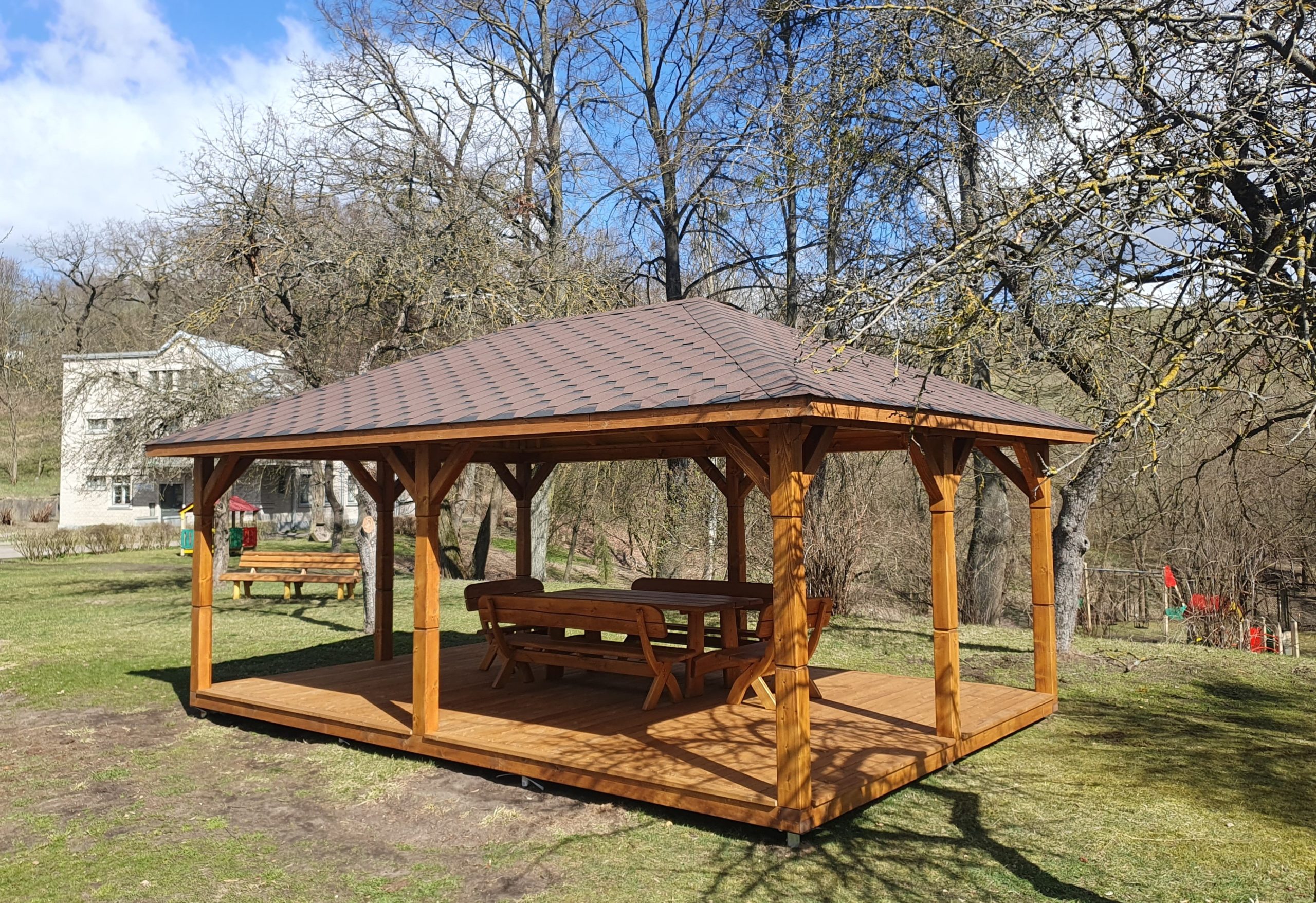
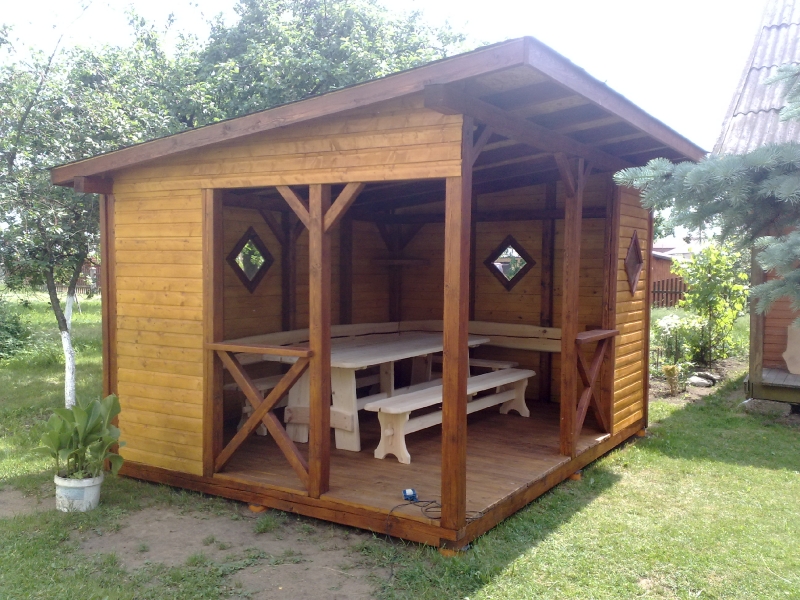
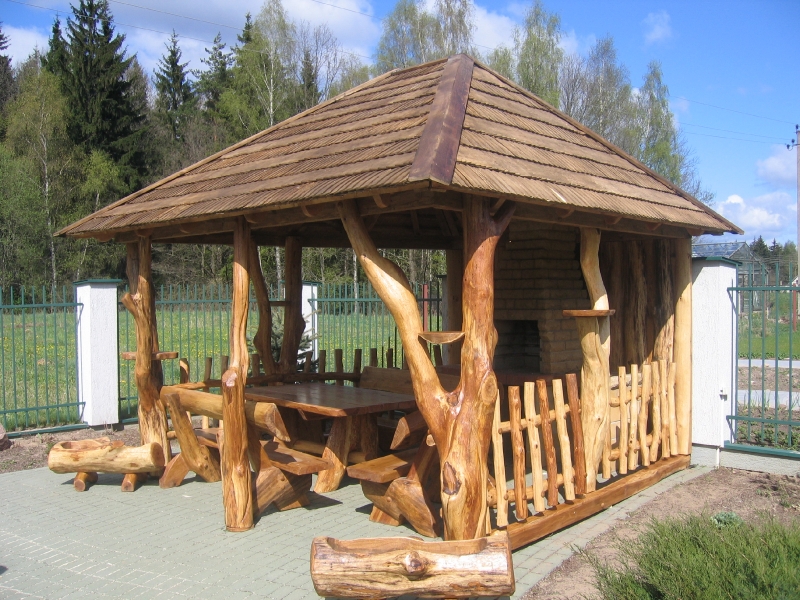
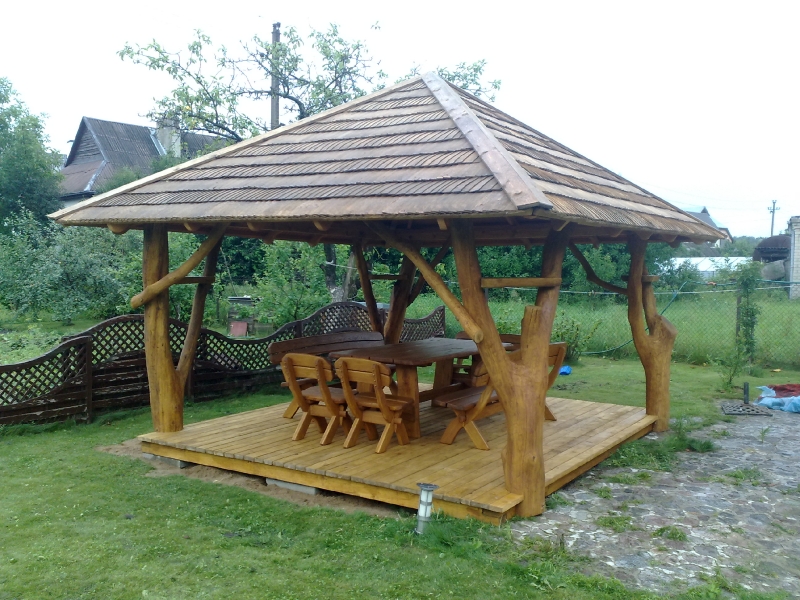
In short: Gazebo with benches No. 25-30 is a glazed wooden gazebo with a gray hip roof, with wooden benches built in along the walls inside. The front and the left side are glazed with sliding glass, the right part is enclosed, and a wooden terrace with profiled columns runs around the gazebo. The size, finishing and equipment are agreed with each customer individually.
A gazebo with benches in a community yard
This example was photographed not in a private garden but next to a large public building. In the background you can see a colorful facade with yellow, green and white stripes, behind the gazebo a children’s playground with a yellow slide and a red toy, and on the left, beyond a fence, a street with a pedestrian crossing sign. The gazebo stands on a lawn among chestnut trees and trimmed shrubs.
In a place like this a gazebo plays a different role than on a farmstead. It becomes a place where a group of people can gather: children with their teacher, pupils with a schoolteacher, members of a community or neighbors. So what matters most here is not a table for one family but as many seats as possible and protection from rain, wind and sun.
That is exactly what the benches along the walls are for. Through the glass you can see that long wooden benches with backrests have been installed inside, along the back wall. They take up little space, yet many people can sit on them. The middle stays free – you can play there, draw on the floor, put up a small table or keep things.
A gazebo with benches is suitable not only for institutions. A similar solution is also useful for a large family, a rural tourism farmstead or the yard of an apartment building where neighbors gather. Wherever you need to fit many people into a small area, benches along the walls are the simplest way.
The photo was taken on an overcast summer day. The warm color of the wood stands out sharply against the gray sky and the colorful facade of the building, so the gazebo becomes a clear landmark in the yard. It is easy to tell children where to gather: “by the wooden gazebo”.
Benches along the walls: many seats in a small space
Benches along the walls have several advantages over separate chairs. Fixed to the walls, they do not move, so children cannot tip them over or carry them around the yard. More people fit on them, because no gaps are needed between those sitting for chair legs. In addition, when benches stand along the walls, the floor stays free and is easy to clean.
Backrests add comfort – you can not only perch on the bench but also sit for longer, leaning back. This matters when activities, conversations take place in the gazebo or people are simply waiting for the rain to pass.
Wooden benches are pleasantly warm even on a cool day, and their color matches the walls. Because they are under a roof and behind glass, rain does not wet them, so you can sit down at any time.
If you plan a similar fit-out, think about:
- along which walls you want benches – the back, the sides or all of them;
- whether you will need a table in the middle or the space should stay free;
- how high the benches should be if children will mostly use them;
- whether you will need space under the benches for storing things.
Laukbaldis also makes solid oak garden furniture – tables, benches and chairs. It is built by experienced craftsmen, and the natural grain and knots of the wood make every piece distinctive. You will find examples in the section oak garden and outdoor furniture.
A terrace on three sides
A wooden terrace runs around the gazebo along the front and the left side and turns behind the right corner. The boards are laid crosswise, and the edge of the terrace is raised above the lawn and finished with a board. At the front the terrace is wider, especially by the glass, where the columns stand.
The terrace is very practical here. Children can wipe their shoes on it before going in, and adults can stand under the roof and watch the children playing in the playground. The wide edges of the terrace are also good for sitting on when there is no longer room inside.
The edge of the terrace is not high, so even small children can climb onto it easily. If the gazebo stood on uneven ground and the terrace were higher, it would be worth building a step or a few stairs at the entrance, and railings at the edges.
Profiled columns with diagonal braces stand at the edges of the terrace and hold up the roof overhang. Their middle sections are carved, so the columns look lighter than plain timbers. Because they stand at the edge of the terrace, they do not get in the way of people going in.
The columns and the terrace are covered with the same honey-colored finish as the walls, so the whole structure looks unified. The light wood goes well with the colorful facade of the building and looks neither too dark nor too bright. If the gazebo is built next to a building of different colors, the shade can be chosen differently.
Glass and the enclosed part
Large sliding glass panes in dark frames are set in at the front and on the left side. Through them you can see not only the interior with the benches but also reflections – the playground, the trees and the windows of the building. The glass lets you use the gazebo on a cooler day too: with it closed, wind and rain stay outside.
The right part of the gazebo is enclosed and clad with horizontal honey-colored boards. An enclosed wall gives shelter and allows benches, shelves or hooks for clothes to be fixed to it. In an institution yard this is very handy: children’s jackets or backpacks can hang under the roof instead of lying on the bench.
The enclosed part can also be adapted for storing things. If you put a cabinet or a lidded box there, it will hold toys, chalk, balls or cushions. Then you will not have to carry things out of the building every time, and the gazebo will always be ready for activities.
It is important that the glass is easy to slide. In a gazebo used by many people the glass is opened and closed often, so its tracks have to be cleaned regularly. More about that in the care section.
In an institution yard the glass has one more advantage – it lets you keep an eye on the children. Adults sitting in the gazebo can see the whole playground, and the children can see them. This gives a sense of safety to both sides and lets you use the gazebo even when some of the children are playing outside.
Features of the example
| Feature | In the photo |
|---|---|
| Hip roof with gray tiles | Yes |
| Benches with backrests along the walls | Yes |
| Sliding glass | Yes, at the front and on the left |
| Enclosed wooden part | Yes, on the right |
| Wooden terrace | Yes, on three sides |
| Profiled columns with braces | Yes |
What to know when building a gazebo in an institution or shared yard
When building a gazebo in a place used by many people, it is worth thinking through a few additional things:
- Capacity. How many people must fit in the gazebo at one time – the size of the gazebo and the length of the benches depend on this.
- Visibility. If the gazebo stands by a playground, the glass lets adults see what is happening outside.
- Sturdiness. The furniture and the terrace must withstand intensive use.
- Maintenance. Who will clean the tracks, sweep the terrace and renew the coating, and how often.
It is also worth finding out whether, when building a gazebo on a shared territory, its location has to be agreed with the municipality, the building manager or the neighbors. It is usually easiest to clarify this before ordering, so that no problems arise later.
On its website Laukbaldis shows only typical examples, and the size, finishing and equipment are agreed individually. If you are creating a children’s space in your yard, also see the section swings, sandboxes and playhouses. For comparison, you will find examples of gazebos here: the glazed gazebo with a terrace all around No. 25-23, the gazebo with a table, benches and profiled columns No. 25-12 and the whole section wooden gazebos.
Care and ordering No. 25-30
A gazebo used by many people needs somewhat more frequent care. Clean the tracks of the sliding glass at least once a month, because sand is carried onto them from the playground. Sweep the terrace regularly, and every spring inspect the boards, the bottoms of the columns and the surface of the benches. If the coating has worn, renew it with a product made for exterior wood.
In autumn sweep chestnut leaves and fruit off the roof and the terrace – they stay damp for a long time and can leave stains on the wood.
The surface of the benches, which are sat on often, is worth sanding once a season and covering with a protective product if it has become rough. This will prevent splinters and the benches will stay pleasant to touch for longer.
UAB “Laukbaldis” has been making wooden products since 1996 and, according to the company, was the first in Lithuania to start making this production. Call +370 687 25388 and quote No. 25-30 – we will discuss the size, the benches, the glass and the terrace.
Frequently asked questions
Why are the benches built in along the walls?
Benches along the walls take up little space, yet many people can sit on them. The middle stays free for games or a small table, and the floor is easy to clean.
Is such a gazebo suitable for a kindergarten or school yard?
This example stands next to a large building by a playground. The size, the number of benches and other solutions are agreed individually, depending on how many people will use the gazebo.
Can benches be ordered without backrests?
Yes, the shape, length and height of the benches are discussed when you order. If children will mostly use the benches, their height is worth adapting.
What is the terrace around the gazebo for?
The terrace lets people wipe their shoes before going in, stand under the roof and watch what is happening around. It also protects the gazebo floor from mud.
How do I look after a gazebo that is used often?
Clean the glass tracks more often, sweep the terrace regularly and inspect the boards and benches every spring. Renew a worn coating in good time.
How do I order gazebo No. 25-30?
Call us and quote No. 25-30. We will discuss the size, the benches, the glass and the terrace.