In short: Wooden gazebo with glass No. 25-46 is a hip-roofed gazebo that combines three sections under one roof: an open corner with columns, a glazed room and a closed wooden section. The sliding glass panels let you open the room to the garden or close it against the wind. The size, finishing and equipment are agreed with each customer individually.
Three sections under one hip roof
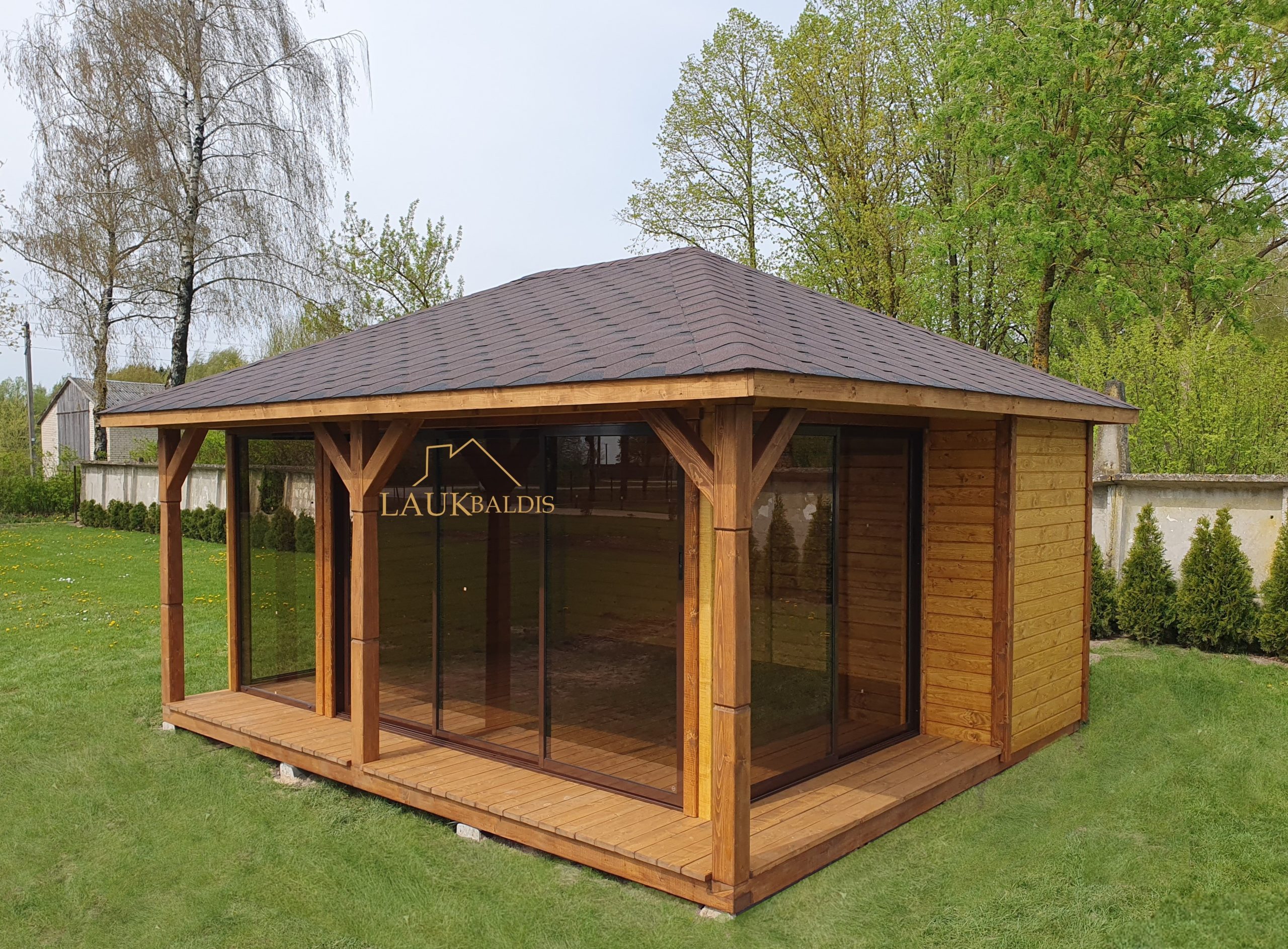
At first glance the gazebo looks like a simple rectangular structure. Look closer, though, and you can see it is divided into three clear zones. On the left is an open corner, covered only by the roof and supported by posts with diagonal braces. In the middle is a glazed room with large sliding glass panels. On the right is a closed section clad in horizontal wooden boards.
All three sections are tied together by a single hip roof covered with brown tiles and by a shared wooden floor. That makes the structure look unified, even though the spaces inside are very different. One gazebo can offer a spot in the sun, shelter from the wind and a closed corner for storing things or for quiet relaxation.
The wood is finished in a warm honey tone. Against the light green lawn and the dark green thuja hedge, this shade looks vivid without being too much, and the brown roof finishes it off calmly.
From the front you can also see a narrow strip of wooden terrace running under the roof overhang along the glass. It connects the open corner with the entrance and lets you move from one part of the gazebo to another without stepping onto the grass. The floor is raised above the lawn, so rain water does not reach it, and the edge clearly separates the gazebo from the garden.
The sections of the gazebo from left to right
To make it easier to picture how the gazebo works, here is a short overview of its parts based on the photo.
| Section | What you see | Good for |
|---|---|---|
| Open corner | Posts with braces, floor under the roof | Sitting in the sun, chairs, grill tools |
| Glazed room | Sliding glass panels in dark frames | Meals and relaxing in any weather |
| Closed section | Horizontal wooden boards | Shelter from the wind, furniture or storage |
| Front strip | Narrow wooden terrace under the roof | Entering and a short stay |
The table describes only the typical version. The size and layout of the sections can be changed when you order. For example, the open corner can be on the right and the closed section on the left.
The open corner: a place for sun and fresh air
The open corner is what sets this wooden gazebo with glass apart from fully enclosed models. There are no walls or glass here, only a roof and a floor. The roof is held up by square posts, and two diagonal braces connect each post to the roof beam, forming a Y-shaped support. Braces like these give the gazebo the look of a traditional timber structure and stiffen the construction.
The open corner is a convenient place for a couple of armchairs or a small table. In the morning you can have coffee in the sun, and in the evening you can sit out in the fresh air while the table for dinner is already set in the glazed section. When it starts to rain, a few steps are enough to move behind the glass.
Another advantage is the grill. In the open section you can keep grill tools or firewood under the roof, while the grill itself stands nearby at a safe distance from the gazebo. That way the cook is not cut off from the guests sitting at the table.
The open corner can also be adapted for children. They can play on the floor under the roof even when the grass is still wet with dew or rain, while the adults sit right next to them behind the glass. This closeness suits families in which the little ones want to be outdoors and the parents want to keep an eye on them.
Wooden gazebo with glass: the balance of glass and walls
The glazed room takes up most of the front facade. Large sliding glass panels in dark frames reflect the garden, and through them you can see the light wooden floor. You can slide the panels aside to open the room when it is warm, or close them when it is windy or raining. That way the gazebo works in spring, summer and autumn alike.
The closed section on the right is clad in horizontal boards. It blocks the wind from one side, gives privacy and helps create a cozy feeling inside. In the closed section you can place a cabinet for dishes, shelves or a bench against the wall. If you need more room for things, this section can be discussed as a separate storage space with a door.
The wooden walls and the glass are balanced here in moderation: there is enough glass to keep the interior bright and let you see the garden, and enough wood to keep the gazebo from looking like a greenhouse or a display case.
When planning your own gazebo, it is worth thinking about how much glass you really need. If your yard has a lovely view of the garden or fields, you can have more glass. If the gazebo stands close to neighbors or the street, more wooden walls will give you peace and quiet. This balance is easiest to decide when we talk about your actual plot.
One gazebo, different seasons
A three-part gazebo really shows its strength when the weather changes. In spring, when the sun is already warm but the wind is still cool, most of the time is spent in the glazed section: the glass is closed, and through it you can watch the lawn turn green and the birches burst into leaf. The open corner is good then for a short warm-up in the midday sun.
In summer everything turns around. The glass is slid aside, the glazed room becomes almost open, and the open corner is the favorite spot in the evenings. On a hot day the roof gives shade, and the draft through the opened panels cools the whole gazebo.
In autumn, when the evenings get shorter and cooler, you move back behind the glass. The closed wooden section brings coziness: you can put a bench there with cushions and blankets. Even on a rainy October day you can have tea here and look out at the garden. In winter the gazebo can become a place where garden furniture is kept under a roof, so you do not have to carry it into the house.
By the thujas and birches: choosing the spot
In the photo the gazebo stands on a spring lawn dotted with dandelions. Behind it runs a row of thujas along a fence of concrete panels, birches grow on the left, and further away you can see a farm building. The wall of thujas plays an important role here: it hides the gray fence and creates a green backdrop that makes the wooden gazebo look even warmer.
When choosing a spot in your own yard, keep a few things in mind:
- turn the open corner toward the side where the sun shines longest;
- turn the closed section toward the side the wind usually comes from, or where the neighbors have windows facing your plot;
- under tall birches, seeds and leaves will fall on the roof, so the roof and the glass tracks will need cleaning more often;
- leave at least enough room by the fence to walk around the gazebo and look after the rear wall.
In the photo the gazebo stands on concrete blocks. Support points like these lift the base frame above the ground, so air can circulate under the floor and the wood does not touch damp soil. How the foundation is built on your plot depends on the soil and the size of the gazebo, so it is discussed individually.
Care and ordering
The open corner gets more rain and sun than the glazed section, so it is worth inspecting its floor and the bottoms of the posts every spring. If the surface has turned pale or water no longer beads up, it is time to renew the protective coating made for exterior wood. Clean the tracks of the sliding glass regularly of sand, grass and birch seeds so that the panels glide easily.
The boards of the closed section and the rear wall by the thujas deserve a closer look: where walls are close to plants, wood dries more slowly. If the thujas grow and start touching the wall, trim them so that there is always an air gap between the branches and the wood.
If you would like to compare several options, take a look at the semi-enclosed gazebo with a terrace No. 25-11.5, the gazebo with sliding windows No. 25-12.3 and the gazebo with an open terrace No. 25-9. All the examples are in the section wooden gazebos. If you would like to turn the closed section into a storage shed, you will find ideas in the section wooden sheds and shelters.
UAB “Laukbaldis” has worked since 1996 and, as the company states, was the first in Lithuania to start making this production. To order, call +370 687 25388 and quote No. 25-46. We will discuss how large each part of the gazebo should be, where the open corner will be, what the finishing will be and what the gazebo will stand on. The website shows only typical examples, so the final solution is adapted to your yard.
Frequently asked questions
How does this wooden gazebo with glass differ from a fully enclosed one?
It has an open corner, covered only by the roof and fitted with columns, so you can also spend time in the fresh air. Next to it are a glazed room and a closed wooden section.
Can the open corner be placed on the other side?
Yes, the photo shows only a typical layout. The position and size of the sections are agreed when you order, taking into account the direction of the sun and the view from the gazebo.
Can the closed section be used as a storage space?
Such a solution can be discussed when you order. The closed section would then usually need a separate door and room for shelves.
What does this gazebo stand on?
In the photo the base frame is raised on concrete blocks. The foundation solution on your plot depends on the soil and the size of the gazebo.
How do I look after the open corner of the gazebo?
Every spring inspect the floor and the bottoms of the posts, because this part gets more rain. If needed, renew the protective coating made for exterior wood.
How do I order gazebo No. 25-46?
Call us and quote No. 25-46. We will discuss the layout of the sections, the size, the glazing and the finishing.