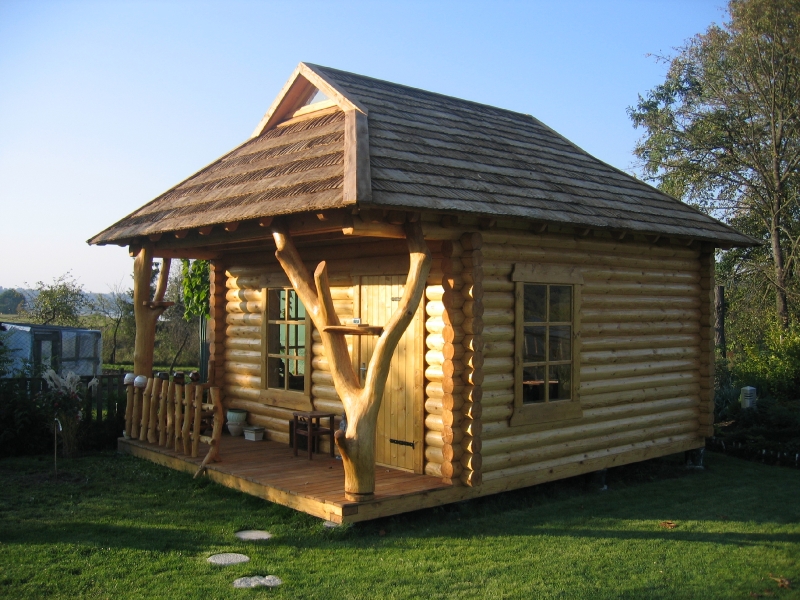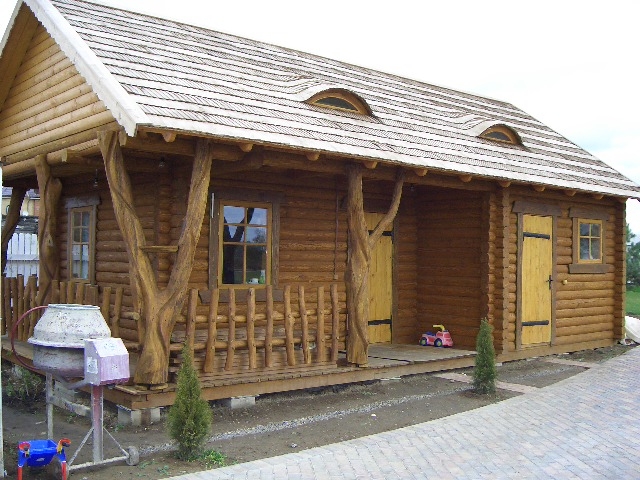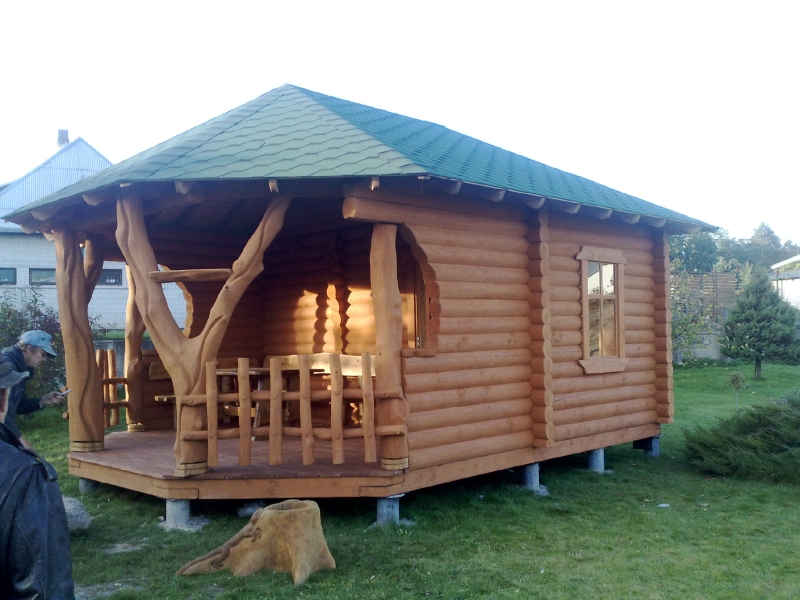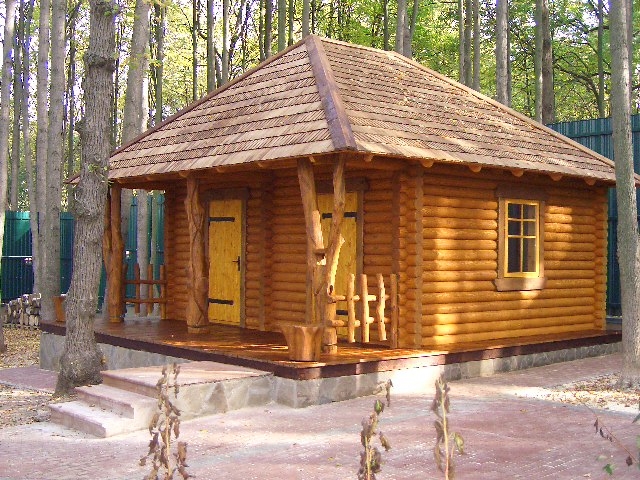
In short: Log cabin in the forest No. 12 is a building of round logs set among tall deciduous trees on a stone plinth. It is covered with a hip shingle roof, and at the front there is a covered terrace with branching trunks, to which stone steps lead. The facade has two yellow board doors. The size, finish and equipment are agreed individually with each customer.
Among tall trees
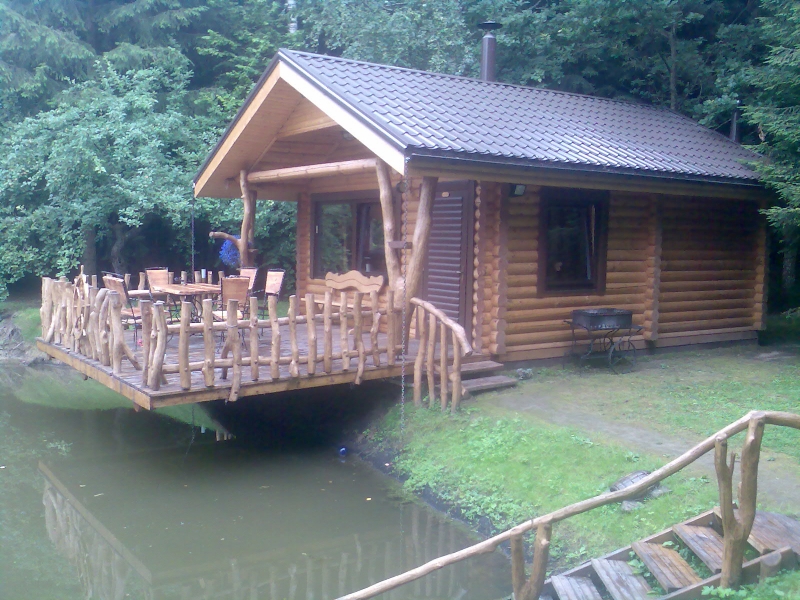
The cabin stands in a forest or a large park, among tall, slender deciduous trunks. The photo was taken in early autumn, when the leaves are still green, though the first fallen ones already lie on the ground. Light falls through the tree crowns, so the log walls glow with a warm, golden shade.
A paved area leads to the cabin, and behind it you can see a tall green fence and a pile of firewood. This shows that the cabin is part of a tidy, maintained property and not a structure standing in the wild. Surroundings like this suit rest homes, farmsteads or larger plots with forest.
The forest gives the cabin’s surroundings a special mood: it is quiet, cool, and smells of trees and earth. A log building in such a place looks as if it had grown out of the forest itself, because its walls, columns and roof are made of the same material that surrounds it.
Still, building in a forest has its peculiarities. The building needs enough room among the trees so that branches do not reach the roof and the roots are not damaged. Moisture lingers longer in a forest, so it is especially important that the building is raised off the ground and well ventilated.
On the other hand, a forest has many advantages. In summer the tree crowns shade the cabin from the scorching sun, so it stays cool inside and on the terrace even in the heat. Trees hold back the wind, and in autumn and winter they create a cozy, enclosed yard. Such a place suits a sauna or a rest cabin especially well, where you want to escape the noise of the city.
A stone plinth and steps
That is exactly why the foundation of this cabin matters so much. The log walls and the terrace are built on a tall stone plinth that lifts the wood well above the ground. The plinth is laid of natural stone, and its top is covered with a dark strip that separates the stone from the wood.
A tall stone plinth protects the logs from ground moisture, rain splashes and snow, which lingers longer in a forest. It also gives the building solidity: the cabin looks firmly rooted to the spot, and stone and wood make a classic combination proven over centuries.
Stone goes well with a forest setting too: grayish stones of natural shape recall the boulders often found in Lithuanian forests and fields. So the cabin does not look like a foreign body but seems to continue the natural environment.
Because the terrace is raised higher, wide stone steps lead up to it. Several steps are laid of the same stone as the plinth, so they look like a natural part of the foundation. The steps are wide enough for two people to climb them or to carry things.
It is worth inspecting the stone steps and plinth every year: whether there are cracks and whether moss or grass is growing between the stones. In winter the steps need to be cleared of snow and ice, because stone can be slippery. The foundation solution always depends on the plot, so it is agreed when you order.
A hip shingle roof
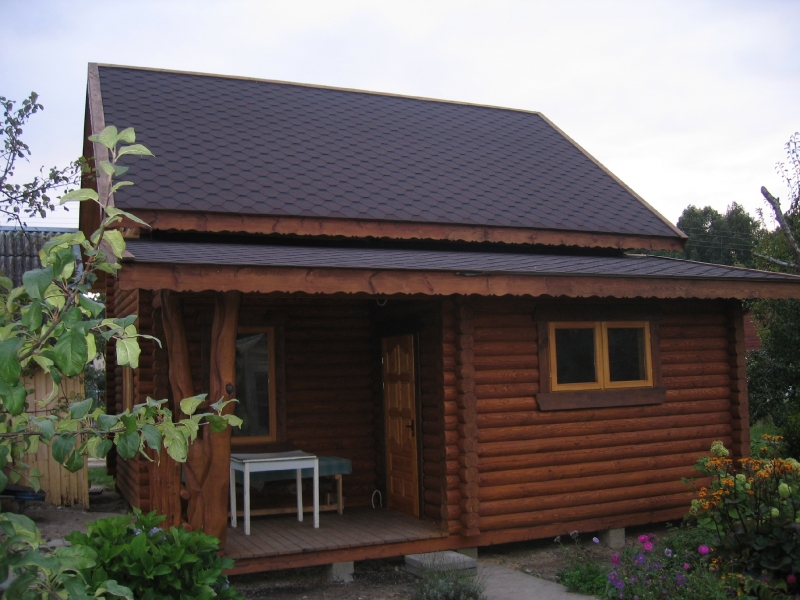
The cabin is covered with a hip roof with a wooden shingle covering. The shingles have already taken on a warm brownish-gray shade, which goes nicely with the autumn forest. The ridge and hips of the roof stand out slightly from the slopes, so the shape of the roof is easy to see even from afar.
A hip roof has no tall gables, so the cabin looks low and compact. All four walls are equally protected by the roof overhangs, which is especially useful in a forest, where rain and moisture act on the building from all sides. The roof edges project widely and cover the terrace.
A low hip roof also catches less wind, so it suits places surrounded by tall trees. During a storm the trees sway, while a low, compact building with a sturdy roof stays calm. Still, before building it is worth assessing whether there are old, dangerously leaning trees nearby.
In a forest a shingle roof needs more attention than in an open place. Leaves and twigs fall on it, and moss can grow in the shade. So the roof is worth inspecting in spring and autumn, clearing off accumulated debris and making sure the covering can dry after rain.
Laukbaldis also makes shingles for roofs, so the roofing can be discussed together with the building itself. A shingle roof is a natural choice for a log house, because the whole structure remains made of a natural material.
A terrace and two yellow doors
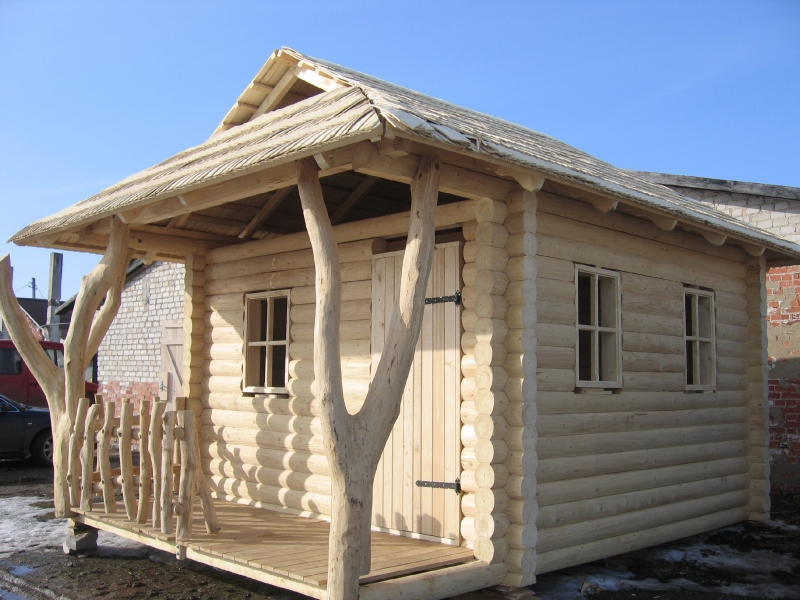
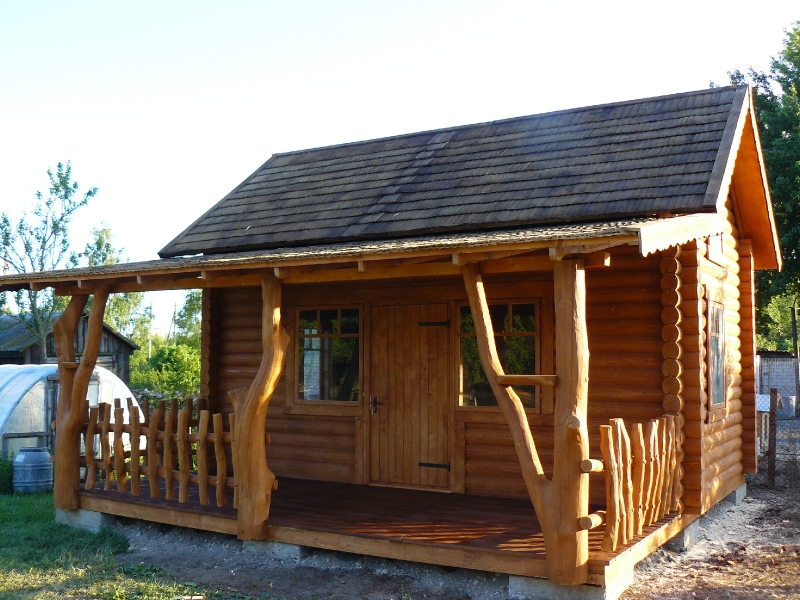
The covered terrace runs along the front facade. The roof above it is held up by natural-shaped trunks: some are straight, others branch at the top. One of them is especially interesting: at the top it divides into two sides and holds up the roof beam with both limbs, and a small stake fence is fixed to the trunk.
There are two doors on the facade, made of vertical boards and painted yellow. They are held by black wrought-iron hinges. The yellow color stands out sharply against the light logs and gives the face of the cabin cheerfulness.
In the green of the forest such doors become a bright accent that is easy to notice from afar, even after dark. Two separate doors let you fit out two rooms inside, for example a rest room and a sauna or a storeroom.
In the side wall there is a window with muntins and yellow frames that match the color of the doors. At the edge of the terrace stands a stump turned into a stool, a small detail showing how natural-wood elements can complement the surroundings.
Stumps like these, benches of logs or wooden planters help create a unified natural-wood environment around the cabin. Laukbaldis also makes planters, benches and other yard products, so they can be chosen in the same style.
A table with benches or a few chairs can be placed on the terrace. Laukbaldis makes oak outdoor furniture that goes very well with a cabin like this.
What the photo shows
A short summary helps you quickly judge the solutions of this typical example.
| Feature | In the photo |
|---|---|
| Walls of round logs | Yes |
| Hip shingle roof | Yes |
| Stone plinth | Yes, tall |
| Stone steps to the terrace | Yes |
| Covered terrace | Yes |
| Natural-shaped trunks | Yes |
| Two board doors | Yes, yellow |
| Window with muntins | Yes, in the side wall |
A log cabin in the forest: what to discuss when ordering
Laukbaldis shows only typical examples, so the size, finish and equipment of the cabin are agreed with each customer. When building in a forest or among trees, it is worth thinking about:
- The purpose. A rest cabin, a sauna, a guest house or all together.
- The place among the trees. How much free space there is and how to avoid damaging the tree roots.
- The foundation. Whether a tall plinth, as in the photo, is needed and what the soil is like.
- Access. Whether a vehicle with materials can reach the site.
- The colors of the doors and windows. Yellow ones are bright, but other colors can be chosen.
- Documents. When building in a forest or at its edge, it is especially important to ask the municipality what is allowed.
Also discuss in advance whether the cabin will be used only in summer or in winter too. Winters in a forest are snowier, so you will have to think about how to reach the cabin and where the firewood will be kept. The equipment to be provided inside depends on the season of use.
Other works will help you compare: the log cabin with a corner terrace No. 19 and the log cabin by a pond No. 15. You will find all the examples in the section saunas and summerhouses.
Care and ordering
In a forest a building dries more slowly after rain, so the annual inspection is especially important. In spring walk around the cabin and check the coating of the logs, especially on the north side, where there is the most shade. If you notice graying or rough wood, renew the protective layer. In autumn sweep leaves off the terrace floor so they do not blow onto the wood.
Do not let dense shrubs and young trees grow around the cabin: the building must be ventilated from all sides. Keep firewood away from the walls or under a roof, leaving a gap between it and the logs.
In winter it is better to sprinkle stone steps with sand rather than salt: salt harms both the stone and the wood next to it. In spring check that no cracks have appeared between the plinth stones through which water could get in.
UAB “Laukbaldis” has worked since 1996 and makes log cabins, saunas, summerhouses, gazebos and outdoor furniture. Call +370 687 25388 and quote No. 12. We will discuss the purpose of the cabin, its size, the foundation, the terrace and the place among the trees.
Frequently asked questions
Why is the cabin built on a stone plinth?
A tall stone plinth lifts the logs above the ground and protects them from moisture, splashes and snow. In a forest, where moisture lingers longer, this is especially useful.
Can a log cabin be built among trees?
Yes, but enough room must be left so that branches do not reach the roof and roots are not damaged. Before building in a forest, it is worth asking the municipality what is allowed.
How many entrances does cabin No. 12 have?
The facade shows two yellow board doors. This lets you fit out two separate rooms inside, whose purpose is agreed when you order.
How do I look after a shingle roof in a forest?
In spring and autumn clear leaves, twigs and moss off the roof. It is important that the covering can dry after rain.
Can a sauna be fitted out in the cabin?
Two separate rooms let you set up a sauna in one and a rest room in the other. The sauna equipment and layout are agreed individually.
How do I order cabin No. 12?
Call us and quote No. 12. We will agree on the purpose of the cabin, its size, the foundation and the place on the plot.