In short: Summerhouse interior finish No. 25-3 is a room of a wooden summerhouse from the same series as the one-story summerhouse No. 25: light horizontal boards on the walls, a wooden ceiling with exposed beams and a dark floor. The room is still empty, so you can clearly see the finish itself, the windows, the air conditioner and the electrical sockets. The interior fitting-out, like the size of the building, is agreed individually with each customer.
What can be seen in this room
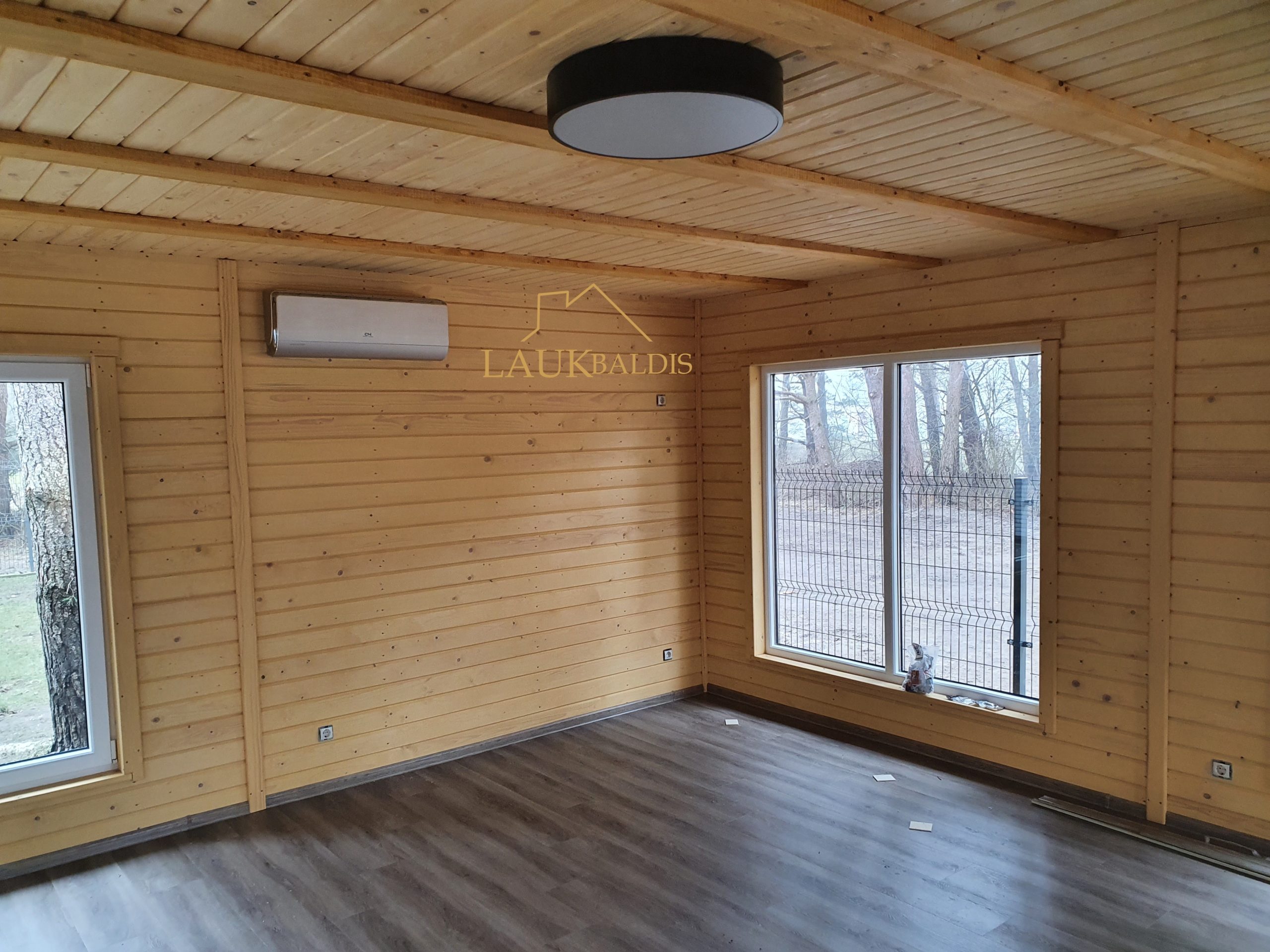
The photo was taken in a corner of the room, so two walls, the ceiling and the floor are visible. The walls are clad with horizontal light boards in which natural knot marks and wood rings are clearly visible. The rows of boards are straight and even, and the joints and corners of the walls are covered with vertical wooden strips. Such strips not only hide the joints but also break a large wall area into clear parts.
On the left wall there is one window, and on the right a large two-part window. From the inside their frames are white, and behind the glass you can see pine trunks, a fence and the yard. The windowsills are wooden, in the same light shade as the walls. On the back wall, high under the ceiling, hangs the indoor unit of an air conditioner.
The ceiling is wooden too, made of narrower boards, and under it several exposed beams can be seen. A large round lamp with a dark rim and a light diffuser hangs in the middle. The floor is dark, with a wood pattern, finished at the walls with dark baseboards.
A few small leftovers of construction are still visible on the floor, and a small bag on the windowsill. It is a real photo of a just-finished project, not a visualization, so you can rely on it to judge how such a finish looks in real daylight.
The short summary helps you compare this room quickly with other examples and note which solutions you would like to repeat in your summerhouse:
| Feature | In the photo |
|---|---|
| Horizontal wooden wall boards | Yes |
| Wooden ceiling with exposed beams | Yes |
| Round ceiling lamp | Yes |
| Indoor air-conditioner unit | Yes |
| Electrical sockets near the floor | Yes |
| Dark floor with baseboards | Yes |
| Furniture | No, the room is empty |
Why wooden interior finish is so popular for a summerhouse
Wooden finishing gives a summerhouse what people mostly look for in the countryside: warmth, naturalness and calm. Stepping into such a room, you smell the wood, and light boards reflect daylight, so the room looks brighter than it would with dark walls. At the same time it continues the exterior: from outside the summerhouse is wooden too, so the inside and the facade make a unified whole.
Horizontal boards also have a visual effect: they seem to stretch the wall in width, so the room looks more spacious. This is especially useful in a one-story building, where the ceiling is not very high. Vertical strips at the wall joints give rhythm and keep a long wall from looking monotonous.
It also matters that a wooden wall does not need wallpaper or painting every few years. It is enough to coat it with a product made for interior work, which protects the surface from dirt and helps keep an even shade. Light wood turns slightly yellow over the years, which is a natural process that for many people only adds coziness.
Natural knot marks in the boards are not a defect but a feature of the wood. They give the wall liveliness and show that the finish is made of real wood and not of a panel imitating it.
A wooden ceiling with beams and lighting
The ceiling is perhaps the most interesting part of the finish in this room. The boards are laid in one direction, and under them run beams distinguished by a slightly richer shade. Such exposed beams give the room features of traditional wooden architecture and make the ceiling livelier than a smooth white plane.
Simple lamps with a clear shape go well with a wooden ceiling. In the photo a large round lamp with a dark rim was chosen: it contrasts with the light wood but does not overshadow it. The dark floor and the dark rim of the lamp seem to “frame” the light room from below and from above.
When planning the lighting, it is worth thinking about:
- whether one main lamp will be enough or additional ones will be needed at a desk or a bed;
- where the switches will be, by the entrance or on the other side of the room as well;
- whether you will want adjustable light brightness for the evenings;
- whether the lamps will match the shade of the wood and the furniture.
Laukbaldis also makes wooden lamps, shelves, chests of drawers and cabinets, so the inside of a summerhouse can be complemented with natural wood furniture that will match the wall finish.
Windows, an air conditioner and electrical equipment
Seen from the inside, the window frames are white, and from the outside they are dark. This combination lets the facade keep a contemporary dark accent, while in the room the frames stay light and match the light wood. A lot of light enters the room through the large two-part window, and sitting by it you can see the pines and the yard.
The indoor unit of the air conditioner is hung on the back wall, high under the ceiling. That way it does not get in the way of the furniture, and the air flow is distributed throughout the room. You can see what the outdoor unit of an air conditioner looks like on the wall of a summerhouse of the same series in the photo of the one-story summerhouse No. 25-2.
Electrical sockets are installed near the floor, in several places on the wall, and there is one more outlet next to the window. It is worth planning their positions before the finishing: where the bed, the table, the refrigerator or other appliances will stand. Moving a socket in a wooden wall later is harder than providing for it in the right place in advance.
Pay attention to the windowsills too. Here they are wooden, wide and the same shade as the walls, so it is convenient to put a book, a flower pot or a cup of tea on them. A wide windowsill by a large window often becomes a favorite spot in a summerhouse for a morning cup of coffee with a view of the yard.
The floor and color contrast
The dark floor plays an important role in this room. It forms a calm base for the light walls and ceiling, so the room does not look monochrome or “faded”. If the floor were light too, the whole room would merge into one shade, whereas now you can clearly see where the wall ends and the floor begins.
The wood-pattern floor covering goes with the wooden walls but differs in color. Dark baseboards at the bottom of the walls complete the transition and hide the gap between the floor and the wall. Such a floor is practical in a summerhouse too: sand or needles brought in, which cannot be avoided in a pine forest, show less on it.
When choosing a floor, think about how often people will walk in straight from the yard, whether there will be pets in the summerhouse and whether the floor will have to withstand a cooler, unheated period. What covering is worth choosing depends on this, so it is best discussed together with the whole interior finish.
Contrast can also be created with furniture. A table or a cabinet of darker wood looks good against light walls, and a light rug against a dark floor warms up the space on cooler evenings.
Caring for a wooden interior
Wooden walls and ceilings inside are far easier to care for than a facade, because rain and sun do not act on them directly. Still, a few habits help keep them looking good longer:
- wipe dust off the boards with a dry or barely damp cloth, without strong cleaners;
- air the room regularly, especially if the summerhouse stays closed for a long time;
- do not stick adhesive tape straight onto the wood, as it may leave marks;
- if a board gets scratched, the spot can be lightly sanded and coated with the same product.
On the sunny side of the room the wood may change faster, so it is sometimes worth rearranging furniture or pictures so that no obvious lighter patches remain on the wall. In winter, if the summerhouse is not heated, it is useful to air the room occasionally and check that moisture is not building up anywhere.
What to discuss when ordering the inside of a summerhouse
UAB “Laukbaldis” has worked since 1996, and the size, finish and equipment of a summerhouse are agreed with the customer every time. Call +370 687 25388 and quote No. 25-3, and we will discuss what finish, ceiling, windows and equipment you would like.
It is useful to decide in advance on the shade of the walls and ceiling, the color of the floor, the positions of the sockets and lamps, and whether you will need an air conditioner. You can see the same summerhouse from outside on the page of the one-story wooden summerhouse No. 25, and the entrance zone from the inside on the page of the wooden summerhouse interior No. 25-4. You will find more examples in the section saunas and summerhouses.
Frequently asked questions
What is the interior finish of this summerhouse made of?
The walls and ceiling are clad with light wooden boards, and the ceiling is crossed by exposed beams. The floor is dark, with a wood pattern, finished with dark baseboards.
Can a different shade of the walls be chosen?
Yes, the finish is agreed individually. In the photo the wood is left light, but the shade can be discussed when you order, so that it matches the floor and the furniture.
Can an air conditioner be installed in the summerhouse?
The photo shows the indoor unit of an air conditioner on the wall. Whether you need one in your summerhouse is agreed when you order, together with the other equipment.
Why are the window frames white inside and dark outside?
This combination lets the facade have a dark accent, while in the room the frames match the light wood. The colors of the frames can be discussed when you order.
Is a dark floor suitable for a summerhouse?
A dark floor creates a contrast with the light walls and ceiling and gives the room a calm base. Sand or needles brought in show less on it, so it is practical in the countryside.
How do I look after wooden walls inside?
It is enough to wipe off dust with a dry or barely damp cloth and to air the room regularly. A scratched spot can be sanded and coated with the same protective product.