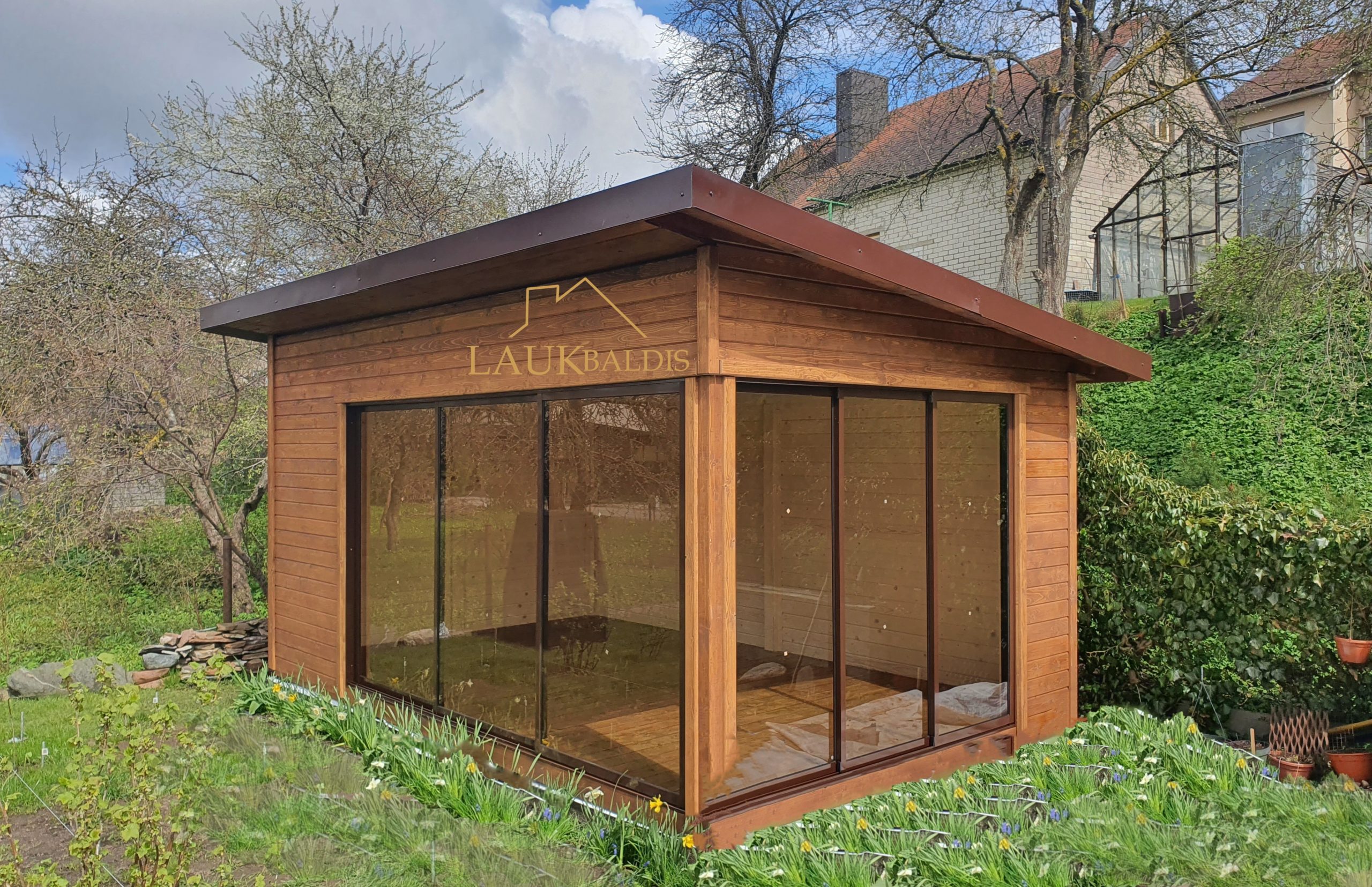
In short: Gazebo with a mono-pitch roof No. 25-43 is a compact enclosed wooden gazebo with honey-colored board walls and sliding glass on two sides. The roof has a single slope and brown sheet-metal trim, and spring flowers bloom around the gazebo. The size, finishing and equipment are agreed with each customer individually.
A gazebo with a mono-pitch roof: a simple silhouette
The first thing you notice is the shape of this gazebo. Instead of the usual hip roof there is a single flat slope: it is highest above the left glass wall and lowers as it moves away from it, so the sloping roofline is clearly visible on the right side. As a result the building, seen from the side, looks like a volume of clear geometry, with no ridges, no intersecting corners and no extra details. Such a silhouette is contemporary, yet the wood gives it warmth.
The mono-pitch roof projects widely over the walls, especially at the front, so the glass is protected from direct rain. The edges of the roof are lined with brown sheet-metal trim, which neatly finishes the edges and goes nicely with the brown tone of the wood. Rainwater runs off such a roof to one side, so it is easier to direct it where it will cause no trouble.
The compact volume suits a small yard or a corner of the garden where a large gazebo with a terrace would not fit. The entire space under the roof is given to the interior, so even a small gazebo feels roomy inside.
A mono-pitch roof also has a practical benefit: on the higher side the room feels more spacious, and by the lower wall it is convenient to put a shelf or a cabinet. In addition, a roof of simple shape is easy to inspect and maintain, because there are no valleys or ridges where leaves would collect.
Honey-colored boards and brown trim
The walls are made of horizontal boards and coated with a warm shade reminiscent of honey or caramel. In the sunlight the natural pattern and knots of the wood are clearly visible, so the surface looks alive rather than smooth like a painted panel. Above the left glass wall the boards continue right up to the roof and form a wide wooden band.
The boards are the same color around the glass too: they frame the panes and form the corner post. The edge of the roof is finished with brown sheet-metal trim. The whole palette, from light honey to dark brown, is warm and calm, so the gazebo goes well with greenery, flowers and brick houses.
This shade suits those who want a modern shape but do not want cold gray or white colors. The same shape in a different color would look quite different, so the shade is worth choosing with the house and the other buildings in the yard in mind.
Glass meeting at the corner
Three large panes in dark frames are installed on each of the front and right sides. The two glass walls meet at a wide wooden corner post, so from inside you get a view to two sides at once. The left wall is left enclosed, clad with boards – it gives the gazebo a feeling of support and shelters from the wind on that side.
The glass slides, so on a warm day it can be pulled aside to open the gazebo to the flower bed. Then you can simply step out into the garden from inside, and the scents and the birdsong reach those sitting inside too. When it is cool or rainy outside, sliding the glass shut turns the gazebo into a cozy enclosed room.
Through the glass you can see the wooden floor and the light interior walls. In the photo the inside is still empty, with a light material laid on the floor. This lets you imagine how the room will look furnished: with a table in the corner so that the garden is visible on both sides, or with soft chairs and a bookshelf by the enclosed wall.
A corner arrangement of glass suits a small gazebo especially well. When there is glass on two adjacent sides, the room does not look like a narrow corridor, and the eye travels freely out to the garden. At the same time, the two enclosed walls preserve privacy and let you place furniture so that those sitting are not visible from every side.
A strip of flowers instead of a terrace
This gazebo has no terrace. It stands low, almost at ground level, and a strip of spring flowers is planted along the front and side walls. In the photo yellow daffodils and white and blue spring blooms are flowering, so it looks as if the gazebo stood right in the flower bed. On the right you can also see clay pots and a woven trellis panel for plants.
This solution is not merely decorative. The strip of flowers by the walls fills a space that would otherwise stay empty or be constantly trampled, and the flowering plants soften the strict lines of the building. Looking out through the glass from inside, you see the flowers right at the front of the view.
In spring, when there are no leaves on the trees yet, such a strip of flowers especially enlivens the yard, and in summer it can be supplemented with annual flowers or grasses. When planting beside wooden walls, it is worth leaving a small gap between the soil and the boards so that the wood can dry. Lower plants, such as bulb flowers, suit best, because their leaves do not lie against the walls and do not hinder ventilation.
A spot beneath a planted slope
In the photo the gazebo stands at the bottom of the garden, by a slope covered with ivy and a hedge. Above the slope you can see the neighbors’ brick houses and a greenhouse, and on the left a flowering fruit tree and stacked boards. This backdrop shows that a compact gazebo fits in well even in a densely built-up place: it does not dominate but becomes one more detail of the garden.
When building a gazebo by a slope, it is important to think about rainwater. If water runs from the slope toward the gazebo, it is worth installing a drain around it or at least leaving a slight slope away from the walls. That way the foundation and the lower boards stay drier.
Another consideration is the sun. Here the glass faces the open garden, so it is bright inside, while the slope and the hedge behind the gazebo hold back the wind. It is a good spot for a quiet morning cup of coffee or for reading.
If your plot is uneven, a similar place at the foot of a slope can be an excellent choice: there is usually less wind, and the gazebo does not stick up above other buildings. Just before building it is worth making sure that water does not collect there in spring or after downpours.
When to choose a gazebo with a mono-pitch roof
- When the yard is small and you need a compact structure without an open terrace.
- When the house is of modern architecture and you want the gazebo to echo its simple lines.
- When the gazebo is built next to a fence, a slope or another building and the water from the roof must run off to one side.
- When the gazebo will be used not only in summer but also in spring and autumn, and so needs an enclosed room.
Laukbaldis shows only typical examples, so the direction of the roof slope, the position of the glass and the number of enclosed walls can be changed. For comparison, look at the modern gazebo with a mono-pitch roof and a terrace No. 25-36, the gazebo by the house with a mono-pitch roof No. 25-21 and the enclosed wooden gazebo with a stepped terrace No. 25-42. You will find all the examples in the section wooden gazebos, and for flowers by the gazebo, products from the section wooden planters and doors will suit.
Care and ordering No. 25-43
The gazebo stands low, so the bottom row of boards needs the most attention. Inspect it and the corner post once a season, and when watering the flower bed, try not to pour water straight onto the walls. If the protective coating begins to fade or the wood becomes rough, clean the surface and coat it with a product made for exterior wood.
It is worth checking the lower edge of the mono-pitch roof in autumn: leaves and twigs collect there. Clean the tracks of the sliding glass of soil and sand, especially in spring when the flower bed is being loosened. After rainy days, air the gazebo by sliding a few panes aside. In winter do not let a thick layer of snow build up on the roof, especially on its lower part, where snow naturally gathers.
UAB “Laukbaldis” has been working since 1996 and, as the company says, was the first in Lithuania to start making this production. To order, call +370 687 25388 and quote No. 25-43. You will discuss the size of the gazebo, the direction of the roof slope, the position of the glass, the shade of the walls and the foundation. If you have photos of your plot, have them ready – it is then easier to judge how the gazebo will look in your yard.
Frequently asked questions
How does a gazebo with a mono-pitch roof differ from one with a hip roof?
A mono-pitch roof has a single slope, so the building looks simpler and more modern, and rainwater runs off to one side. A hip roof gives a more traditional, classic gazebo look.
Can I choose which way the slope faces?
Yes, the direction of the roof slope is discussed when you order. It is worth choosing according to where you want to direct the rainwater and which side the glass will be on.
Can a terrace be added to this gazebo?
In the photo the gazebo has no terrace and stands right by the flower bed. It is a typical example, so a terrace or a wider roof overhang can be discussed individually.
Can I plant flowers right next to the walls of the gazebo?
You can, but it is worth choosing lower plants and leaving a gap between the soil and the boards. That way the wood can dry and the bottom row of boards will stay tidy longer.
Is such a small gazebo suitable for year-round use?
With the sliding glass closed, the gazebo protects from wind and rain, so it is comfortable to use in spring and autumn. In winter it can be a place to spend a short while in the fresh air, and whether any extra equipment is needed is worth discussing when you order.
How do I order gazebo No. 25-43?
Call us and quote No. 25-43. You will discuss the size, the shape of the roof, the glazing, the color and the position on your plot.