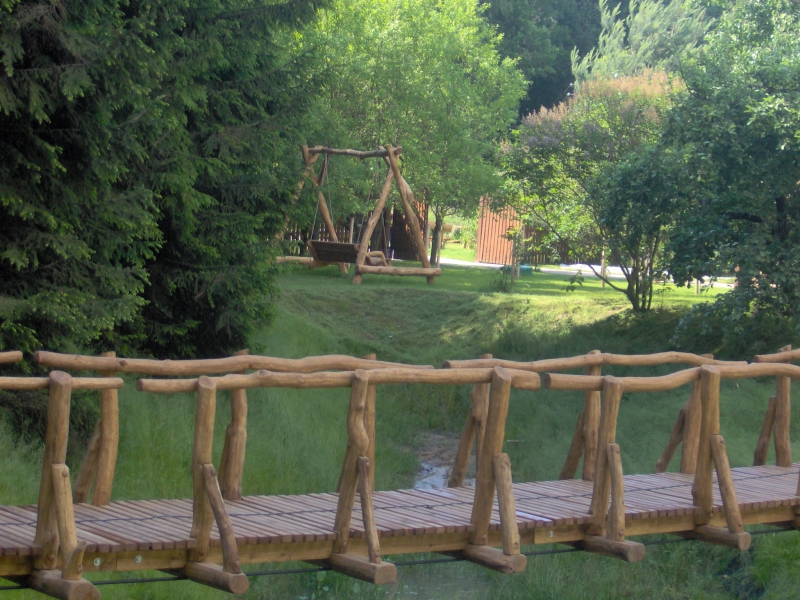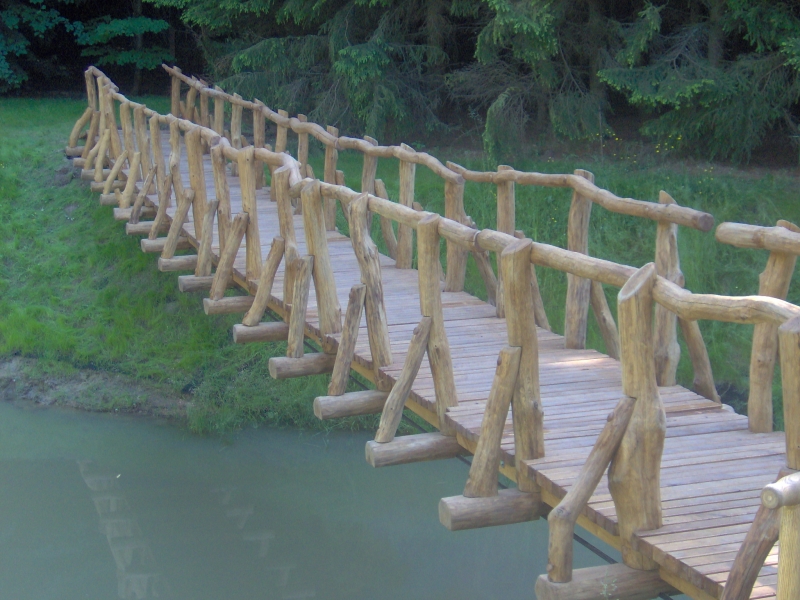
In short: Bridge over a pond No. 3 is a long wooden bridge with a plank deck and railings of natural small logs on both sides. Each railing post is supported from the side by a diagonal brace resting on the projecting end of a crosswise small log, so a clear, rhythmic pattern repeats along the whole length. The length, width and finish are agreed to suit your pond.
A bridge over a pond by a spruce grove
In the photo the bridge stretches across part of the pond from the far bank right up to the photographer. In the lower left you can see calm, greenish water, behind it a grassy bank, and the whole background is filled by a dark, dense spruce grove. The sun lights the bridge from the side, so the log railings glow in a warm honey shade and stand out sharply against the dark spruces.
Because of the angle the photo was taken from, you can see clearly how long the bridge is. The posts line up one after another and merge into a single line in the distance, and the handrail seems to lead the eye across the whole water to the opposite bank. This is not a small decorative footbridge but a real crossing, by which you can reach the other side of the pond or a small island.
In a spot like this the bridge becomes the main element of the landscape. It joins the two banks, but it also gives the place character: instead of an empty water surface there is a path that you want to walk along, to stop in the middle and look at the water.
It is also important that the bridge does not compete with nature. Natural small logs, slightly bent and uneven, look like part of the forest. If straight beams or metal were used instead, the view would become stricter and would recall a city park more than a farmstead by a spruce grove.
The photo was taken on a sunny summer day, when the banks are green and the water is calm. The bridge will look similar in other seasons, only against a different background: in autumn among yellowing leaves, in winter over a frozen pond and snow. The spruce grove behind it stays green all year round, so the contrast between the dark spruces and the warm wood will always be visible.
The rhythm of the length: posts, handrails and projecting crosspieces
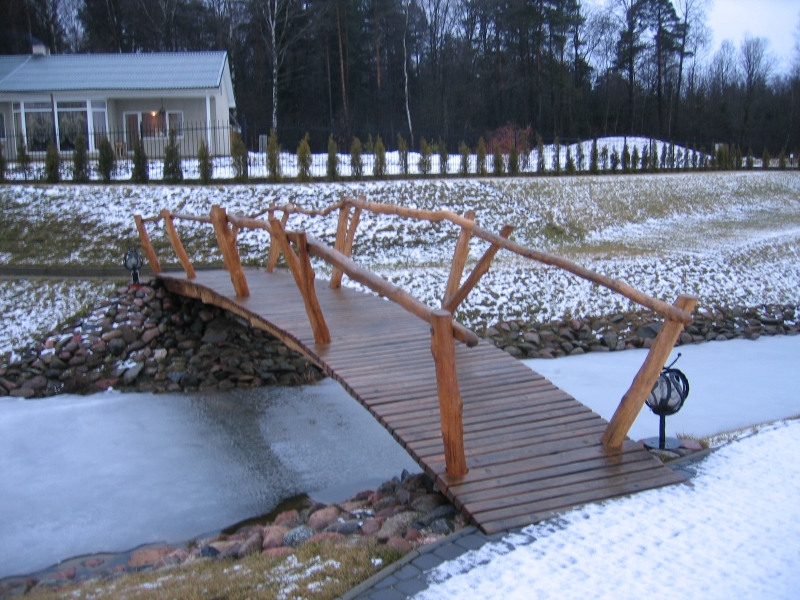
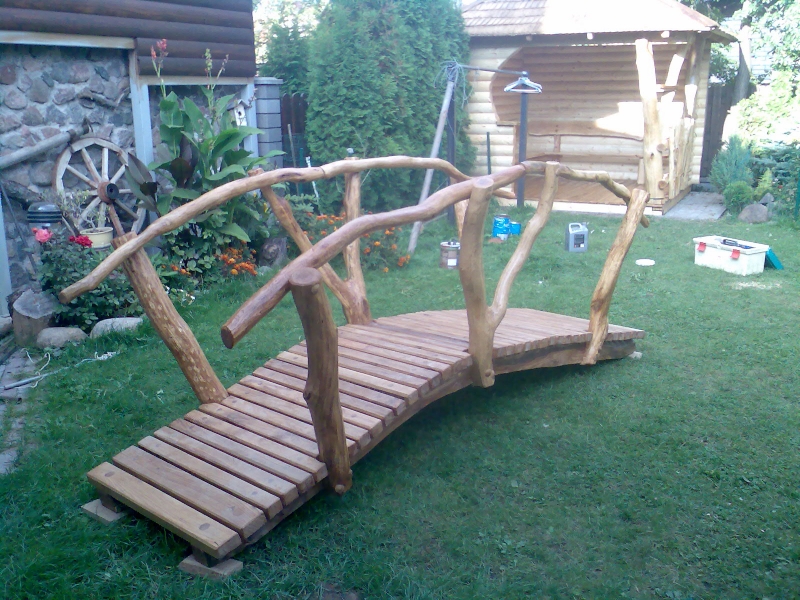
For a long bridge it is important that it does not look dull. In this example that is achieved by a construction that also decorates. Small logs are laid crosswise under the deck, and their ends project beyond the edges of the bridge on both sides. From each such end a diagonal brace rises, supporting a railing post.
This produces a repeating pattern: post, brace, projecting end of a small log, and again from the start. Seen from the side, the bridge looks like a long, rhythmic composition and not just a path with railings. Every element is made of a natural small log, so their thickness and bends differ slightly, which gives liveliness.
The handrails are joined from several long small logs whose joints coincide with the posts. The handrail runs smoothly along the whole length, so it is comfortable to hold on to it the whole way. Some posts rise a little higher than the handrail, which is one more feature of natural wood that nobody tried to even out.
The deck is made of wooden boards with small gaps left between them. In the sun the joints of the boards and the growth rings can be seen clearly. The gaps let rainwater run straight into the pond, so the deck dries quickly.
What was captured in the photo
A short summary helps you judge how this bridge differs from other examples. It is a typical variant that can be changed.
| Feature | In the photo |
|---|---|
| Long bridge over a body of water | Yes |
| Deck of wooden boards | Yes |
| Railings on both sides | Yes |
| Diagonal braces by every post | Yes |
| Projecting ends of crosswise small logs | Yes |
| Handrails of natural small logs | Yes |
| Curved arch shape | No |
What a bridge over a body of water gives you
A pond on a farmstead is often its greatest adornment, but also an obstacle. To get to the other bank you have to go around, and if the pond is elongated, the way can be quite long. A wooden bridge shortens this way considerably.
Besides the practical benefit, a bridge over a pond opens new possibilities for relaxation:
- A place to watch the water. From the middle of the bridge you can see fish, water plants and reflections well.
- A walking route. The bridge joins the paths around the pond into one circle.
- A way to an island or the other bank. There you can set up a gazebo, a bench or a fire pit.
- A backdrop for photographs. Celebrations, weddings or family gatherings at a farmstead are often photographed on the bridge.
On farmsteads that receive guests, a long wooden bridge also becomes a kind of calling card. It is memorable, and the photographs taken on it long recall the time spent.
A bridge over a pond is useful every day as well. It is handy to walk across to the other bank to feed the fish, cut the grass or check how the shore plants are growing. For children it becomes a place of adventure, so railings on both sides are especially needed here: they let you watch more calmly as the little ones run from one bank to the other.
A long bridge also helps to divide a larger farmstead territory. One side of the pond can become a quiet relaxation zone, the other a place for more active pursuits, and the bridge joins them into a unified whole.
Planning: the banks and the bottom of the pond
The longer the bridge, the more important the advance planning. Laukbaldis shows only typical examples, so every bridge is adapted to a particular pond. Before calling, prepare answers to a few questions:
- What distance has to be crossed. Measure the width of the water at the place where you want the bridge and add the distance to firm ground on the banks.
- How deep the water is. It determines how the supports will be set up.
- What the bottom is like. A sandy, clayey or silty bottom calls for different support solutions.
- How the water level changes. The bridge must be higher than the spring water.
- Who will walk over the bridge. If many people will use it, a greater width is worth discussing.
Think also about where the bridge will begin and end. At both ends it is handy to have a firm, dry path, so that you do not have to step from the bridge straight onto wet grass or mud. If the bank is steep, a few steps or a gentler approach may be needed. All of this is easier to plan in advance, while the bridge is still only being discussed, than to fix after it has been built.
If your pond is narrower or you want only a decorative accent, compare with other examples: the straight footbridge over a stream No. 2 or the curved wooden footbridge No. 1. You will find all the works in the section wooden bridges, footbridges and fences. And if you also want a relaxation spot by the pond that is sheltered from sun and rain, take a look at the section wooden gazebos.
The effect of water and sun on the wood
A long bridge over a pond is open to all weather. The sun heats it from above, moisture rises from the water, and in the mornings dew settles on the deck and the railings. So a protective coating made for exterior wood is especially important here: it slows the graying of the wood and reduces the effect of moisture.
Tips that help the bridge stay tidy for a long time:
- in spring inspect the supports and beams to see whether ice or flooding has damaged them;
- in autumn sweep leaves and needles off the deck; beside a spruce grove a lot of them fall;
- check the joints of the braces and posts, because water lingers longest there;
- renew the coating when the surface turns pale and water no longer beads into drops.
Small cracks appear in natural small logs as they dry, which is normal and usually does not harm the strength. If a board begins to bend or crack, it is better to replace it at once. In winter it is worth clearing snow off the deck so that it does not melt on the boards and freeze into a crust of ice.
A bridge standing by a spruce grove or other large trees stays in shade longer, so its surface dries more slowly. In places like this the maintenance is worth doing a little more often than in an open, sunny spot.
How to order bridge No. 3
UAB “Laukbaldis” has been making wooden products since 1996 and, according to the company, was the first in Lithuania to start making this production. The company is based in Dapkiškių village, Tauragės district.
Call +370 687 25388 and quote the product number, No. 3. Tell us about your pond: how wide it is at the place where you want the bridge, and what the depth and the banks are. During the call you will discuss the length of the bridge, its width, the supports, the railings and the shade. Photos of the place and approximate measurements make the first conversation much easier.
The bridge in the photo is only one possible solution. The length, width and details can be changed, so the final bridge will be adapted to your pond and its banks.
Frequently asked questions
Is the bridge suitable for a wide pond?
Yes, the photo shows a long bridge stretching across a large part of the water. The length and the solutions for the supports are agreed individually according to the width, depth and bottom of the pond.
Why are there diagonal braces by the railings?
The braces support the railing posts from the side, so a long railing is stiffer. At the same time they create a rhythmic pattern along the whole length of the bridge.
Can I order a wider bridge?
Yes, the width is discussed when you order. It depends on how many people will walk on the bridge at once and how often it will be used.
Are winter and ice harmful to the bridge?
Ice and spring floods can affect the supports, so it is worth inspecting them in spring. Properly planned supports and regular care help the bridge stay strong for a long time.
Will every bridge look the same?
No, natural small logs are used for the railings, and their thickness and bends differ. The general solution stays the same, but the details are different each time.
How do I order bridge No. 3?
Call us and quote No. 3. We will discuss the width of the pond, the length of the bridge, the supports and the finish.