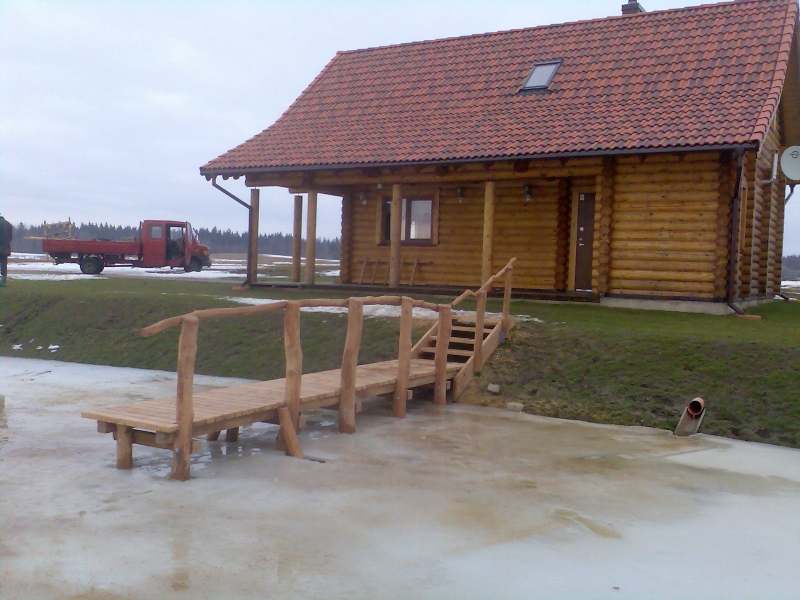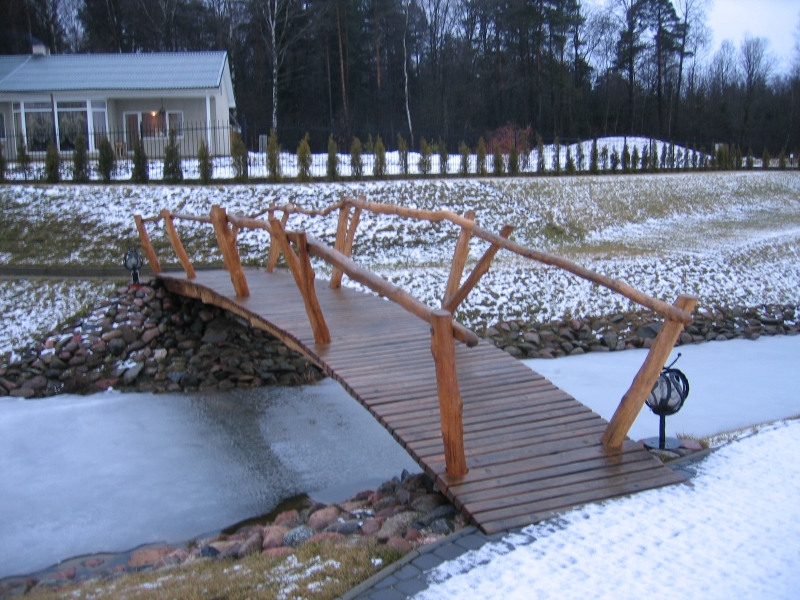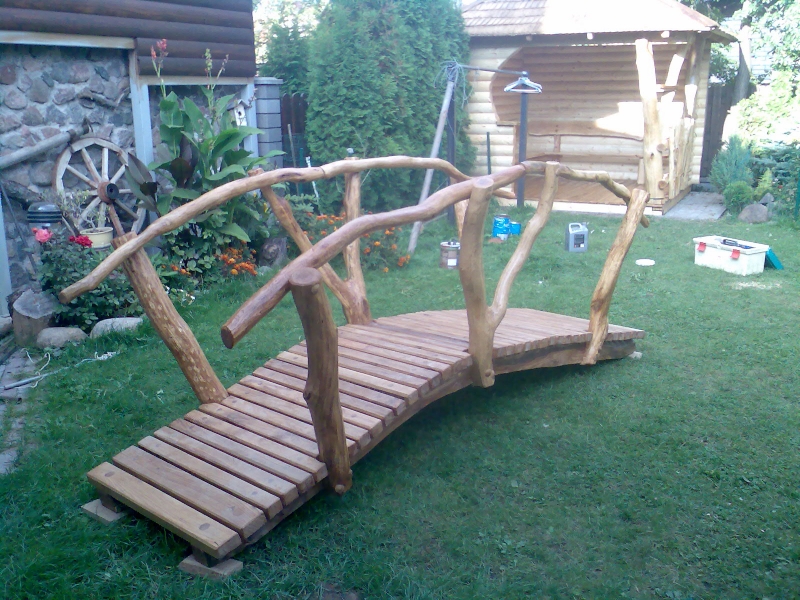
In short: Footbridge over a stream No. 2 is a straight, long wooden footbridge thrown across a grassy ditch with a narrow stream running along its bottom. The deck is made of crosswise slats, and the railings on both sides are made of natural, slightly curved small logs and supported by diagonal braces. The length, width and finish are agreed to suit your site.
A footbridge over a stream in a summer garden
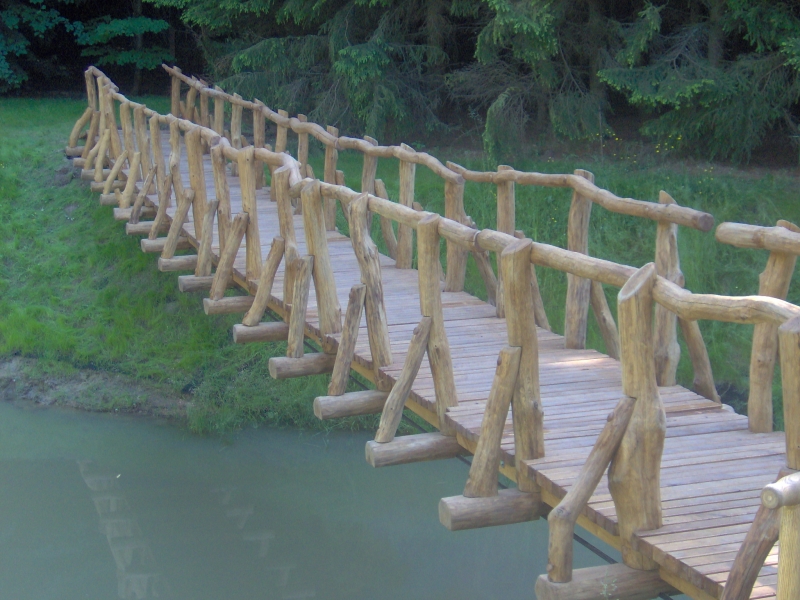
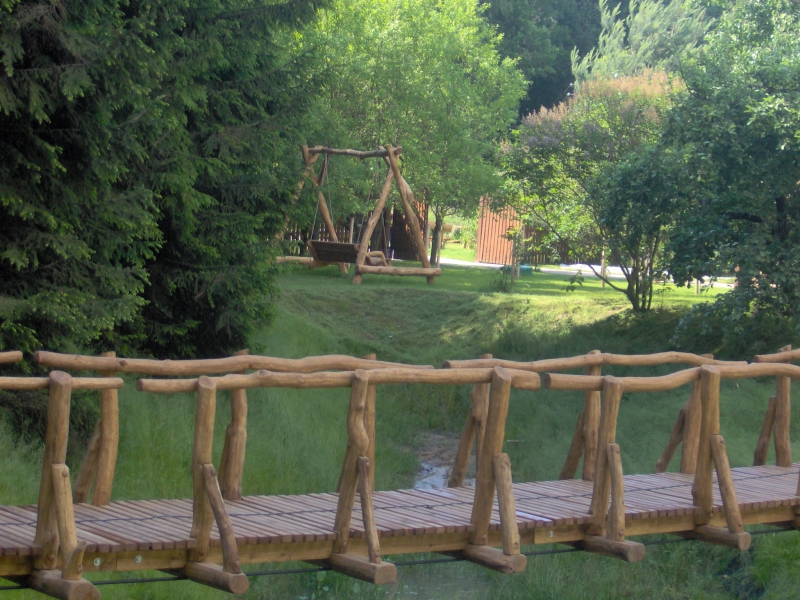
The photo was taken in summer, when everything around is green. The slopes of the ditch are overgrown with tall grass, dense spruces grow on the left, and deciduous bushes and trees on the right. At the very bottom of the ditch you can barely see the narrow stream that the footbridge crosses. Beyond it, in a sunlit meadow, stands a log swing set with a small bench, and farther away a wooden board wall.
This view shows well why a footbridge over a stream is more than a decoration. Without it you would have to go down the slope to reach the other side of the ditch, wade through the stream and climb back up. With a footbridge the way becomes straight and dry, and the swing set or another relaxation corner beyond the ditch can be reached in a few moments.
The footbridge is seen from the side in the photo, so its length is clearly visible. It is not curved: the deck runs level from one edge to the other, and the railings repeat the same straight line. This shape suits places where the footbridge has to be thrown across a wider gap and where it is walked on every day and not only occasionally.
The shade of the natural small logs in the photo is warm, yellowish brown. Against the background of summer greenery the footbridge stands out but does not jar the eye; it looks as if it had always stood here.
Notice also how well the footbridge goes with the swing set on the other side of the ditch. Both products are made of natural small logs and are of a warm shade, so a unified, well-thought-out view forms in the garden. In a similar way you can match other yard structures: a gazebo, benches, a low fence or a children’s play area. When all of them are made of the same natural wood, the yard looks calm and harmonious.
Supports and braces: how the deck holds
Looking closely at the lower part of the footbridge, an interesting structural solution can be seen. Under the deck short small logs are laid crosswise, with their ends projecting beyond the edges of the footbridge. Diagonally placed braces rest on these ends, rising up to the railing posts and supporting them from the side.
This solution has several advantages:
- Stiffer railings. Every post is supported not only at the bottom but also by a brace from the side, so the railing sways less when leaned on.
- An even rhythm. The posts and braces repeat at regular intervals, so a long footbridge does not look monotonous.
- More room on the deck. The braces rest on the projecting ends of the small logs, so they do not take up the path and do not get in the way of walking.
- A traditional look. The projecting ends of the small logs and the braces recall old village footbridges over streams and drainage ditches.
The deck is made of crosswise slats with small gaps. Rainwater runs off through them, and leaves and sand do not collect for long. The slats rest on lengthwise beams, which carry the whole load from one bank to the other.
The handrails of the railings are joined from several natural small logs whose joints coincide with the posts. The small logs are not perfectly straight, so the handrail waves a little. This gives the footbridge liveliness, and a hand sliding along it feels real wood.
A construction like this can be seen clearly only up close, but it is exactly what decides how the footbridge will feel underfoot: whether it will be firm and whether the railings will not sway when several people lean on them at once. So when choosing a footbridge, it is worth looking not only at the general view but at details like these.
The details of the photo in a table
The summary will help you quickly understand what can be seen in the photo of this footbridge. It is a typical example that can be adapted to your site.
| Feature | In the photo |
|---|---|
| Straight, not curved deck | Yes |
| Crosswise slats with gaps | Yes |
| Railings on both sides | Yes |
| Diagonal braces by the posts | Yes |
| Projecting ends of crosswise small logs | Yes |
| Thrown across a ditch with a stream | Yes |
| Curved, arched line | No |
When a footbridge over a stream is really needed
On many farmsteads a drainage ditch or a natural stream runs across the plot. In spring and after downpours there is a lot of water in it, while in summer only a narrow trickle remains. In both cases the ditch divides the yard into two parts, and without a convenient crossing the other side often stays unused.
A wooden footbridge over a ditch solves this problem. Beyond the water you can set up a swing set, a fire pit, a gazebo or simply a walking path. The photo shows exactly this solution: beyond the footbridge stand swings that are reached from the house side straight across the ditch.
A footbridge over a stream is also handy when:
- you need to cross comfortably with children, carrying a basket or pushing a cart;
- you want to connect the yard with the edge of a meadow or forest beyond the ditch;
- in spring the stream floods and crossing it becomes difficult;
- you want a spot from which it is nice to look at the flowing water.
Railings on both sides are especially important when the ditch is deep and the slopes are steep. They help both children and older people feel safer, particularly when the deck is damp with dew.
It also matters that a straight footbridge is more convenient every day. It is easy to take a garden cart across it, carry firewood or walk to the vegetable garden on the other side of the ditch. A curved footbridge looks nicer from the side, while a straight one suits better where it is part of an everyday path.
Before ordering: measure the ditch
Laukbaldis shows only typical examples, so every footbridge is adapted to the particular site. To keep the conversation short and useful, prepare a few details in advance:
- The width of the ditch at the top. Measure from the top of one slope to the other, because the ends of the footbridge must rest on a firm bank and not on the slope.
- The difference in bank heights. If one bank is higher, this needs to be known in advance.
- The water level in spring. The footbridge must be higher than the highest water so that a flood does not reach it.
- Who will walk over the footbridge. The width and the height of the railings depend on it.
- The nature of the ground. In a sandy, clayey or peaty bank the supports are prepared differently.
You will find examples of other shapes among the other works of this group: the curved wooden footbridge No. 1 with forked railings and the long bridge over a pond No. 3. You will find all the works in the section wooden bridges, footbridges and fences, and swing sets like the one in the photo in the section outdoor swing sets and sandboxes.
Wood beside running water
A footbridge over a stream lives in damper conditions than other yard structures. In the morning dew gathers on the deck, mist settles on the railings, and in spring the water may rise closer to the beams. So the protective coating made for exterior wood is especially important here, and its condition is worth checking more often.
A few things that are useful to do regularly:
- in spring, once the water has gone down, inspect the beams and supports for silt and debris left on them;
- clear the gaps in the deck of leaves and soil so that the slats dry quickly;
- check the joints of the braces and posts, because moisture lingers longest there;
- renew the protective coating when the wood turns pale and starts to absorb water.
It is worth mowing the grass that grows on the slopes of the ditch, including under the footbridge, so that air circulates freely and the lower structure dries faster. Small cracks that appear in natural wood are normal and usually do not harm the strength.
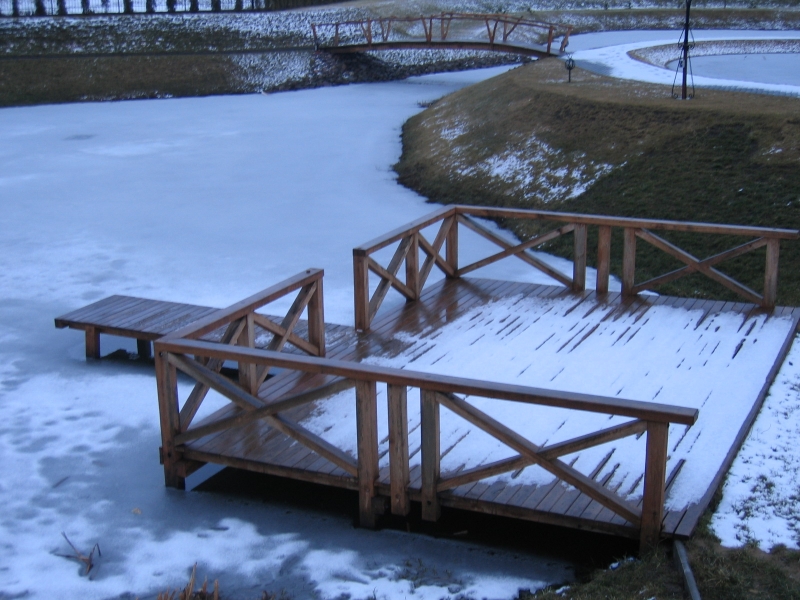
In winter, when the stream freezes, the footbridge becomes especially picturesque. It is worth sweeping snow off the deck so that it does not melt on the slats and soak the wood.
If you notice that a slat has started to bend or has cracked, it is best to replace it at once, without waiting for the damage to grow. Small jobs done in time help the footbridge stay strong and safe for a long time.
How to order footbridge No. 2
UAB “Laukbaldis” has been making wooden products since 1996 and, according to the company, was the first in Lithuania to start making this production. The company operates in Dapkiškių village, Tauragės district.
Call +370 687 25388 and quote the product number, No. 2. Say what ditch or stream you want to cross, how wide it is at the top and what the banks are like. Together you will discuss the length, width, railings, braces and shade. If you have photos of the site, they will help a lot.
If the footbridge in the photo is too long or too short for you, that is no obstacle. The product is adapted according to the agreed solutions, so you will get a footbridge that suits your plot.
Frequently asked questions
Can the footbridge be adapted for a wider ditch?
Yes, the length and width are agreed individually. When you order, you need to know the width of the ditch at the top and the nature of the banks.
What are the diagonal braces by the railings for?
The braces support the railing posts from the side, so the railings sway less. They also give the footbridge the look of a traditional village footbridge.
Can the footbridge be curved and not straight?
Yes, Laukbaldis also makes curved footbridges. It is worth choosing the shape according to how long the footbridge is and how often it will be walked over.
What if the stream floods in spring?
The footbridge must be built higher than the highest water level. It is worth mentioning spring floods in advance so that the supports are chosen correctly.
How do I look after a footbridge over water?
Regularly clear the gaps in the deck and inspect the supports in spring. When the wood starts to absorb water, renew a protective coating made for exterior wood.
How do I order footbridge No. 2?
Call us and quote No. 2. We will discuss the width of the ditch, the length of the footbridge, the railings and the finish.