In short: Wooden pier No. 4 is a wide wooden platform with railings built on a pond shore, from which a narrower walkway leads into the water. The railings are made of straight timbers, and diagonals set between the posts form a clear crossed pattern. The size of the platform, the length of the walkway and the arrangement of the railings are agreed with each customer individually.
A wooden pier on a winter pond
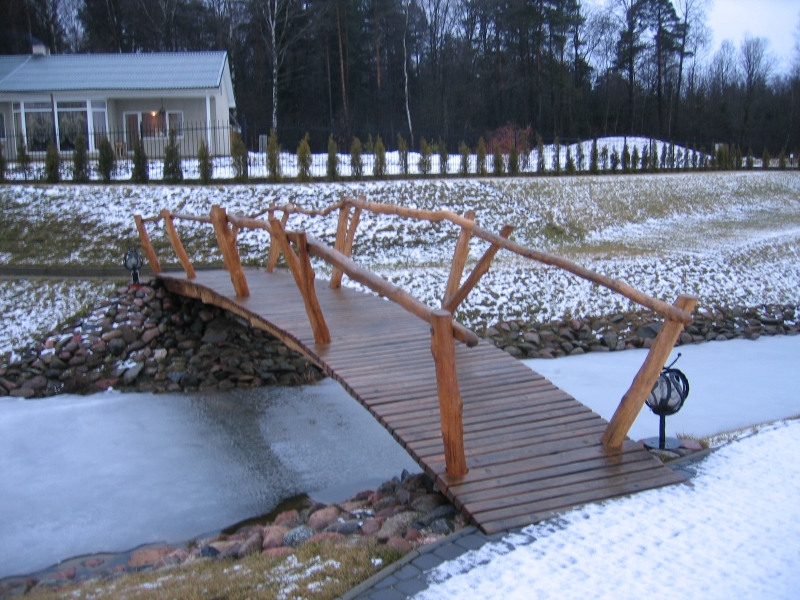
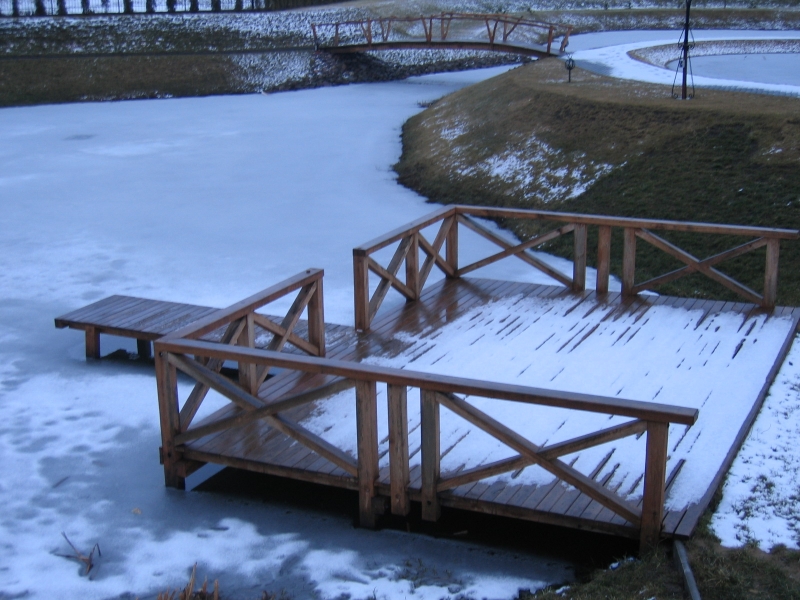
The photo was taken in winter, at dusk. The pond is frozen and covered with a thin layer of snow, the banks have turned white, and on the floor of the pier snow lies in strips between the boards. Against the cold, bluish background the warm brown wood looks especially cozy. In the distance, on another part of the water, you can see another wooden footbridge with railings, and on the right, on a small hill, a lantern and other landscape fixtures.
A photo like this is useful because it shows the pier not in ideal summer conditions but when it withstands snow and ice. You can see that the structure stands level, the railings are straight and the platform rests firmly on the bank. In summer this will be a place for swimming and relaxing, while in winter the pier becomes a pretty accent of the pond and a handy spot from which to step onto the ice.
The pier is built so that most of the platform projects over the water, while the rear edge rests on the grassy bank. This way the platform is reached from the shore in just a few steps, without any stairs or steps. A solution like this is convenient for everyone, children and older people alike.
In a spot like this the pier plays one more role: it tidies the shore. Instead of a squelchy, trampled shoreline where everyone walks to the water by their own route, there appears one clear, convenient place. The bank around the pier stays whole and green, and the water beside it cleaner.
The platform, the narrow walkway and the crossed railings
This pier consists of two clearly different parts. The first is a wide, almost square platform where several people can gather comfortably. The second is a narrower walkway that stretches from the edge of the platform farther into the water. At its end it is handy to sit with your legs dangling, to step down into the water or to moor a boat.
The platform is surrounded by railings on several sides. They are made of straight, even timbers, and in each section two diagonals crossing in the middle are fitted between the posts. This forms a crossed pattern that recalls traditional village fences and terrace railings. The top is finished with a straight handrail on which it is comfortable to rest your elbows and look at the water.
The railings do not close the platform off completely. A gap is left between two sections, through which you step onto the narrow walkway. The walkway itself has no railings, so the water can be reached freely from it. This combination is well thought out: the wide part is safer for relaxing, while the narrow one is meant for getting to the water.
The floor is made of wooden boards with small gaps. In the photo you can clearly see how snow lingers on the boards while the gaps between them remain dark. In summer water runs off quickly through such gaps, so the floor dries faster after swimming or rain.
All the wood is coated with a warm brown shade that goes nicely with both the green summer bank and the white winter snow. A darker finish also shows less of the dirt that inevitably appears on a pier walked on often with wet feet.
Crossed railings of straight timbers look tidier and stricter than railings of natural branches. This style suits more modern houses, neatly planned banks and decorative ponds with paths, lanterns and planting around them. The photo shows just such a setting: well-kept banks, a lantern and another footbridge in the distance.
What the photo shows
A short summary helps you quickly judge the solutions of this pier. It is a typical example that can be changed to suit your needs.
| Feature | In the photo |
|---|---|
| Wide platform over the water | Yes |
| Narrow walkway into the water | Yes |
| Railings with a crossed pattern | Yes, on the sides of the platform |
| Railings on the narrow walkway | No |
| Floor of wooden boards | Yes |
| Stairs into the water | No |
| Warm brown finish | Yes |
What a pier with a platform is used for
A simple narrow pier serves one purpose: to reach the water. A pier with a platform offers far more possibilities. Several people fit on it, you can put a chair or a bench, and lay down a towel or fishing rods. So the pier becomes a small terrace by the water where you want to stay longer.
A platform like this comes in handy for:
- swimming: in the wide part it is convenient to change and put your things down, and from the narrow walkway to step into the water;
- fishing: anglers can settle both on the platform and at the end of the walkway;
- relaxing with the family: in the evening it is good to sit here, watch the sunset and the surface of the water;
- boats: a small boat can be moored at the narrow walkway;
- winter: from the pier it is handy to step onto the ice for skating when the ice is thick enough.
The railings on the platform give peace of mind when there are children by the water. They not only protect but also clearly show where the platform ends, so it is easy to find your bearings even after dark. The narrow walkway has been left without railings on purpose: it must be easy to reach the water from it.
A pier with a platform also suits farmsteads that receive guests. A larger group can gather here all together and not stand one behind another on a narrow walkway.
In addition, a wooden pier with a platform goes with other structures in the yard. If the farmstead has a gazebo, a sauna or a terrace, the pier can be finished in the same shade and with the same railings so that the whole surroundings look unified.
Questions before ordering a pier
Laukbaldis shows only typical examples, so every pier is adapted to a particular body of water. Before calling, think about the following:
- The depth of the water by the shore. It determines how far the walkway must reach and what the supports will be.
- The nature of the bottom. A sandy or silty bottom calls for different foundation solutions.
- Fluctuations of the water level. In spring the water may rise, so the pier must be high enough.
- The size of the platform. Think about how many people are usually there and whether you will want to place furniture.
- The arrangement of the railings. On which sides railings are needed and which to leave open.
- Whether stairs into the water are needed. There are none in the photo, but it can be discussed.
If the bank is higher, it is worth looking at the pier with stairs and natural log railings No. 5, and if you need to cross to the other bank, the long wooden bridge over a pond No. 3. You will find all the examples in the section wooden bridges, footbridges and fences, and a sheltered spot by the water can be added from the section wooden gazebos.
Ice, moisture and caring for the wood
A pier is one of the wooden structures most exposed to weather on a farmstead. In summer the sun heats it and water splashes it, in autumn leaves fall on it, and in winter ice surrounds the supports. So a protective coating made for exterior wood and regular inspection are especially important here.
What is worth doing every year:
- in spring, after the ice has melted, inspect the supports and beams to see whether the movement of the ice has damaged them;
- check the joints of the railings and the fastenings of the diagonals, because the railings are often leaned on;
- sweep leaves and soil off the floor so that the boards dry quickly;
- when the wood turns pale and starts to absorb water, renew the protective coating.
In winter it is worth sweeping snow off the platform, especially before a thaw. Melting snow soaks the boards, and when it freezes again, slippery ice forms on the floor. When walking on the pier in winter, be careful and do not step onto the ice until you are sure it is thick enough.
If a board starts to bend or crack, it is better to replace it at once. Small repairs done in time help the pier stay safe for a long time.
How to order pier No. 4
UAB “Laukbaldis” has been making wooden products since 1996 and, according to the company, was the first in Lithuania to start making this production. The company operates in Dapkiškių village, Tauragės district.
Call +370 687 25388 and quote the product number, No. 4. Tell us about your pond or lake: how deep it is by the shore, what the bottom is like and how much the water level changes. During the call you will discuss the size of the platform, the length of the walkway, the railings and the finish. Photos of the shore will help you find a suitable solution faster.
The pier in the photo is only one possible variant. The platform can be larger or smaller, the walkway longer, and the railings arranged differently. The pier is made according to the agreed solutions, so it will suit your shore.
Frequently asked questions
How does a pier with a platform differ from a simple pier?
Several people fit on the wide platform, and you can put a bench or lay down your things. The narrow walkway leading from the platform is for getting to the water.
Why is the narrow walkway without railings?
It must be easy to reach the water from the walkway, to step down for a swim or to get to a boat. The railings are placed around the platform, where people gather most.
Does the pier withstand winter and ice?
In the photo the pier can be seen in winter by a frozen pond. In spring, after the ice has melted, it is worth inspecting the supports and repairing them if needed.
Can stairs into the water be added?
There are no stairs in the photo, but the size, finish and equipment of the product are agreed individually. It is worth mentioning stairs when you order, because they depend on the depth of the water.
How do I look after a wooden pier?
Regularly clean the floor and inspect the supports and railings in spring. When the wood turns pale and starts to absorb water, renew a protective coating made for exterior wood.
How do I order pier No. 4?
Call us and quote No. 4. We will discuss the depth of the water, the size of the platform, the length of the walkway and the railings.