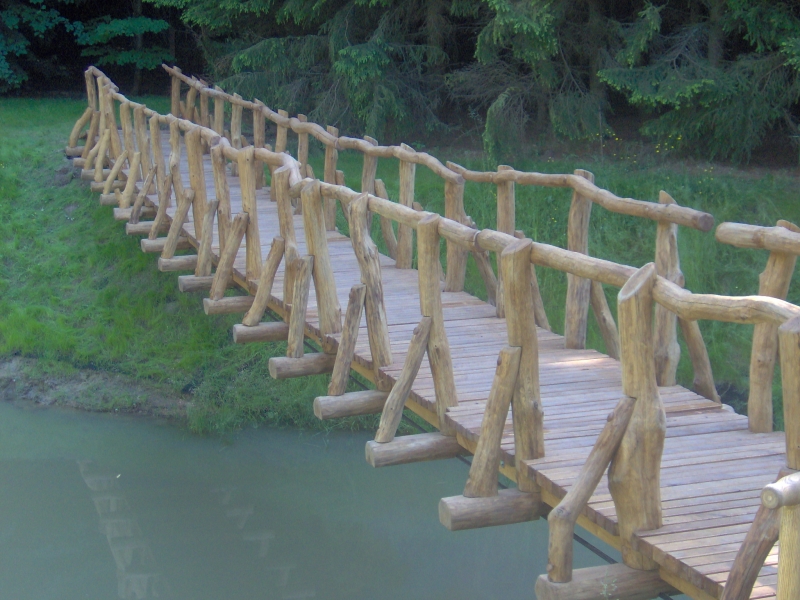
In short: Pier with stairs No. 5 is a wooden pier that descends from a higher bank by wooden steps to a pond and continues along a long walkway over the water. The stairs and the walkway are accompanied by railings of natural, slightly curved small logs. The height of the stairs, the length of the walkway and the arrangement of the railings are agreed to suit your bank.
A pier with stairs by a log house
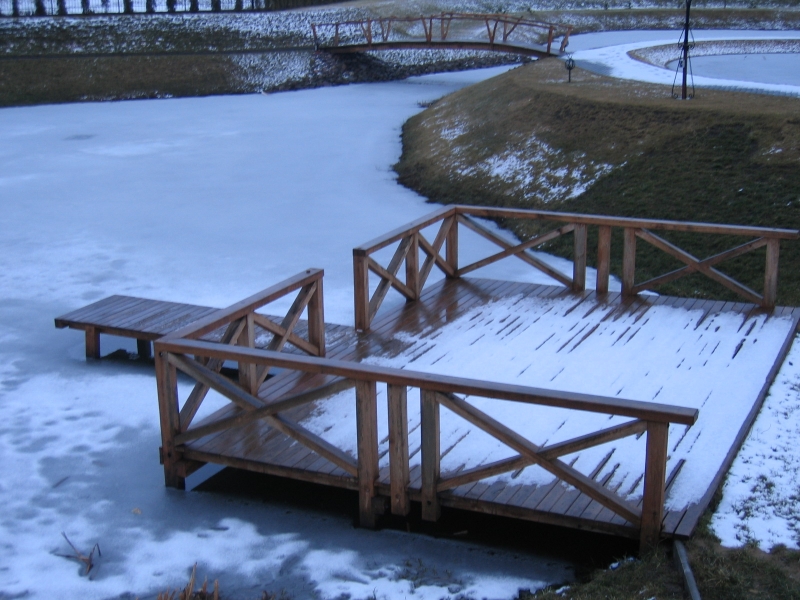
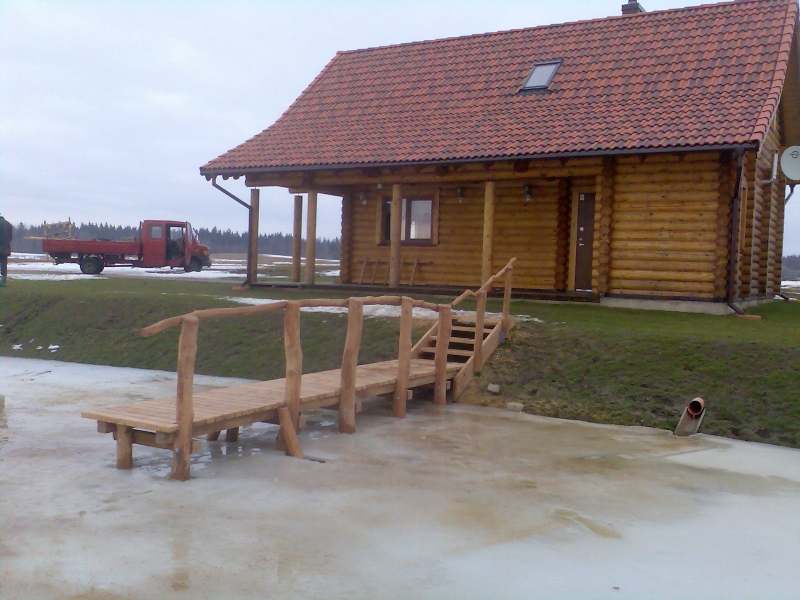
In the photo the pier is built on a pond by a large log house with a red tile roof and a covered porch. Between the house and the water there is a grassy slope, and from its bottom a wooden walkway stretches out over the pond. The photo was taken at the end of winter: the water is still covered with ice and slush, patches of snow can be seen on the meadow, and the sky is overcast.
The pier looks here like a natural continuation of the house. The log walls and the light wood of the pier are of a similar shade, so the whole composition, the house, the slope and the pier, merges into a single whole. From the terrace or the porch, the way to the water is short and clear.
The most important feature of this pier is the stairs. The bank here is much higher than the water, so a plank walkway could not simply be lowered: it would be too steep. A few wooden steps solve this problem and let you go down comfortably to the level of the walkway, and from it step farther over the water.
Piers like this especially suit farmsteads where the house or sauna stands on a small hill and the pond is dug lower down. The photo shows exactly such a situation, so it shows well how a pier helps to join two levels.
On the left side of the photo, beyond the pond, you can see open fields and a strip of forest on the horizon. In such a spacious place the pier also becomes a viewing spot: having walked to the end of the walkway, you see the whole pond and the fields beyond it. On a summer evening it is good to stand here, listen to the birds and watch mist rise over the water.
How you go down from the slope to the water
The stairs begin at the top of the slope, almost at the edge of the meadow. The steps are made of wooden boards and rest on side beams that run diagonally down to the walkway. Railings of natural small logs rise on both sides of the stairs: they start from posts at the top of the slope and run down together with the steps.
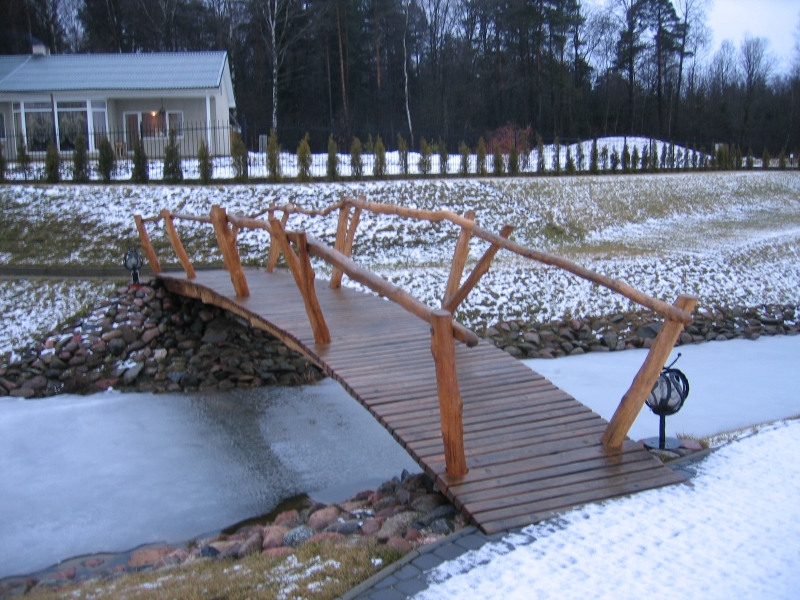
After the stairs, a long plank walkway begins. It goes straight into the pond and rests on short posts with crosswise beams, which can be seen under the deck in the photo. The floor of the walkway is made of crosswise boards, and the railings are fitted on one side only, the far one. The near side is left open, so it is handy to approach the water from it or to sit on the edge.
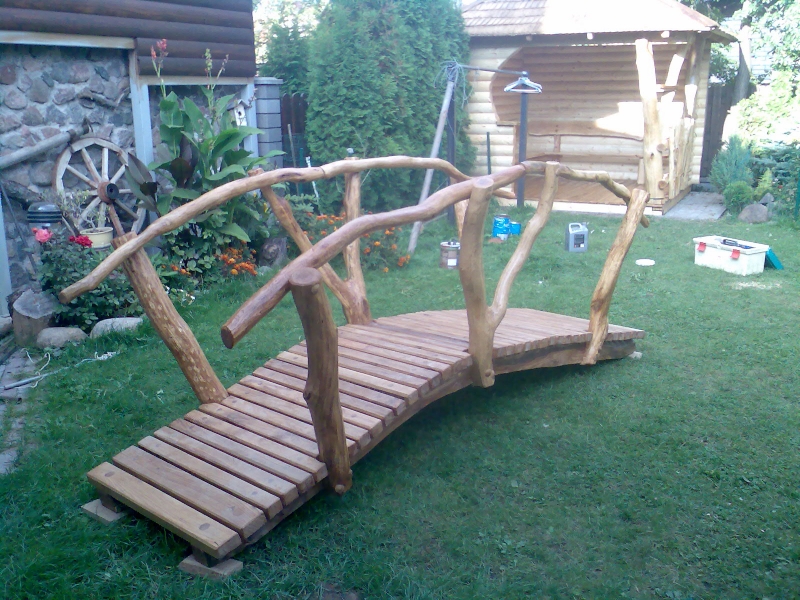
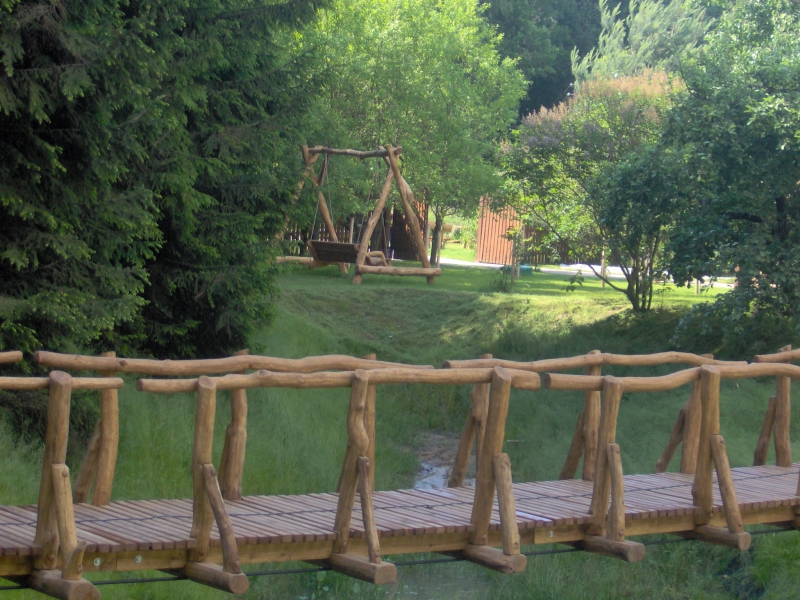
The railing posts and handrails are made of natural small logs whose shape has not been evened out. Some posts are slightly tilted or curved, and the handrail is not perfectly straight either. This is exactly what gives the pier its rustic coziness and ties it to the log house.
A construction like this is convenient in that a person going down the stairs can hold on to the railing the whole time. This is especially important when the steps are wet with dew or rain and the slope is slippery.
Notice also how the stairs join the walkway. The last step almost merges with the floor of the walkway, so after going down you do not have to step over any high threshold. Small details like these decide whether the pier will be convenient to use every day or will remain only a beautiful but rarely visited structure.
The details we can see
The summary helps you quickly judge the solutions of this pier. It is a typical example that can be adapted to a different bank.
| Feature | In the photo |
|---|---|
| Wooden steps from the bank | Yes |
| Railings by the stairs | Yes |
| Long walkway over the water | Yes |
| Railings on the far side of the walkway | Yes |
| Railings on both sides of the walkway | No |
| Posts and handrails of natural small logs | Yes |
| Wide platform at the end of the walkway | No |
When a slope needs stairs
Many ponds on farmsteads are dug so that an embankment of excavated soil or a steep bank remains around them. Going down such a slope is awkward, especially after rain, when the grass is slippery, or in winter, when the slope is icy. A pier with stairs solves this problem: instead of a slippery slope there are steps with railings.
It is worth thinking about stairs if:
- the bank is more than a few steps higher than the water;
- children or older people often go down to the water;
- a sauna stands nearby and you want to get to the water quickly after it;
- the slope is clayey and becomes slippery after rain;
- you want to protect the turf of the slope from being trampled.
Stairs also help the whole bank look tidy. Instead of trodden paths in the grass there is one clear way, and the rest of the slope stays green and healthy.
One more advantage is safety after dark. In the evening, coming back from the water or from the sauna, stairs with railings let you climb with confidence even if the lighting is weak. A small lamp can also be set up beside the stairs so that the steps are well visible. Laukbaldis also makes lamps, so lighting can be discussed together with the pier.
A pier with stairs is also useful when you have to carry things down to the water: chairs, fishing rods, towels or children’s toys. With a railing and even steps it is much simpler than going down the slope.
What to prepare before the conversation
Laukbaldis shows only typical examples, so every pier with stairs is adapted to a particular bank. The conversation will be shorter if you know a few things in advance:
- The height of the bank. How much higher the top of the slope is than the water level; the number of steps depends on it.
- The length of the slope. The slope of the stairs and their comfort depend on it.
- How far the walkway must reach. Whether a short walkway is enough or you need to go out to deeper water.
- The need for railings. In the photo the walkway has railings on one side, but another variant can be discussed.
- The ground of the bottom and the bank. It determines the solutions for the supports.
For comparison, look at the wooden pier with a platform No. 4, which is built on a low bank, and the long bridge over a pond No. 3. You will find all the works in the section wooden bridges, footbridges and fences. And if you are also planning a sauna or a summerhouse by the pond, take a look at the section saunas and summerhouses.
The stairs and the pier in different seasons
A wooden pier with stairs lives together with the pond. In summer the sun heats it and water splashes it, in autumn leaves fall on the steps, and in winter ice surrounds the supports. The photo shows exactly this last stage: the ice begins to melt, the water is slushy, and the pier stands firmly.
To make the stairs and the walkway last a long time, it is worth following a few rules:
- in autumn sweep leaves off the steps, because wet leaves are slippery and hold moisture;
- in winter clear snow off the steps so that it does not freeze into a crust of ice;
- in spring, after the ice has melted, inspect the supports of the walkway and the beams of the stairs;
- check the railing posts to see that they are holding firmly, because they are leaned on when going down;
- renew the protective coating made for exterior wood when the surface turns pale.
Small cracks appear in natural small logs as they dry, which is normal and usually does not harm the strength. Pay special attention to the steps: if one of them begins to bend, it is better to replace it at once.
Wooden structures standing by water dry more slowly than in the middle of the yard, so they are worth inspecting more often. This applies especially to the parts of the walkway closest to the water surface: waves, spray and spring flood water reach them. Damage noticed in time is repaired quickly and simply, and the pier stays safe for many years.
How to order pier No. 5
UAB “Laukbaldis” has been making wooden products since 1996 and, according to the company, was the first in Lithuania to start making this production. The company is based in Dapkiškių village, Tauragės district.
Call +370 687 25388 and quote the product number, No. 5. Tell us about your bank: how high it is, how long the slope is and how far the walkway must reach. During the call you will discuss the number of steps, the length of the walkway, the railings and the finish. Photos of the bank taken from the side help a lot in understanding the difference in heights.
The pier in the photo is only one possible solution. The stairs can be longer or shorter, the walkway wider, and the railings fitted on both sides. Everything is made according to the agreed solutions.
Frequently asked questions
How many steps can the pier stairs have?
The number of steps depends on how much higher the bank is than the water. It is determined individually once the height of the bank and the length of the slope are known.
Why are the railings on only one side of the walkway?
The open side is left so that it is easy to approach the water from the walkway or sit on the edge. When you order, you can discuss railings on both sides.
Is the pier suitable beside a sauna?
Yes, a pier with stairs is handy where the sauna stands on a small hill and the water is lower. Steps with railings let you go down safely even with wet feet.
Will the stairs be slippery?
Outdoor stairs become slippery when wet leaves, snow or ice lie on them. So sweep the leaves off in autumn and the snow in winter so that the steps do not ice over.
How do I look after a pier with stairs?
In spring inspect the supports, the beams of the stairs and the railing posts. When the wood turns pale and starts to absorb water, renew a protective coating made for exterior wood.
How do I order pier No. 5?
Call us and quote No. 5. We will discuss the height of the bank, the number of steps, the length of the walkway and the railings.