In short: Garden footbridge No. 7 is a curved wooden footbridge with a deck of wider crosswise boards and railings of winding natural branches on both sides. In the photo it stands simply on a lawn, among flower beds and garden buildings, so it plays a decorative role. The length, width, curve and finish are agreed with each customer individually.
A garden footbridge among the flowers in the yard
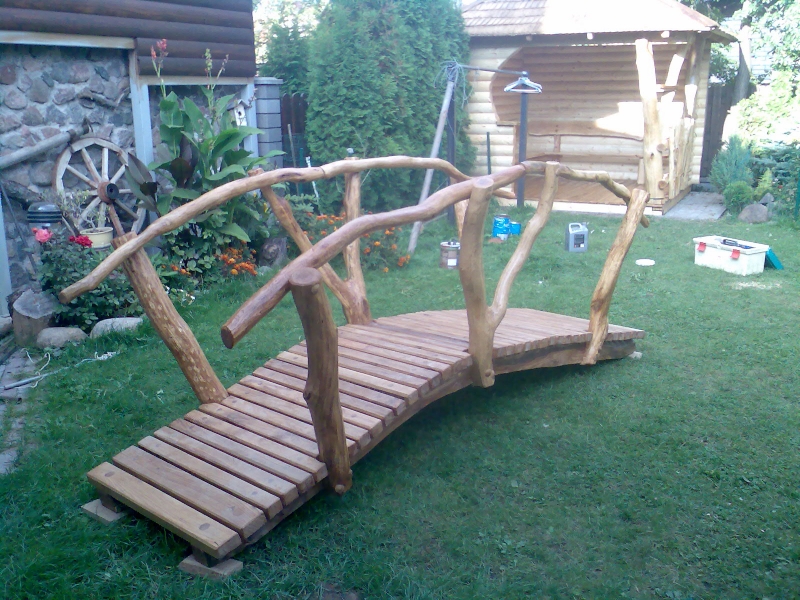
The photo was taken in summer in a cozy, lively farmstead yard. On the left you can see a building with a field-stone plinth and log walls, an old wooden cartwheel leaning against it, and red and orange flowers blooming beneath. Behind the footbridge grow dense thujas, and on the right stands a light log structure. The lawn is lush, green and tidy.
In this setting the footbridge looks like a natural part of the farmstead. Its branch railings echo the mood of the cartwheel and the log walls, and the warm wood goes with the stones and the flowers. It is not a strict park structure but a cozy accent of a rustic garden.
Notice that there is neither a stream nor a pond here. The garden footbridge is placed right on the lawn and becomes a kind of sculpture that you see as soon as you enter the yard. For children it is a place of adventure, for adults a lovely backdrop for photographs and celebrations. In addition, the footbridge helps to divide a large lawn space and gives it a clear center.
Judging by the look of the yard, it seems the footbridge has just been delivered or is being installed: a toolbox and a few containers stand beside it. So the photo shows the footbridge as it is right after being set up, not yet overgrown with surrounding grass and plants.
Imagine how this spot will look in a year or two. Low flowers or grasses can be planted around the ends of the footbridge, climbers by the railings, and the spot itself can be edged with pebbles. Then the footbridge will blend completely into the garden and become one of the coziest places in the yard.
Wider boards and winding handrails
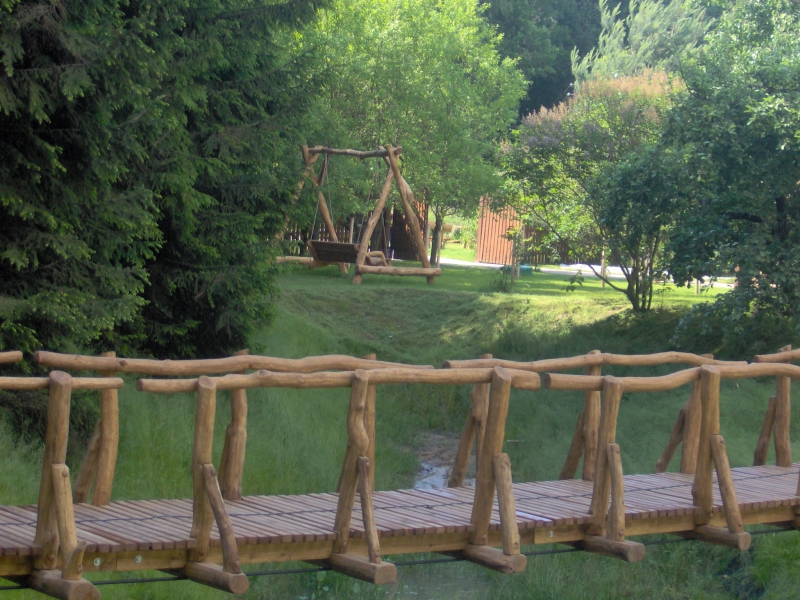
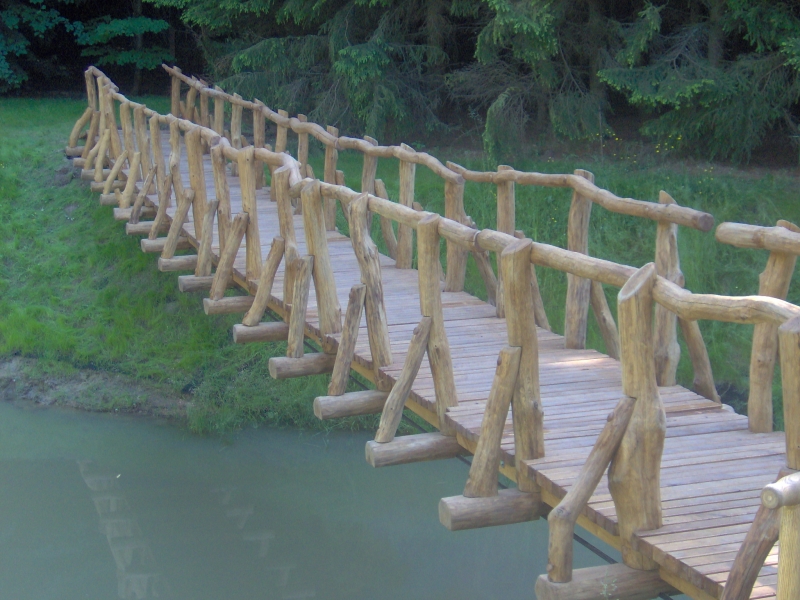
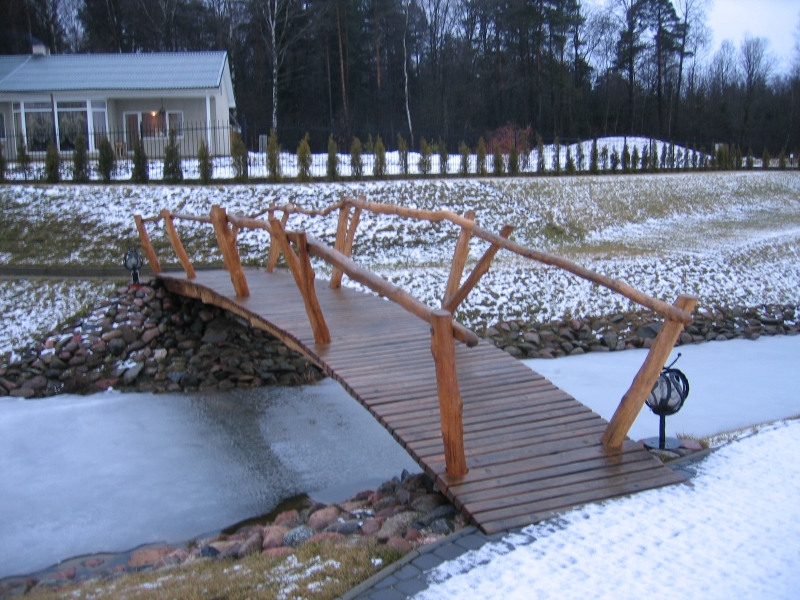
The deck of this footbridge is made of fairly wide crosswise boards. They rest on curved side beams, so the deck rises to the middle and gently descends to the other side. Wider boards give a sturdier, more solid impression and feel comfortable underfoot. The ends are set on small supports so that the boards do not touch damp ground.
The railings are the most striking part of this footbridge. The handrails are made of long, strongly curved branches that wind as if alive. They are different on each side, because every branch has grown in its own way. The posts are natural too: some are straighter, others have forks, and the farthest corner post rises higher than the others and completes the composition.
The ends of the handrails come down right to the ground, as if rooted in the lawn. Because of this the footbridge looks not placed on the grass but grown out of it. A solution like this gives the product special liveliness and a fairy-tale quality.
The finish is warm, yellowish brown, with clearly visible growth rings and branch scars. In the sun it glows, and in the shade it becomes richer. The combination of the light handrails and the deck stands out well against the background of the lush green lawn.
Compared with other similar footbridges, this one looks freer and more fairy-tale. The handrails are not evened out or joined into a straight line: they undulate, rise and fall just as the branches grew. A character like this especially suits farmsteads where naturalness, old objects and handmade details are valued.
UAB “Laukbaldis” has long valued the natural shape of wood in its products: branches, knots and bends make each product distinctive. This footbridge is a good example of that: another one exactly like it will not exist.
Solutions seen in the photo
A short summary helps you compare this footbridge with other examples. It is a typical variant that can be changed.
| Feature | In the photo |
|---|---|
| Curved deck | Yes |
| Wider crosswise boards | Yes |
| Winding branch handrails | Yes, on both sides |
| Natural posts with forks | Yes |
| Ends on supports | Yes |
| Set over water | No, on a lawn |
A footbridge without water: ideas for a garden
Not every plot has a stream or a pond, but a garden footbridge can decorate a dry yard too. The main thing is to find a spot where it looks meaningful. Here are a few ideas:
- A dry stream of stones. A winding strip formed of gravel and boulders under the footbridge creates the impression of water without the care that water needs.
- A strip of flowers. Flowers planted under the footbridge or on both sides of it make it part of a blooming garden.
- A path crossing. A footbridge on a garden path becomes its natural part, which you walk over every day.
- A children’s play zone. Next to a swing set or a sandbox, a footbridge becomes one more adventure object.
- A photo spot. At celebrations, weddings or birthdays a garden footbridge makes a lovely backdrop.
The photo shows that the footbridge goes nicely with the surrounding buildings. If your yard has log structures, stone masonry or old wooden objects, a footbridge with branch railings will add to this mood.
When choosing a spot, think about where you will most often look at the footbridge from. The curved shape shows best from the side, so it is worth placing the footbridge so that you see it from the terrace, the gazebo or a window of the house.
One more tip: do not put the footbridge where water stands for a long time after rain. Even on supports its ends will stay damp longer, and the lawn around will turn soggy. It is best to choose a level, dry, sunlit spot where the footbridge is clearly visible and easy to reach.
What to say when calling
Laukbaldis shows only typical examples, so the footbridge is made to suit your site and wishes. To keep the conversation short, think in advance about:
- Where the footbridge will stand. On a lawn, over a dry stream of stones or over water.
- How long it should be. Think about proportions: a footbridge that is too small will get lost in a large yard, and one that is too big will overshadow other elements.
- How wide. Whether people will only walk on it or you will want to cross with a cart.
- What railings. Winding, as in the photo, or calmer and straighter.
- What finish. Light, as in this example, or darker.
For comparison, look at the curved wooden footbridge No. 1 with forked posts and the decorative footbridge No. 6 with a dark finish. You will find all the examples in the section wooden bridges, footbridges and fences. A bench or a table from the section oak garden and outdoor furniture also goes well next to a footbridge.
Caring for the boards and branches
A garden footbridge standing on a lawn is less exposed to moisture than a footbridge over water, but rain, sun and leaves lying for a long time still harm it. To keep it looking good, it is worth following a few simple rules:
- when mowing the lawn, do not leave piles of cut grass by the ends of the footbridge;
- in autumn sweep the leaves off the deck so that they do not rot on the boards;
- in spring check that the ends stand firmly on the supports and are not sinking into the ground;
- renew the protective coating made for exterior wood when the surface turns pale.
Winding branches have many bends and branch scars where water can linger. Inspect these places more carefully and, if needed, rub in a protective product. Natural small cracks that appear as the wood dries are normal and usually do not harm the strength.
You do not need to take the footbridge indoors for winter, but it is worth sweeping snow off the deck, especially before a thaw. A well-kept footbridge acquires an even nicer patina over the years and blends more and more into the garden.
If the footbridge stands close to trees, more leaves, resin and bird droppings will fall on it. In that case it is worth sweeping and washing the deck more often and checking the protective coating every spring.
How to order footbridge No. 7
UAB “Laukbaldis” has been making wooden products since 1996 and, according to the company, was the first in Lithuania to start making this production. The company is based in Dapkiškių village, Tauragės district.
Call +370 687 25388 and quote the product number, No. 7. Tell us where the footbridge will stand and what size it should be. During the call you will discuss the length, width, curve, railings and finish. If you have photos of the yard, they will help you understand faster how the footbridge will look in your surroundings.
The footbridge in the photo is only one possible solution. Because natural branches are used for the railings, your footbridge will have its own unrepeatable bends, but it will keep the same cozy character.
Do not be afraid to ask about changes either: a wider deck, a lower arch, railings on one side only or a different shade. The product is made according to the agreed solutions, so the result will match your garden and not only this photo.
Frequently asked questions
Can a garden footbridge stand without water?
Yes, in the photo the footbridge simply stands on a lawn. It can also be placed over a dry stream of stones, a flower strip or a garden path.
Are the handrails always so winding?
Natural branches are used for the handrails, so their shape is different each time. When you order, you can discuss whether you want strongly winding or calmer lines.
Why do the ends of the footbridge stand on supports?
The supports lift the boards off the damp ground, so the deck dries faster. This helps the wood stay in good condition for longer.
Is the footbridge suitable for children?
A footbridge with railings on both sides often becomes a favorite place for children to play. The size and the height of the arch are worth discussing when you order, with the users in mind.
How do I look after a garden footbridge?
Sweep leaves off the deck and in spring check that the ends stand firmly. When the wood turns pale, renew a protective coating made for exterior wood.
How do I order footbridge No. 7?
Call us and quote No. 7. We will discuss the spot, the length, the width, the railings and the finish.