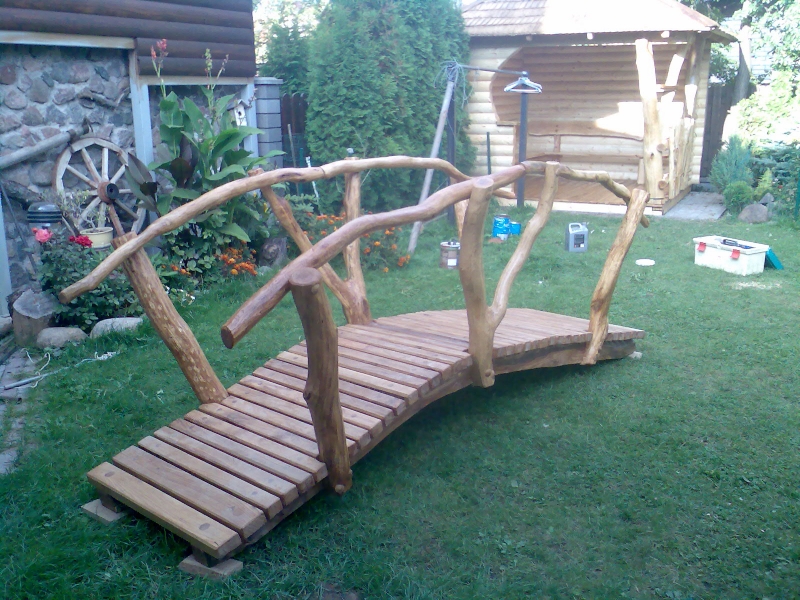
In short: Wooden footbridge No. 1 is a curved, upward-rising footbridge with a deck of crosswise slats and railings of natural branches on both sides. The railing posts are chosen with forks, so they resemble the letter Y, and the handrails are bent the way the tree grew. The length, width, curve and finish of the footbridge are agreed with each customer individually.
A curved wooden footbridge up close
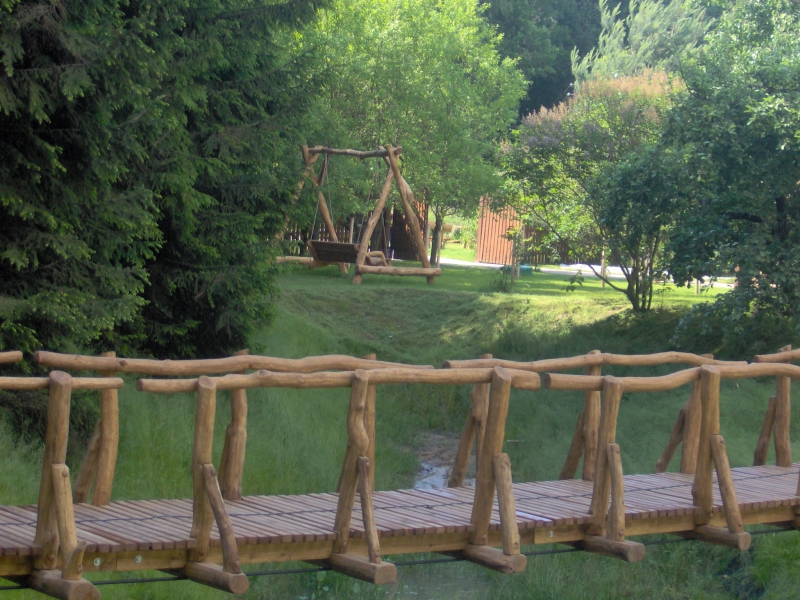
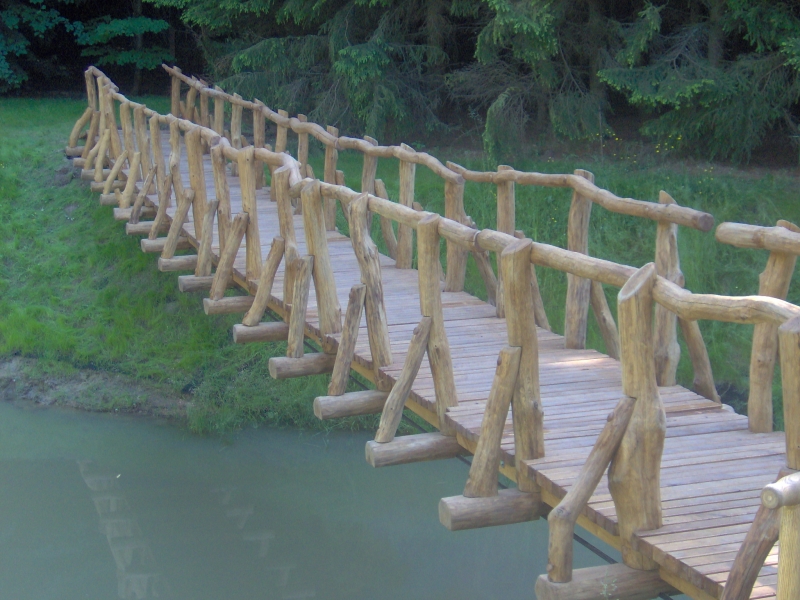
In the photo the footbridge stands on grass in an open area, not yet over water. This lets you see its whole construction clearly: how the deck is curved, how the railings are fastened and what shape of branches was chosen for them. A view like this is useful for those who want to understand how the footbridge will look not only from afar but right up close.
The deck is made of many crosswise slats with narrow gaps left between them. The slats rest on two curved side beams, so the footbridge rises gently to the middle and descends again. The ends almost touch the ground, so it is easy to step onto the footbridge, while the middle rises enough that a clear arch forms when seen from the side.
There are railings on both sides. On each side stand several forked posts: one trunk divides into two branches at the top, and both rise to the handrail. The handrails are made of long, naturally curved branches that run along the whole length of the footbridge and descend at the ends. Thanks to such curves the footbridge looks light and alive, as if it had grown in the garden itself.
All the wood is coated with a light, warm honey-colored finish. On the branches you can see growth rings, the places where branches grew and natural irregularities that nobody tried to hide. These are exactly what create the character of this product.
Notice also how the parts are joined. The posts rest on the side beams, and the handrails are placed on top of the posts, so every branch has a clear support. The gaps between the slats let rainwater and snow run down and not collect on the deck. Small details like these decide that the footbridge will be not only beautiful but also convenient to use every day.
What the photo shows
A short summary will help you quickly compare this footbridge with others. It is a typical example and not the only possible variant.
| Feature | In the photo |
|---|---|
| Curved, upward-rising deck | Yes |
| Crosswise slats with gaps | Yes |
| Railings on both sides | Yes |
| Forked, Y-shaped posts | Yes |
| Naturally curved handrails | Yes |
| Light honey-colored finish | Yes |
| Set over water | No, it stands on the lawn |
Where to put a footbridge with branch railings
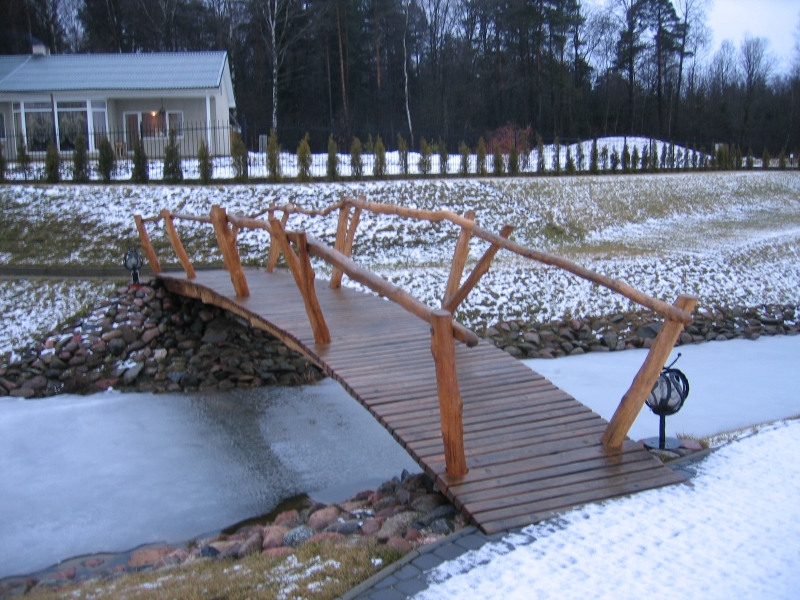
Many people imagine a footbridge only over a stream or a pond. In fact a curved wooden footbridge looks lovely in a dry spot too. It can be put over a dry stream of stones, a decorative ditch, a lower part of the lawn or simply at the edge of a path, where it becomes a garden decoration.
A few ideas for where a footbridge like this looks best:
- Over a stream or a ditch. Then it also has a practical function: it lets you cross with dry feet.
- By a pond. A footbridge over a narrow stretch of water or a bay joins two banks and creates a picturesque accent.
- Over a stone stream. A dry streambed made of boulders and gravel with a footbridge looks like a real stream, only without the worries of looking after water.
- In a flower bed or among bushes. There the footbridge works as a sculpture that makes you want to stop.
When choosing a spot, think about where you will most often look at the footbridge from. The curved shape is best seen from the side, so it is worth placing it so that the side view opens from the terrace, the gazebo or the windows of the house.
The base matters as well. The ends of the footbridge must rest on a firm, dry spot, so in soft or often flooded ground it is worth preparing supports in advance, for example flat stones or another firm base. Then the footbridge will sit level, will not wobble and will not sink into the ground after rainy weeks.
If children are growing up in the yard, the footbridge quickly becomes their favorite play object. The low ends and the railings on both sides help them feel safer, and the curved shape invites running back and forth. For adults it is a place for a quiet walk from which it is nice to look at the garden from a slightly different angle.
Why natural branches and not straight beams
With hewn railings the footbridge would be tidier, but also more like many others. Natural branches give it a rustic, slightly fairy-tale look. Every branch grows differently, so even when made from the same sample, two completely identical footbridges will not occur.
UAB “Laukbaldis” has long worked with wood of natural shape: branches, knots and bends of the tree are in its products not a flaw but a sign of individuality. The same principle applies to footbridges. The craftsmen choose the branches so that their bends go together and the forked posts are spaced evenly along the whole length.
Forked posts have a practical benefit too. The two branches support the handrail in two places, so the railing is stiffer. In addition, the Y shape visually fills the gap between the deck and the handrail, so a child walking over the footbridge has more to hold on to.
The light finish in this example emphasizes the shapes of the branches: against a light background every bend, branch scar and growth ring is clearly visible. A darker shade would make the footbridge more restrained and blend it more into the surroundings, so the color is worth choosing according to whether you want a bright accent or a calm, barely noticeable element of the garden.
What to discuss when ordering a wooden footbridge
Only typical examples are shown on the website, so the photo is a starting point for a conversation. Before calling, think about the following:
- What gap needs to be spanned. Measure the width of the stream, ditch or other spot and add the amount the footbridge should rest on the banks.
- Width. Whether the footbridge will be only decorative or will often be walked over, perhaps even with a stroller or a wheelbarrow.
- Height of the curve. A higher arch looks more impressive, while a lower one is more comfortable to walk on.
- Railings. In the photo they are on both sides. You can discuss whether you need them and how many forked posts you want.
- Shade. The light honey color goes with green lawn, but the shade can also be chosen to match other structures in the yard.
If you want to compare, look at the decorative footbridge No. 6 over a stream with stone banks and the garden footbridge No. 7 on a lawn. You will find all the examples in the section wooden bridges, footbridges and fences, and relaxation spots that suit a waterside in the section wooden gazebos.
Caring for natural wood outdoors
What harms a footbridge outdoors most is moisture, the ultraviolet rays of the sun and leaves lying on it for a long time. To keep the wood looking good, it is worth inspecting it regularly and, if needed, renewing a protective coating made for exterior wood: oil, glaze or another similar product.
A few tips that help the footbridge look tidy for longer:
- in autumn sweep the leaves off the deck so that they do not rot between the slats;
- in spring inspect the branches at the joints, because water lingers longest there;
- if the surface has turned pale and water no longer beads into drops, it is time to renew the coating;
- make sure the ends of the footbridge do not get stuck in the soil and water does not collect beneath them.
Small cracks can appear in natural wood as it dries. This is a normal phenomenon that usually does not harm the strength, but it is worth rubbing a protective product into them. Inspect a footbridge standing by water more often, because dew and moisture affect the wood more there.
In winter it is better to sweep snow that has gathered on the deck off with a broom and not a shovel, so that you do not scratch the surface of the slats. A well-kept wooden footbridge acquires an even nicer patina over the years and looks more and more natural in the garden.
How to order footbridge No. 1
UAB “Laukbaldis” has been making wooden products since 1996 and, according to the company, was the first in Lithuania to start making this production. The company is based in Dapkiškių village, Tauragės district.
The simplest way to start is a phone call to +370 687 25388. Quote No. 1 so it is clear which footbridge is meant. During the call you will discuss the length, width, curve, railings, shade and the place where the footbridge will stand. If you have photos of the plot or have measured the gap to be spanned, have this information ready in advance.
Do not be afraid to ask for changes: a longer or wider footbridge, a lower arch, railings on one side only. The product is made according to the agreed solutions, so the final result will match your garden and not only this photo.
Frequently asked questions
Can this footbridge be put in a place without water?
Yes, in the photo the footbridge stands on a lawn and looks like a garden decoration. It can be placed over a dry stream of stones, a ditch or simply in a flower bed.
Why are the railing posts forked?
Naturally forked branches are chosen for the posts, and they support the handrail in two places. This gives the railing stiffness and a distinctive look that recalls nature.
Can I order a longer or wider footbridge?
Yes, only typical examples are shown on the website. The length, width, height of the curve and finish are agreed individually to suit your site.
Will two footbridges be completely identical?
No, because branches of natural shape are used for the railings, and their bends do not repeat. The general form stays the same, but the details differ a little each time.
How do I look after a wooden footbridge?
Regularly sweep leaves off the deck and inspect the joints in spring. When the surface turns pale and starts to absorb water, renew a protective coating made for exterior wood.
How do I order footbridge No. 1?
Call us and quote No. 1. We will discuss the length, width, railings, shade and the place where the footbridge will stand.