In short: Wooden fence No. 3 is a fence in which wood is combined with field stones: a low plinth and massive posts are laid from boulders, and between them is set a section of vertical boards with a wavy top. Beside it stands a wooden gate with a curved top and long black wrought-iron hinges. The dimensions, the shape of the boards and the finish are agreed with each customer individually.
A wooden fence: wood and stone
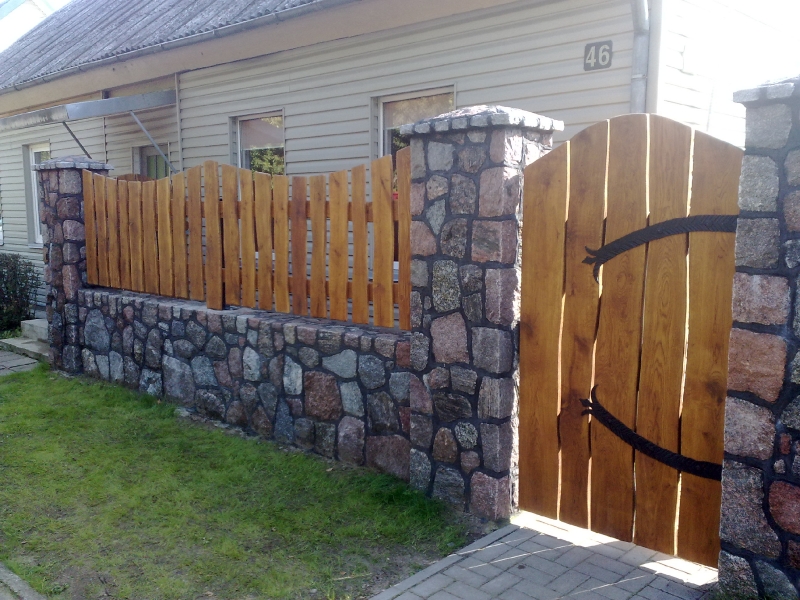
In the photo the fence stands in front of a single-story house with light facade cladding. It separates the yard from the street or the path and at the same time becomes the face of the house, the first thing every passerby and guest sees. In the foreground you can see a green lawn, and in the lower right a path of paving stones leading to the gate.
The most striking feature of this fence is the combination of two natural materials. Along the bottom runs a low plinth of multicolored field stones: gray, pinkish and brownish. The massive posts are laid from the same stones, and their tops are covered with flat stone caps. On the plinth, between the posts, a wooden section is set, whose warm honey color contrasts nicely with the cooler shades of the stones.
A fence like this looks solid and cozy at the same time. The stone gives it an impression of strength and durability, and the wood gives warmth. This combination is typical of traditional Lithuanian farmsteads, where field stones have long been used for foundations and fences, and wood for everything above them.
The photo was taken on a sunny day, so both the grain of the wood and the pattern of every stone can be seen well. The shadows on the stones emphasize the relief of the masonry, and the wood in the sun simply glows.
A wooden fence with a stone base suits more than a rural farmstead. It looks lovely on a city or suburban street, too, where most neighbors choose sheet-metal or concrete fences. Against that background the wood and stone stand out at once and give the house individuality.
Boards with a wavy top
The wooden section of the fence is made of vertical boards with small gaps left between them. The boards are not of equal height: their tops form a gently undulating line that rises higher at the end of the fence. The top of each board is slightly rounded, so the edge of the fence looks soft and not angular.
The boards are fastened to horizontal rails, which can be seen through the gaps. The gaps let air circulate freely, so the wood dries faster after rain, and the fence catches less wind. At the same time you can slightly see the yard through the gaps, so the fence does not look like a blind wall.
On the surface of the boards you can see the natural patterns of the wood, growth rings and branch scars. Each board is of a slightly different shade, so the whole section looks alive. It is a property of natural wood that nobody tried to hide.
The wavy top is not only a decorative detail. It helps the fence not to look monotonous even along a long stretch, and at the same time its line echoes the curved top of the gate. In this way the fence and the gate form a unified composition.
The height of the boards is chosen so that the fence partly screens the yard but does not block the windows of the house. From the outside you see the upper part of the facade, while the yard stays calmer. This balance of height suits many houses that stand close to the street or the path.
A wooden gate with wrought-iron hinges
On the right side of the photo, between two stone posts, a wooden gate is set. It is made of wide vertical boards with a curved top: the middle rises highest, and the edges drop lower. The boards are set closely together, so the gate is more closed than the fence section.
What catches the eye most are two long black wrought-iron hinges. They stretch across almost the whole width of the gate, and their ends are curled into decorative shapes. The black forged hardware stands out sharply against the light wood and gives the gate an old-fashioned, sturdy look, recalling the doors of old manors or castles.
Hinges like these are more than decoration. A long strap spreads the weight of the gate over a larger area and strengthens the boards so that they do not warp. So forged hinges are especially suitable for heavier wooden gates.
The gate is framed by massive stone posts, so the entrance looks stately. Through the opening of the gate you can see the paved path that leads into the yard.
The boards of the gate, like those of the fence, show the natural patterns of the wood, and narrow slits can be seen between them. Light comes through them, so the gate does not look heavy and dark. The curved top, the vertical boards and the black forged hardware together create a memorable entrance that guests will recognize easily.
What can be seen in the photo
A short summary helps you quickly judge the solutions of this fence. It is a typical example that can be changed.
| Feature | In the photo |
|---|---|
| Field-stone plinth | Yes |
| Stone posts with caps | Yes |
| Vertical boards with a wavy top | Yes |
| Gaps between the boards | Yes |
| Wooden gate with a curved top | Yes |
| Black wrought-iron hinges | Yes |
What to think through when ordering a wooden fence
Laukbaldis shows only typical examples, so every fence is adapted to a particular plot. Before calling, think about the following:
- The length of the fence and the number of sections. Measure the whole stretch and mark where the posts will be.
- Height. It determines how much the fence will screen the yard from the street.
- Arrangement of the boards. Larger gaps mean more light and air, smaller ones more privacy.
- Shape of the top. Wavy, as in the photo, straight or curved.
- Gate. Where the entrance will be, how wide, and which way it will open.
- Stonework. If the plot already has a stone plinth or posts, measure the gaps between them.
Whether the stone plinth and posts will be included in the work is something to discuss on the phone. If the posts are already built, the wooden sections can be made exactly to the gaps between them.
For comparison, look at lighter solutions as well: the low wooden fence of round stakes No. 1 and the decorative low fence of dark stakes No. 2. You will find all the examples in the section wooden bridges, footbridges and fences, and wooden doors and other entrance solutions in the section planters and wooden doors.
Caring for the wood and the hardware
A wooden fence at the edge of a plot is open to all weather. It is affected most by the sun, which fades the color, and by the rain, which dampens the ends of the boards. The stone plinth helps: the wooden part does not touch the ground and gets less damp.
What is worth doing regularly:
- in spring inspect the tops and bottom ends of the boards, because the wood gets wet most there;
- renew the protective coating made for exterior wood when the color fades or the surface becomes rough;
- check the hinges and the latch of the gate, to see that it has not warped and opens easily;
- clean the wrought-iron hinges when needed and protect them from rust with a product made for the purpose;
- do not let dense bushes grow by the plinth, as they would keep moisture against the wood.
Small cracks that appear in natural wood are normal and usually do not harm the strength. If a board is damaged, it can be replaced without taking down the whole section.
A gate is used every day, so its condition is worth checking more often than the fence. If you notice that the gate leaf starts to catch on the ground or the paving stones, do not wait; a gate adjusted in time serves longer.
It is also worth inspecting the stone plinth and posts from time to time. Weeds or moss may take root between the stones, and their roots slowly break up the joints. If they are removed in time, the masonry will stay tidy longer, and the wooden part of the fence will have a firm base.
How to order fence No. 3
UAB “Laukbaldis” has been making wooden products since 1996 and, according to the company, was the first in Lithuania to start making this production. The company is based in Dapkiškių village, Tauragės district.
Call +370 687 25388 and quote No. 3 from the fences section. Tell us how long a fence you need, whether the posts and plinth already exist and where the gate will be. During the call you will discuss the shape of the boards, the height, the gaps, the gate solution and the finish. Photos and dimensions of the plot will help a lot. If you like exactly the kind of wrought-iron hinges shown in the photo, say so right away.
The fence in the photo is only one possible solution. The shape of the boards, the line of the top, the size of the gate and the finish can be different. Everything is made according to the agreed solutions, so the fence will suit your house.
If you are still deciding which fence to choose, think about how it will look in a few years. Stone only becomes more beautiful with time, and well-kept wood takes on a richer shade. So a fence like this does not age over the years but matures together with the house and the garden.
Frequently asked questions
Are the stone posts included in the order?
This is discussed when you order, because every solution is agreed individually. If the posts already exist, the wooden sections and the gate can be made to fit the gaps between them.
Can the gate be made without wrought-iron hinges?
Yes, the size, finish and hardware of the gate are agreed individually. In the photo the wrought-iron hinges give an old-fashioned look and strengthen the boards.
Why are there gaps between the fence boards?
The gaps let air circulate, so the wood dries faster and the fence catches less wind. If you want more privacy, the gaps can be made smaller.
Can I order a straight top for the fence?
Yes, the wavy top is only one option. It is worth matching the shape of the top to the shape of the gate so that the fence looks unified.
How do I look after a wooden fence?
In spring inspect the boards and the gate, and when the color fades, renew a protective coating made for exterior wood. Protect the wrought-iron hinges from rust.
How do I order fence No. 3?
Call us and quote No. 3 from the fences section. We will discuss the length, the height, the shape of the boards, the gate and the finish.