In short: Decorative footbridge No. 6 is a curved wooden footbridge across a narrow stream whose banks are reinforced with field stones. The deck is made of crosswise slats and coated with a dark, reddish-brown finish, and the railings on both sides are made of natural branches. The length, curve and shade are agreed with each customer individually.
A decorative footbridge among stones and thujas
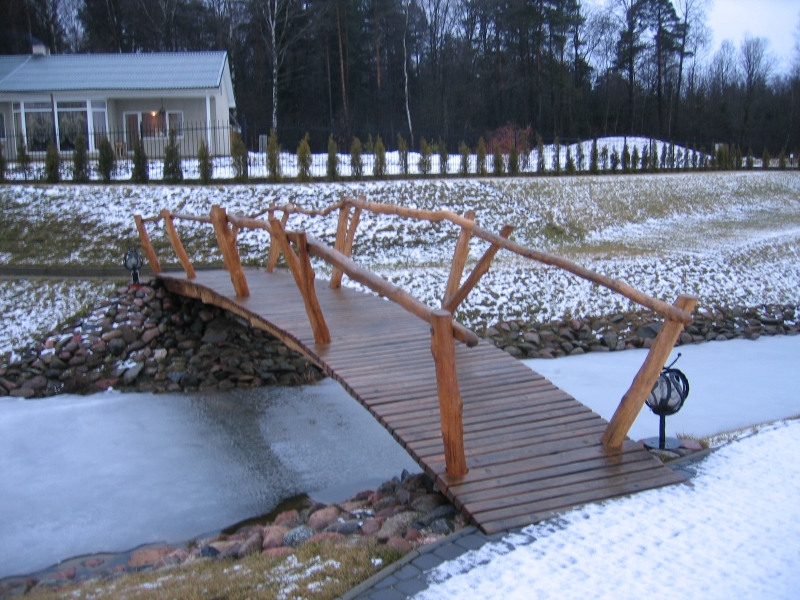
The photo was taken in winter, in the twilight. The stream under the footbridge is frozen and covered with a thin layer of snow, and both its banks are reinforced with field stones of various sizes. A band of stones winds along the water and clearly separates it from the lawn. Beyond the stream rises a snow-covered slope, along its top grows a row of densely planted thujas, and farther away you can see a light single-story house with large windows and a tall pine forest.
In this setting the footbridge is truly the center of the composition. It joins the two banks, but above all it ties together all the other elements: stones, water, lawn and plantings. Without it the stream would be just a ditch, and with it the place becomes a picturesque corner of the garden that you want to look at even through a window of the house.
At both ends of the footbridge stands a small black garden lamp. After dark they light the beginning and the end of the footbridge, so the crossing is visible in the evening too. The lamps, the stones and the dark wood make a well-thought-out, unified picture in the photo.
This photo shows well that a decorative footbridge is beautiful not only in summer. In winter, when the garden is bare and gray, its dark curved line on the white snow becomes one of the brightest accents in the whole yard.
In summer the same view will be quite different: water will flow in the stream, grass will turn green between the stones, and the thujas and pines will form a rich green background. The dark footbridge will then look calm and restrained, like an old part of the garden proven by time.
The dark finish and the line of the arch
The first thing that catches the eye is the color of the footbridge. Unlike footbridges of a light honey shade, this one is coated with a dark, reddish-brown finish. It goes well with the stones, among which there are many pinkish and brownish boulders, and with the dark wall of the pine forest in the background. A darker wood also shows less of the dirt and mud that inevitably appear on a deck when it is walked on.
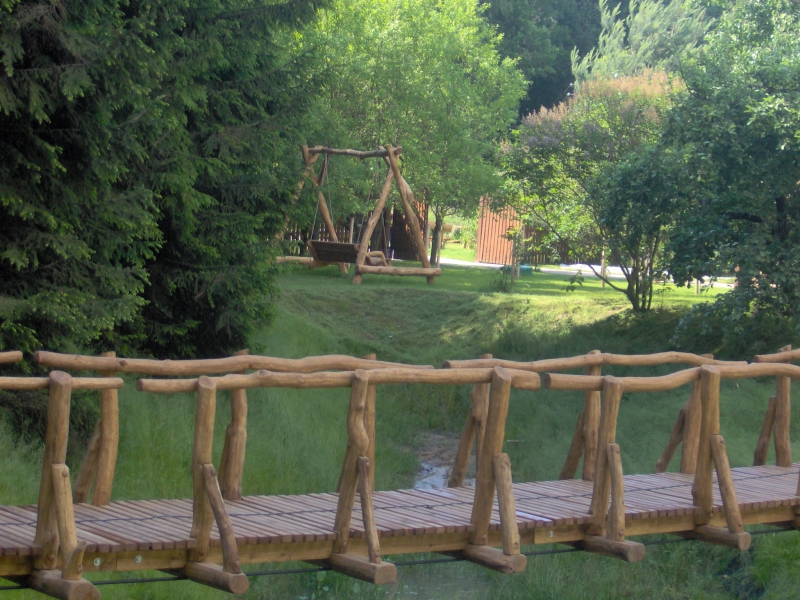
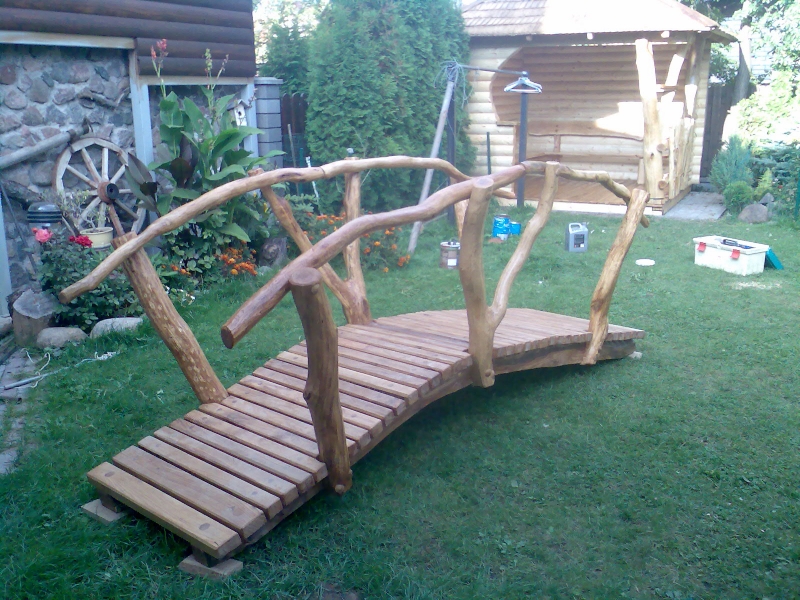
The deck is made of many crosswise slats with narrow gaps between them. The slats rest on curved side beams, so the footbridge rises to the middle and gently descends again. The arch is not very high, so you do not have to climb a hill to walk across the footbridge, while its shape is still clearly visible from the side.
The railings on both sides are made of natural branches. Each handrail is supported by several posts, and to some of them diagonal struts are fixed that look like forks of branches. The handrails are slightly curved and drop lower at the ends of the footbridge, so their line repeats the arch of the deck.
The somewhat lighter branch posts and handrails stand out clearly against the dark deck. This combination of two shades gives the footbridge depth and lets you see every bend of the branches well.
In the photo you can see that the ends of the footbridge reach beyond the band of stones to the bank. This way the stones remain visible from both sides of the footbridge, and the footbridge itself does not press on or disturb the bank wall. It is an important detail worth noticing when planning a footbridge beside water reinforced with stones.
A solution like this requires measuring the distance between the banks precisely before the footbridge is made. If the stream is winding, it is worth choosing the narrowest spot where both banks are firm and level. Then the footbridge will look natural and stand stably.
Summary of the photo
The table briefly sums up what can be seen in the photo of this footbridge. It is a typical example and not the only possible variant.
| Feature | In the photo |
|---|---|
| Curved, arched deck | Yes |
| Dark, reddish-brown finish of the deck | Yes |
| Branch railings on both sides | Yes |
| A stream with banks reinforced with stones | Yes |
| Garden lamps at the ends of the footbridge | Yes |
| Light honey-colored finish | No |
Stones, lamps and the footbridge as one composition
This example illustrates well how a decorative footbridge can become part of a larger landscape composition. Banks reinforced with stones are not only beautiful but also practical: they keep the water from washing out the bank and keep the bed of the stream tidy. A footbridge over such a stream looks as if it had stood there for ages.
If you are planning a similar spot in your own garden, you can use several ideas from the photo:
- A band of stones along the water. It frames the stream or pond and makes a clear border between the water and the lawn.
- Lamps at the ends of the footbridge. They mark the crossing after dark and create a cozy mood in the evening.
- Evergreen plants in the background. A row of thujas or other conifers fills the view in winter too, when deciduous trees are bare.
- Dark wood. It goes with stones and conifers, so the whole corner looks unified.
It is also important that the footbridge here is not only decoration. It joins two banks, so you can cross it to another part of the plot. The decorative and the practical role merge into one.
A corner like this can become a favorite spot for photographs too. Family celebrations, birthdays or simply winter walks in the garden gain a new backdrop, and in the evening the footbridge with its lamps looks like something from a postcard.
When the yard has a modern house with large windows, as in the photo, a footbridge of natural branches gives a warm, natural contrast. It softens the straight lines of the architecture and reminds us that the garden is part of nature.
Before ordering: location, length and color
Laukbaldis shows only typical examples, so every footbridge is adapted to a particular place. Before calling, think about the following:
- The width of the stream or ditch. Measure the distance between the banks, including the band of stones if there is one.
- Supports. The ends of the footbridge must rest on a firm base and not on loose stones or soft ground.
- The height of the arch. A higher arch is more striking, a lower one more comfortable to walk on.
- The color of the finish. A dark finish goes with stones and conifers, a light one with green lawn and light buildings.
- Railings. In the photo they are on both sides, but another variant can be discussed.
For comparison, look at the light curved wooden footbridge No. 1 and the curved footbridge No. 8 over water reinforced with stones. You will find all the examples in the section wooden bridges, footbridges and fences, and lighting ideas in the section lamps, shelves, dressers and cabinets.
Caring for the footbridge in winter and summer
A footbridge over water always lives in damper conditions than other garden products. In summer the sun heats it, in autumn leaves and needles fall on it, and in winter snow gathers on the deck. A dark protective coating helps the wood withstand these effects, but it needs to be renewed regularly.
Practical tips:
- in winter sweep snow off the deck so that it does not melt on the slats and freeze into a crust of ice;
- in spring check that the ends of the footbridge rest firmly on the base and that the stones have not shifted;
- in autumn clear leaves and needles from the gaps between the slats;
- renew the coating when the surface turns pale and water starts to soak into it.
Small cracks can appear in natural branches as they dry, which is normal and usually does not harm the strength. When renewing a dark finish, it is worth choosing a similar shade so that the footbridge keeps a unified look.
If there are electric lamps beside the footbridge, check them in spring as well: whether the cables are undamaged and whether the lamps are holding firmly. A tidily kept corner with a footbridge will please for many years.
It is also worth inspecting the stone bank wall from time to time: in spring ice and water can move the smaller stones, and grass or weeds that have grown up between them hide the line of the banks. When the stones are tidy and the ends of the footbridge rest firmly on the base, the whole composition stays as beautiful as in the photo.
How to order footbridge No. 6
UAB “Laukbaldis” has been making wooden products since 1996 and, according to the company, was the first in Lithuania to start making this production. The company operates in Dapkiškių village, Tauragės district.
Call +370 687 25388 and quote the product number, No. 6. Tell us what stream or ditch you want to cross, how wide it is and what the banks are like. During the call you will discuss the length of the footbridge, the height of the arch, the railings and the color of the finish. Photos of the place help you agree on the details faster. If your yard already has a stone bank wall or lamps, show those too, so that the color and shape of the footbridge match the existing surroundings.
The footbridge in the photo is only one possible solution. The length, color and railings can be changed, so the final product will be adapted to your garden.
Frequently asked questions
Can a decorative footbridge also be practical?
Yes, in the photo the footbridge is thrown across a stream and joins two banks. You can cross it every day to reach another part of the plot.
Can I order a lighter shade?
Yes, the finish is agreed individually. A dark color goes with stones and conifers, and a light one with green lawn and light buildings.
Are the lamps included with the footbridge?
In the photo garden lamps stand at the ends of the footbridge, but that is a separate solution. It is worth talking about lighting when you order the footbridge.
How does the footbridge rest on banks reinforced with stones?
The ends of the footbridge must rest on a firm base and not on loose stones. The solution for the base is discussed individually according to your banks.
How do I look after a dark finish on a footbridge?
Regularly clean the deck and inspect the surface in spring. When the wood turns pale, renew the protective coating in a similar shade.
How do I order footbridge No. 6?
Call us and quote No. 6. We will discuss the width of the stream, the length of the footbridge, the height of the arch and the color of the finish.