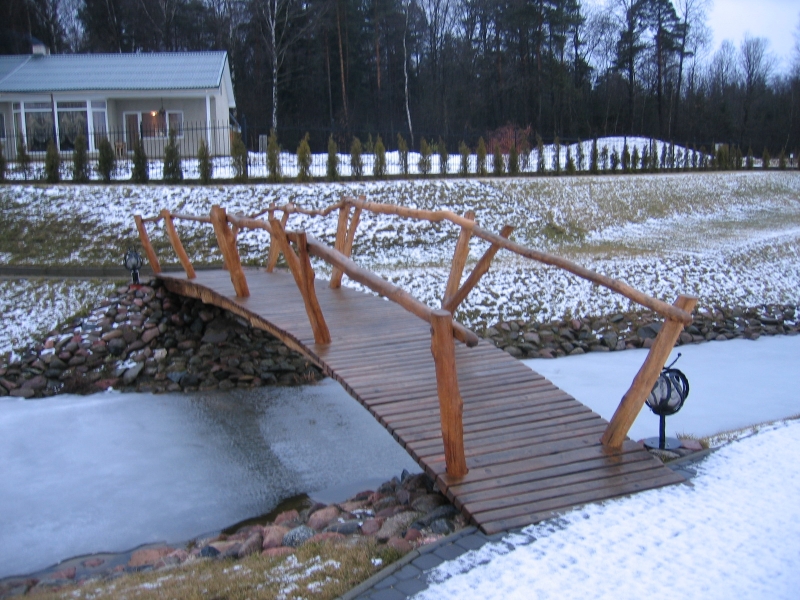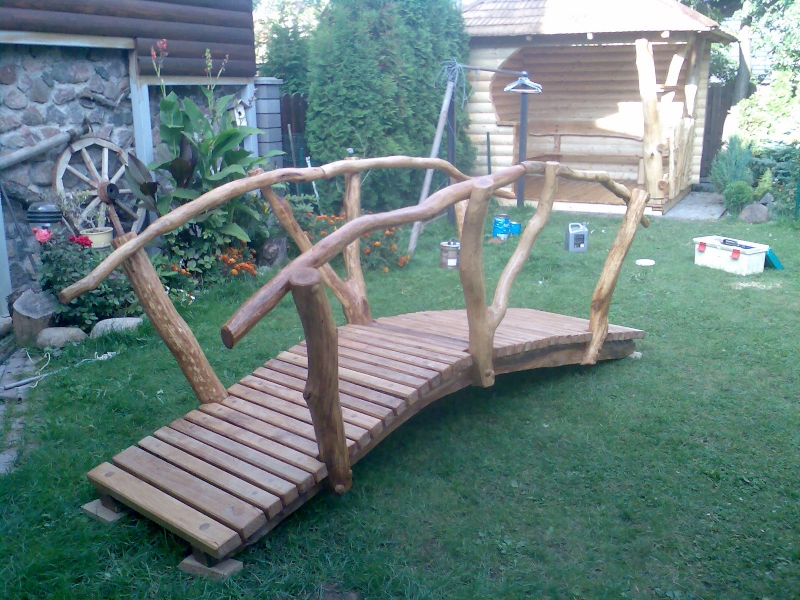
In short: Curved footbridge No. 8 is an arched wooden footbridge thrown across a water channel in a neatly planned area. The railings on both sides are made of natural branches, a pile of field stones lies beside the footbridge, and garden lanterns stand at its end. The length, curve and finish are agreed with each customer individually.
Please note: the description and photo show a general idea of what an order could include. The exact contents of your order (the product, furniture, benches, tables and other extras) are agreed with the manufacturer by phone +370 687 25388.
A curved footbridge in a larger landscape composition
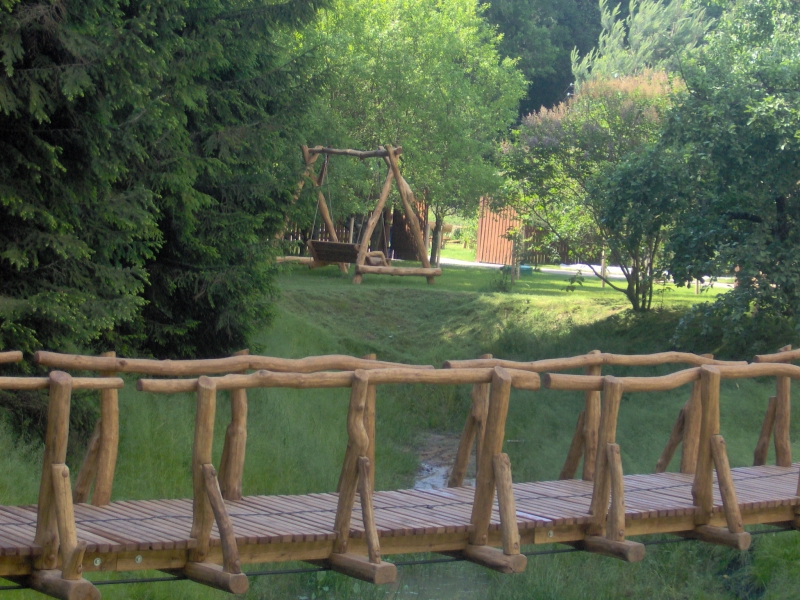
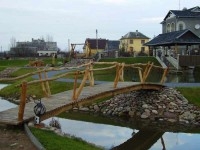
This photo is small, so fine details cannot be seen in it. But it shows something else well: how the footbridge looks in a wider space. In the foreground a curved wooden footbridge with railings is thrown across a narrow water channel. On the right, on the bank, there is a pile of large field stones, and closer to the left edge stand dark garden lanterns on posts.
Beyond the footbridge a wide, neatly planned area opens up: lawn, a few more bodies of water, other wooden structures and lines of railings, and on the horizon residential houses with variously colored facades. It seems to be a larger homestead, a recreation spot or a settlement yard where bridges and footbridges join several bodies of water into one whole.
In such surroundings the curved footbridge plays a double role. First, it lets you cross the channel from one path to another. Second, its arched line becomes a bright accent in a flat, wide landscape that would otherwise be dominated by horizontals: the water surface, the lawn and the paths.
The photo was taken in early spring or late autumn: the lawn is still pale green and the sky is overcast. Even at such a gray time the warm wood stands out and gives the view coziness.
It is exactly this kind of view that often helps those planning a larger area make up their minds. A small footbridge on its own may look like a toy, but among water, stones, lanterns and paths it becomes an important part of the whole. The photo shows that even a small structure can join and tidy a wide space.
The shape of the arch and the branch railings
The curved footbridge in this example rises from one bank to the middle and descends again to the other side. The arch is visible even from afar, because its line stands out clearly above the water surface. The shape is not only beautiful: more room is left under the footbridge for the water, and in spring a risen water level does not reach the deck as quickly as under a straight footbridge.
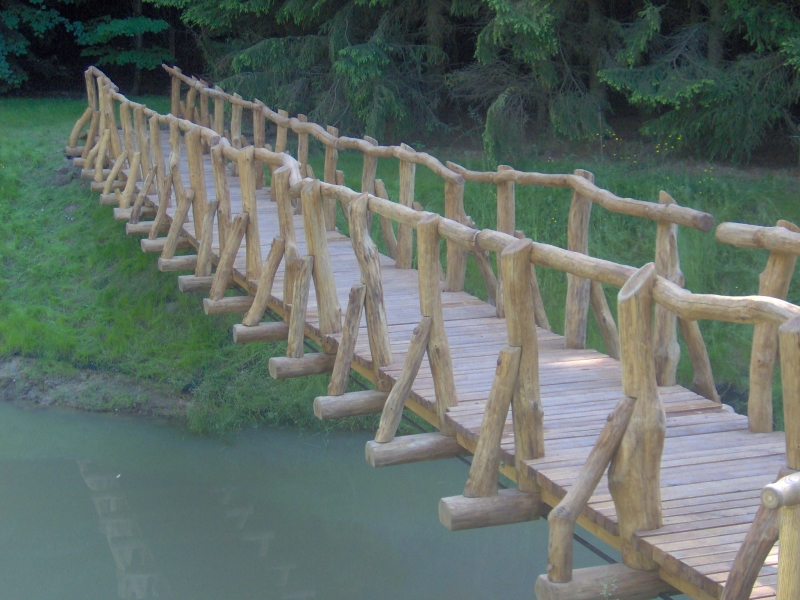
There are railings on both sides. Their posts and handrails are made of natural branches, so the line of the railing is not perfectly straight: it undulates slightly, repeating the shape of the arch. From a distance the railings look like a light, see-through frame that does not block the view of the water and the stones beyond the footbridge.
Branch railings go well with stones and water. All three materials are natural, so together they create a calm, nature-like mood that suits both modern houses and traditional farmsteads.
The pile of stones at the end of the footbridge also has a practical function. It strengthens the bank in the place where people walk most and keeps the water from washing it out. At the same time the stones create a natural transition between the footbridge and the lawn, so the footbridge looks not placed on the bank but grown into it.
The lanterns by the footbridge are one more idea worth borrowing. They mark where the crossing begins and help you cross safely in the evening. In addition, after dark a lit footbridge with branch railings looks especially cozy, and its shadows on the water create an extra picture.
What can be recognized in the photo
Since the photo is small, the summary lists only what can be clearly seen in it. It is a typical example that can be changed.
| Feature | In the photo |
|---|---|
| Curved, arched line | Yes |
| Railings on both sides | Yes |
| Posts and handrails of natural branches | Yes |
| Thrown across a water channel | Yes |
| Pile of field stones nearby | Yes |
| Garden lanterns by the footbridge | Yes |
Several footbridges in one area
The photo shows that the footbridge is not the only wooden structure in this place. Farther on, beyond it, you can see other wooden railings and structures. Areas like these, with several ponds or channels, are often planned as one whole park, and footbridges join its parts.
If you are planning a similar area, it is worth thinking about a few things:
- A unified style. When all the footbridges, piers and railings are made on the same principle, the area looks well thought out and calm.
- Different shapes. A curved footbridge can stand in one place and a long straight bridge or pier in another, while the materials and finish stay the same.
- A network of paths. The footbridges must be where people really walk, otherwise they will remain only decoration.
- Lighting. Lanterns at the ends of the footbridges, as in the photo, help you cross safely after dark.
- Stones and planting. They join the wooden structures with the surroundings and soften the transition between water and lawn.
In an area like this a curved footbridge often becomes the most photographed spot. It looks nice from all sides, and its arch is reflected well in calm water.
In a larger area it is especially important that the footbridges are convenient for everyone: children, older people and parents with strollers. So when planning, it is worth discussing not only the shape but also the width, the steepness of the arch and the height of the railings. A moderate arch and a wider deck make a footbridge more convenient without spoiling its appearance.
It is especially worth choosing a curved shape where the footbridge is seen from far away, from the terrace of a house, from the bank of another body of water or from the main path. A straight footbridge blends into the line of the bank from afar, while an arch stays visible and clearly marks the crossing.
Before ordering a curved footbridge
Laukbaldis shows only typical examples, so every footbridge is adapted to a particular place. Before calling, be ready to answer a few questions:
- How wide the channel or stream is. Measure from one firm bank to the other.
- What the banks are like. Whether they are reinforced with stones or natural and grassy.
- How the water level changes. In spring the water may rise, so the arch must be high enough.
- Who will walk over the footbridge. The width and the height of the arch depend on it.
- Whether there will be more footbridges. If you plan several, it is worth discussing them together so they match each other.
For comparison, look at the decorative footbridge No. 6 over a stream with stone banks and the long wooden bridge No. 9 with a turn. You will find all the works in the section wooden bridges, footbridges and fences, and a relaxation spot by the water can be added from the section wooden gazebos.
How to look after a footbridge by the water
A footbridge over a channel is constantly near water, so dew settles on it more often and the supports are damper. A protective coating made for exterior wood helps the wood withstand moisture and the rays of the sun, but it has to be renewed regularly.
What is worth doing every year:
- in spring inspect the supports and the ends of the footbridge to see whether ice and water have moved them;
- check that the stones piled nearby are not pressing on the structure of the footbridge;
- in autumn clear leaves off the deck and out of the gaps between the boards;
- renew the protective coating when the wood turns pale and starts to absorb water;
- inspect the joints of the railings, because they are often leaned on.
Small cracks appear in natural branches as they dry, which is normal and usually does not harm the strength. In winter it is worth sweeping snow off the deck so that the boards do not soak as it melts.
In autumn and winter also think about how slippery the surface is. A wet, icy or leaf-covered deck can be slippery, so in winter and autumn it has to be cleaned more often than in summer.
In more public places, where many people walk over the footbridge, it is worth inspecting it more often. A loosened part noticed in time is quickly put right, and the footbridge stays safe for all visitors.
How to order footbridge No. 8
UAB “Laukbaldis” has been making wooden products since 1996 and, according to the company, was the first in Lithuania to start making this production. The company operates in Dapkiškių village, Tauragės district.
Call +370 687 25388 and quote the product number, No. 8. Tell us what water you want to cross, how wide it is and what the banks are like. If you are planning several footbridges or piers, say so too, as they can be planned together. Photos of the place and a plan help a lot in agreeing on the details.
The footbridge in the photo is only one possible solution. The length, the height of the arch, the railings and the finish can be changed, so the final footbridge will be adapted exactly to your place.
Because natural branches are used for the railings, every footbridge has bends of its own. The general shape and mood stay the same, but your footbridge will be the only one of its kind.
Frequently asked questions
Why is a curved footbridge better than a straight one?
The curved shape is nicely visible from afar, and more room is left under the arch for the water. A straight footbridge is more convenient for everyday walking, so the shape is worth choosing according to the place.
Can I order several footbridges for one area?
Yes, several footbridges or piers can be discussed together. Then they will be matched to each other, and the area will look unified.
Are the lanterns and stones included in the set?
The lanterns and stones in the photo are part of the surroundings. Lighting and other solutions are worth discussing when you order the footbridge.
Why can fine details not be seen in the photo?
This photo is small and shows the footbridge in a wider setting. It is best to ask by phone about details such as the deck and railing solutions.
How do I look after a footbridge over water?
In spring inspect the supports and the railings, and in autumn clear off the leaves. When the wood turns pale, renew a protective coating made for exterior wood.
How do I order footbridge No. 8?
Call us and quote No. 8. We will discuss the width of the water, the length of the footbridge, the height of the arch and the railings.