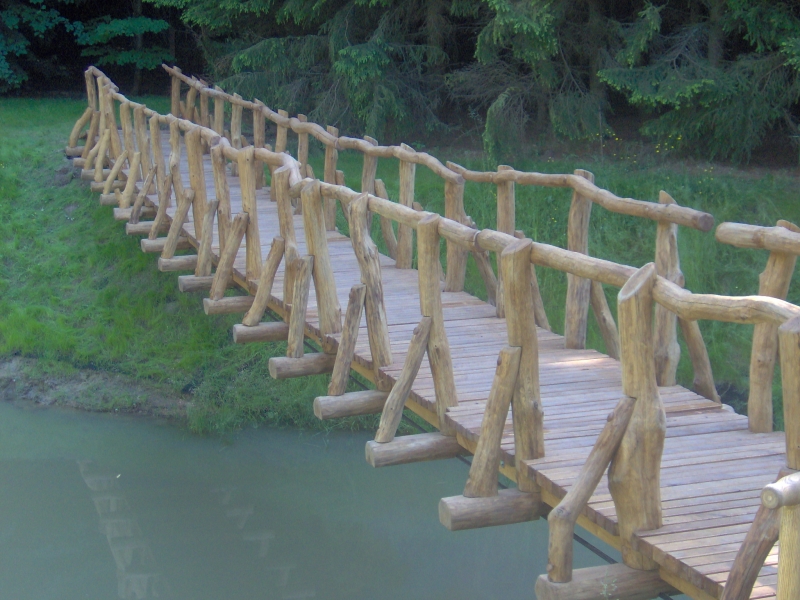
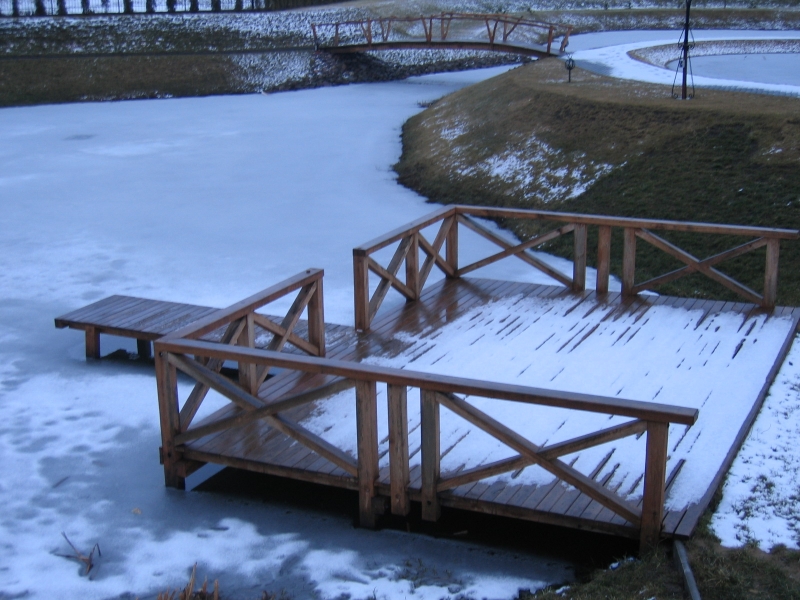
In short: Long wooden bridge No. 9 is a bridge laid across a pond in two sections, which join at a small platform and shift sideways there, forming a turn. The deck is made of crosswise slats, the railings on both sides are made of natural branches, and the bridge is held in the water by wooden supports with diagonal braces. The length, shape and finish are agreed to suit your pond.
A long wooden bridge on a farmstead in the plains
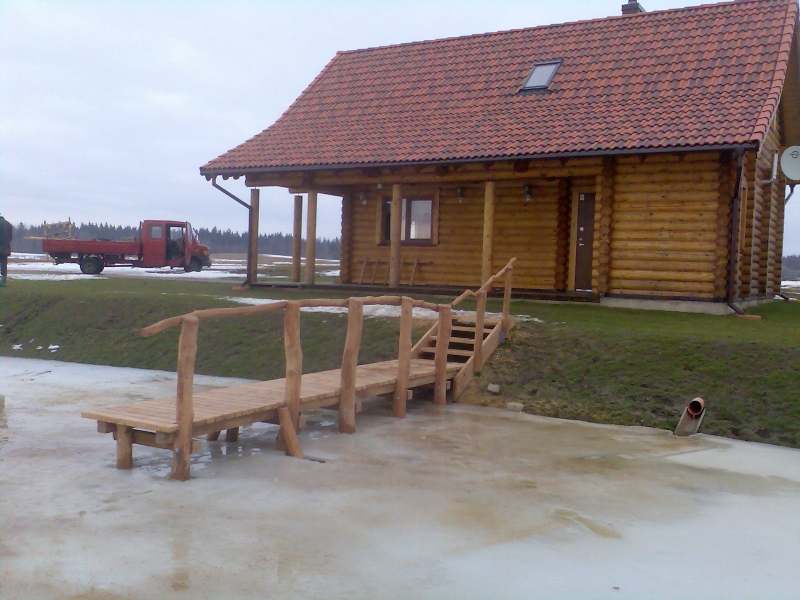
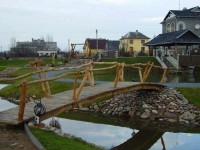
The photo was taken in early spring. The pond is still covered with melting ice, the banks are brownish green, and all around spread wide, flat fields with a strip of forest on the horizon. The sky is overcast, so the whole landscape looks grayish and calm. Against a background like this the warm, honey-colored bridge stands out from far away.
The bridge begins right by the photographer, on a grassy bank, and stretches across the pond to the opposite bank. There you can see a large boulder, a few young conifers and bushes, and farther on a decorative heap formed of stones. It seems that the pond and its surroundings are only just being created, and the bridge is one of the first elements.
In a spot like this a long bridge becomes the most important line of the landscape. On a plain, where there are no hills or tall trees, it is the bridge that gives the view structure and leads the eye across the water. When plantings grow up around it, the bridge will become a natural part of the farmstead, joining the two banks of the pond.
This photo is valuable also because it shows the bridge in a surrounding that has not yet grown over. You can clearly see its whole construction: how the sections are joined, what the supports look like and how the railings follow the line of the deck. Later, when the banks turn green and the water rises, some of these details will be hidden, but the overall picture will become even cozier.
A long wooden bridge on a plain also protects the banks. Without it people would walk around the pond by various routes and trample the young turf. With a bridge there is one clear route, and the surrounding areas can green up in peace.
The turn and the platform in the middle of the bridge
The most interesting feature of this bridge is the turn. The first section goes straight from the bank to a small platform roughly in the middle of the pond. There the bridge shifts sideways, and the second section continues parallel to the first up to the other bank. Seen from above, such a shape would resemble a step or a zigzag.
A solution like this has several advantages:
- A more interesting route. Walking on the bridge, the view changes at the turn, so the way across the water becomes more varied.
- A place to stop. The platform at the turn is a natural spot to pause, look at the water or talk without getting in the way of others.
- Adapting to the bank. The turn lets you bring the bridge exactly to where it is convenient on the opposite bank, even if that place is not directly opposite.
- Visual lightness. A long straight bridge can look monotonous, while a turn divides it into two proportionate parts.
On the platform you can also see a small step or a projection to the side that lets you get closer to the water. Details like these can be discussed when you order; a bench can be placed on the platform as well.
The turn has an aesthetic meaning too. Seen from the bank, the bridge no longer looks like a single straight strip across the water; it becomes more spacious and its parts open up at different angles. When photographing or simply looking from the terrace, a shape like this gives the view depth.
It is also important that a turn helps to avoid monotony while walking. When walking along a long straight bridge, your gaze is directed at the same point the whole time, while at the turn another part of the pond opens up. So a long wooden bridge with a turn becomes not only a crossing but also a small walking route.
Supports in the water and branch railings
A long bridge cannot rest on the banks alone, so it is held up by supports in the pond. In the photo they are clearly visible because the water is still low and covered with ice. Each support consists of vertical posts joined by crosspieces, and diagonal braces additionally support them from the side. The supports stand on firm bases, which in the photo look like light-colored blocks.
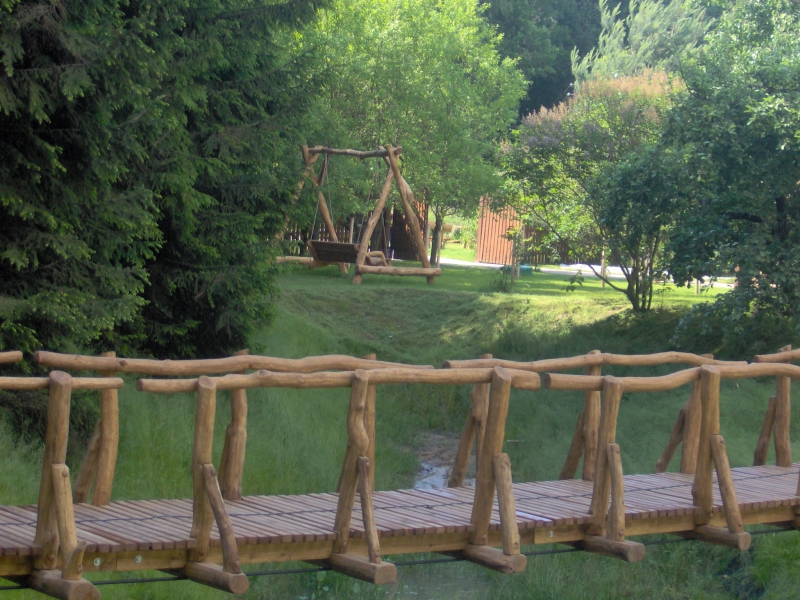
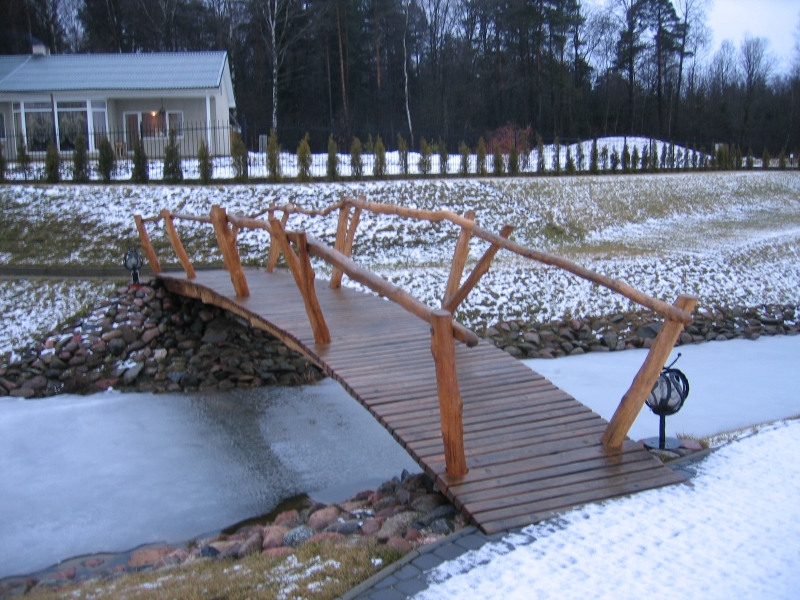
The railings on both sides are made of natural branches. The posts are branches with forks, one branch of which supports the handrail, while the other sometimes rises diagonally like an additional shoulder. The handrails are joined from several long, slightly curved branches, so the line of the railing undulates along the whole length of the bridge.
The deck is made of crosswise slats with narrow gaps. The rows of slats are clearly visible in the front part, where the bridge rests on the bank. The gaps let rainwater and melting snow run straight into the pond.
All the wood is coated with a light, warm finish that emphasizes the shapes of the branches. Every bend and branch scar is clearly visible, so the bridge looks like a handmade work and not an industrial structure.
Branch railings are especially important for safety on a long bridge. When children or older people walk on it, they can hold on the whole way from one bank to the other. Railings on both sides also clearly show the edges of the bridge, so even at dusk it is easy to find your bearings and not go too close to the water.
Overview of the photo
The summary helps you quickly understand the solutions of this bridge. It is a typical example that can be changed to suit your pond.
| Feature | In the photo |
|---|---|
| Two sections with a turn | Yes |
| Platform at the turn | Yes |
| Deck of crosswise slats | Yes |
| Branch railings on both sides | Yes |
| Wooden supports with braces | Yes |
| Curved arched shape | No |
What to think through before ordering a long bridge
Laukbaldis shows only typical examples, and a long bridge is always adapted to a particular pond. The more information you have in advance, the faster you will find a suitable solution:
- The width of the pond at the place of the bridge. The length and the number of supports depend on it.
- The depth of the water and the bottom. They determine which supports are suitable and how they will be set up.
- Where the bridge will begin and end. If the ends are not directly opposite each other, a turn, as in the photo, can be a good solution.
- Whether a platform is needed. You can stop on it, sit down or set up a bench.
- Fluctuations of the water level. The deck must stay above the spring water.
- The effect of ice. In winter the frozen water acts on the supports, so they must be strong.
A long bridge is a larger project than a small footbridge, so it is worth setting aside time for planning. Look at other examples as well: the long bridge over a pond No. 3 with braces and the curved footbridge over water No. 8. You will find all the works in the section wooden bridges, footbridges and fences. And if you want a relaxation spot by the pond, take a look at the section wooden gazebos.
Caring for a long bridge
A long bridge over a pond is open to all weather and constantly near water. Its supports stand in the water, in winter they are surrounded by ice, and in spring by melting snow and risen water. So maintenance is especially important here.
A long wooden bridge has more joints, supports and railings than a small footbridge, so the inspection takes more time. It is most convenient to do it in spring, when the water is still low and the supports are clearly visible.
What is worth doing regularly:
- in spring, after the ice has melted, inspect all the supports and braces;
- check the joints of the turn platform, because that is where the two sections of the bridge meet;
- inspect the railing posts and the joints of the handrails;
- in autumn clear leaves and debris off the deck;
- renew the protective coating made for exterior wood when the wood turns pale and starts to absorb water.
Small cracks appear in natural branches as they dry, which is normal and usually does not harm the strength. If a slat begins to bend or crack, it is better to replace it at once. In winter it is worth sweeping snow off the deck so that it does not melt on the slats.
Chunks of ice that have come to rest against the supports, or branches brought by the spring flood, should be removed so that they do not press on the structure. A carefully maintained long bridge will serve for many years and become the pride of the pond.
How to order bridge No. 9
UAB “Laukbaldis” has been making wooden products since 1996 and, according to the company, was the first in Lithuania to start making this production. The company operates in Dapkiškių village, Tauragės district.
Call +370 687 25388 and quote the product number, No. 9. Tell us about your pond: how wide, deep and what kind of bottom it has, and where you would like the bridge to begin and end. During the call you will discuss the length, the turn, the platform, the supports, the railings and the finish. A plan of the pond or photos from several sides will help a lot.
The bridge in the photo is only one possible solution. The bridge can be straight or with a turn, with one platform or several, wider or narrower. Everything is made according to the agreed solutions, so the bridge will match your pond and not only this photo.
Frequently asked questions
Why does the bridge have a turn?
The turn lets you bring the bridge to where it is convenient on the opposite bank and divides a long route into two sections. A platform forms at the turn where it is convenient to stop.
Can I order a straight bridge without a turn?
Yes, the shape is agreed individually to suit the pond. Only typical examples are shown on the website.
How does the bridge stay up in the water?
In the photo you can see wooden supports with crosspieces and diagonal braces. The solution for the supports is chosen according to the depth of the water and the bottom.
Does the bridge withstand winter?
In the photo the bridge can be seen in early spring, when the pond is still covered with ice. In spring it is worth inspecting the supports and repairing them if needed.
Can a bench be placed on the platform?
Yes, the platform at the turn is suitable for a bench or another relaxation solution. This is discussed when you order.
How do I order bridge No. 9?
Call us and quote No. 9. We will discuss the width of the pond, the shape of the bridge, the supports and the railings.