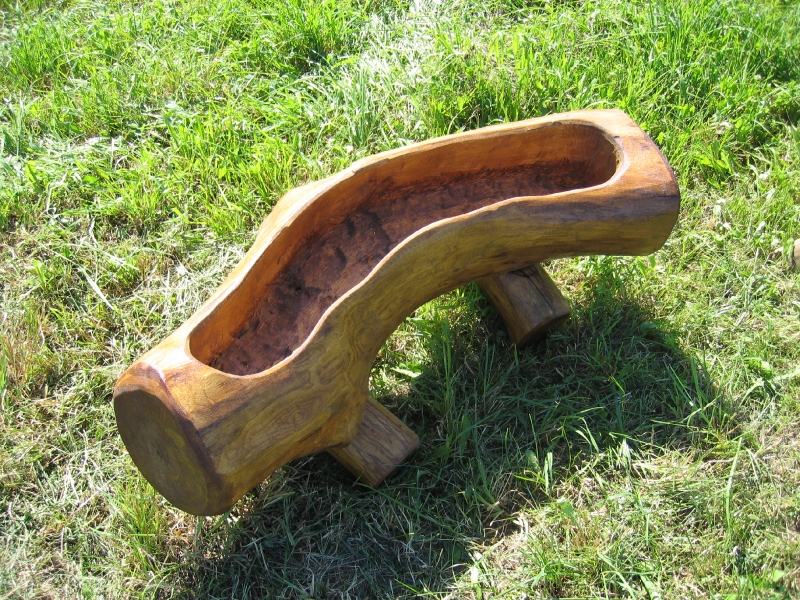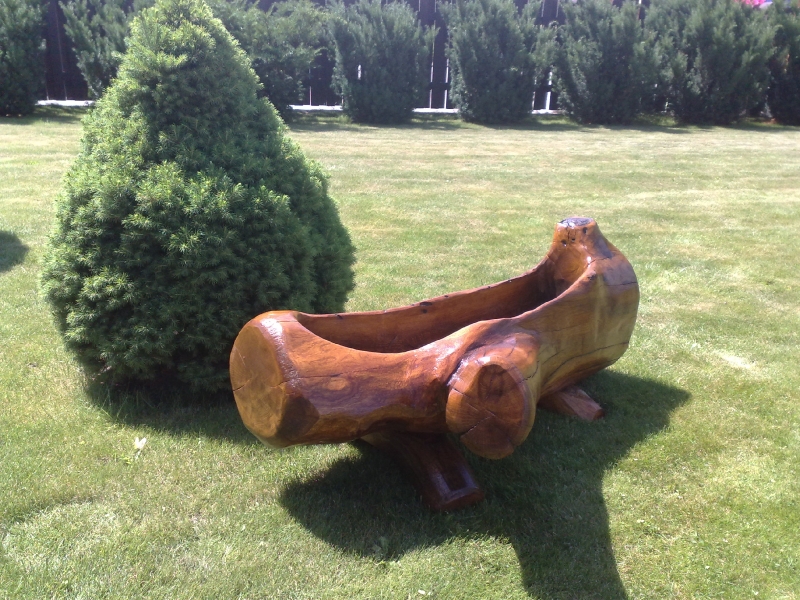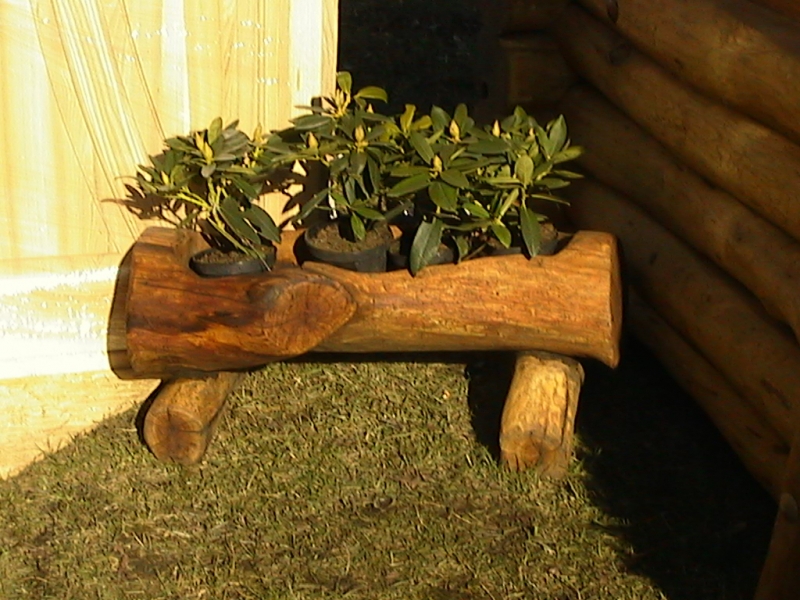
In short: Log planter No. 1 is an elongated log, hollowed out from the top and set on two short small logs laid crosswise. A prominent branch scar has been left at its front, so the planter looks like something made by nature. In the photo three small shrubs in pots are set in it, and the size, shape and finish are agreed with each customer individually.
A log planter in a sunny corner
In the photo the planter stands on grass, in a cozy corner between two walls. On the right rises a log wall of thick round logs, on the left a light, smooth wooden wall. The bright sun falls from the side, so the planter casts a long shadow and its wood glows a warm orange-brown.
A spot like this suits a planter perfectly. The corner shelters the plants from the wind, and the sun warms them. Besides, a corner beside walls often stays empty and dreary, and a log planter fills it and turns it into a cozy accent of the yard. Even a small log planter in such a spot catches the eye and brings the yard to life.
The planter goes very well with the log wall. Both the planter and the wall are made of round wood, so they look like parts of one whole.
In the photo three green shrubs in black plastic pots are placed in the planter. This shows a convenient way to use a planter like this: the plants do not have to be planted directly into the wood; it is enough to set them in pots and change them easily when needed.
Why choose a log planter and not a plastic or ceramic one? First, because of the look: natural wood goes with greenery, stones and wooden buildings, while plastic in a garden often looks foreign. In addition, a massive log is heavy and stable, so the wind does not blow it over and playing children or dogs do not tip it. Ceramics can crack in frost, while wood simply rests in winter.
A hollowed-out log and a branch scar
The planter is made from a single elongated log. It is hollowed out from the top, so a deep cavity forms inside for plants or pots. The walls are left thick enough for the planter to be sturdy and keep its shape.
What catches the eye most is the large branch scar on the front side of the planter. Where a branch once grew out of the trunk, a round projection with clear growth rings is left. The craftsmen did not cut it off or even it out, so the planter looks not like an industrial product but like a work of nature. It is exactly the branches, knots and natural bends of the wood that make each Laukbaldis product distinctive.
The surface of the log is sanded and coated with a warm finish, but it keeps all the natural patterns of the wood. You can clearly see the growth rings, small irregularities and transitions of color. On the other side of the planter, or in another specimen, the branch scar will be different, as every log planter is one of a kind.
The cavity of the hollowed-out log is fairly deep, so even larger pots with shrubs fit in it, as in the photo. This lets you grow not only low summer flowers but also taller plants that give the composition volume.
Why the planter stands on legs
The planter does not stand directly on the ground. It is held up by two short small logs laid crosswise under both ends. It is a simple but very useful solution.
- Less moisture. The bottom of the planter does not touch the wet ground or grass, so the wood dries faster after rain.
- Stability. A round log without legs could roll, while the crosswise small logs hold it firmly in place.
- A more convenient height. A raised planter is easier to look after, to water and to change the plants in.
- A nicer look. A gap remains between the planter and the ground, so the planter looks lighter and more like a small bench or a piece of furniture.
The legs are made of the same wood and coated with the same finish, so the whole product looks unified. Their round ends with visible growth rings echo the shape of the planter.
A solution like this is especially useful if the planter stands on a lawn. The grass under it can grow and be mown, and water does not collect beneath the bottom of the planter.
The height and thickness of the legs can be discussed when you order. Taller legs raise the planter closer to eye level and make it stand out more, while lower ones let it blend calmly into the surroundings. In the photo the legs are low, so the planter looks sturdy and heavy, as if lying on the ground, yet without touching it.
What the photo shows
A short summary helps you judge the features of this planter. It is a typical example and not the only possible variant.
| Feature | In the photo |
|---|---|
| Elongated hollowed-out log | Yes |
| Prominent branch scar at the front | Yes |
| Two crosswise small-log legs | Yes |
| Warm orange-brown finish | Yes |
| Plants in pots inside | Yes, three small shrubs |
| Plants planted directly into the soil in the planter | No |
What to plant and where to put it
An elongated log planter suits various plants. In the photo it holds evergreen shrubs, but you can also choose other solutions:
- Summer flowers. Pelargoniums, petunias or marigolds look lovely against warm wood.
- Herbs. By the kitchen door or on the terrace it is handy to grow herbs in a planter.
- Small shrubs. As in the photo, they stay green longer than summer flowers.
- Seasonal decorations. In autumn pumpkins and heather, in winter spruce branches and pine cones.
The planter can be placed by the wall of a house, near the entrance, on a terrace, by a sauna or a gazebo. It looks especially good next to log buildings, because it repeats their material and shape. In a sunny spot sun-loving plants will grow, and in the shade plants that tolerate shade.
If you plant directly in the planter, it is worth putting in a plastic liner or film so that damp soil does not touch the wood. Then the planter will stay beautiful longer. The most convenient way, as in the photo, is to set the plants in separate pots.
Several log planters placed next to each other or arranged along a path make a unified composition. They can be of different lengths but the same finish, so that the yard looks well thought out. Such planters also go well with other wooden products: benches, tables, low fences or wells.
If the yard has a log house, a sauna or a gazebo, it is worth choosing the finish of the planter to match their shade. Then the planter will look like a continuation of those buildings, as in the photo, where it stands right by a log wall.
Before ordering, think about the size: how long a planter your spot needs and how many plants you want to put in it. Laukbaldis shows only typical examples, so the dimensions are agreed individually. Compare other examples too: the wooden flower trough made of a curved log No. 3 and the wooden planter with red pelargoniums No. 10. You will find all the examples in the section wooden planters and doors, and benches that go next to a planter in the section oak garden and outdoor furniture.
Caring for a wooden planter
A wooden planter stands outdoors and is exposed to rain, sun and watering. To keep it beautiful for a long time, it is worth following a few simple rules:
- use pots or a liner so that damp soil does not touch the wood;
- when watering, try not to pour water on the edges of the planter;
- make sure water does not collect inside the planter; pour it out if needed;
- when the surface turns pale and starts to absorb water, renew the protective coating made for exterior wood;
- for the winter the planter can be put under a roof so that it does not get snowed on and iced over.
Small cracks appear in natural wood as it dries, especially at the ends of the log. This is normal and usually does not harm the planter. It is worth rubbing a protective product into the cracks.
Once a season it is worth emptying the planter and inspecting the inside. If soil, leaves or water have collected there, clean them out and let the wood dry. That way the bottom of the cavity will stay healthy longer, and the planter will serve for many seasons.
How to order planter No. 1
UAB “Laukbaldis” has been making wooden products since 1996 and, according to the company, was the first in Lithuania to start making this production. The company is based in Dapkiškių village, Tauragės district.
Call +370 687 25388 and quote No. 1 from the planters section. Tell us where the planter will stand and how many plants you want to put in it. During the call you will discuss the length, the depth, the legs and the finish. If the planter has to match existing buildings, show photos of them.
Do not be afraid to ask for changes: a longer or shorter planter, taller legs or a different finish. Everything is made according to the agreed solutions.
Because every log is different, your planter will have its own branch scars and bends. The general form will stay the same, but the product will be one of a kind.
Frequently asked questions
Can I plant directly in the planter?
You can, but it is worth putting in a liner or film so that damp soil does not touch the wood. The most convenient way, as in the photo, is to set the plants in pots.
What are the legs under the planter for?
The legs lift the planter off the damp ground and keep the round log from rolling. In addition, a raised planter is more convenient to look after.
Do all log planters look the same?
No, every log has its own branch scars, bends and growth rings. The general form is similar, but each planter is distinctive.
Which plants are best to choose?
Summer flowers, herbs or small shrubs suit it. Choose the plants according to whether the spot is sunny or shady.
How do I look after a wooden planter?
Do not let water collect inside, and protect the wood from constant dampness. When the surface turns pale, renew a protective coating made for exterior wood.
How do I order planter No. 1?
Call us and quote No. 1 from the planters section. We will discuss the length, the depth, the legs and the finish.