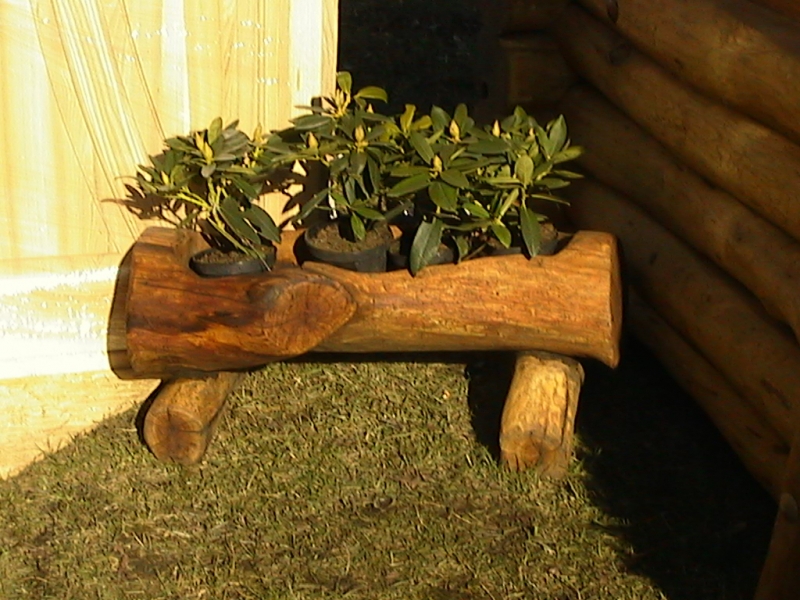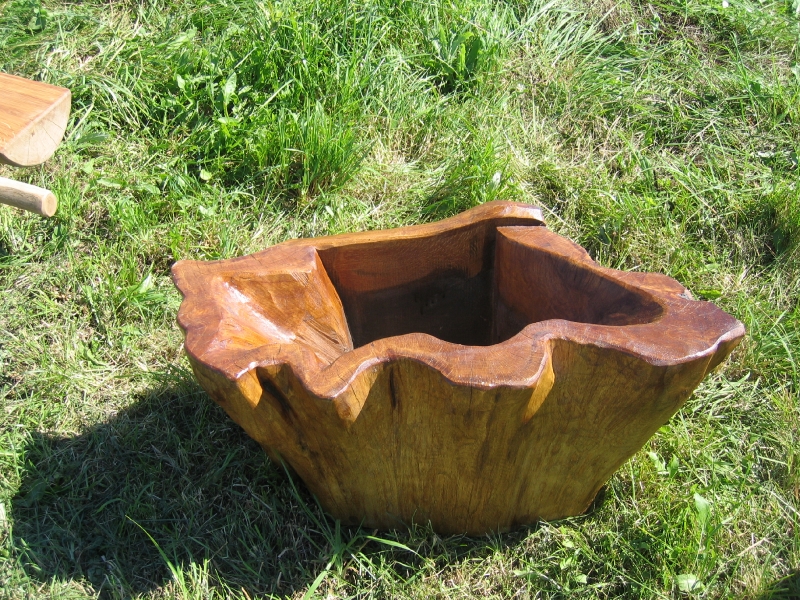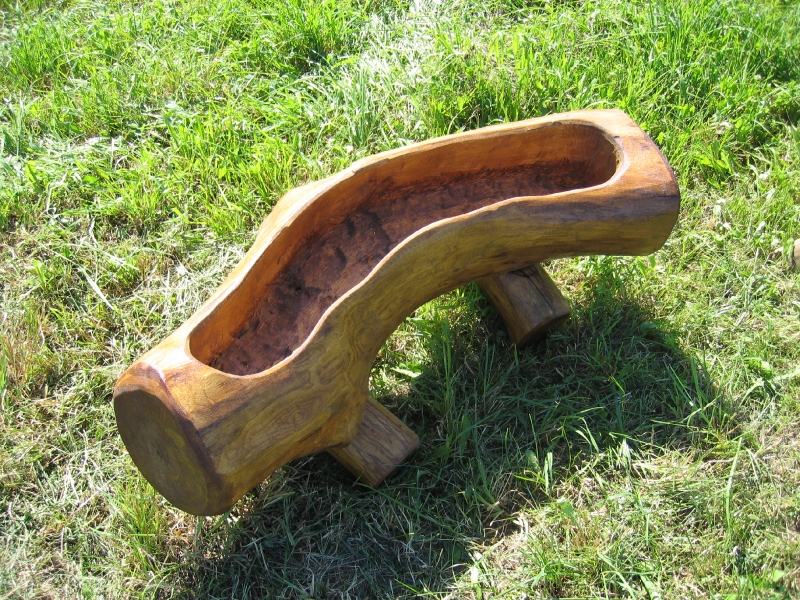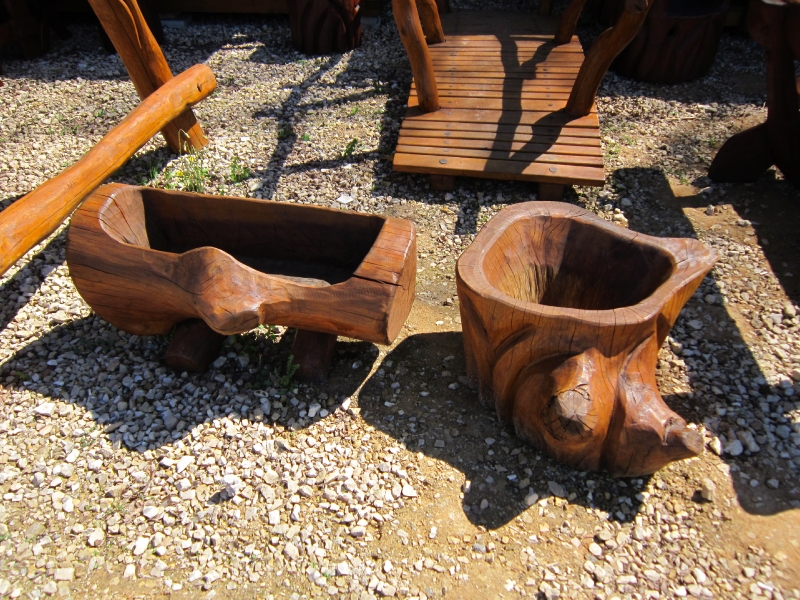
In short: Outdoor planters No. 7 are two wooden planters of different shapes: an elongated trough hollowed out of a log, on two short legs, and a wide stump planter with a prominent root projection. Both are coated with a rich reddish-brown finish, so they go nicely together. The size, shape and finish are agreed with each customer individually.
Two outdoor planters on gravel
In the photo both planters stand on light gravel in bright sun. Around them you can see parts of other wooden products: legs of natural branches, a plank deck, dark round stumps. It seems the photo was taken among other finished wooden products, so the planters are shown as they are, without plants and without extra decoration.
A view like this is useful because the shape, cavities and surface of both planters are clearly visible. The sun casts strong shadows on the gravel and brings out the growth rings, branch scars and natural irregularities of the wood.
The two planters differ, yet make a harmonious pair. The trough is low and elongated, the stump planter taller and rounder. Set side by side they complement each other: a horizontal and a vertical, a long cavity and a deep, wide vessel.
These outdoor planters show how different but kindred products can be made from different parts of a tree, the trunk and the stump. Both keep the natural shape of the wood, both are coated with the same finish, so they are suitable to place together.
The rich reddish-brown finish is one more feature of these planters. It is warmer and darker than natural light wood, so the planters look solid and go nicely with greenery, stones and other wooden products. In the sun the surface glows, and in the shade it takes on a deep, calm shade.
The log trough: long and low
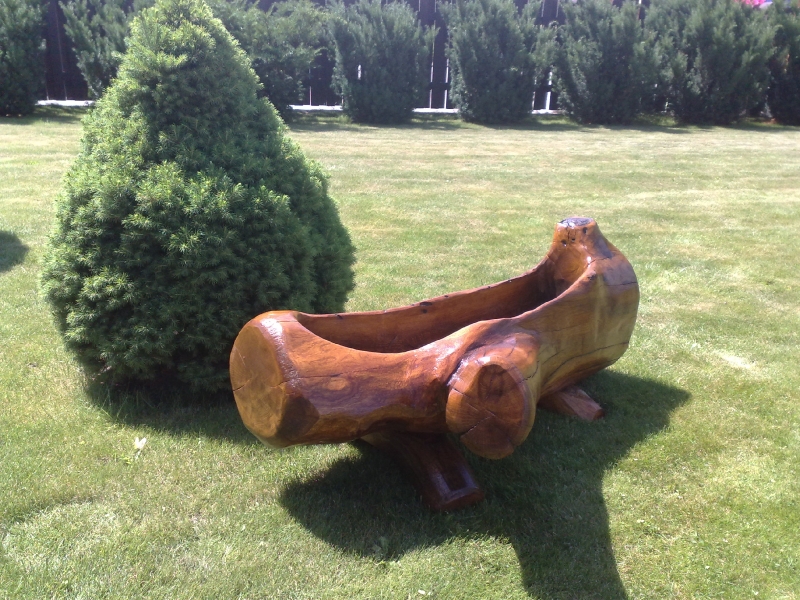
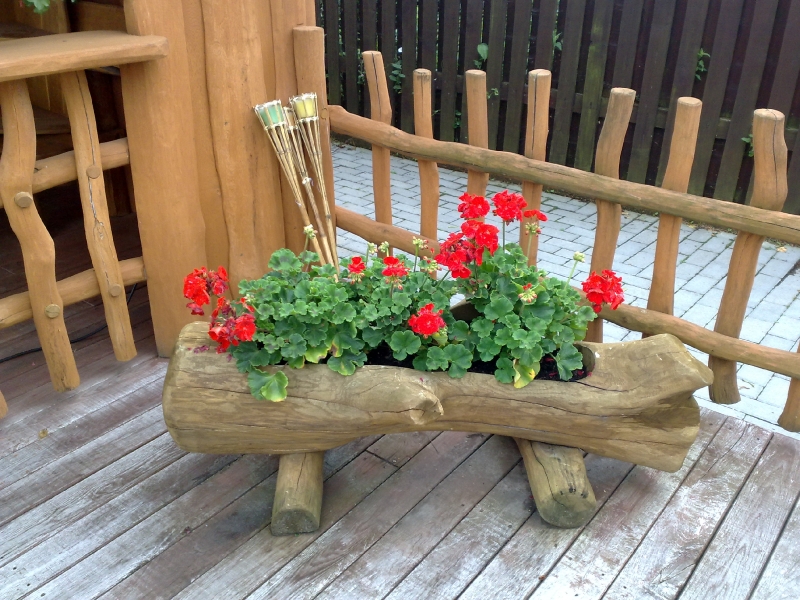
The left planter is made from an elongated log hollowed out from the top. The cavity is wide and deep, almost rectangular, so several pots or a long row of plants fit in it. The walls of the trough are thick, and the edges are smooth.
On the front side of the trough a branch scar projects: where a branch once grew out of the trunk, an elongated projection was left that flows smoothly into the wall of the trough. It gives the trough liveliness and reminds us that this is natural wood and not an industrial product.
The trough stands on two short small logs laid crosswise under it. They lift the trough off the ground, so a gap remains between the bottom and the gravel. This helps the wood dry faster and keeps the trough from rolling.
The ends of the trough are cut crosswise, so the cross-section of the log is visible. The trough suits placing along a wall, a path or the edge of a terrace, where a long, low strip of plants is needed.
It is convenient to grow plants in the trough that look best in a row: pelargoniums, marigolds, begonias or herbs. The long cavity lets you set several pots next to each other and swap them around when needed. This way the trough can change every season while staying the same itself.
The stump planter with a root projection
The right planter is made from a stump. It is taller and rounder than the trough, and its cavity is wide and deep. The rim is irregular, slightly wavy, and one side rises higher than the other.
The most striking detail of this planter is the large projection in its lower part. This is the beginning of a root or a thick branch, which the craftsmen left and emphasized. It projects to the side and downward, so the planter looks rooted in the ground. On the sides you can see more natural bumps and bends.
The stump planter stands directly on the ground, without legs. Thanks to its wide base it is stable and does not wobble. It suits standing alone, as an accent, or together with the trough, as in the photo. The wide base also allows it to be placed on an uneven surface, for example on gravel or in a meadow.
In the products of UAB “Laukbaldis” branches, knots and the natural bends of the tree make each product distinctive. This stump planter is a good example: its form will not be repeated in another planter.
One larger plant looks good in a stump planter: a lush pelargonium, an ornamental grass or a small shrub. If you want more color, trailing flowers can be planted around the main plant, which will hang over the rim and hide part of the projection.
What can be seen in the photo
A short summary helps you judge the features of both planters. These are typical examples.
| Feature | In the photo |
|---|---|
| Elongated log trough | Yes |
| Short legs of the trough | Yes |
| Stump planter with a root projection | Yes |
| Rich reddish-brown finish | Yes, on both planters |
| Branch scar on the side of the trough | Yes |
| Plants in the planters | No, the planters are empty |
How to combine different outdoor planters
Planters of different shapes placed together make a more interesting composition than several identical ones. This pair shows it well. Here are a few ideas for combining wooden outdoor planters:
- Different heights. A low trough and a taller stump planter create variety of heights.
- Different plants. A low strip of flowers in the trough, a taller plant or grasses in the stump planter.
- The same finish. Even if the shapes differ, the same color ties the planters into a whole.
- A group by an entrance. The trough along a wall, and the stump planter at the corner of a door.
- A composition on gravel. As in the photo, natural wood looks lovely on gravel or pebbles.
Outdoor planters can complement other wooden products too: benches, tables, swing sets or low fences. If your yard already has Laukbaldis products, the color of the planters can be chosen to match them.
It is most convenient to plant in liners or pots so that damp soil does not touch the wood. Then the planters will stay beautiful longer, and the plants will be easy to change every season.
When setting out outdoor planters, consider where you will most often look at them from. The trough is worth placing sideways to the viewer so its full length shows, and the stump planter so that the root projection is visible. Then both planters will look their best.
Wooden outdoor planters suit more than a farmstead. They also look good by a modern house, on a cafe terrace, by a sauna or at holiday cabins. Everywhere they play the same role: they give the surroundings the warmth of nature and handwork.
Laukbaldis shows only typical examples, so the size and shape can be discussed. Compare other examples too: the set of wooden planters by the water No. 9 and the wooden planter of a curved log No. 6. You will find all the planters in the section wooden planters and doors, and furniture of natural branches in the section oak garden and outdoor furniture.
Caring for outdoor planters
Wooden outdoor planters stand under the open sky all season, so rain, sun and watering act on them. To keep them beautiful for a long time, it is worth following a few rules:
- use liners so that damp soil does not touch the wood;
- do not let water stand in the cavities; pour it out if needed;
- under the stump planter, which stands without legs, you can put flat stones;
- when the color fades, renew the protective coating made for exterior wood in a similar shade;
- for the winter empty the planters and, if possible, put them under a roof.
Small cracks appear in natural wood as it dries; this is normal and usually does not harm the planters. The open log cross-sections and the root projection absorb the most moisture, so inspect them more carefully.
In spring, before planting new plants, brush the planters with a soft brush and check whether the coating needs renewing. Well-kept planters become more beautiful over the years, and their color becomes richer.
How to order planters No. 7
UAB “Laukbaldis” has been making wooden products since 1996 and, according to the company, was the first in Lithuania to start making this production. The company is based in Dapkiškių village, Tauragės district.
Call +370 687 25388 and quote No. 7 from the planters section. Say whether you want both planters or only one of them, where they will stand and what you plan to grow. During the call you will discuss the approximate size, shape and finish.
Because every log and every stump is different, your planters will not be an exact copy of the photo. They will have bends and branch scars of their own, but will keep the same natural form and warm color.
Do not be afraid to ask for changes: a longer trough, a taller or lower stump planter, different legs or a lighter shade. If you want more than two planters, say so in advance, and products that match each other will be chosen. Everything is made according to the agreed solutions, so the planters will suit your yard.
Frequently asked questions
Can the planters be ordered separately?
Yes, you can order both planters or only one of them. This is discussed on the phone.
How does the log trough differ from the stump planter?
The trough is elongated and low, suited to a row of plants. The stump planter is taller and rounder, suited to one larger plant or an accent.
Why does the trough stand on legs and the stump planter does not?
A round log without legs could roll, so two crosswise small logs hold it. The stump planter has a wide base and stands stably on its own.
Can I order a lighter finish?
Yes, the finish is agreed individually. It is important that the shade of both planters is similar if they will stand together.
How do I look after wooden outdoor planters?
Use liners, do not let water collect in the cavities and empty the planters for winter. When the color fades, renew the protective coating.
How do I order planters No. 7?
Call us and quote No. 7 from the planters section. We will discuss which planters you need, their size and the finish.