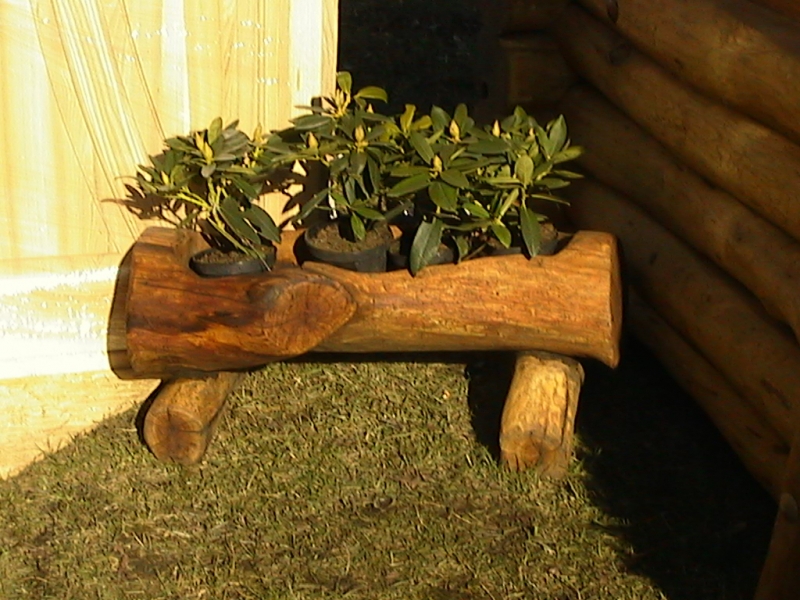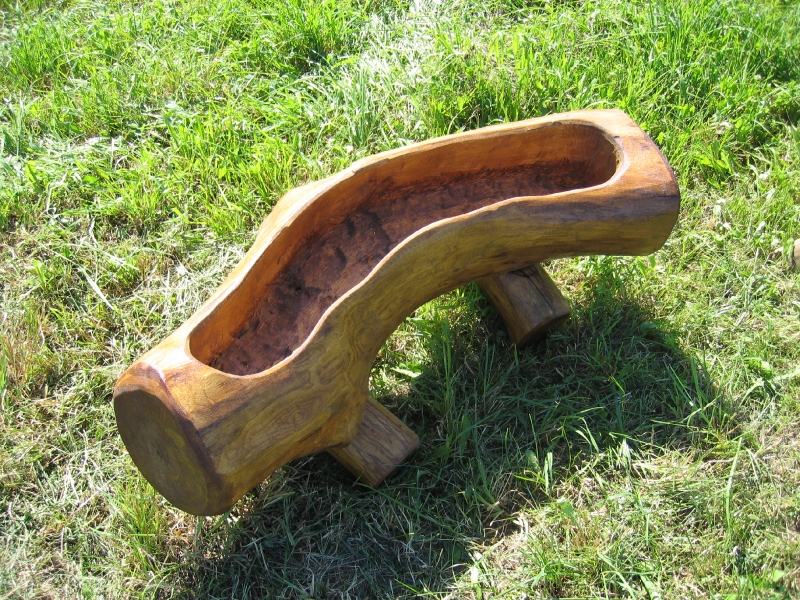
In short: Wooden flower trough No. 3 is a naturally curved log hollowed out lengthwise and set on two short small legs. Because of the bend of the log, the trough looks from above like a crescent or a boat, and at its ends you can see the cross-section of the log with growth rings. The length, depth and finish are agreed with each customer individually.
A curved wooden flower trough
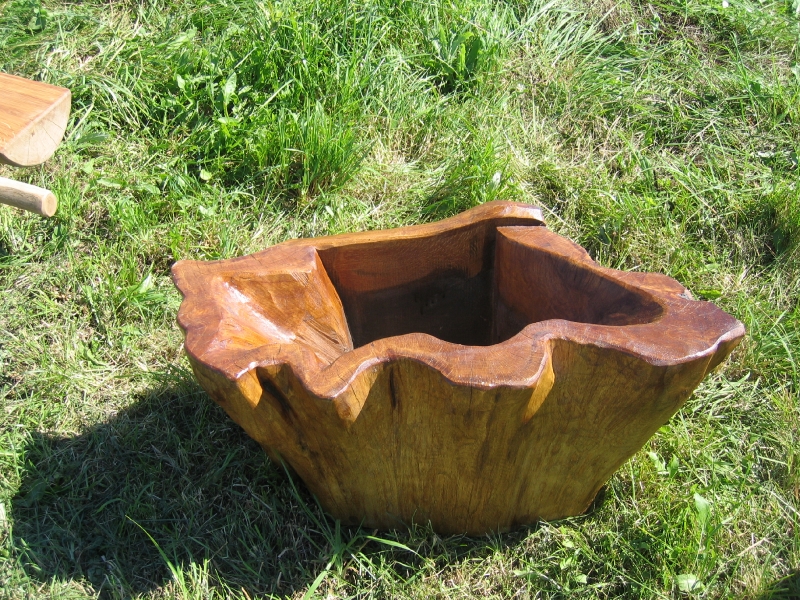
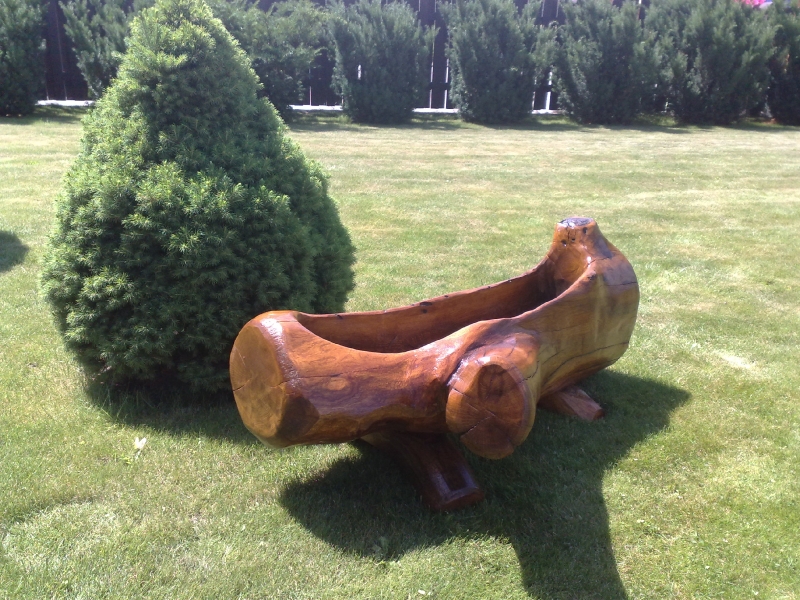
In the photo the trough stands on sunlit grass. It is empty, so its whole shape is clearly visible: long, curved to one side, with a wide cavity along its entire length. The bright summer sun casts a dark shadow under it and brings out the color and texture of the wood.
The most important feature of this trough is its bend. The log was not straight: the tree curved as it grew, and the craftsmen did not straighten that bend. On the contrary, they used it: the cavity was hollowed out so that it follows the shape of the log. Because of this the trough looks dynamic, as if moving, and differs a great deal from ordinary straight planters.
A shape like this recalls an old wooden boat or a trough from which livestock were once watered in the countryside. It gives the yard a rustic, old-fashioned coziness, yet at the same time looks contemporary, like a garden sculpture.
In the products of UAB “Laukbaldis” the natural bends, branches and knots of the wood are not a flaw but a mark of individuality. This trough is one of the clearest examples: its shape depends on the tree that gave it, so another trough will be similar but not identical.
A wooden flower trough is a practical solution for those who want to grow plants where there is no flower bed. It can be placed on paving stones, on a terrace, by the stairs or even on gravel. The trough becomes a small movable flower bed that can be moved to another place when needed.
The shape of the curved log up close
The cavity of the trough is hollowed out along almost the whole length of the log. Its edges are irregular and slightly wavy, and inside you can see a rougher surface with carving marks. The inside of the cavity is darker, brownish, while the outside is lighter, yellowish brown. This contrast lets you see clearly how thick the walls of the trough are.
One end of the trough, the one closer to the photographer, is cut crosswise. There the cross-section of the log with concentric growth rings is clearly visible. It is a natural detail that reminds us the trough was made from a single tree trunk. The other end is rounded and flows smoothly into the side of the trough.
The outer surface is sanded but keeps its natural forms. At the bend of the trough, on the outside, you can see a branch scar and gentle bumps. The surface is coated with a warm finish that emphasizes the pattern of the wood.
Seen from above, the line of the edges undulates together with the bend of the log and forms a lively, irregular outline. In one place the edge rises higher, in another it drops, so the trough looks as if it had grown and not been made to a drawing. This line is especially beautiful when the trough stands in the sun and its edges cast shadows into the cavity.
The trough stands on two short small logs laid crosswise under it. One leg is closer to one end, the other near the bend of the trough. Because of this the trough stands stably, does not wobble and does not roll, even though its shape is irregular.
The legs lift the trough off the ground enough to leave a gap beneath it. This helps the wood dry faster after rain, and the trough looks lighter, as if floating above the grass. At the same time, such raising makes it easier to mow the grass around it.
What is visible in the photo
A short summary helps you judge the features of this trough. It is a typical example, because every log is different.
| Feature | In the photo |
|---|---|
| Naturally curved log | Yes |
| Cavity hollowed out lengthwise | Yes |
| Log cross-section with growth rings at the end | Yes |
| Two short legs | Yes |
| Warm yellowish-brown finish | Yes |
| Plants in the trough | No, the trough is empty |
A curved shape in the garden: where it suits
A curved trough has no straight lines, so it suits places where straight planters would look too strict. Its shape blends naturally into a garden and lets you create soft, natural compositions.
- Beside a winding path. The trough can follow the bend of the path and emphasize it.
- Around a tree trunk. The curved shape neatly wraps around part of a tree or bush.
- By a round terrace or fire pit. The trough repeats the line of a circle and creates a cozy frame.
- In the corner of a flower bed. It can finish off the bed and give it height.
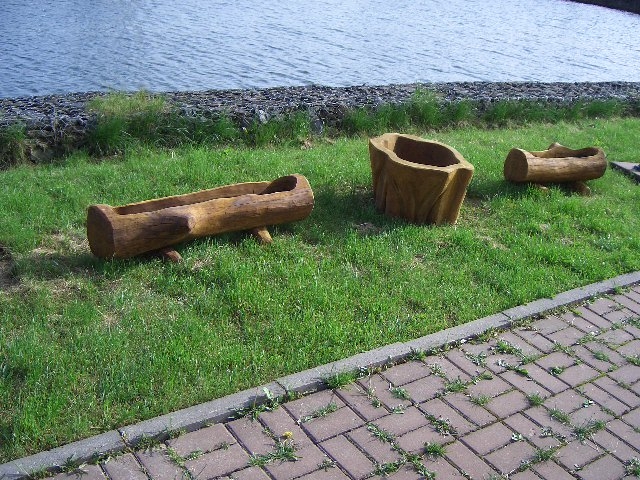
- By a pond. The trough resembles a boat, so it looks especially fitting by the water.
Since the trough is long and curved, its spot is worth choosing so that it is seen from the side or from above. That is when its shape shows best. Looking straight at the bend, the trough may look shorter than it is.
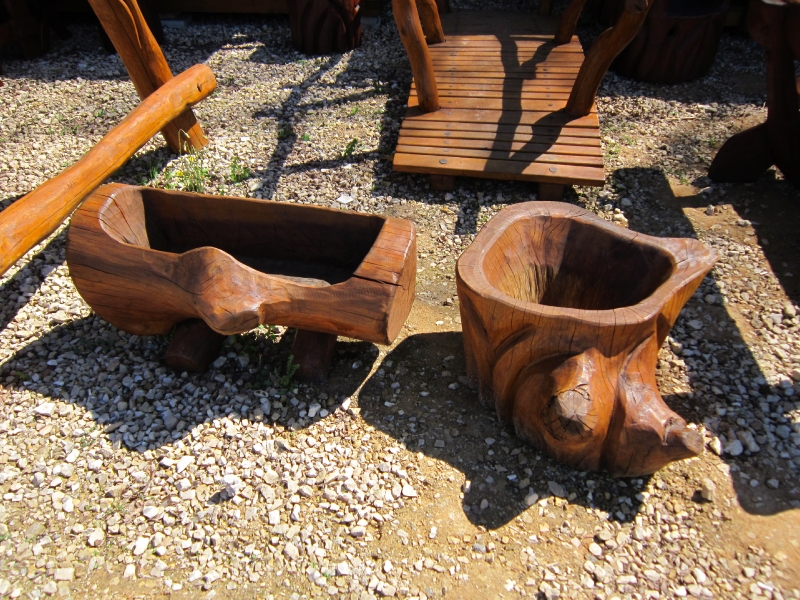
The trough also suits a larger composition. Several wooden planters of different shapes, a straight log trough, a stump planter and this curved one, together create a varied but unified picture. The main thing is that their finish is similar.
A curved trough also suits smaller yards. Since its shape has no sharp corners, it does not look bulky even in a narrow space. It can be placed in the corner of a terrace so that the bend follows the corner of the walls, or by stairs, where it gently finishes off the line of the steps.
Flower ideas for a curved trough
A long, narrow cavity suits plants that grow in a row or trail over the edge. Here are a few ideas:
- Trailing flowers. Petunias, surfinias or lobelias will trail over the edges of the trough and hide part of the walls.
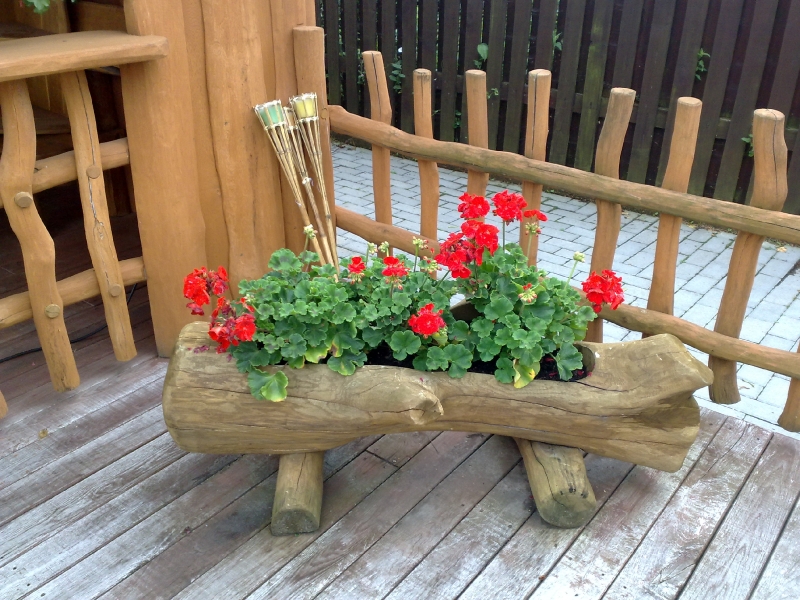
- Low summer flowers. Marigolds, begonias or pelargoniums form a colorful strip.
- Herbs. Thyme, mint or oregano smell lovely and suit a sunny spot.
- Succulents. They like drier soil and look good against a background of natural wood.
It is most convenient to plant in a liner or to set the plants in pots, so that damp soil does not touch the wood. For a curved cavity you can choose several smaller pots that fit along the bend of the trough.
A wooden flower trough can change with the seasons. In spring bulb flowers can bloom in it, in summer colorful summer flowers, and in autumn heather or ornamental cabbages. In winter the trough can be decorated with spruce branches, pine cones or a lantern.
If the trough stands in the sun, choose drought-tolerant plants, because in a small cavity the soil dries out faster than in a flower bed. In shade ferns, hostas and other shade-loving plants will grow better.
Laukbaldis shows only typical examples, so the length, depth and shape of the trough can be discussed. Compare other examples too: the log planter by a wall No. 1 and the stump planter with a wavy rim No. 2. You will find all the planters in the section wooden planters and doors, and the benches and tables that go with them in the section oak garden and outdoor furniture.
Caring for the trough through the season
A wooden trough stands outdoors all season, so it is affected by rain, sun and watering. To keep it beautiful for a long time, it is worth following a few rules:
- in spring, before planting, inspect the cavity and clean it;
- use a liner or pots so that the wood is not constantly damp;
- in summer try not to pour water over the edges of the trough;
- in autumn empty the trough and let it dry;
- when the surface turns pale, renew the protective coating made for exterior wood.
The open cross-section of the log at the end absorbs the most moisture, so it is worth protecting more carefully. Small cracks that appear in natural wood as it dries are normal and usually do not harm the trough.
For the winter it is best to put the trough under a roof, or at least turn it over so that snow and ice do not collect in the cavity. In spring it will be ready for a new season.
A well-kept wooden flower trough takes on an even richer shade over time and blends more and more into the garden. It becomes not only a vessel for plants but also a distinctive detail of the yard that every guest notices.
How to order trough No. 3
UAB “Laukbaldis” has been making wooden products since 1996 and, according to the company, was the first in Lithuania to start making this production. The company is based in Dapkiškių village, Tauragės district.
Call +370 687 25388 and quote No. 3 from the planters section. Tell us where the trough will stand and what you want to grow in it. During the call you will discuss the approximate length, depth, shape and finish. If you have photos of the spot, they will help you choose the right size.
Because every log is bent in its own way, your trough will not be an exact copy of the photo. It will have its own bend and grain, but will keep the same natural, lively form.
Do not be afraid to ask for changes: a longer or shorter trough, a deeper cavity or taller legs. Everything is made according to the agreed solutions.
Frequently asked questions
Why is the trough curved?
The trough is made from a naturally curved log whose shape has not been straightened. Because of this every such trough is distinctive.
Can I order a straight trough?
Yes, Laukbaldis also makes straight log troughs. It is worth choosing the shape according to the spot where the trough will stand.
Which plants suit a curved trough?
Trailing flowers, low summer flowers, herbs or succulents suit it. It is most convenient to plant them in a liner or in pots.
Is the trough stable on its legs?
Yes, two crosswise legs hold the trough firmly even though its shape is irregular. The legs also lift it off the damp ground.
How do I look after a wooden trough?
Use a liner, empty the trough in autumn and let it dry. When the surface turns pale, renew a protective coating made for exterior wood.
How do I order trough No. 3?
Call us and quote No. 3 from the planters section. We will discuss the length, depth, shape and finish.