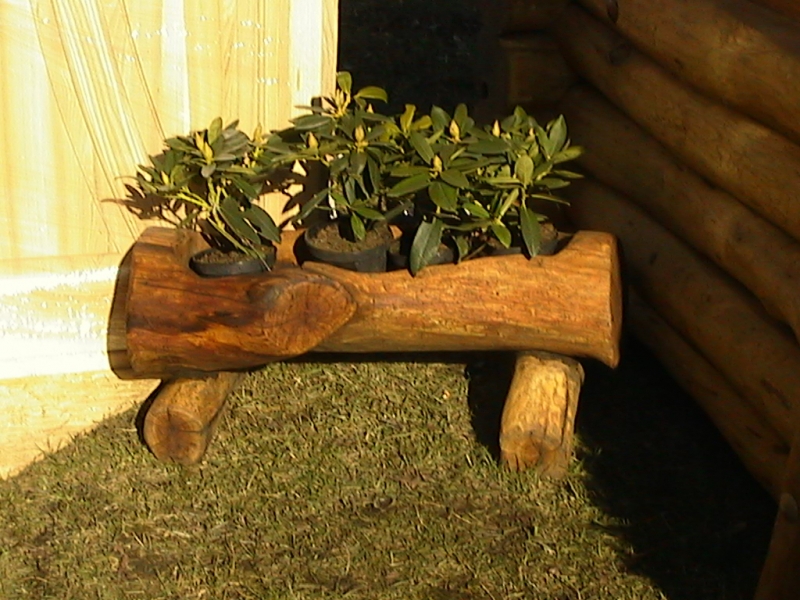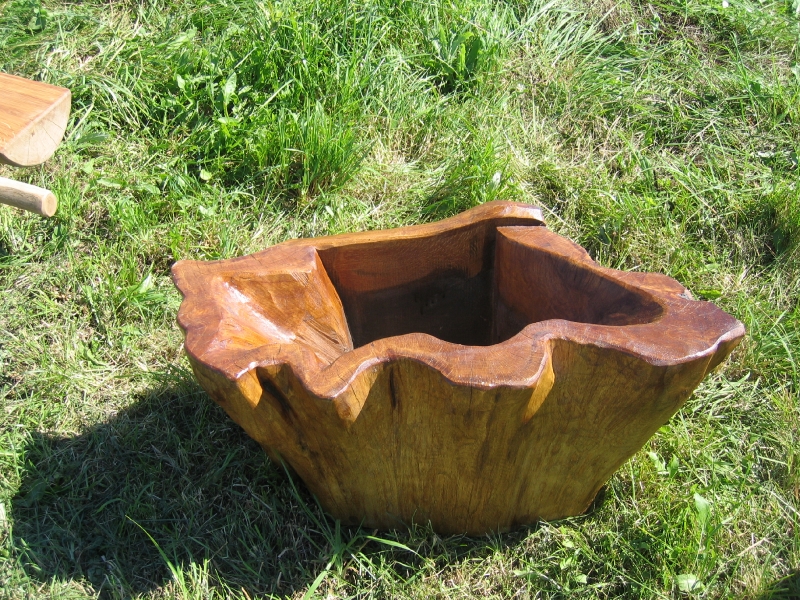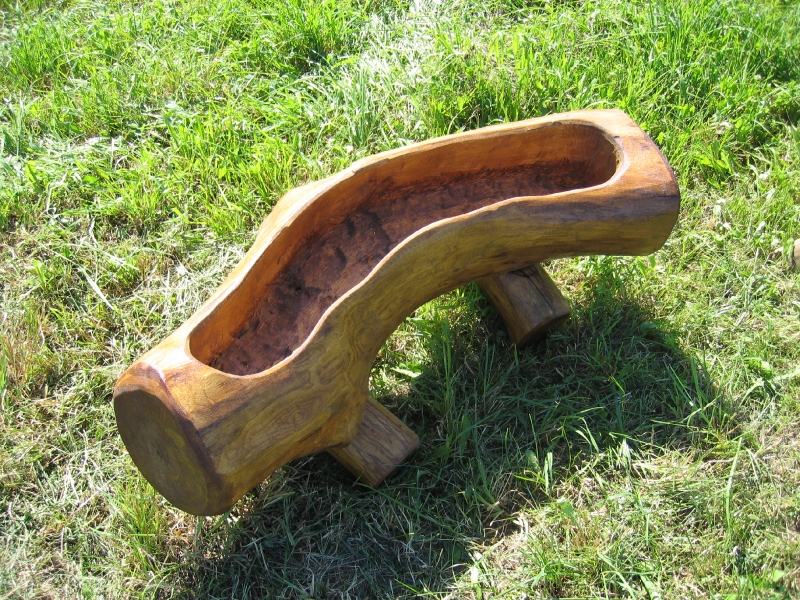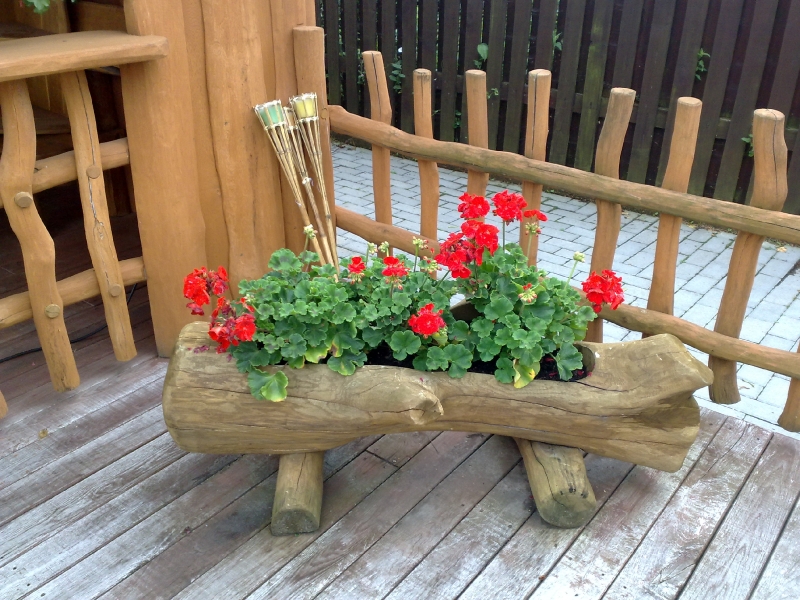
In short: Wooden planter for a terrace No. 10 is a log hollowed out from the top and set on two log pieces laid crosswise. In the photo it is planted with red pelargoniums and stands on a wooden terrace by a low stake fence. The length, height and finish are agreed with each customer individually.
A wooden planter for a terrace with red flowers
This example shows how a log trough looks when it is already in use. The cavity is filled with soil, and pelargoniums with bright red blooms and round green leaves grow lushly in it. The blooms rise above the edge of the trough, and the leaves hang over it, so the plants and the wood form a single whole.
The planter stands on the wooden floor of a terrace laid with grayish boards. Behind it is a low fence of round stakes sharpened at the top with a rail; farther on you can see a yard paved with stones and a dark board fence. On the left side of the frame stand a tall wooden piece of furniture with legs of natural shape, a thick wooden post and two garden torches.
A setting like this shows well what the product is for. It is not a separate garden object in the middle of a lawn but a detail of a terrace or a relaxation area, which complements the furniture, the low fence and the other wooden elements. Bright flowers become a color accent among the shades of natural wood.
The photo was taken in the warm season, when the pelargoniums are in bloom. A view like this helps you imagine how the trough will look on your terrace at the height of the season: the wooden vessel stays visible, but the main role goes to the blooms.
Because the planter stands right by the low fence, it does not take up the passage and does not get underfoot. The flowers can be seen both from the terrace and from the yard, so one trough decorates two spaces at once.
A naturally graying log and crosswise legs
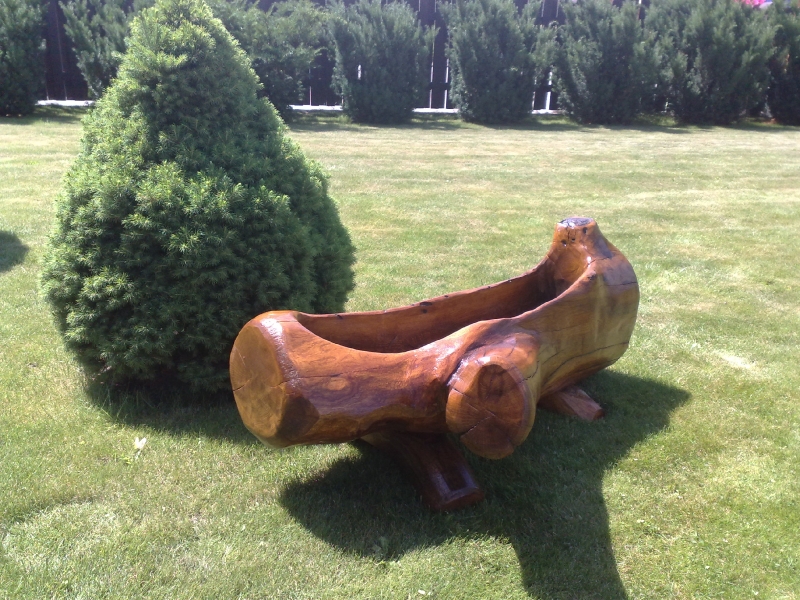
The trough is made from a thick log whose shape has been left almost unchanged. On the front side you can see a bump, the place of a former branch, and the right end narrows and finishes with a rounded, slightly uneven edge. Details like these show that the product is made of a real tree trunk and not of boards or molds.
The cavity is hollowed out along almost the whole length of the log, and the edges are left fairly thick. Because of this the trough looks massive, and there is plenty of room for soil and plant roots.
The wood is light, grayish-sand colored. The growth rings, lengthwise bends and small cracks are clearly visible on the surface. This tone goes well with the gray terrace boards and the stake fence, so the trough does not stand out from its surroundings but looks as if it had always stood here.
Two short log pieces are laid crosswise under the ends of the trough. They play the role of legs: they lift the trough off the floor so that air can move beneath it and water can run off. On a terrace this is especially important, because the boards under the planter do not stay constantly damp, and the bottom of the trough dries faster after watering or rain.
The legs seem to be made of the same wood as the trough, so the whole product looks unified. They are small but sturdy, and their round shape repeats the line of the log itself.
What this photo shows
The table lists what can be seen in the photo of this typical example.
| Feature | In the photo |
|---|---|
| Hollowed-out log trough | Yes |
| Two crosswise log legs | Yes |
| Branch bump on the side | Yes |
| Light, grayish wood color | Yes |
| Planted flowers | Yes, red pelargoniums |
| Dark or colored coating | No |
Why a log trough suits a terrace
A terrace often lacks greenery: the floor, furniture and railings are wooden, and the plants stay in the yard. A log flower trough fills this gap and at the same time does not clash with the wood, as plastic or ceramic planters sometimes do.
A few things that make an elongated wooden planter a convenient choice for a terrace:
- A narrow, elongated shape. The trough sits well by a railing, a low fence or a wall and does not take up the middle of the terrace.
- Many plants in one place. Instead of several small pots there is a single container that is easier to water and look after.
- Stability. A massive log with legs stands firmly, and once filled with soil it becomes even heavier.
- It matches wooden furniture. Natural wood goes with an outdoor table, benches or bar stools.
A wooden planter for a terrace is also useful when the terrace is large. Several troughs placed along the railing can separate the relaxation zone from the dining area, and the gaps left between them can mark the passages. In this way the plants become not only decoration but also a gentle divider of the space.
A trough can be placed not only on a terrace. It suits an entrance to a house, a gazebo, a sauna or an outdoor kitchen. The main thing is that the base is level and firm and that enough room remains around it for watering and reaching the plants.
The photo shows that the trough goes nicely with the stake fence. You will find similar low fences, footbridges and gates in the section wooden fences and footbridges, and by combining them with planters it is easy to create a unified style for the yard.
Pelargoniums and other plants for a sunny terrace
Pelargoniums are among the most popular plants for outdoor planters. They like sun, bloom for a long time and are not afraid of a short drought, so they do well on a terrace, where the soil in a planter dries out faster than in a vegetable garden. Red blooms look especially bright next to natural wood.
If you want a different look, you can plant in a trough like this:
- petunias or other trailing plants that spill over the edge;
- marigolds and calendulas, a combination of warm yellow and orange shades;
- lavender or thyme, which smell lovely and attract bees;
- herbs, basil, oregano or chives, close to the outdoor table.
When planting in an elongated trough, it is convenient to arrange the plants in a row, with the taller ones in the middle and the lower and trailing ones at the ends. Then the planter looks tidy from all sides, and the flowers do not overshadow one another.
It is convenient to water pelargoniums less often but more generously, when the top layer of soil has already dried. It is worth regularly picking off faded flower heads: then the plant keeps producing new blooms longer, and the trough looks tidy all summer.
The plants can be planted in a separate liner or in containers set into the cavity of the log. Then soil does not touch the wood directly, and in autumn the plants are easy to take out. If you plant straight into the trough, make a drainage layer at the bottom so that water does not collect.
A planter on a wooden floor: care tips
When a wooden planter stands on a wooden terrace, it is important to look after both surfaces. A few simple tips:
- water carefully so that water does not run over the edge onto the boards and stand long under the legs of the trough;
- once a season move the trough and check that the boards beneath it are dry and have not become overgrown;
- in spring inspect the log and, if needed, renew the protective coating with a product made for exterior wood;
- in autumn take out the annual plants, clean the cavity and, if possible, keep the trough under a roof.
Natural wood outdoors gradually grays, and small cracks appear on the surface. Many people like the light, grayish tone seen in the photo precisely for its naturalness. If you want a warmer shade, the finish can be discussed when you order.
You will find more log troughs among the other examples: the log planter on legs No. 1, the curved wooden flower trough No. 3 and the log troughs with a stump planter No. 9. You will find all the products in the section wooden planters.
How to order planter No. 10
UAB “Laukbaldis” has been making wooden products since 1996 and, as the company states, was the first in Lithuania to start making this production. Branches and natural bends of the wood make each product unique, so every log trough has a form of its own.
Call +370 687 25388 and quote the product number, No. 10. Tell us where the trough will stand, whether on a terrace, by an entrance or in the yard, and how long it needs to be. Also discuss the finish: the natural light tone or a warmer shade.
Before calling, measure the spot by the railing or the wall and think about how many plants you would like to plant. If the terrace already has wooden furniture, a photo of it will help you choose the right color for the trough.
If you want several troughs in the same style, for example on both sides of the terrace steps, say so right away. Then it will be easier to choose logs of similar thickness and the same finish.
Only typical examples are shown on the website. Planter No. 10 shows one possible solution, a log trough on crosswise legs planted with red flowers, while the exact dimensions and finish are agreed before production.
Frequently asked questions
Is this wooden planter suitable for a terrace?
Yes, in the photo it stands on a wooden terrace by a stake fence. An elongated trough is convenient to place by a railing or a wall so that it does not take up the middle of the terrace.
What are the crosswise legs for?
The two log pieces lift the trough off the floor, so air moves beneath it and water runs off. That way the boards under the planter and the bottom of the trough itself dry faster.
Which flowers grow in the planter in the photo?
In the photo the trough is planted with red pelargoniums. Petunias, marigolds, lavender and herbs also suit it.
Can I choose a different color for the trough?
Yes, the light, grayish natural wood tone in the photo is only one option. The finish is agreed individually with each customer.
How do I look after a log trough on a terrace?
Water carefully so that water does not stand under the legs, and check the boards under the trough once a season. In spring renew the protective coating if needed, and for the winter keep the trough under a roof.
How many plants fit in such a trough?
That depends on the length of the trough and the size of the plants. In the photo the pelargoniums fill the whole cavity and form a continuous flowering strip. When you order, say how many plants you want to plant, and it will be easier to choose the length.