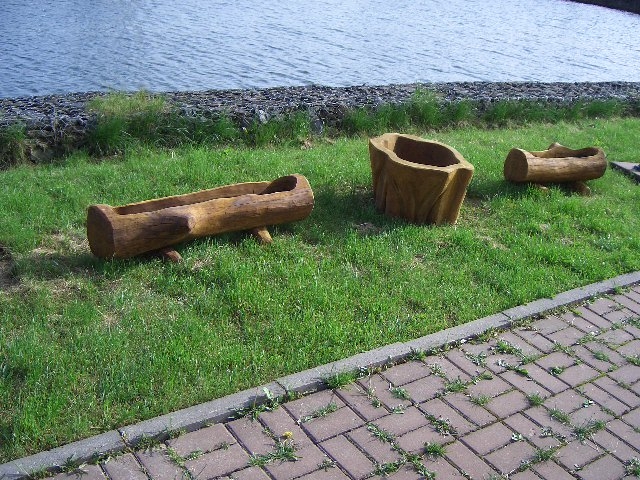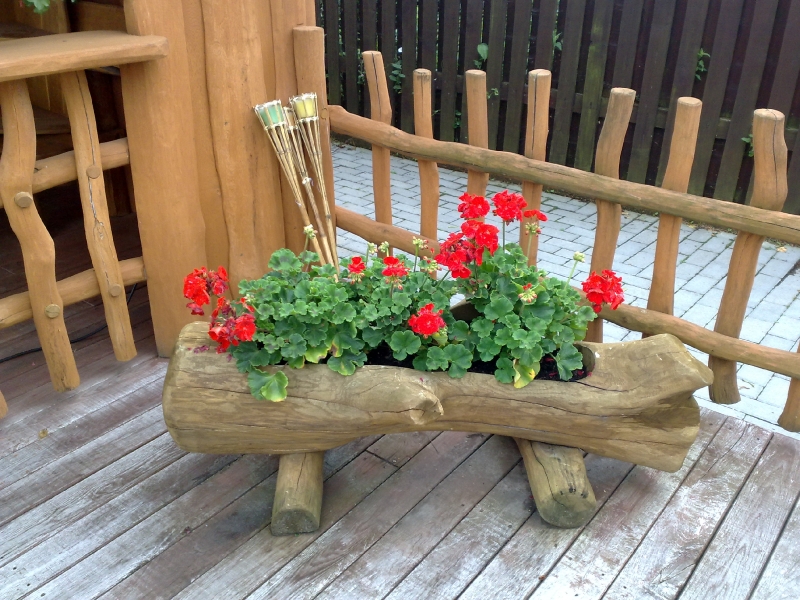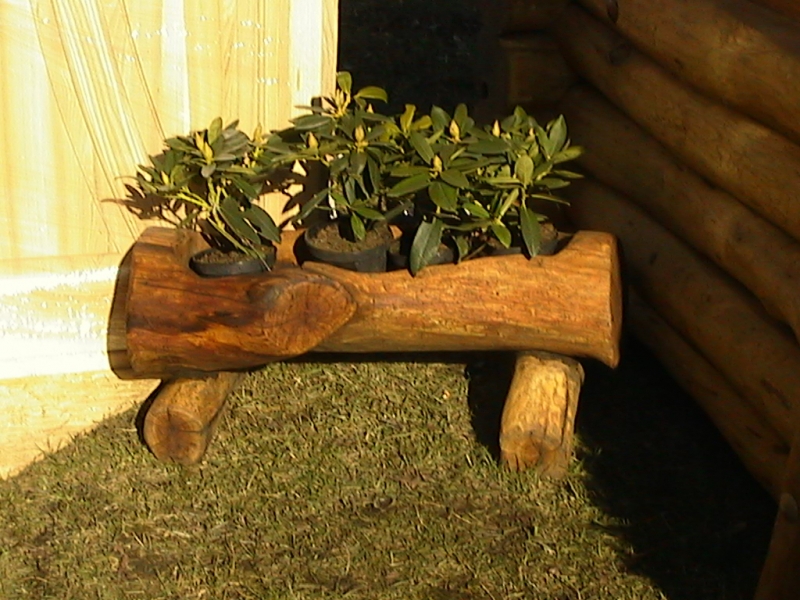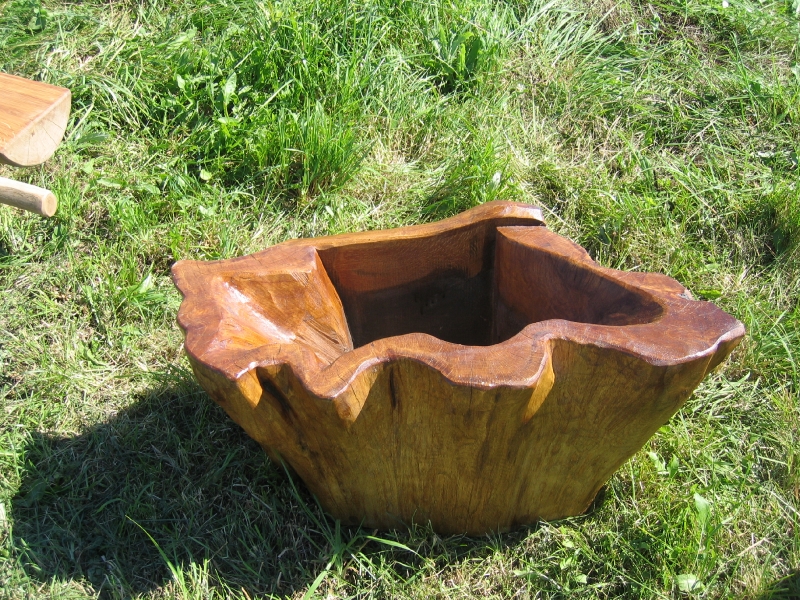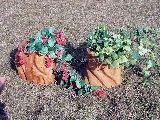
In short: Wooden planters for flowers No. 5 are two low, wide planters made of stumps, set side by side and planted with blooming plants. In the photo pinkish flowers bloom in one of them and lush green leaves in the other, and the two planters make a harmonious pair. The size, shape and finish are agreed with each customer individually.
Wooden planters for flowers in pairs
This photo is small, so fine details cannot be seen in it. But it shows well how wooden planters look when they are already planted, at the height of the blooming season. Two low stump planters stand side by side on the ground, and their tops are almost completely covered by plants: on the left, bright pinkish blooms with green leaves, on the right, lush green leaves.
The plants burst out over the rims of the planters and trail down a little, so the wood is visible only at the bottom and on the sides. This shows that a low stump planter is perfect for abundant, lush flowers: it becomes a kind of natural base for a dome of blooms.
This view helps you imagine how the planters will look in your yard in midsummer. In spring, when the plants are still small, more of the wood will be seen, and in August the blooms and leaves will cover almost the whole top. In this way the planters change with the season and never look the same.
Both planters are of similar size and shade, but not completely identical. Each has a shape of its own, because each is made from a different stump. A pair like this looks natural, as if two trees that grew side by side had left their stumps.
The reddish-brown finish of the planters goes well with the soil and the flowers. It is not bright, so it lets the plants be the main accent, while the planters remain a warm, calm background.
Wooden planters for flowers like these create quite a different impression from plastic or ceramic containers. They do not stand out from their surroundings with bright color or a shiny surface; they seem to grow into the garden. Flowers in such a planter look as if they were growing straight out of an old stump at the edge of a forest.
Low stumps and lush blooms
The shape of these planters differs from tall stump planters. They are low and wide, so they stand firmly and do not catch the eye with their height. Their role is not to be a sculpture but to be a natural, warm vessel in which flowers look their best.
A low planter has several advantages:
- Stability. A wide, low planter does not tip over even in strong wind or if bumped by accident.
- Suits low plants. The plants are seen from above, so carpet-forming and trailing flowers look especially beautiful.
- Blends easily into the surroundings. A low planter does not block the view and suits the front of a flower bed or a path well.
- Convenient to look after. A wide cavity makes it easy to plant, water and change the plants.
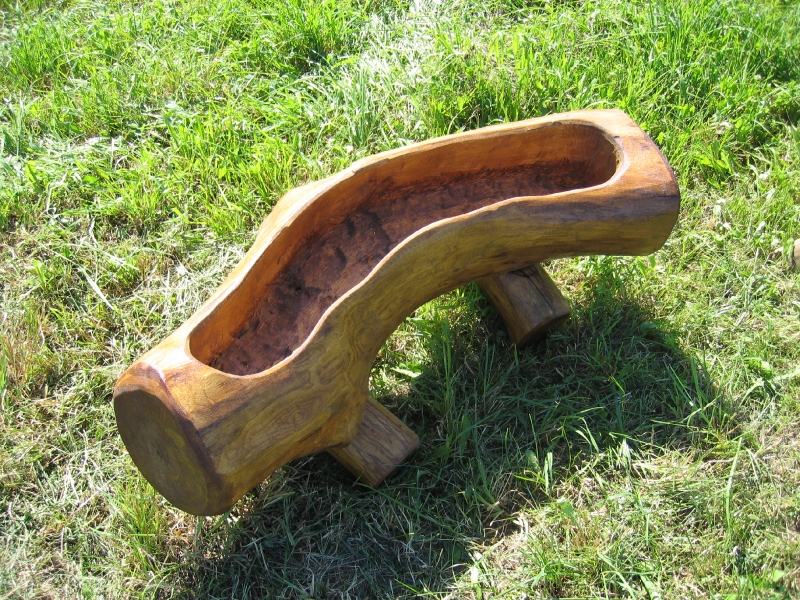
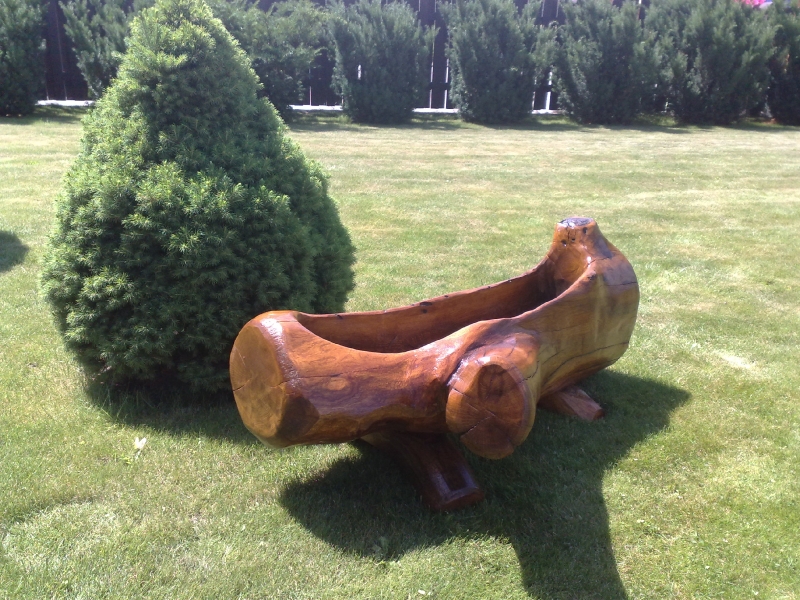
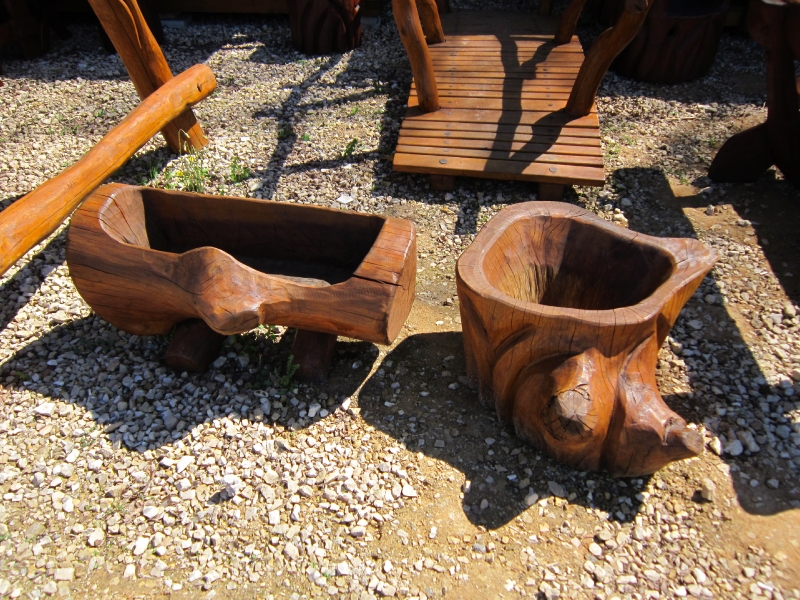
The planters are made from parts of stumps, so natural bends and bumps of the wood remain on their sides. The rim is irregular and slightly wavy. Every lobe and growth ring reminds us that this is real wood that has grown, not a casting.
In the products of UAB “Laukbaldis” branches, knots and the natural bends of the tree are not a flaw but a mark of individuality. Because of them each planter is one of a kind, even when made from the same sample.
Low stump planters have thick walls, so the soil in them warms up more slowly on a hot day and cools down more slowly on a cool night. This is better for plant roots than thin-walled containers, which heat up quickly in the sun.
Details of the photo
Since the photo is small, the summary lists only what can be clearly seen in it. It is a typical example.
| Feature | In the photo |
|---|---|
| Two planters made of stumps | Yes |
| Low, wide shape | Yes |
| Reddish-brown finish | Yes |
| Blooming plants | Yes, pinkish blooms |
| Green leafy plants | Yes |
| Legs under the planters | Not visible |
Why planters look better in groups
A single planter can be beautiful, but two or three planters together create a composition. The photo shows this well: two planters with different plants complement each other and look like a unified group.
A few ideas for combining wooden planters:
- Different plants. Bright blooms in one planter and green leaves in the other, so the colors do not overpower each other.
- Different heights. Next to low planters you can place a taller stump planter or a log trough.
- An odd number. Three or five planters often look more natural than two or four, but a pair suits both sides of a path well.
- The same finish. Even if the shapes of the planters differ, a similar shade ties them together.
A group of planters can be placed by an entrance, at the edge of a flower bed, by a pond or a terrace. It looks especially nice on gravel or mulch, where natural wood goes with the texture of the surroundings.
When planning a group, it is worth thinking about how it will look in different seasons. When the flowers have finished blooming, the planters remain visible, so their shape and finish must be beautiful without plants too.
Wooden planters for flowers also go well with other wooden products: low fences, benches, footbridges or wells. If your yard already has Laukbaldis products, the shade of the planters can be chosen to match them. Then the whole yard will look like a thought-out whole in which every detail has its place.
Flowers for a low stump planter
A low, wide planter suits plants that grow in a dome or trail over the edge. Here are a few ideas:
- Begonias and pelargoniums. They bloom for a long time and do well both in sun and in partial shade.
- Petunias and surfinias. They bloom abundantly and trail over the rim of the planter.
- Impatiens. They suit shady spots and bloom all summer.
- Ornamental foliage plants. Ivy and other leafy plants make a green background for blooming planters.
- Succulents. In a sunny spot they make an interesting composition that needs little care.
It is most convenient to plant in a liner or in a pot set into the wooden planter. That way damp soil does not touch the wood, and the plants are easy to change.
When choosing plants, take the spot into account. In the sun pelargoniums, petunias and succulents do better, while in shade impatiens, begonias and leafy plants do. If the planters stand in pairs, as in the photo, blooming plants can be grown in one and green ones in the other. That way the composition stays beautiful even when there are fewer blooms.
Laukbaldis shows only typical examples, so the size and number of the planters can be discussed. Compare other examples too: the large wooden stump planter No. 4 and the outdoor planters: a log trough and a stump planter No. 7. You will find all the planters in the section wooden planters and doors, and furniture that goes with the planters in the section oak garden and outdoor furniture.
Caring for the planters in summer and autumn
Planted planters are watered often in summer, so the wood gets more moisture than other garden products. To keep the planters beautiful for a long time, it is worth following a few rules:
- use a liner with drainage holes so that water does not accumulate;
- when watering, try not to pour water over the rims and sides of the planter;
- you can put a few stones or pads under the planter so that the bottom does not touch wet ground;
- in autumn, after the flowers have finished blooming, empty the planters and let them dry;
- when the wood turns pale, renew the protective coating made for exterior wood.
For the winter it is best to put the empty planters under a roof. Small cracks appear in natural wood as it dries; this is normal and usually does not harm the planters.
In spring, before planting new plants, the planters are worth inspecting, brushing with a soft brush and, if needed, renewing the protective coating. That way wooden planters for flowers will serve for many seasons and look tidy every year.
How to order planters No. 5
UAB “Laukbaldis” has been making wooden products since 1996 and, according to the company, was the first in Lithuania to start making this production. The company is based in Dapkiškių village, Tauragės district.
Call +370 687 25388 and quote No. 5 from the planters section. Tell us how many planters you want, where they will stand and what flowers you plan to plant. During the call you will discuss the approximate size, shape and finish.
Because every stump is different, your planters will not be an exact copy of the photo. They will have their own bends and growth rings, but will keep the same low, wide form that suits blooming flowers so well.
If the planters are to stand in a particular place, for example on both sides of stairs or a gate, say so in advance. It will then be easier to choose the right size and shape. If you have photos of the place, they will help you agree faster. Do not be afraid to ask for other changes either, such as taller, wider or darker planters. Everything is made according to the agreed solutions.
Frequently asked questions
Can I order the planters in pairs?
Yes, the photo shows two similar planters set side by side. When you order, you can discuss how many planters you need and what size they should be.
Will all the planters be identical?
Not completely, because every stump has its own shape and growth rings. Still, the planters are chosen so that they match each other.
Which flowers suit a low planter?
Begonias, pelargoniums, petunias, impatiens and other plants that grow in a dome or trail over the edge suit it. In a sunny spot succulents do well too.
Can I plant directly in the planter?
You can, but it is more convenient and safer for the wood to use a liner. That way damp soil does not touch the wood, and the plants are easy to change.
How do I look after wooden planters?
Use a liner with drainage, and in autumn empty the planters and let them dry. When the wood turns pale, renew a protective coating made for exterior wood.
How do I order planters No. 5?
Call us and quote No. 5 from the planters section. We will discuss the quantity, the size, the shape and the finish.