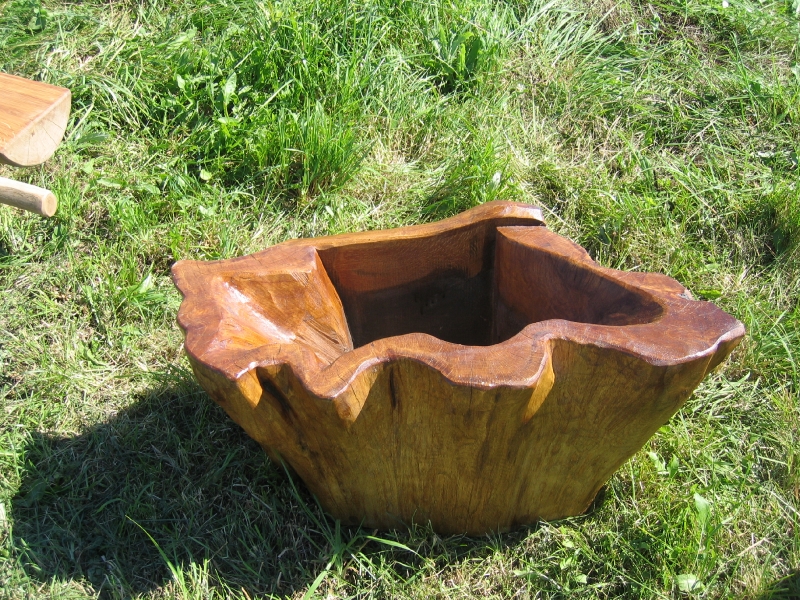
In short: Stump planters No. 8 are a group of three wooden planters of different sizes, whose top rims are cut into pointed lobes that look like a star or an opened flower from above. The planters are coated with a light, yellowish-brown finish and photographed on a lawn by the water. The size, shape and finish are agreed with each customer individually.
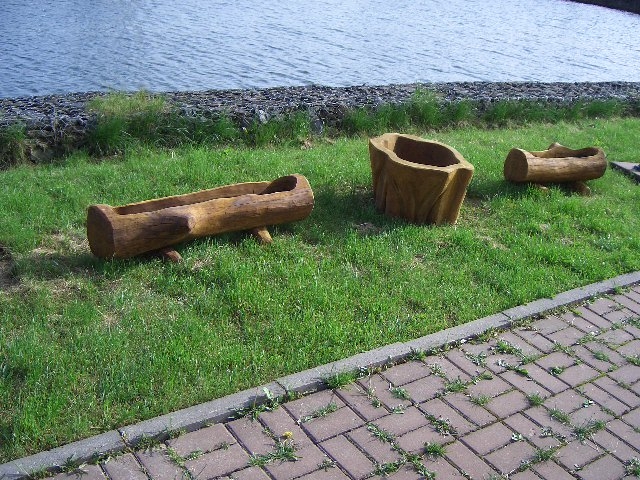
Three stump planters by the water
In the photo the planters are arranged on green grass near the bank. Beyond them water glistens, the bank is reinforced with stones, and on the right you can see a black garden lantern on a post. The planters stand without plants, so their shape, cavities and wall thickness are clearly visible.
All three planters are different. The one on the left is taller and widens upward, resembling a goblet or a bell. The middle one is the biggest: lower but much wider, with lobes stretched out to the sides, especially to the right. The third, standing farther by the lantern, is of medium size and is similar in shape to the left one.
A group like this shows how planters of one spirit but different proportions can make a unified composition. They do not repeat each other, yet the same finish and the same motif of pointed rims join them.
The planters were photographed on a sunny day, so bright shadows of them fall on the lawn. The light also brings out the silhouette of the rims: every lobe casts a shadow into the inside of the cavity, so the planters look even more sculptural. In the evening a group like this can be softly lit by a garden lantern standing nearby.
The choice of the place itself is telling too. By the water, where stones, grass and wood meet naturally, a wooden planter looks like part of the bank and not like something brought in. They would look similar by a pond on a farmstead or beside a relaxation area.
Pointed rims: why a stump planter resembles a flower
The brightest detail of these planters is the top rim. It is not smooth or just wavy: the rim is cut into several pointed lobes that spread out to the sides. Seen from above, the planter resembles a star, and from the side a flower in bloom or the cup of a lily.
The number and length of the lobes differ in each planter. In the smaller planters they are shorter and point more upward, in the largest they are long, almost lying down. Because of this each planter has a character of its own, although all three clearly belong to the same family.
On the sides you can see the lengthwise bends and bumps of the stump surface. They are not sanded to complete smoothness, so the planters keep the impression of natural wood. The inner cavity is hollowed out fairly wide, and the walls are thick enough for the planter to be sturdy.
It is exactly this shape that sets these planters apart from other stump planters, whose rims are usually round or only slightly wavy. The pointed lobes add dynamism: even without flowers the planter looks like a sculpture, and planted plants seem to grow out of a wooden blossom.
The photo in brief: a table of details
The table lists what can be seen in the photo of this typical example.
| Feature | In the photo |
|---|---|
| Number of planters | Three, of different sizes |
| Pointed, star-shaped rims | Yes |
| Light, yellowish-brown finish | Yes |
| Hollowed-out inner cavity | Yes |
| Legs or a base | No, they stand directly on the lawn |
| Planted plants | No |
How to arrange several planters of different sizes
Several stump planters often look more impressive than one large one. To make the group harmonious, it is worth following a few simple principles:
- An odd number. Three or five planters look more natural to the eye than two or four lined up like soldiers.
- Different heights. Put the taller planter farther back, and the lower, wider one closer to the path, so that none blocks another.
- Not in one line. As in the photo, arrange the planters in a triangle or a loose curve and not in a straight row.
- A common finish. When the coating is the same, even planters of different shapes look like a set.
A group of planters can also be built up gradually. At first one larger planter is enough, and later smaller ones with a similar finish can be added to it. The main thing is to discuss the color in advance so that new planters match those you already have.
A group like this is convenient to place where the yard opens up wider: by a body of water, by terrace steps, in a corner of the lawn or by the driveway. By a narrow path the large planter with long lobes may get in the way of passing, so it is worth leaving it more room.
If the yard already has other wooden products, such as benches, a footbridge or a low fence, the planters can be arranged so that they link these accents. By the water they go well with a wooden footbridge or pier; you will find such products in the section wooden bridges, footbridges and fences.
Plants for wide and tall stump planters
Different shapes of planters let you choose different plants for each. A wide, low middle planter suits plants that spread sideways and hang over the rim. Taller planters suit compact, upright plants that do not overshadow the pointed rims.
A few ideas that can be applied to any stump planter for flowers:
- in a sunny spot: pelargoniums, marigolds, petunias or dwarf daisies;
- in shade: begonias, hostas or ferns of various colors;
- herbs: thyme, oregano or mint, which are handy to pick close at hand;
- in autumn: heather or ornamental cabbages that decorate even after the first frosts.
Pointed rims look best when the plants do not cover them completely. So it is worth planting a little fewer plants in a star-shaped planter than in a round one and leaving the lobes visible.
By the water the wind blows more often, so tall, easily broken plants do not always suit there. It is better to choose sturdier, lower plants that fill the cavity nicely and do not fear the wind.
It is convenient to plant in a separate container or liner set into the cavity of the planter. Then soil and moisture do not touch the wood directly, and the plants are easy to change next season. If you plant directly in the planter, take care of drainage so that water does not collect at the bottom.
A light finish and its care outdoors
The yellowish-brown coating brings out the growth rings and glows nicely in the sun. A light color is visible from afar outdoors, so the planters become clear accents of the yard even without flowers. On the other hand, dust and specks of dirt show more on a light surface, so it is worth washing it from time to time.
A few general tips that help wooden outdoor planters stay beautiful longer:
- in spring inspect the planters and, when the coating turns pale or rough, renew it with a product made for exterior wood;
- check the pointed lobes more carefully: thin edges dry out and get wet faster than thick walls;
- do not let the planters stand in a puddle; if the lawn is damp, you can slip a slab or a layer of gravel under them;
- for the winter take the plants out, and if possible keep the planter under a roof.
Stump planters are massive, so it is worth choosing a place for them before planting. A planter filled with soil is much harder to move than an empty one, so first set the planters out, see how they look from the terrace or the path, and only then plant the flowers.
Small lengthwise cracks appear naturally on the surface of the stump as the wood dries and gets wet. They are typical of natural wood and usually do not harm the strength of the planter.
You will find similar shapes in other products: the stump planter with a wavy rim No. 2 has a deep cavity, and the two low stump planters No. 5 are shown already planted. You will find all the examples in the section wooden planters.
How to order planters No. 8
UAB “Laukbaldis” has been making wooden products since 1996 and, as the company states, was the first in Lithuania to start making this production. Branches, knots and the natural bends of the wood make each product unique, so two completely identical planters do not occur.
Call +370 687 25388 and quote the product number, No. 8. Say how many planters you want and where they will stand, and discuss their size, the shape of the rims and the shade of the finish. If you have a photo of the place, it will help you imagine what size of planters will suit.
When ordering several planters, it is worth thinking about their proportions relative to each other. You can choose one wide and two taller ones, as in the photo, or all three of a similar size. Also say whether you want pointed rims or a calmer, rounder shape; that makes it easier to choose the right solution.
Only typical examples are shown on the website. Planters No. 8 show one possible solution, a group of three different sizes with pointed rims and a light finish, while the exact dimensions and finish are agreed before production.
Frequently asked questions
How many planters are there in this example?
The photo shows three stump planters of different sizes. The number and sizes can be chosen to suit your yard.
How do these planters differ from other stump planters?
Their top rims are cut into pointed lobes, so from above the planter resembles a star or an opened flower. The rims of many other stump planters are round or only wavy.
Can I plant directly in the planter?
You can, but it is more convenient to use a separate container or liner. That way the wood stays less damp, and the plants are easier to change.
Where is it best to place such planters?
They look lovely by a body of water, a terrace, a driveway or a corner of the lawn. Leave more room for the large planter with long lobes so that it does not get in the way of passing.
How do I look after wooden outdoor planters?
In spring inspect the planters and renew the protective coating if needed. Do not let them stand in a puddle, and for the winter keep them under a roof if possible.
Can the planters be a different color?
Yes, the light yellowish-brown coating in the photo is only one option. The shade of the finish can be chosen to match the house, the terrace or other wooden products in the yard.