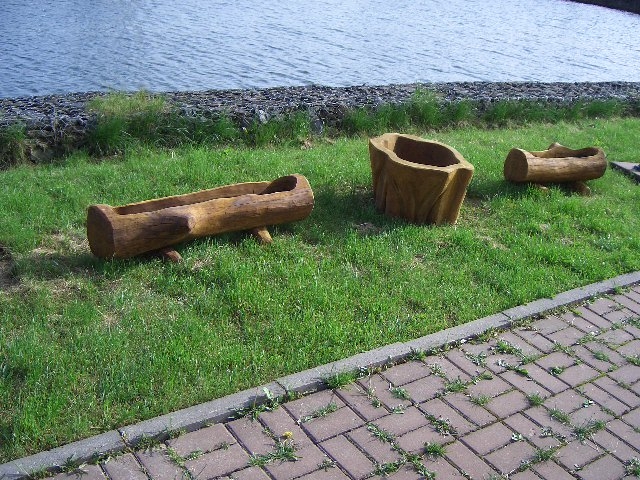
In short: Log flower troughs No. 9 are a set of three wooden containers for plants: a long trough on two small legs, a shorter trough and a wide stump planter with lengthwise ribbed sides. All three are coated with a warm, reddish-brown finish, so they go well together. The sizes, shape and finish are agreed with each customer individually.
Flower troughs and a stump planter on a lawn
In the photo all three products are set in one row on the lawn. Behind them is a bank reinforced with stones and the water, and in front a path of paving stones with grass sprouting in its joints. The containers are empty, without soil or plants, so you can see clearly how they are hollowed out and how thick their walls are.
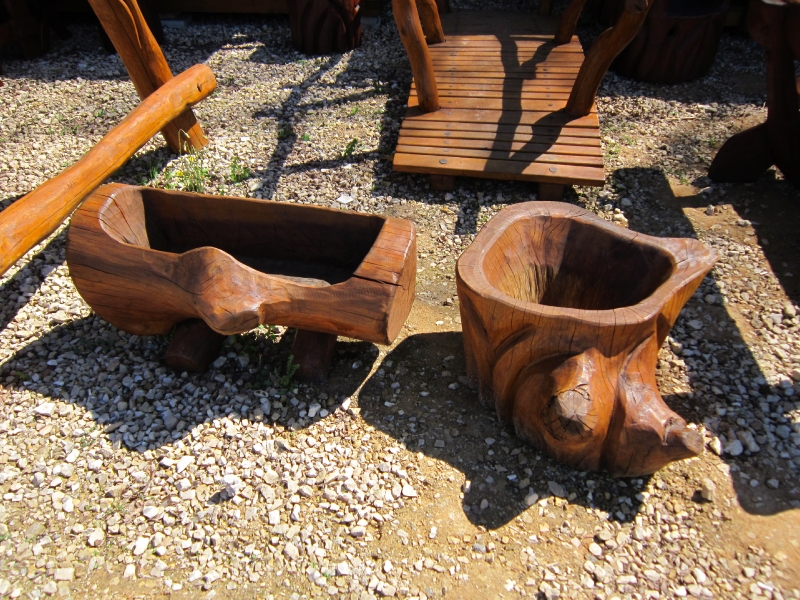
On the left stands the longest product, a log trough whose cavity takes up almost the whole length of the log. In the middle is a low, wide stump planter. On the right, a little farther, you can see a shorter trough, also set on small legs. So the set brings together two different forms: elongated and compact, almost square.
All the containers are coated with the same warm, reddish-brown finish. In the sun it glows with a honey shade, and in shadow it looks richer and darker. Because of the identical color, different containers look like one set, though each is made from a different part of the tree.
The warm color of the containers stands out well against the green lawn, so the set is visible even from afar. Even without plants it looks like a decorative detail of the yard, and with flowers planted it becomes a bright accent.
A set like this is especially handy for those who want to decorate a larger part of the yard: the edge of a path, the edge of a terrace or a strip of lawn by the water. A single large container would look lonely in such a place, while several different ones create a rhythm and lead the eye along the path.
The long and the short log trough
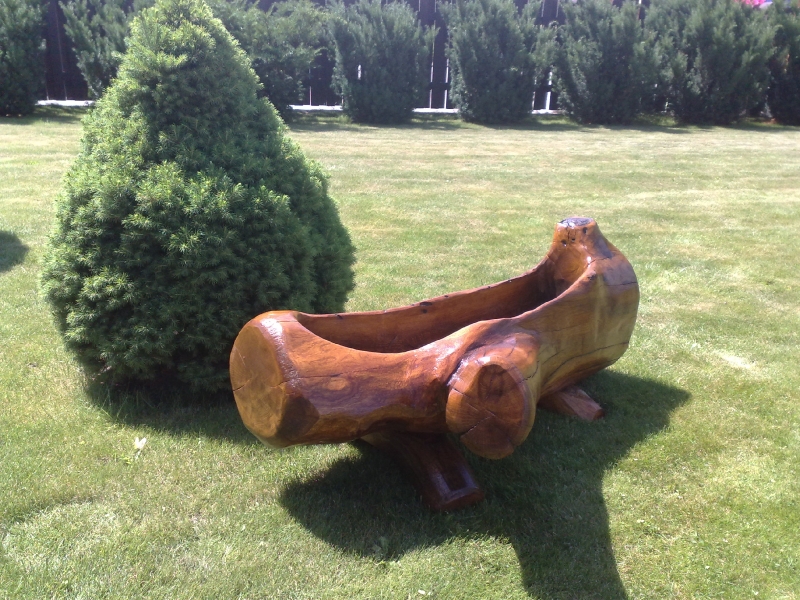
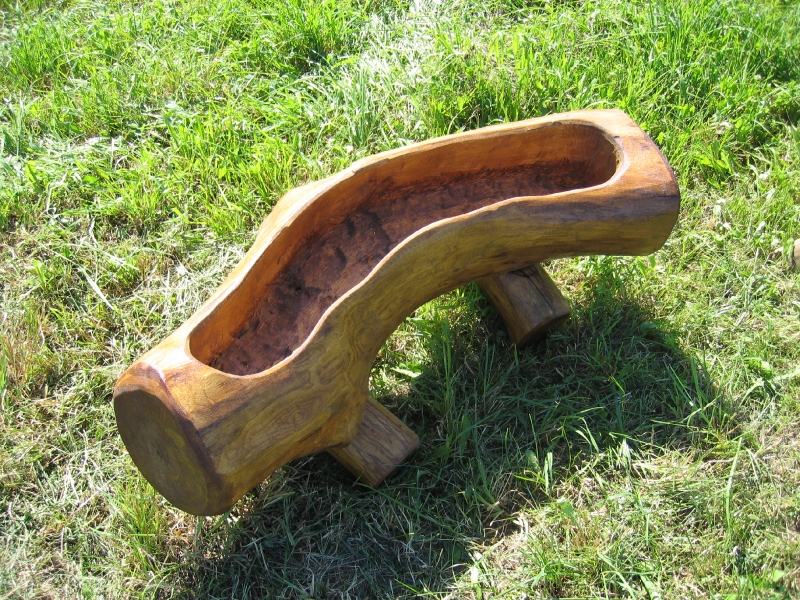
Both troughs are made of a round log hollowed out from the top. The edges are left rounded, and on the sides you can see the natural bends of the log and the places where branches grew. At the right end of the longer trough the cavity finishes in a notch through which the inside can be seen. A detail like this adds liveliness and shows that the shape was not stamped out.
The troughs stand on two short small legs, so their bottoms do not touch the lawn. This matters for two reasons. First, after rain the water runs off quickly and the underside of the log dries faster. Second, a raised trough looks lighter, as if hovering over the grass.
The little legs help the troughs stand steadily, and once filled with soil they become even heavier. The thick wooden walls heat up in the sun more slowly than the thin walls of plastic pots, so the soil does not dry out as quickly.
The short trough is very useful where there is no room for a longer one: by stairs, by a door, on a wider step or beside a bench. The long one suits a fence, a wall or the edge of a path, where you want an unbroken strip of flowers.
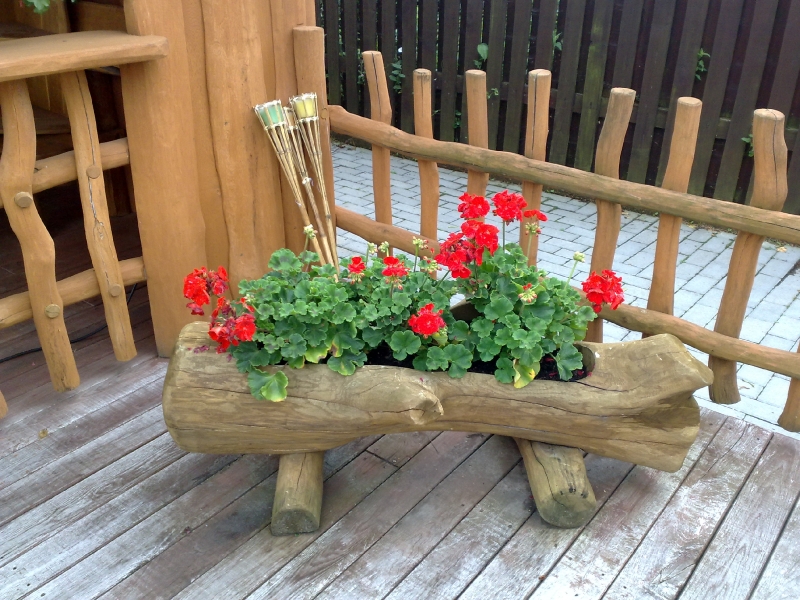
Log flower troughs differ from round planters in that the plants in them are set out in a row. This allows a tidy, rhythmic look: for example a row of a single plant, or alternating several kinds along the whole length of the trough.
The stump planter with lengthwise ribs
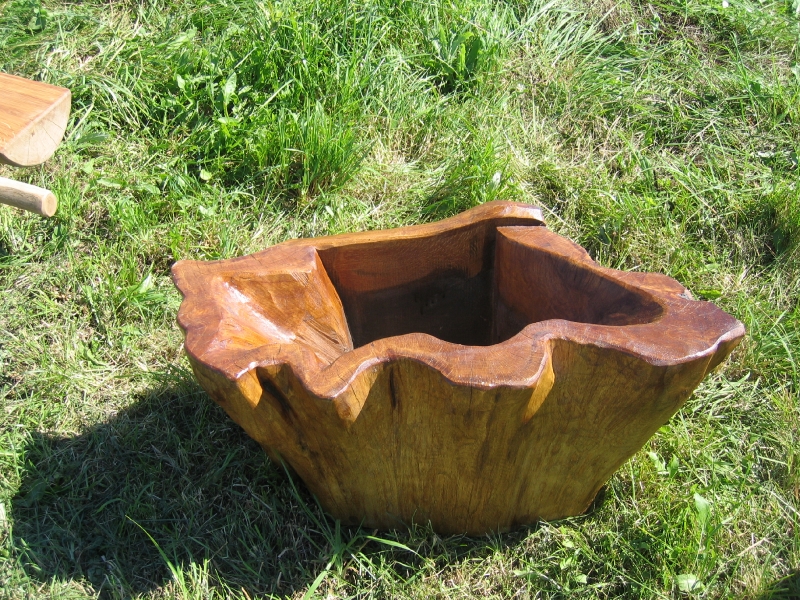
The middle container of the set is made from a thick piece of trunk. Its sides are not smooth: lengthwise ribs and grooves run along the whole height, like those found right at the stump where the trunk passes into the roots. The top is wider than the bottom, and seen from above the cavity looks like a rounded square.
The ribbed sides give the planter a sculptural quality. In the sun each rib casts a shadow, so the surface looks alive and changes depending on the time of day. A pattern like this cannot be repeated exactly, so every stump planter is distinctive.
The stump planter is lower than the troughs but considerably wider, so it holds more soil. It suits lusher plants or even a small shrub, which in another container would not have enough room for its roots.
The best place for such a planter is where it can be seen from several sides: a bend of a path, the middle of a lawn or the entrance to the yard. Then the ribbed sides show off in full and are not left hidden against a wall.
Details visible in the photo
The table briefly lists what the photo of this typical example shows.
| Feature | In the photo |
|---|---|
| Long log trough on small legs | Yes |
| Short log trough on small legs | Yes |
| Stump planter with ribbed sides | Yes |
| Warm, reddish-brown finish | Yes |
| Planted plants | No |
| Liners or inner containers | Not visible |
How to use three different containers for plants
Containers of three different shapes let you give each one a separate role. A few ideas for using them in the yard:
- The long trough for a strip of flowers. Lower flowering plants set in a row suit it: marigolds, petunias, begonias or trailing pelargoniums.
- The short trough for herbs. Placed closer to the kitchen or the terrace, it can become a small herb garden with thyme, basil or parsley.
- The stump planter as an accent. The wider cavity holds a lush plant or several plants of different heights planted together.
All three containers can be placed in one spot, as in the photo, or spread around the yard. For example, the long trough can decorate the edge of a path, the stump planter the entrance, and the short one a corner of the terrace. Since the finish is the same, the yard will still look unified.
If you put the set by water, as in the photo, choose plants that like sun and wind. On an open shore flower troughs get a lot of light but also dry out faster, so on hot days they are worth watering more often.
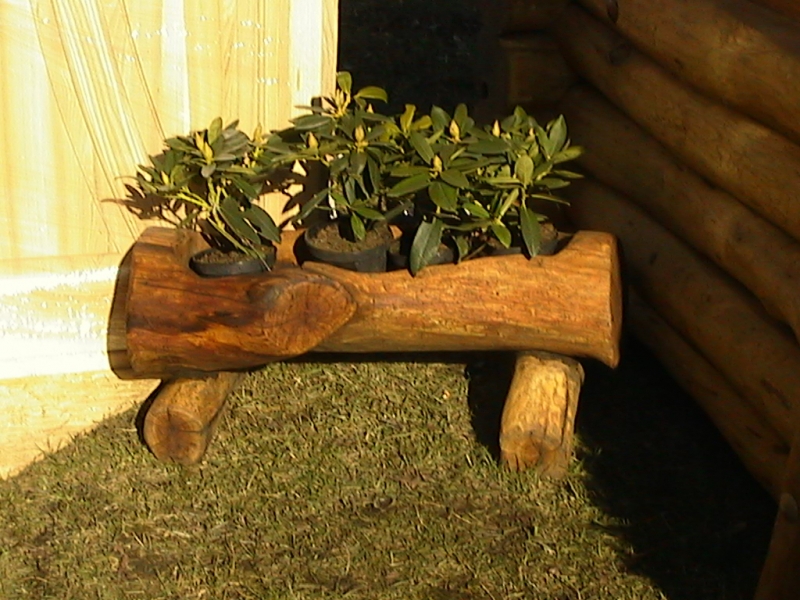
It is convenient to plant in separate containers or liners set into the cavity. Then soil does not touch the wood directly, and the plants are easier to change next season. If you plant straight into the trough, make a drainage layer at the bottom and make sure water can drain away.
The troughs and the planter can be combined with other wooden products in the yard: a bench, a table or a footbridge. You will find suitable furniture for a relaxation spot in the section garden and outdoor furniture, and a choice of wooden planters in the section wooden planters.
What to do so that a log trough lasts longer
Wooden planters standing outdoors face rain, sun, watering and winter frost. Simple but regular care helps them stay beautiful for longer:
- in spring inspect all the containers and, when the coating turns pale or rough, renew it with a product made for exterior wood;
- when watering, try to keep the water from running down the outer walls and let it stay in the cavity;
- check the little legs: they must stand firmly and not sink into soft ground;
- in autumn remove the annual plants and clear the cavity of leaves and remnants of soil;
- for the winter, if possible, keep the containers under a roof, or at least lift them off the snow and puddles.
In the ribs and grooves of the stump planter dust or pollen can collect, so once or twice a season it is worth wiping them with a damp cloth or rinsing them with water.
Natural wood changes outdoors: it may darken or lighten a little, and small cracks appear on the surface. This is typical of natural wood and usually does not harm the strength of the container. The main thing is not to let water stand at the bottom of the cavity for long.
You will find similar forms in other examples: the log planter on legs No. 1 shows a single trough by a wall, and the log trough and stump planter No. 7 shows one more combination of two different containers.
How to order planter set No. 9
UAB “Laukbaldis” has been making wooden products since 1996 and, as the company states, was the first in Lithuania to start making this production. Branches, bends and other natural features of the wood make every product unique, so the containers in this set are not copies of one another.
Call +370 687 25388 and quote the product number, No. 9. Say whether you need the whole set or only some parts of it, for example two troughs. Discuss the length of the troughs, the size of the stump planter and the shade of the finish.
Before calling, measure the spot where the containers will stand and think about what you will plant in them. Longer strips of flowers need a longer trough, and lusher plants need a wider cavity.
If you plan to add to the set later, mention it right away. Then the new troughs or planters will be coated with a similar shade and will match those you already have.
Only typical examples are shown on the website. Set No. 9 shows one possible solution, two log troughs on small legs and a ribbed stump planter, while the exact dimensions and finish are agreed before production.
Frequently asked questions
What does set No. 9 include?
The photo shows a long log trough, a shorter trough and a wide stump planter. You can order all three containers or only those you need.
Why do the troughs stand on small legs?
The little legs lift the trough off the lawn, so its bottom does not touch damp ground and dries faster. In addition, a raised trough looks lighter.
Which flowers should I plant in a log trough?
Lower plants set in a row suit it: marigolds, petunias, begonias or trailing pelargoniums. In the shorter trough you can also grow herbs.
Can I plant directly in a wooden trough?
You can, but it is more convenient to use separate containers or liners. If you plant directly, make a drainage layer at the bottom so that water does not collect.
Can I choose a different length of trough?
Yes, only typical examples are shown on the website. The length of the troughs, the size of the stump planter and the finish are agreed individually.
How do I look after wooden flower troughs?
In spring inspect the containers and renew the protective coating if needed. In autumn clear the cavities, and for the winter it is better to keep the containers under a roof.