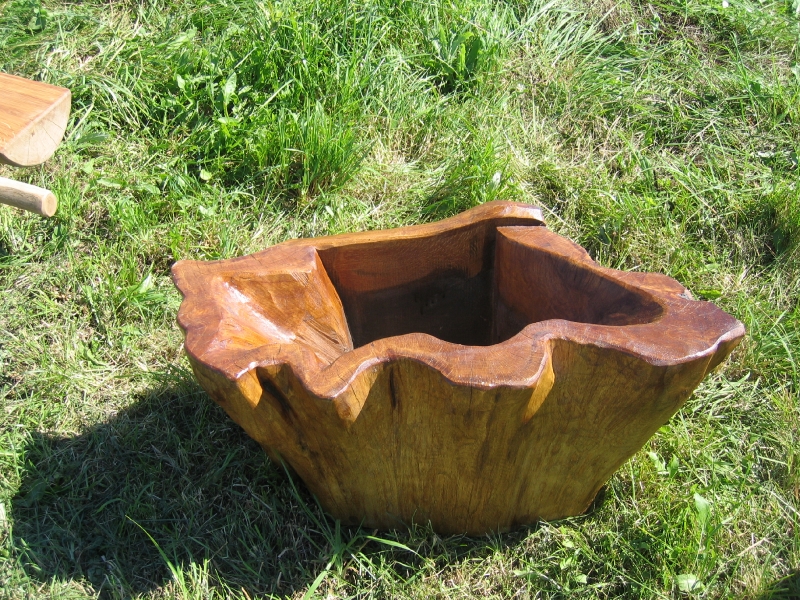
In short: Stump planter No. 2 is a planter hollowed out of a thick piece of trunk, with a wavy rim branching into several lobes and a deep cavity inside. The natural bumps and grooves of the stump are kept on its sides, so the planter looks as if it had grown out of the ground. The size, shape and finish are agreed with each customer individually.
A stump planter: a vessel shaped by nature
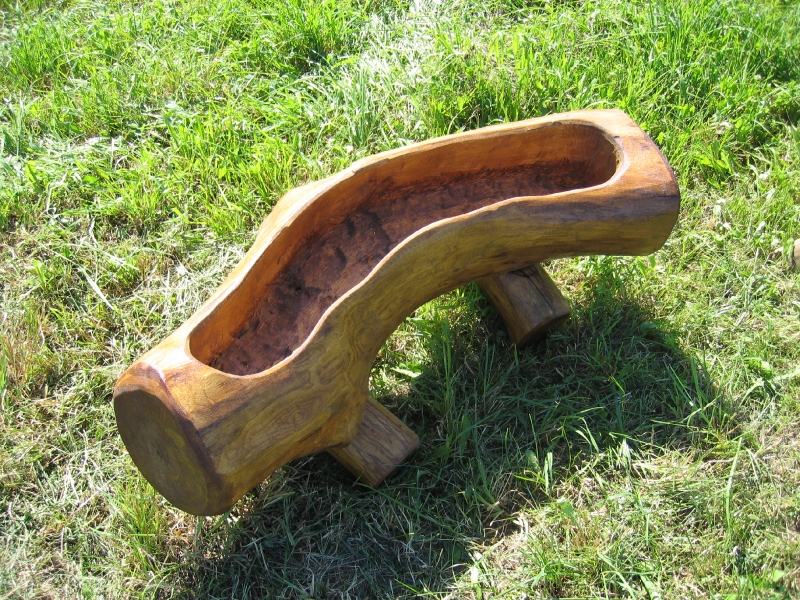
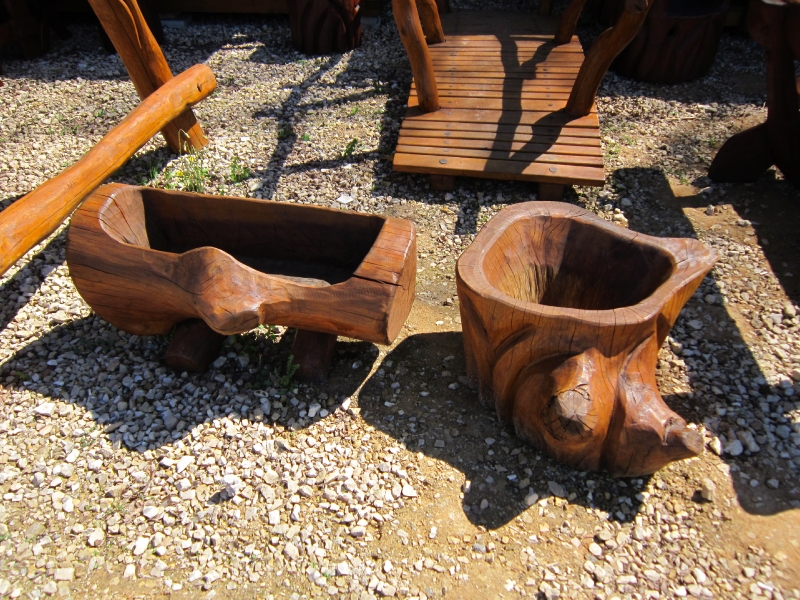
In the photo the planter stands on green grass in bright sun. Around it grows lush, unmown grass, and on the left edge of the picture part of another wooden product can be seen. The planter is empty, so its inside, the depth of the cavity and the shape of the rim are clearly visible.
At first glance this object looks less like a planter than like a large wooden goblet hollowed out by nature. Its rim is not round or smooth: it undulates, rises and falls, and in several places juts out to the sides like the tips of leaves or petals. Such a shape comes about because the planter is made from a stump, which naturally widens toward the bottom and forms the lobes from which the roots grow.
The craftsmen did not even these shapes out. On the contrary, they were emphasized, so every bend and lobe is clearly visible. This shows best what natural wood form means: branches, knots and the bends of the tree make each Laukbaldis product one of a kind.
A stump planter is one of the most natural garden products. Making it does not require gluing or joining separate parts: the whole form is obtained from a single piece of wood. So the planter looks whole, and its lines flow smoothly into one another without any joints or screws.
The sunlight in the photo brings out the color of the wood well. The outside is lighter, yellowish pink, while the inside of the cavity is darker and richer. This contrast gives the planter depth and shows how thick its wall is.
The empty planter in the photo lets you imagine how it will look with plants. Green, trailing flowers over the wavy rim would soften the massive form, while taller grasses would emphasize the height of the planter. Yet even without plants it looks like a finished, independent garden object. So it can be placed even where plants get too little light: the planter will decorate the spot without them.
A wavy rim and grooved sides
The rim is the planter’s brightest detail. It is wide and thick, so the planter looks massive and sturdy. Seen from above, the rim forms an irregular shape of several lobes, like a star or a ring. Each lobe bends slightly outward, so the top of the planter looks open, as if in bloom.
The sides are not smooth either. Vertical grooves and bumps can be seen in them: this is the relief of the stump surface, preserved during processing. Toward the bottom the planter narrows a little, so its silhouette recalls an old vessel or a goblet. On the sides you can also see growth rings and natural cracks in the wood, which give liveliness and remind us that this is real wood that has grown.
Inside, a deep, wide cavity has been hollowed out. Its walls are smoother than the outside, but they also keep the shape of the stump: the cavity follows the outer contours of the planter. A large pot with a plant fits in such a cavity, or enough soil to plant several flowers.
The thick walls have a practical benefit, too. They heat up more slowly in the sun and cool down more slowly at night, so the roots of the plants in the planter are protected from sudden temperature swings. In addition, a massive planter is stable and does not tip over even in strong wind.
The whole surface is coated with a warm, pinkish honey-colored finish that brings out the pattern of the wood and protects it from moisture.
Review of the photo
A short summary helps you judge the features of this planter. It is a typical example, because every stump is different.
| Feature | In the photo |
|---|---|
| Hollowed-out stump | Yes |
| Wavy rim with lobes | Yes |
| Natural grooves and bumps on the sides | Yes |
| Deep, wide cavity | Yes |
| Legs or a base | No |
| Plants in the planter | No, the planter is empty |
How to use a stump planter
A stump planter is not only a vessel for plants but also an independent garden sculpture. Even empty it looks impressive, so it can be used in various ways:
- With flowers. A large pot with pelargoniums, petunias or other summer flowers can be placed in the cavity, and they will trail over the wavy rim.
- With grasses. Ornamental grasses contrast nicely with massive wood and sway in the wind.
- With succulents. These plants like drier soil and suit a sunny spot well.
- As a decoration. In autumn you can put pumpkins, pine cones or heather in the planter, and in winter spruce branches.
- By an entrance. Two such planters on both sides of a door create a stately entrance.
A stump planter looks especially good in a natural setting: by a pond, on a lawn, next to stones or wooden buildings. It also goes with modern houses, where it becomes a warm, natural contrast to smooth walls and glass.
A stump planter can also become the center of a garden composition. You can plant low plants around it and scatter pebbles or bark mulch. Then the planter will look as if it had been left from an old tree, and the garden around it as if it had grown by itself.
Since the planter is massive and heavy, it is worth putting it straight away where it will stand for a long time. It can be moved later, but you may need help.
Several stump planters of different sizes grouped together create a natural composition reminiscent of a forest clearing. If the garden already has other Laukbaldis products, the planter can be matched to them in shade and form.
Ordering: size and shape
Laukbaldis shows only typical examples, and a stump planter always depends on the wood available. So when ordering it is worth discussing:
- The approximate size. A large planter suits an open space, a smaller one a terrace or steps.
- The depth of the cavity. It determines which plants or pots you can put in.
- The shape. Every stump is different, but you can say whether you want more pronounced lobes or a calmer rim.
- The finish. Lighter or darker, to match the other garden products.
- The quantity. If you want several planters, they can be chosen as a set.
For comparison, look at the stump planters for the garden No. 8 and the log planter on legs No. 1. You will find all the examples in the section wooden planters and doors, and other products of natural form in the section oak garden and outdoor furniture.
How to protect a stump planter from moisture
The greatest enemy of a wooden planter is constant dampness. A stump planter stands directly on the ground, so its bottom is closest to the moisture. To keep it beautiful for a long time, it is worth following a few rules:
- plant in a separate pot or liner so that damp soil does not touch the wood;
- do not let rainwater stand in the cavity for long; pour it out if needed;
- you can put a few stones or a slab under the planter so that the bottom does not touch the wet ground;
- renew the protective coating made for exterior wood when the surface turns pale;
- for the winter it is worth putting the planter under a roof, or at least emptying it.
Cracks appear in natural wood as it dries, especially in thick stumps. This is normal and usually does not harm the planter, but it is worth rubbing a protective product into the cracks. The lobes of the wavy rim are the most exposed to rain, so inspect them more carefully.
In spring it is worth cleaning the planter with a soft brush and removing the leaves and moss that have collected. If the planter stands in shade under trees, it dries more slowly, so inspect it more often. In a sunny spot the wood dries faster but also fades sooner, so the protective coating should be renewed a little more often there.
How to order planter No. 2
UAB “Laukbaldis” has been making wooden products since 1996 and, according to the company, was the first in Lithuania to start making this production. The company operates in Dapkiškių village, Tauragės district.
Call +370 687 25388 and quote No. 2 from the planters section. Tell us where the planter will stand and what you want to grow in it. During the call you will discuss the approximate size, the depth of the cavity, the shape and the finish. If you have a photo of the spot where the planter will stand, it will help you choose the right size.
Because every stump is different, your planter will not be an exact copy of the photo. It will have lobes and bends of its own, but will keep the same natural, impressive form.
If you want several planters, say so in advance. Then it will be easier to choose stumps that match one another in size and shade, and to create a harmonious set for your yard.
Frequently asked questions
Will the stump planter be exactly like the one in the photo?
Not exactly, because every stump has its own shape, lobes and growth rings. The general solution stays similar, but every planter is one of a kind.
Can I plant directly in a stump planter?
You can, but it is more convenient and safer for the wood to use a separate pot or liner. That way damp soil does not touch the wood.
Which plants suit a stump planter?
Summer flowers, ornamental grasses or succulents suit it. Trailing plants look especially nice over the wavy rim.
Is the planter heavy?
Yes, a planter made from a thick stump is massive. So it is worth putting it straight away where it will stand for a long time.
How do I look after a stump planter?
Do not let water stand in the cavity, and protect the bottom from wet ground. When the surface turns pale, renew a protective coating made for exterior wood.
How do I order planter No. 2?
Call us and quote No. 2 from the planters section. We will discuss the size, the depth of the cavity, the shape and the finish.