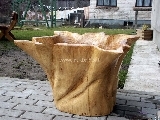
In short: Large wooden planter No. 4 is a tall planter hollowed out of a stump, whose rim flares upward and undulates like the cup of a flower. A light, yellowish sand-colored finish brings out its shape, and in the photo the planter stands on paving stones in a yard. The size, shape and finish are agreed with each customer individually.
A large wooden planter on paving stones
This photo is small, so fine details cannot be seen in it. But it clearly shows the most important things: the size and the silhouette of the planter. The planter stands on gray paving stones next to a strip of green lawn, and in the background you can see a building and other things in the yard. Compared with the surroundings, it is obvious that this is not a small vessel for flowers but a large, bright accent of the yard.
On paving stones the planter looks especially impressive. The smooth gray surface beneath it emphasizes the natural, lively form of the wood and its warm color. A contrast like this suits modern yards with a lot of stone, concrete or paving: a wooden planter softens the strict lines and brings nature into the space.
In a place like this a large wooden planter works as a sculpture. Everyone who enters the yard notices it, and its shape invites you to come closer and look. Even without plants it is a finished, independent object, and with flowers it becomes a real jewel of the yard that you can see from afar.
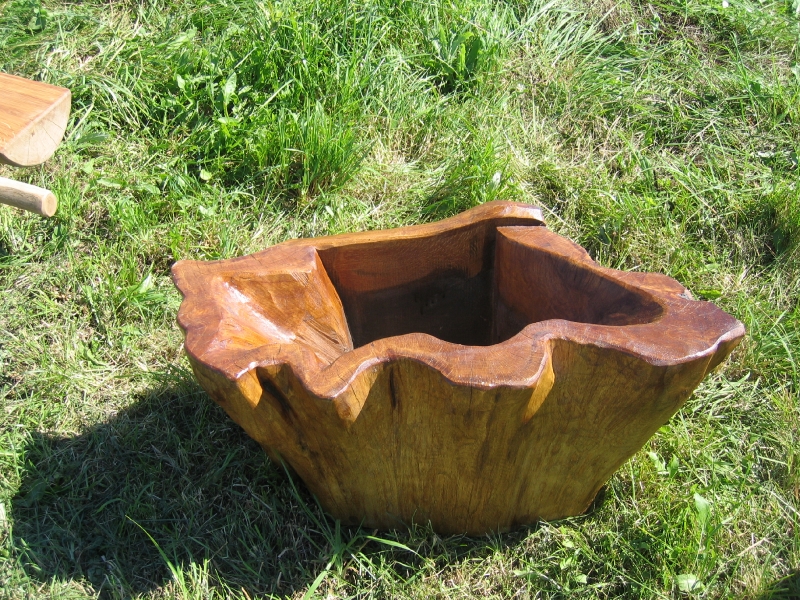
Although the photo is small, you can see clearly that the planter is made from a single massive stump. Its walls are thick, and its form is irregular, with lobes and grooves that survive from the natural surface of the stump.
A large wooden planter also suits those who want something out of the ordinary in the yard. Shops mostly offer identical plastic or ceramic containers, while a stump planter is a one-off product whose form is never repeated. It becomes a sign of the individuality of the yard that guests easily remember.
A tall silhouette and a flaring rim
The shape of this planter recalls a large goblet or a ring. It is narrower at the bottom and gradually widens upward. The rim is not round: it undulates and in several places juts out to the sides, so the top of the planter looks open and light even though the planter itself is massive.
Such a shape comes about because the planter is made from the part of a stump that naturally widens toward the roots. It seems the wider part of the stump has become the top of the planter here, and the cavity was hollowed out following its natural contours. This is how a planter was born whose silhouette was created not by drawing but by nature itself.
On the side surfaces you can see vertical grooves and bumps: this is the relief of the stump, preserved during processing. They cast shadows and give the planter depth. Every such planter differs, because every stump is different.
The light, yellowish sand-colored finish is one more feature of this planter. It looks natural, as if the wood had just been sanded, and goes well with light paving stones and buildings. A light planter is also clearly visible after dark, especially if there is lighting nearby.
A tall planter has a practical advantage too: the plants in it are closer to eye level, so they are more convenient to look after, to water and to pick off wilted flowers. You do not have to bend down to the ground, and the plants are better seen from a distance.
What can be made out in the photo
Since the photo is small, the summary lists only what can be clearly seen in it. It is a typical example.
| Feature | In the photo |
|---|---|
| Tall planter made of a stump | Yes |
| Flaring upward rim | Yes |
| Wavy, irregular rim | Yes |
| Light finish | Yes |
| Standing on paving stones | Yes |
| Plants in the planter | Not visible |
The role of a large planter in the yard
A large wooden planter plays a different role from smaller planters. Smaller planters mostly complement a composition, while a large one creates it by itself. It can become the center of the yard around which other elements are arranged.
A few ways to use a large planter:
- In the center of the yard. Placed in the middle of a paved area, it becomes an accent that is seen from all sides.
- By the entrance. Two large planters on both sides of a door or gate create a stately entrance.
- At the beginning or end of a path. The planter marks a crossing of paths or a turn.
- By a terrace. It separates the terrace from the lawn and gives it coziness.
- As a sculpture. Even without plants a large stump planter decorates the yard.
A large planter needs space. It is worth placing it where free room remains around it and where it does not overshadow other elements. In a small yard it is better to choose one large planter than several medium ones; the space will look tidier.
Since the planter is massive, it is worth putting it straight away where it will stand for a long time. It can be moved, but you may need help.
A large planter looks especially good where the yard has many straight lines: by the wall of a house, next to stairs, a garage or a paved area. Its lively, irregular form contrasts with the architecture and reminds us of nature even in a very tidy setting.
It is worth choosing the size of the planter according to the surrounding elements. Beside a large house or a wide paved area a small planter would get lost, while a large one becomes a proportionate and noticeable detail. Before ordering, you can set a cardboard box or another object of approximately the same size in the chosen spot and see how it looks.
Plants for a large planter
A large cavity lets you grow bigger plants than an ordinary planter does. Here are a few ideas:
- Large summer flowers. Cannas, dahlias or big pelargoniums fill the planter and create a colorful accent.
- Trailing plants. Surfinias or other trailing flowers soften the massive rim.
- Ornamental grasses. Tall grasses repeat the height of the planter and sway nicely in the wind.
- Small shrubs. They stay green longer than summer flowers.
- Seasonal compositions. In autumn pumpkins and heather, in winter spruce branches and lanterns.
It is most convenient to plant in a large liner or in a pot set inside the wooden one. That way damp soil does not touch the wood, and the plants are easy to change every season.
Since the cavity is large, it holds a lot of soil. This means the plants dry out more slowly than in small pots, so in a hot summer they need watering less often. Still, excess water must have somewhere to run off, so a liner with drainage holes is a good solution.
Laukbaldis shows only typical examples, so the size and shape can be discussed. Compare other examples too: the stump planter with a wavy rim No. 2 and the wooden planters for flowers No. 5. You will find all the planters in the section wooden planters and doors, and benches that go with a planter in the section oak garden and outdoor furniture.
Care and a place for winter
A large wooden planter stands outdoors all season, so it is affected by rain, sun and watering. To keep it beautiful for a long time, it is worth following a few rules:
- use a liner so that damp soil does not touch the wood;
- do not let water stand in the cavity; pour it out if needed;
- you can put a few pads under the planter so that the bottom does not touch a wet surface;
- when the light finish begins to gray, renew the protective coating made for exterior wood;
- for the winter empty the planter and, if possible, put it under a roof.
A light finish shows dirt and graying sooner than a dark one, so it is worth renewing it a little more often. Small cracks appear in natural wood as it dries; this is normal and usually does not harm the planter.
A planter standing on paving stones dries faster than on the ground, because the water runs off. That is an advantage, but it is still worth checking from time to time that moisture and dirt do not collect beneath the planter. Once a season lift the planter slightly and sweep away the leaves that have collected underneath.
How to order planter No. 4
UAB “Laukbaldis” has been making wooden products since 1996 and, according to the company, was the first in Lithuania to start making this production. The company operates in Dapkiškių village, Tauragės district.
Call +370 687 25388 and quote No. 4 from the planters section. Tell us where the planter will stand and what size you need. During the call you will discuss the approximate height, width, depth of the cavity and finish. If you have photos of the yard, they will help you choose the right size.
Because every stump is different, your planter will not be an exact copy of the photo. It will have lobes and bends of its own, but will keep the same impressive, goblet-shaped silhouette.
If you want two planters, for example on both sides of an entrance, say so in advance. Then stumps of similar size and shape will be chosen so that the planters match each other. Do not be afraid to ask for other changes either; everything is made according to the agreed solutions.
Frequently asked questions
How big is this planter?
Only typical examples are shown on the website, so the exact dimensions are agreed individually. The photo shows that it is a large, tall planter that suits an accent of the yard.
Why does the rim of the planter flare?
The planter is made from a part of a stump that naturally widens toward the roots. This shape has been kept, so the planter resembles a goblet or a ring.
Can I order a darker finish?
Yes, the finish is agreed individually. A light color goes with light paving stones and buildings, and a darker one with a darker setting.
Which plants suit a large planter?
Large summer flowers, trailing plants, ornamental grasses or small shrubs suit it. It is most convenient to plant them in a liner.
How do I look after a light wooden planter?
Do not let water stand in the cavity, and use a liner. A light finish grays sooner, so it is worth renewing the protective coating a little more often.
How do I order planter No. 4?
Call us and quote No. 4 from the planters section. We will discuss the size, the depth of the cavity, the shape and the finish.